Matcha: History and Secrets of Japanese Green Tea
From the emerald powder of Zen monks to the global matcha latte, a deep dive into the history, production, and secrets of Japan's most iconic tea.
La rédaction Kotoba Interactive
Studio éditorial
In Uji, the tea fields stretch beneath vast black nets that confiscate the light, and the bushes unfurl an unreal jade green. is not simply a drink: it is a concentrate of civilization blending the knowledge of Buddhist monks, the patience of stone-mill artisans, and the refinement of tea masters. Before it was a trendy ingredient, it was a monastic remedy, an aristocratic treasure, a vehicle for meditation. To understand it, we must trace its origins to Song dynasty China.
From Song Monasteries to Medieval Japan#
The story of matcha begins not in Japan but in imperial China, under the Song dynasty (960-1279), when powdered tea whisked in a bowl was the most refined way to drink tea. Scholars and Chan Buddhist monks (the precursor to Japanese Zen) practiced : steamed, dried, and ground leaves were placed in a dark bowl, doused with hot water, and whisked with bamboo until a creamy froth formed. Emperor , an avid tea enthusiast, personally authored the Daguan Chalun (大觀茶論, "Treatise on Tea from the Daguan Era"). Under the Song, powdered tea was a marker of distinction and an object of tasting contests known as .
It was against this backdrop that the Japanese Zen monk , returning from two study trips to Song China, brought back tea seeds and the technique of whisked tea. In 1191, he planted these seeds in Kyushu and near Kyoto. But his most enduring contribution was a book, the Kissa Yojoki (喫茶養生記, "Treatise on Tea and Health"), completed in 1211, in which he presented tea as a near-miraculous remedy. He offered a copy to the shogun , who was ill at the time, helping to popularize tea among the warrior class.
Matcha spread first through Zen temples. For monks, the tea's caffeine and L-theanine sustained calm alertness during long hours of seated meditation, : tea was a spiritual tool, not a gustatory pleasure. This contemplative dimension set Japanese tea culture apart from its Chinese origins, which leaned more toward scholarly pleasure. Over the thirteenth and fourteenth centuries, powdered tea spread beyond the monasteries: the samurai, advised by Zen monks, adopted it as an object of prestige, consumed at lavish tasting competitions called .
In the mist of a Song monastery, a monk whisked green powder in a bowl of dark stoneware. He could not have known that the gesture he was shaping would be repeated by millions of hands a thousand years later, from Kyoto to New York.
The irony of this story lies in a complete reversal. When the Ming dynasty (1368-1644) came to power, its founder decreed the abandonment of powdered tea, deemed too closely associated with the Mongol aristocracy of the Yuan he had just overthrown. China adopted the infusion of whole leaves, a method that persists today, and whisked tea vanished from its country of origin; it was Japan, and Japan alone, that preserved this technique over the next six centuries.
Between the fifteenth and sixteenth centuries, matcha found its most accomplished form through three founding masters of the Way of Tea. introduced the aesthetic of , beauty found in simplicity and imperfection, replacing lavish Chinese utensils with humble Japanese ones. created intimate, austere tea spaces. Above all, brought the Way of Tea to its apex, codifying its rituals, shrinking the tea room to two tatami, and elevating every gesture to a form of meditation. Matcha had become the heart of a total art form. For a deeper look at the tea ceremony, its rituals and philosophy, a dedicated article on is available on this site; here, we focus on the production, gastronomy, and global journey of matcha.
From Leaf to Powder: How Matcha Is Made#
The production of matcha is a process of slowness and precision that explains its high price. Every step, from shading to milling, aims to extract from the leaf the essence of its flavor and color.
Shading: The Secret Behind Umami#
Matcha stands apart from all other green teas through one crucial step that precedes the harvest: shading. Twenty to thirty days before picking, the plantations are covered with structures that drastically reduce sun exposure, triggering biochemical reactions that transform the composition of the leaf.
The most prestigious technique is : bamboo and straw structures erected above the bushes form a roof that filters between 85 and 95% of sunlight. Historically, rice straw was used (wara, 藁); today, synthetic black fabric is common, although the most exacting producers in Uji keep the traditional straw. The second type, , drapes fabric directly over the bushes: less expensive, it yields a respectable tea but lacks the aromatic complexity of tana.
Deprived of sunlight, the plant massively increases its chlorophyll production, giving matcha its vivid, almost fluorescent green, far from the dull olive of sun-grown teas. Shading also causes a spectacular accumulation of , an amino acid responsible for umami and the calming effect: normally sunlight converts it into bitter catechins, but shade blocks this conversion. The result is a tea sweeter, richer in umami, and more soothing than any conventional green tea.
The numbers speak for themselves: a high-grade ceremonial matcha can contain five to six times more L-theanine than an ordinary sencha. This molecule explains matcha's paradoxical effect: stimulating thanks to caffeine, yet free from coffee's jitteriness, because L-theanine promotes alpha waves associated with relaxed focus.
Harvest, Steaming, and Drying#
The first spring picking, , takes place in May and yields the finest matcha. Subsequent harvests (second in June, third in summer) produce leaves richer in bitter catechins, destined for culinary grades.
Immediately after picking, the leaves undergo a brief but intense steam treatment, : twenty to thirty seconds in a high-temperature steam tunnel. This process, specific to Japanese green teas, prevents fermentation, locks in the color, preserves amino acids, and stabilizes aromas. This is the fundamental difference from Chinese green tea, typically pan-fired in a wok (shaqing, 杀青).
The steamed leaves are then dried in a special oven, the , over about twenty minutes. The result is , the essential intermediate product, as flat, brittle deep-green leaves. Next comes sorting: central veins and stems are removed by air blowers and sieves, retaining only the tender part, the mesophyll. This step sometimes eliminates up to half the weight of the dried leaves, but it guarantees the fineness of the powder.
Stone Milling#
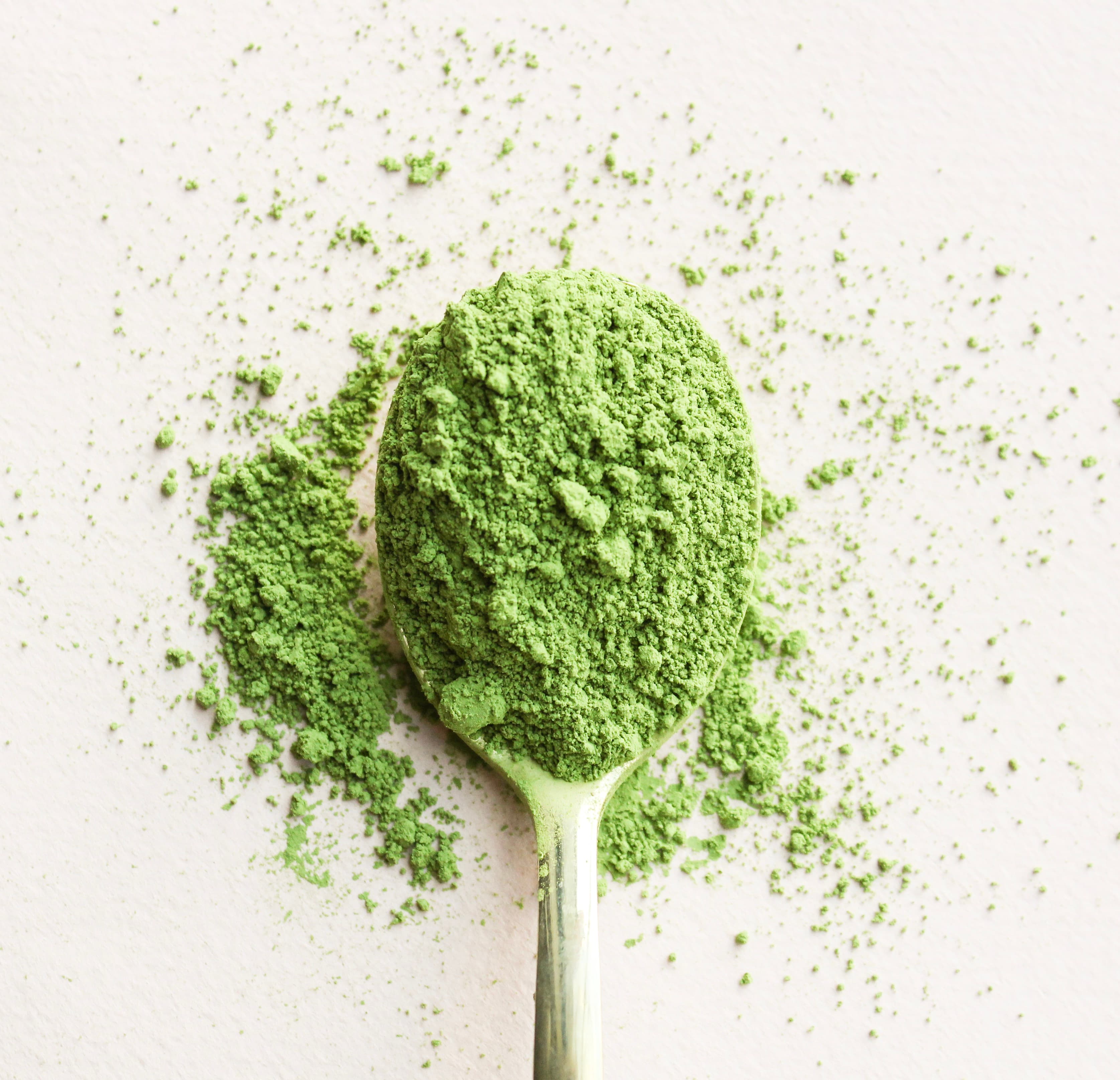
The final step, the slowest and most iconic, is grinding the tencha using granite mills, the , two discs carved with grooves that rotate at 40 to 60 revolutions per minute. This slowness is a technical necessity: excessive speed would generate frictional heat, which would damage aromas, degrade chlorophyll (turning the powder yellow-brown), and oxidize amino acids.
At this pace, a mill produces roughly 30 to 40 grams of matcha per hour: a 30-gram ceremonial tin thus represents nearly an hour of work. The powder is remarkably fine, between 5 and 10 microns, finer than talc, which lets matcha suspend in water, form a creamy froth, and release its aromas with an intensity no infusion could match. Some tea houses in Uji, such as , founded in 1704, and , founded in 1717, run dozens of mills day and night. This chain of craftsmanship makes real matcha expensive and sets it apart from industrial powders.
The vocabulary of matcha is an ideal doorway into Japanese: 抹茶 (matcha, ground tea), 茶筅 (chasen, bamboo whisk), and 薄茶 (usucha, thin tea) pack kanji and culture into a few words. With JapaneseSRS and its spaced repetition, you will learn to read these terms in their original script, one bowl at a time.
Grades of Matcha#
Not all matcha is created equal. Behind the apparent uniformity of the powder lies a quality hierarchy as rigorous as that of fine wines, based on the harvest, the shading, and the part of the leaf used.
| Grade | Harvest and leaves | Flavor profile | Use and price |
|---|---|---|---|
| Ceremonial (tenchu) | First spring harvest, youngest leaves under tana | Dominant umami, natural sweetness, phosphorescent green | ; 20 to 50 euros per 20-30 g |
| Premium (high-quality everyday) | First harvest, less selected leaves | Balanced umami, mild hint of bitterness | ; 15 to 30 euros per 30 g |
| Culinary (cooking grade) | Later harvests, mature leaves | Robust, astringent, olive green | Baking and cooking; 5 to 15 euros per 100 g |
Ceremonial grade matcha (tenchu, sometimes labeled "ceremonial grade" in international trade) sits at the top. Coming exclusively from the first spring harvest, from the youngest leaves grown under tana shading, it shows an electric, almost phosphorescent green, dominated by umami and natural sweetness. This is the only grade suitable for , the most concentrated form. Expect to pay 20 to 50 euros for a 20-to-30-gram tin, the equivalent of ten to fifteen bowls.
Premium matcha (or high-quality everyday matcha) also comes from the first harvest, but from less selected leaves. A beautiful bright green, its taste balances umami with a mild hint of bitterness. It is an excellent choice for daily , typically 15 to 30 euros for 30 grams.
Culinary matcha (cooking grade or culinary grade) comes from later harvests, from more mature leaves richer in bitter catechins. Its color leans toward olive green, its flavor more robust and astringent. These traits, flaws in a bowl, become assets in baking, where the bitterness pairs with sugar, cream, and white chocolate. Its price is more accessible: 5 to 15 euros for 100 grams.
Major Producing Regions#
Japan cultivates tea in many prefectures, from southern Kyushu to central Honshu, but three regions dominate matcha production.
, a small city in Kyoto Prefecture nestled between the Uji and Kizu rivers, is the historic and spiritual birthplace of matcha. According to tradition, the monk , a disciple of Eisai, planted here the first seeds given to him by his master. The conditions are ideal: hills that promote drainage, morning mists, rich soil, and a temperature swing that concentrates flavor. Uji accounts for only 3 to 4% of national production, but its prestige is immense; the names of Marukyu Koyamaen, Ippodo, and resonate like those of great wine estates.
, in Aichi Prefecture, is the leading producer by volume, with roughly 30% of Japan's output. Less well known to the public, it supplies matcha of consistent quality, widely used by the food industry and professional pastry chefs. Tea cultivation there is documented since the thirteenth century, when the monk brought back tea seeds from China and planted them at Jissoji Temple.
, at the southern tip of Kyushu, is the rapidly expanding region. Its subtropical climate, abundant rainfall, and vast plains enable large-scale production and early harvests (as early as April). Kagoshima has surpassed Shizuoka to become Japan's second-largest tea-producing prefecture, and its share of matcha output continues to grow.
How to Recognize Good Matcha#
Spotting good matcha requires no expertise, only your senses. Color: a good matcha is vivid, almost fluorescent green; a poor one veers toward olive or khaki. Smell should be fresh and vegetal, evoking cut grass; a stale matcha smells like dry hay. Taste is dominated by umami, with subtle bitterness and a sweet finish; a bad one is harsh and leaves the mouth dry. Finally, froth: a quality powder produces a thick, fine, uniform foam; a mediocre matcha, a coarse and uneven froth.
Matcha in Japanese Cuisine#
Long before it became the star ingredient of trendy cafes, matcha held a place of honor in Japanese gastronomy, capable of elevating traditional confections and savory dishes alike.
Wagashi: The Age-Old Alliance of Tea and Confectionery#
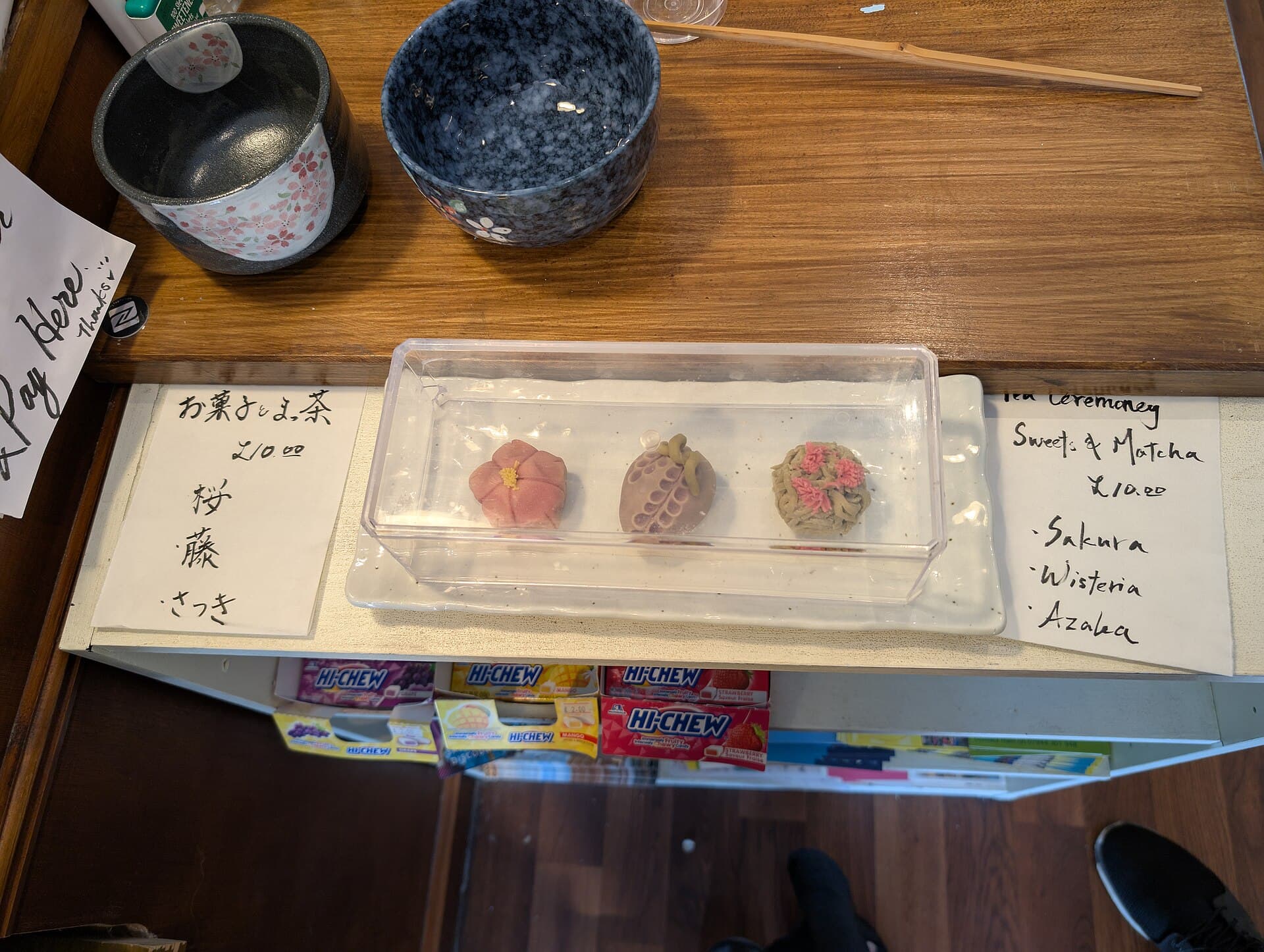
share a symbiotic relationship with matcha stretching back several centuries: designed to accompany tea, they balance its bitterness with their sweetness. Matcha , a dense block of red bean paste (azuki, 小豆), sets the confection's sweetness against the tea's vegetal notes. Matcha wraps a green tea ganache in glutinous rice paste (mochi, 餅). Matcha , filled with white bean paste (shiro-an, 白餡), are a classic of the souvenir shops of Kyoto and Uji.
In Uji itself, the street leading to the Byodo-in shrine is lined with dozens of shops offering matcha specialties: dusted with powder, matcha parfaits layering ice cream, jelly, azuki, and whipped cream, crepes filled with matcha cream. This concentration of green treats has turned Uji into a gastronomic destination in its own right.
Ice Cream, Soft Serve, and Modern Desserts#
Matcha and ice cream are an obvious match: cold tames bitterness and amplifies umami. Matcha , sold on the streets of Kyoto, Uji, and Nara, is one of the icons of gastronomic tourism in Japan. Some establishments, such as in Uji, founded in 1854, offer matcha ice cream at multiple concentration levels.
Modern Western-inspired pastry has embraced matcha. Matcha tiramisu replaces coffee with a concentrated green tea infusion. Matcha cheesecake, creamy and deeply green, is a Tokyo cafe classic. The matcha financier, soaked in brown butter, offers an elegant Franco-Japanese marriage. Cream puffs, macarons, white chocolate terrines: contemporary Japanese pastry has made this powder as fundamental as vanilla or cacao.
Beyond Sweet: Matcha in Savory Cooking#
Matcha is not confined to desserts. , buckwheat noodles incorporating matcha powder, is a specialty of Uji and Kyoto: these jade-green noodles, served cold with a dipping sauce (tsuyu, つゆ), offer a herbaceous flavor that complements the nuttiness of buckwheat. , a blend of fine salt and powder, seasons in place of tentsuyu sauce, the contrast between crispy batter, sea salt, and vegetal bitterness being remarkable.
The KitKat Matcha Phenomenon#
No discussion of matcha in Japanese food culture is complete without the KitKat. Nestle Japan, headquartered in Kobe, launched the KitKat matcha in 2004 as part of a regional limited-edition strategy that became legendary. Coated in white chocolate infused with green tea powder, it became the number-one tourist souvenir in Japan. Nestle Japan produced more than 300 limited-edition flavors (Tochigi strawberry, Okinawa sweet potato, Niigata sake), but matcha remained the best-seller, spawning intense matcha, double matcha, Uji matcha, matcha and azuki. Far from an elitist ingredient reserved for ceremonies, matcha is woven into the everyday pleasures of the Japanese.
Matcha is a color before it is a flavor. That green, so vivid it seems to vibrate, carries within it the promise of a taste the eye perceives before the tongue confirms.
The Global Matcha Wave#
Starting in the early 2010s, matcha underwent a meteoric international expansion, going within a decade from exotic curiosity to planetary cultural phenomenon.
The Instagram Era and the Matcha Latte#
The catalyst was visual. With its intense, photogenic green, matcha proved perfect for the age of social media. Trendy cafes in Los Angeles, London, Melbourne, and Paris offered matcha lattes (matcha, hot milk, sometimes sugar or vanilla syrup) whose aesthetic, jade green and froth adorned with latte art, was irresistible on Instagram, where the hashtag #matcha amassed tens of millions of posts. At Starbucks, which had introduced its Matcha Green Tea Latte as early as 2006 in the United States, sales surged as the trend hit cruising speed between 2015 and 2020.
Specialized cafes opened in major cities: Cha Cha Matcha in New York, Matcha Cafe Maiko (originally from Uji) in Hawaii and then the American West Coast, with franchises in London, Toronto, Vancouver, and across Southeast Asia. Matcha became a global product, consumed from Dubai to Sao Paulo, from Seoul to Stockholm.
The "Superfood" and Health Claims#
The commercial explosion was accompanied by a health narrative that amplified the powder's properties. Elevated to "superfood" status alongside turmeric and kale, matcha was credited with: its EGCG (epigallocatechin gallate), an antioxidant far more concentrated than in brewed tea since you consume the whole leaf; its richness in L-theanine, which promotes relaxation without drowsiness; its caffeine (roughly 30 to 40 milligrams per bowl, compared to 80 to 100 for an espresso) released gradually, avoiding coffee's spike and crash; its chlorophyll and vitamins A, C, and E.
These properties, backed by studies, are real. But the marketing often extrapolated them beyond the evidence, presenting matcha as a cancer remedy or a fountain of youth. The reality is more measured: matcha is a tea of remarkable nutritional quality, but it is not a medicine.
A Booming Market Under Supply Pressure#
The global matcha market was estimated at roughly $4.5 billion in 2024, with annual growth of 8 to 10%, driven by Asian demand (China and South Korea have become major consumers) and expansion into European and Latin American markets.
But this growth has created a structural problem: demand far exceeds Japan's capacity. Japan produces only around 3,000 tons of matcha per year (out of a total tea production of approximately 80,000 tons), and growers, often elderly and facing rural demographic decline, struggle to expand their cultivated area.
This scarcity has opened the door to substitutes. China, which had abandoned powdered tea since the Ming, resumed large-scale production. Chinese "matcha," sold at a fraction of the price, is most often or simply ground, without the shading step or tencha-oven drying. The result is a duller, more bitter powder, devoid of the umami of real matcha, yet often marketed as "matcha" at low prices.
The Authenticity Problem#
The democratization of matcha has given rise to a market rife with confusion. Mediocre powders, sometimes enhanced with food coloring to revive their green, are sold at premium prices under the label "ceremonial grade matcha." Western brands market blends containing barely 30% real matcha, the rest being sugar, powdered milk, or ordinary powder. Since "matcha" is not protected by a designation of origin, unlike champagne or parmigiano reggiano, nothing legally prevents these practices.
Several initiatives aim to protect authenticity: Kyoto Prefecture has launched a certification label for Uji matcha, and several producers have created traceability systems tracing matcha back to the field and harvest date. But for the uninformed consumer, distinguishing genuine Uji matcha from an industrial Chinese powder remains a challenge.
Preparing Matcha at Home#
Making a good bowl of matcha at home requires no formal ceremony, no tatami, no kimono: a few proper utensils, quality matcha, and attention to water temperature are enough.
Essential Utensils#
The is the indispensable tool. Hand-carved from a single piece of bamboo, it has 80 to 120 fine tines that create an airy, uniform froth; no metal or electric whisk reproduces this texture. The is wide and rounded to allow movement of the whisk, but a wide cereal bowl works fine. The measures the powder: one and a half scoops equals roughly two grams. Finally, the , often overlooked, is critical: sifting the matcha before whisking eliminates clumps and ensures a smooth froth.
Usucha: The Everyday Thin Tea#
is the most commonly prepared form. The recipe is deceptively simple: sift two grams of matcha into the chawan; pour 70 to 80 milliliters of water at 70-80 degrees C; whisk vigorously with the chasen in W or M-shaped strokes (not circular motions, which generate too little froth) for fifteen to twenty seconds, until a fine, creamy foam forms.
The difficulty lies mainly in water temperature: too hot (above 85 degrees C), it scorches the amino acids, destroys umami, and releases bitter catechins; too cold (below 60 degrees C), it yields a flat tea. The sweet spot is between 70 and 80 degrees C. Without a thermometer, boil the water, pour it into an empty vessel, and wait about two minutes: it drops naturally to around 80 degrees C.
Koicha: The Ultimate Test of Exceptional Matcha#
is the most concentrated and demanding form. It can only be prepared with high-quality ceremonial matcha, because the slightest flaw would be amplified. The method: sift four grams of matcha into the chawan; pour 30 to 40 milliliters of water at 80 degrees C; knead slowly with the chasen, not to create froth but to achieve a homogeneous paste close to liquid honey. Koicha does not foam; it flows, thick, a green so deep it appears black. Its flavor is an explosion of umami and complexity, radically different from usucha.
Storing Your Matcha#
Matcha is fragile: light, heat, humidity, and oxygen are its four enemies. Once opened, a pouch or tin should be consumed within a month. The best storage is in the refrigerator, in an opaque, airtight container, away from odors (matcha absorbs surrounding aromas eagerly). Before each use, take it out a few minutes in advance to prevent condensation, then sift it. Fresh matcha emits a bright fragrance of spring grass; poorly stored, it smells like dry hay.
The most common beginner mistake is twofold: boiling water and mediocre matcha, which produce a bitter, astringent brew. With quality powder, water at the right temperature, and a bamboo whisk, every bowl becomes an invitation to understand why monks, lords, and artisans spent a millennium perfecting this emerald powder.
Matcha has traveled an extraordinary path. Born in the monasteries of Song China, adopted by Zen monks as an aid to meditation, elevated to an art form by the masters of the Way of Tea, transformed into a gastronomic treasure by pastry chefs, then propelled onto the world stage by social media, it has journeyed in a thousand years from the dark stoneware bowl of a medieval monk to the paper cup of a New York cafe. Yet the powder has remained the same, and the gesture too: pour hot water, take up the whisk, beat until froth forms. In this permanence lies perhaps matcha's most profound lesson: that patience and attention to simple things produce, in the end, something infinitely precious.
Photo credits: images used in this article are from Pexels and Unsplash and are royalty-free.
In this article
The cultural terms covered here, each with a short definition.
- Matcha
- Finely ground Japanese green tea powder, whisked with hot water, central to the tea ceremony.
- Tea ceremony
- The Japanese way of tea (chanoyu), a ritual of hospitality around a bowl of matcha.
- Uji
- Town near Kyōto renowned for its exceptional green teas, including the most prized matcha.
Japanese Tea: Sencha, Gyokuro, Hojicha, Genmaicha
Japanese tea is not just matcha: sencha, gyokuro, hojicha, genmaicha. Origins, terroirs, brewing temperatures and the vocabulary to understand it all.
Cover image: Evanhoever · Wikimedia Commons · CC BY-SA 4.0