Karaoke: From Japan to the World, the Art of Singing Together
History of karaoke, from its invention in Japan to noraebang culture in Korea and KTV in China. How a machine changed our evenings.
La rédaction Kotoba Interactive
Studio éditorial
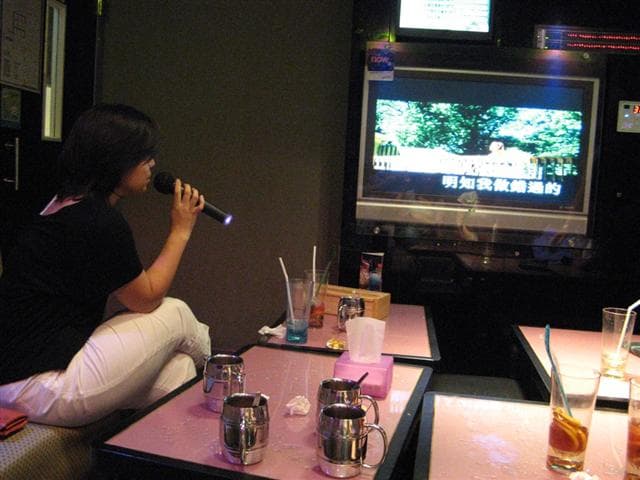
Eleven at night in Tokyo's Kabukicho district. You push open the glass door of a narrow building wedged between a konbini and a pachinko parlor. At the reception counter, an employee hands you a remote control and a drink menu. Door 7. The booth is barely six square meters: two purple vinyl benches, a low table cluttered with plastic tambourines and maracas, two wireless microphones, a screen that takes up the entire back wall. Your friend scrolls through thousands of titles. The opening notes of a Dreams Come True ballad fill the room, lyrics appear in color over a kitsch video backdrop, and he is singing, eyes closed. You are inside a , one of the most powerful cultural phenomena Asia has ever exported to the world.
is a social ritual, an emotional outlet, a multi-billion-dollar industry, and, for hundreds of millions of people across East Asia, an element as natural in daily life as restaurants or movie theaters. Its story begins in a Kobe bar in the early 1970s.
The Invention of a Musical Revolution#
The word karaoke is a contraction of two Japanese terms: and , literally "empty orchestra." The term already existed in the jargon of Japanese professional musicians to describe an instrumental track without vocals, used during rehearsals or recordings.
, born in 1940 in Osaka, made his living accompanying customers at a Kobe snack bar who liked to sing after a few drinks. In 1971, when a regular asked Inoue to accompany him on a business trip, Inoue, unable to go, recorded instrumental accompaniments on tape. He assembled a rudimentary machine, the : an amplifier, an eight-track tape player, a microphone, and a mechanism triggered by a hundred-yen coin. The machine did not reproduce the original singer's voice; it provided only the musical backing, leaving the user to sing.
Inoue installed his first machines in bars and snack bars in Kobe, then Osaka. The success was immediate. Japanese businessmen, accustomed to evenings in hostess bars (sunakku, スナック), loved the concept.
But Inoue never patented his invention, often described as one of the greatest business blunders in entertainment history. Within a few years, dozens of Japanese manufacturers were producing their own karaoke machines, and Inoue never received a single yen in royalties from a market that would grow to be worth billions.
On the other side of the Pacific, a Filipino inventor named Roberto del Rosario patented a similar machine in 1975, which he called the Sing Along System. He defended his patents in the Philippines and claimed the title of karaoke inventor for decades. The historical consensus generally credits Inoue as the originator, while recognizing del Rosario as a parallel inventor and a pioneer of karaoke's commercialization in Southeast Asia.
Karaoke was born from a simple gesture: a musician who could not be there left his music behind. And millions of voices rushed into the silence he had left.
In 2004, Inoue Daisuke received the Ig Nobel Peace Prize, awarded by Harvard University, for "inventing karaoke, thereby providing an entirely new way for people to learn to tolerate each other."
From Japan to the Rest of Asia#
In the 1970s, karaoke remained Japanese and confined to bars. The machines were bulky, the tapes expensive, and the repertoire limited to the standards of , the Japanese popular music of the era. Two technological innovations would change everything.
| Country | Local name | Dominant format | Associated ritual |
|---|---|---|---|
| Japan | private booth among friends or colleagues | after-work company evenings | |
| South Korea | neighborhood booth, from luxury to | , collective office outing | |
| China | entire buildings, from presidential lounge to | , weaving business bonds | |
| Japan (solo) | individual booth to practice alone | personal outlet, private rehearsal |
The first was the laser disc in the early 1980s. This format stored music and also video images to accompany the songs: landscapes, romantic scenes, sometimes unintentionally hilarious clips. Lyrics appeared as overlays, changing color syllable by syllable to guide the singer.
The second was the in the late 1980s. Instead of singing in a bar in front of strangers, customers could rent a private booth for a group of friends, colleagues, or family. The booth eliminated the fear of embarrassment and allowed chains to operate at scale with dozens or even hundreds of booths per venue.
Karaoke quickly spread beyond Japan. South Korea adopted it in the 1980s, followed by Taiwan, Hong Kong, mainland China, and Southeast Asia. In the West, it arrived in the mid-1980s, first in the Asian communities of major American cities (Los Angeles, San Francisco, New York), before spreading to bars worldwide. But Western karaoke, performed on a stage in front of a bar crowd, remained fundamentally different from the Asian private-booth model.
Singing a hits far harder once you can read every 歌詞 (kashi, lyric). Learn to read kanji and kana at your own pace with JapaneseSRS (spaced repetition) and turn your next 一人カラオケ (hitokara, solo karaoke) into a real immersion session.
Noraebang: The Korean Way of Karaoke#
In South Korea, karaoke is called , and understanding contemporary Korean society is impossible without understanding the place it occupies.
The first noraebang opened in Busan in 1991, and the concept spread with staggering speed. Within five years, tens of thousands covered the peninsula. Today, South Korea has roughly 33,000, about one for every 1,500 residents. They are everywhere: in basements of commercial buildings, on upper floors of entertainment complexes, next to restaurants, in residential neighborhoods. There are luxury noraebang with cocktails and buffets, budget noraebang at a thousand won per hour (less than a dollar), and , tiny booths for one or two people installed in shopping malls.
Noraebang is deeply woven into the Korean social fabric. Students go after exams, couples spend evenings there, families celebrate birthdays. But it is in the professional context that it reveals its full power. Korean corporate culture is built around , collective outings among colleagues, typically organized by a superior. The classic script unfolds in three acts: dinner (often Korean barbecue washed down with soju, 소주), the second bar, and noraebang, the grand finale. Declining a hoeshik is socially awkward; refusing to sing is even more so. Shared song temporarily erases hierarchies and cements group cohesion.
The rise of K-pop has reshaped noraebang. Korean youth rehearse the choreographies of , BLACKPINK, and aespa there, microphone in one hand, smartphone in the other to film themselves. Catalogs integrate new K-pop releases within hours of their drop.
KTV: The Chinese Version#
China discovered karaoke in the 1980s through Taiwan and Hong Kong, then transformed it into an industry under the name . The Chinese KTV market is the largest in the world, valued at over ten billion dollars, with hundreds of thousands of venues across the country.
Chinese KTV often operates on a monumental scale. Major chains like , , and occupy entire multi-story buildings with hundreds of rooms: intimate booths for four people, presidential lounges that can host fifty guests, equipped with buffets, private bars, and audiovisual systems worthy of a concert hall.
KTV holds a central place in Chinese business culture. The concept of , fundamental to social and commercial life in China, relies on building personal bonds of trust that transcend the professional sphere. Inviting a business partner to KTV, ordering bottles of whisky or cognac, singing together, applauding their performances: all of this is part of a commercial courtship ritual as codified as a Western business dinner.
Regional differences are considerable. In the eastern metropolises (Shanghai, Beijing, Shenzhen), KTV tends toward luxury: touch interfaces, catalogs of hundreds of thousands of titles in Mandarin, Cantonese, English, Korean, and Japanese, and sophisticated vocal scoring systems. In provincial cities, KTV remains more modest but no less popular. In northeastern China (Dongbei, 东北), KTV is practically sacred: the residents, known for their bluntness and exuberant sociability, have turned it into a way of life.
China also gave birth to , glass-enclosed individual booths found in shopping malls, train stations, and airports since the mid-2010s. For a few yuan, a passerby steps in alone, picks a song, records it, and shares it on . This format, reminiscent of Japan's hitokara, caters to young urban Chinese who want to sing without the social commitment of a full KTV evening.
Karaoke in Japan Today#
It is in its country of origin that karaoke has undergone its most radical transformation, becoming a technological and cultural ecosystem of remarkable sophistication.
The Japanese market is dominated by two competing systems: , developed by , and , developed by . Each claims over 300,000 titles in Japanese, English, Korean, Chinese, and roughly twenty other languages. Modern machines feature high-definition screens, real-time vocal scoring systems (evaluating pitch, rhythm, vibrato, and expression), online collaboration modes, and the ability to record performances for sharing on social media.
The major karaoke box chains, , , , and others, offer hourly packages that include unlimited drinks (nomihoudai, 飲み放題), often for less than a thousand yen per hour during the daytime. Fierce competition has driven prices down and quality up: themed booths (anime or music-group style), tablet-based ordering, and catalogs updated weekly with the latest releases.
One of the most fascinating phenomena is , a contraction of . Once seen as an admission of loneliness, going to sing alone has become a perfectly accepted, even trendy, practice in Japan. Smaller, cheaper single-person booths are offered by most chains, and some venues specialize exclusively in hitokara. The practice appeals to serious singers who want to practice without witnesses, office workers seeking a lunchtime release, and introverts who dread the group setting.
Japanese karaoke also maintains an intimate connection with culture. and make up a significant share of the catalogs. Anime fans gather to sing the theme songs of their favorite series, sometimes reproducing the choreography. Themed karaoke events regularly attract dozens of enthusiasts in major cities.
More Than Entertainment: A Social Phenomenon#
Why has karaoke conquered East Asia with such intensity, while remaining just another bar activity in the West? The answer lies at the intersection of social psychology, Asian cultural codes, and the cathartic function of song.
Japanese, Korean, and Chinese societies share a common trait: the importance placed on social harmony, emotional restraint, and respect for hierarchies. In Japan, requires containing one's emotions in public. In Korea, demands constant vigilance. In China, governs social interactions.
Karaoke, inside its closed booth, creates a space where these rules are temporarily suspended. Shielded by walls, loosened by alcohol (beer, soju, shochu, whisky, or baijiu depending on the country), the singer can express emotions that everyday life forbids. The sadness of a ballad, the rage of a rock song, the joy of a pop hit: karaoke offers a legitimate channel of expression in societies where the direct display of feelings is often unwelcome.
This therapeutic function is documented. Studies in Japan and South Korea have measured the positive effects of karaoke singing on stress, self-esteem, and social bonding. In Japan, karaoke programs are offered in nursing homes to combat isolation and stimulate cognitive function in the elderly. In Korea, psychologists use noraebang as a therapeutic tool for patients suffering from depression or social anxiety.
Karaoke also serves as a mirror for social change. The success of hitokara reflects the rise of individualism in an aging society. Korean coin noraebang respond to the fragmentation of socializing patterns among younger generations. Chinese mini-KTV booths dovetail with the culture of instant sharing on social media.
Daisuke Inoue says he did not invent a machine: he invented a space where people who are not singers have the right to sing. That may be the most beautiful definition of karaoke: not an empty orchestra, but an orchestra waiting for your voice.
In this article
The cultural terms covered here, each with a short definition.
Ulzzang: the style born from a Korean photo contest
Ulzzang, aegyo-sal, circle lenses, V-line: where this Korean style comes from, what it actually requires and why the word has aged in Korea.
Cover image: Pokman817 · Wikimedia Commons · CC BY-SA 3.0