Korean baseball: the KBO and its culture of the stands
Per-player chants, a cheer leader facing the crowd, fried chicken in the stands and a ten-million attendance record: how baseball became Korea's biggest sport.
La rédaction Kotoba Interactive
Studio éditorial
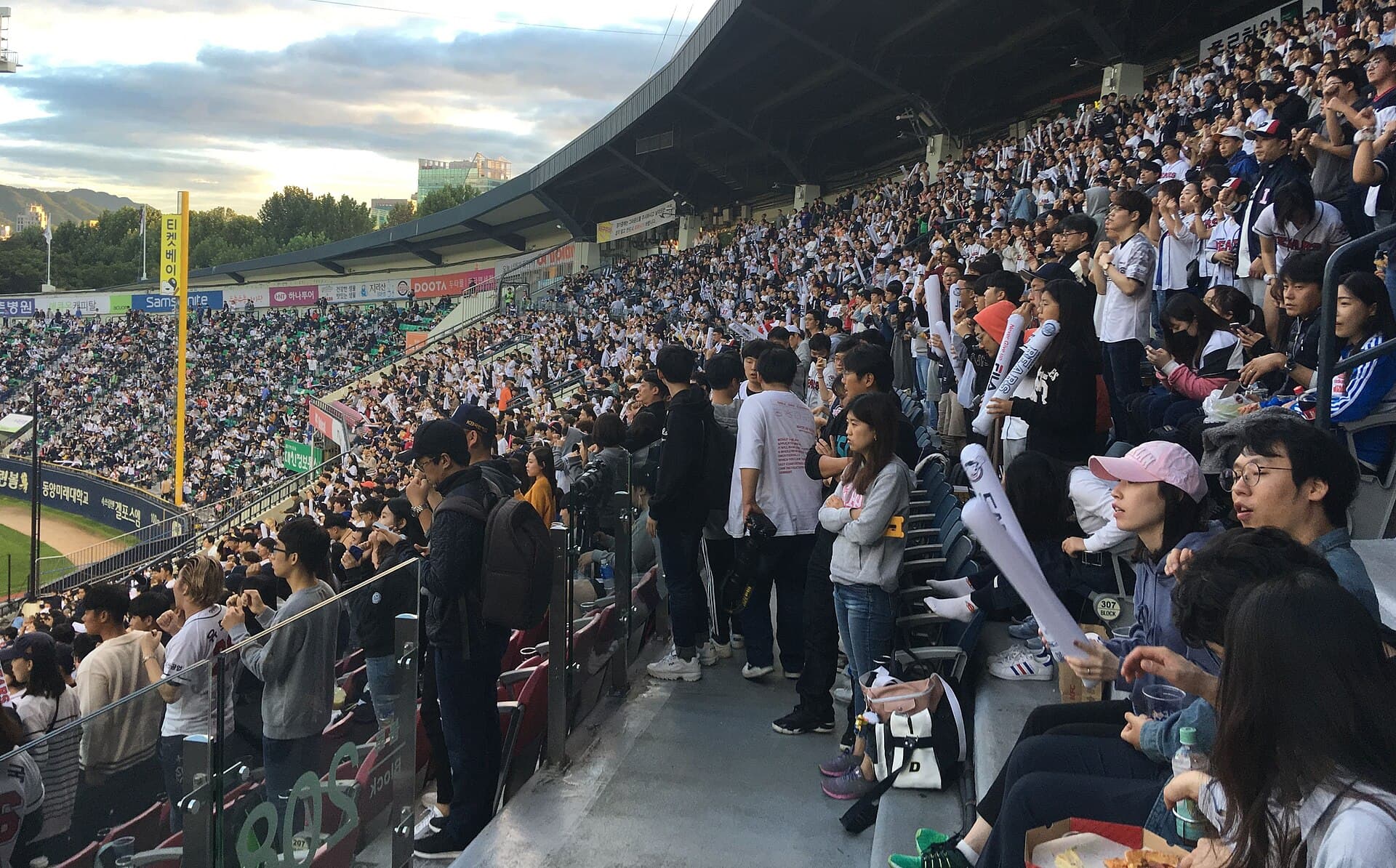
In a Korean baseball stadium, half the show has its back to the field. On a platform planted in front of the stands, a man with a microphone faces the crowd, launches the chant of the batter walking up, and twenty thousand people join in, inflatable sticks in hand. Behind him the game goes on; nobody is watching him play.
Baseball is South Korea's most followed sport, far ahead of football, and it holds that place for reasons that have as much to do with the stands as with the game. In 2024, the professional league passed the ten million spectator mark in a single season for the first time.
A league born of a political calculation#
The Korea Baseball Organization was founded in 1982 with six clubs. The first game was played on 27 March that year, at Dongdaemun Stadium in Seoul, between the Samsung Lions and the MBC Chungyong, the future LG Twins, with President Chun Doo-hwan throwing the first pitch.
The context matters. Having taken power in a coup, and responsible for the repression at Gwangju in 1980, the regime was looking to occupy a public kept out of political life. Historians of the period describe a mass entertainment strategy summed up in the "3S" formula, for sport, screen, sex: professional baseball is its centrepiece, with clubs backed by the big industrial groups and rooted in the regional capitals.
The irony is that the manoeuvre produced something other than what it aimed at. By giving each province a team to defend, it offered an outlet for old regional rivalries, notably between Gyeongsang and Jeolla, and created attachments that forty years have not worn down.
Baseball is , literally "field ball", a word coined in Japan in the late nineteenth century and carried over unchanged into Korean. Organised support is , "backing, encouragement", a term that covers the chants, the gear and the gestures alike.
Ten teams, ten conglomerates#
A Korean team is named first for its owner, not its city. Nobody says "the Busan Giants" but "the Lotte Giants", and the shirt is a nightly reminder of which group pays the wages.
| Club | City | Owning group | Stadium |
|---|---|---|---|
| Doosan Bears | Seoul | Doosan | Jamsil |
| LG Twins | Seoul | LG | Jamsil |
| Kiwoom Heroes | Seoul | Kiwoom Securities | Gocheok Sky Dome |
| SSG Landers | Incheon | Shinsegae | Munhak |
| KT Wiz | Suwon | KT | Suwon KT Wiz Park |
| Hanwha Eagles | Daejeon | Hanwha | Daejeon |
| Samsung Lions | Daegu | Samsung | Daegu Samsung Lions Park |
| Lotte Giants | Busan | Lotte | Sajik |
| KIA Tigers | Gwangju | Hyundai Motor (KIA) | Gwangju-KIA Champions Field |
| NC Dinos | Changwon | NC Soft | Changwon NC Park |
The regular season runs to 144 games per team, from April to early October. The top five reach a stepladder play-off in which the best-placed side waits directly in the final, the Korean Series, regularly contested in front of full houses by the two Seoul clubs that share Jamsil Stadium.
The cheer leader is the real master of ceremonies#
Every club employs an , a cheer leader, and a team of cheerleaders who work on a platform, backs to the field, facing the crowd. Their role is not decorative: they decide which chant to launch and when, and hold the rhythm for three hours.
Each player has his own walk-up chant, often built on a pop or K-pop song whose lyrics have been replaced by his name. Supporters know them all, including the opposition's, and a transferred player sometimes takes his tune with him. Add club songs, situational songs, one for a hit, one for a comeback, and the constant use of inflatable batons, the makdaefungseon, which produce the stadium's continuous wall of sound.
Sajik Stadium in Busan, home of the Lotte Giants, is nicknamed "the largest karaoke room in Asia". The crowd sings Busan Galmaegi (부산 갈매기, "the Busan seagull"), a 1982 pop song turned unofficial city anthem, and supporters wear on their heads the orange plastic bags handed out for rubbish, turned into collective headgear.
In Seoul you go to the stadium to watch a game. In Busan you go to sing, and the game happens to be on.
What people eat in the stands#
The second difference is obvious at the gate: you bring your own food into a Korean stadium, and you can have a meal delivered to your seat. Fried chicken, takeaway boxes, draught beer poured in the aisles, all of it forming , a contraction of chicken and maekju, beer.
That tolerance has produced a particular sociology of the crowd. A game lasts three hours, is watched seated in a group, while eating, with no obligation to follow every pitch. Families come, so do work colleagues, and the cheapest seats fill up first.
Three words are enough to follow an evening at the ballpark: 야구 (yagu, baseball), 응원 (eungwon, cheering) and 홈런 (homreon, home run). KoreanSRS, our spaced repetition app, installs that vocabulary and the everyday Korean that goes with it.
Ppadeon, or the art of throwing your bat#
The most exported gesture in Korean baseball scores no runs. The , short for ppatta deonjigi, "bat throwing", means flicking your bat into the air after hitting a ball you have decided is leaving the park.
In the United States, the gesture was long read as an insult to the pitcher and settled, for decades, by a ball in the ribs next time up. In Korea it is part of the pleasure, is practised, is compared, and compilations of Korean bat flips travelled the social networks from the 2010s onwards. American baseball eventually softened its doctrine, partly under the influence of those clips.
In spring 2020, the KBO was one of the first professional leagues in the world to resume play, behind closed doors, during the pandemic. American network ESPN, starved of baseball, broadcast the Korean games live overnight: millions of American viewers discovered stand chants echoing around empty seats filled with cardboard cut-outs.
2024, the ten million season#
The league had long plateaued around eight million spectators a year. The 2024 season broke through: 10,731,646 admissions in total, an average of roughly 15,100 per game, a record in KBO history.
Clubs and ticketing platforms attributed a large share of the surge to a younger and markedly more female crowd than before, arriving via social media, chant videos and merchandise. The shift was pronounced enough that players became fashion figures, with photoshoots and brand deals, a long way from the working-class image of 1980s baseball.
What the league exports#
Korean baseball has supplied Major League Baseball with a line of players that began with Park Chan-ho, the first Korean to play there, in a Los Angeles Dodgers shirt in 1994. Pitcher Ryu Hyun-jin followed, leaving in 2013 and returning to finish his career with the Hanwha Eagles, then a more recent generation including Kim Ha-seong and Lee Jung-hoo, signed by the San Francisco Giants after the 2023 season.
Internationally, two dates count. The gold medal at the 2008 Beijing Olympics, won with a perfect run, and the 2009 World Baseball Classic final, lost to Japan in extra innings, still the most discussed game in the recent history of the sport in Korea.
What strikes you on walking into a Korean stadium on a weeknight, though, is neither the standard of play nor the honours list. It is that a slow, imported sport, long used as political distraction, has become the place where a city sings together for three hours without anyone needing to explain why.
Read alsoChimaek: Fried Chicken and Beer, Korea's National ReligionFried chicken and beer have a Korean history of their own, of which the stadium is only one stage.
Korea's other mass sport took the opposite path: born in back rooms, it ended up filling stadiums.
FAQ#
How much is a ticket? Prices vary by club and category, but Korean baseball remains cheap entertainment compared with European football, with general-admission seats at a few thousand won and pricing designed for families.
Can you bring your own food? Yes, that is the custom. Stadiums allow food and drink to be brought in, delivery to your seat is common, and stalls sell fried chicken, dried squid and draught beer.
When is the season? The regular season runs from April to early October, with 144 games per team, followed by the play-offs and the Korean Series in October or early November.
Do you need to know the rules of baseball? Not necessarily to enjoy the evening: the chants, announcements and screens carry the crowd along. Knowing the basics, hit, out, inning, does make the key moments far easier to read.
Which team should a newcomer follow? The Lotte Giants for the Sajik atmosphere, the Doosan Bears or LG Twins for an easy-to-reach Seoul stadium, the KIA Tigers for the most decorated club in league history. Picking a club in Korea is usually a matter of home town, rarely of trophies.
Photo credits: the images in this article come from Wikimedia Commons and are under free licences.
Korean military service: length, exemptions, realities
18 to 21 months depending on the branch, a seven-grade fitness exam, vanishingly rare exemptions: how South Korean conscription works and what it costs.
Cover image: Christophe95 · Christophe95, via Wikimedia Commons · CC BY-SA 4.0