Korean esports: why Korea keeps winning
From the 1997 IMF crisis to T1's world titles: how Korea built the first competitive gaming industry, and why it is still winning three decades later.
La rédaction Kotoba Interactive
Studio éditorial
On 3 December 1997, South Korea signed the largest rescue package the International Monetary Fund had granted to that date, on the order of fifty-eight billion dollars. The conglomerates laid off tens of thousands, forty-year-old managers found themselves without a job or any prospect of rehiring, and they needed a business they could start with little capital. Many chose the same one: a room, some computers, a connection, an hourly rate.
Three months later, in March 1998, Blizzard released StarCraft. The collision of a demanding strategy game, a country that had just built the best broadband network in the world, and thousands of computer rooms open around the clock produced a phenomenon nobody had planned. South Korea did not decide to become the leading power in competitive gaming: it became one by accident, and then spent twenty-five years organising that accident.
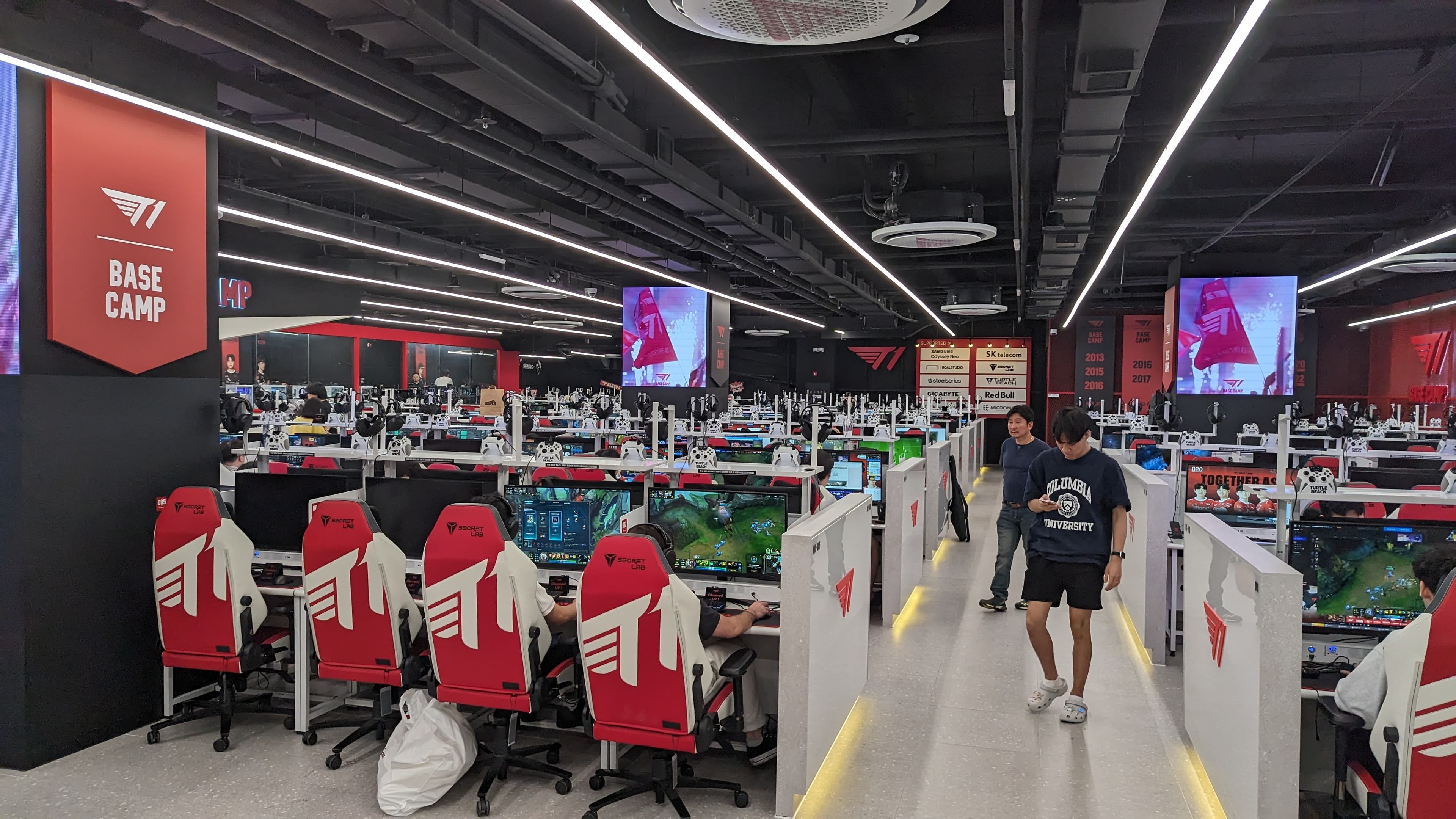
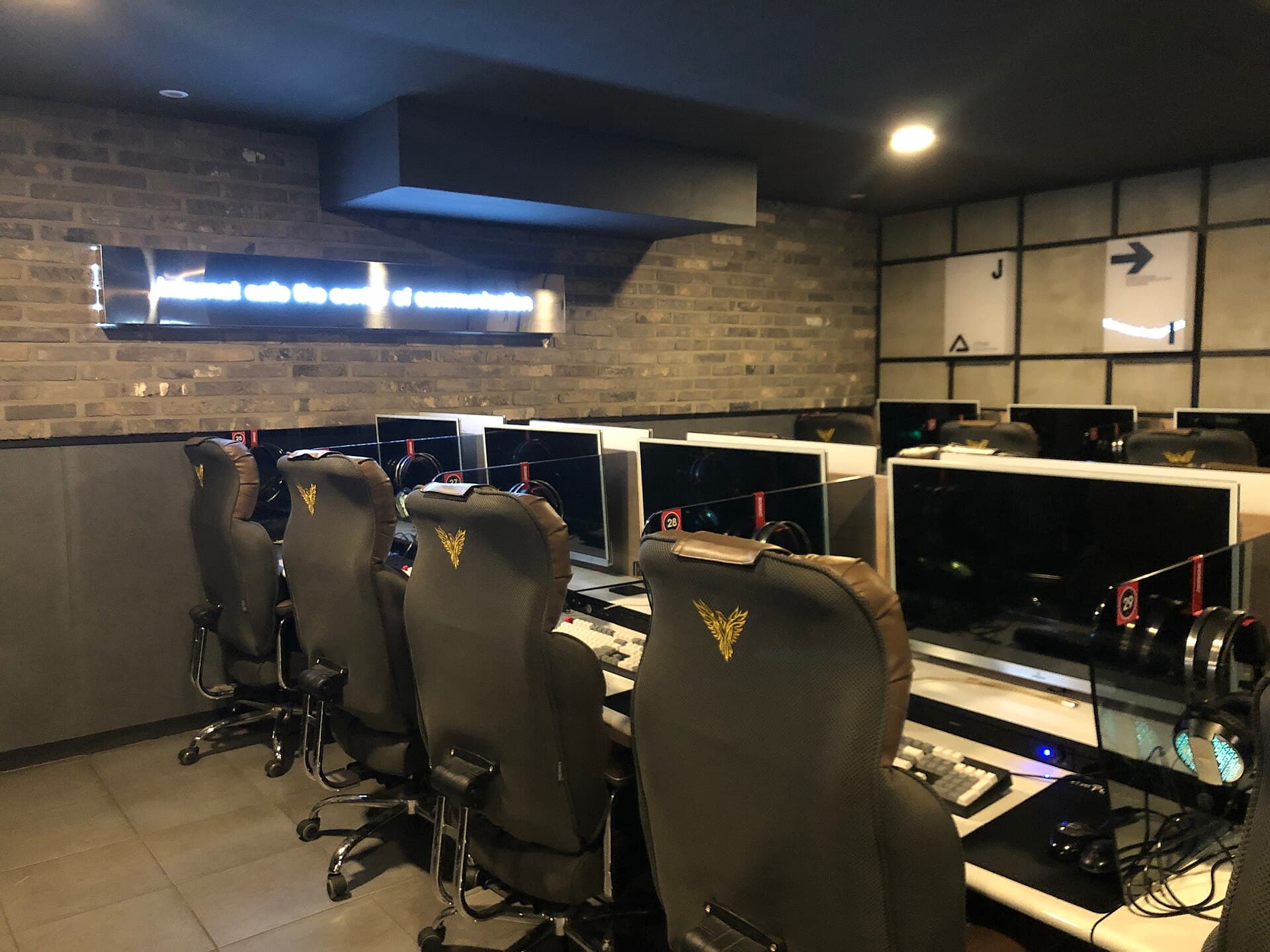
The PC bang as national laboratory#
The cost about a thousand won an hour in its early days. You went for the machine, for the connection, and above all because playing there was a collective outing rather than a solitary hobby.
The estate exploded. From around a hundred establishments in 1997, the country passed fifteen thousand in 1999 and went beyond twenty thousand at the turn of the 2000s. StarCraft and its Brood War expansion sold at a rate with no equivalent anywhere: estimates put Korean sales at roughly four and a half million copies, close to half the worldwide total for an American game, in a country of under fifty million people.
The infrastructure followed. The government launched the Cyber Korea 21 plan in 1999, making broadband a public policy; by the early 2000s Korea had the highest penetration rate on the planet. A Korean player therefore had, before anyone else, three things at once: a decent machine, low latency, and opponents available at any hour.
The suffix 방 (bang) simply means "room". It forms a whole family of Korean businesses built on renting a space by the hour: the 노래방 (noraebang, singing room), the 찜질방 (jjimjilbang, bathhouse), the 만화방 (manhwabang, comics room) and therefore the PC방. Korean esports was born inside a commercial category that already existed.
The television that invented the profession#
What really set Korea apart was not having many players but having television channels to film them. launched in 2000, followed by MBC Game: the first cable channels in the world devoted around the clock to video games.
Those channels invented an audiovisual grammar that did not exist: commentary desks, draft screens, replays, statistics, season-long drama. They also created the Starleague, a competition with regular seasons and playoffs, modelled on professional sport.
National celebrities emerged. , known as BoxeR and nicknamed the Terran Emperor, reached a level of mainstream fame his supporters' club counted in the hundreds of thousands of members. In 2004, a final staged on Gwangalli beach in Busan drew a crowd estimated in the tens of thousands, a figure the press often rounded up to a hundred thousand. At that moment, no other country had any idea what a stadium full of people watching a video game looked like.
The state steps in#
, the Korea e-Sports Association, was founded in 2000 under the Ministry of Culture, Sports and Tourism. This is a major structural difference from the West, where competitive gaming developed for fifteen years without any institutional recognition: in Korea there was a federation, professional player licences, standard contracts and a supervising ministry.
That institutionalisation had a downside. KeSPA long controlled StarCraft broadcast rights without an agreement with Blizzard, which ended in a legal dispute settled in 2012. It also imposed a collective discipline that weighed on individual careers.
The Korean state has in fact maintained an ambivalent relationship with video games, subsidising them as a cultural industry while treating them as a health risk.
From 2011 to 2021 Korea applied the , formally the shutdown law: under-sixteens were barred from online games between midnight and six in the morning, enforced through the national identity number. The country producing the world's best professional players was forbidding its own teenagers to play at night. The measure was repealed in 2021.
Collapse, then rebuilding#
The StarCraft era collapsed in 2010. An investigation exposed a large match-fixing operation organised around illegal betting: eleven players, including the former champion , were banned for life by the federation, and criminal convictions followed. The audience turned away, sponsors retreated, MBC Game stopped broadcasting in 2012 and the historic Starleague ended the same year.
That is precisely when League of Legends arrived. The Korean server opened in December 2011, teams reformed, and fifteen years of accumulated know-how in structured training, coaching and television production transferred wholesale to the new game in under two seasons.
The result was overwhelming.
| Year | World champion | Region |
|---|---|---|
| 2011 | Fnatic | Europe |
| 2012 | Taipei Assassins | Taiwan |
| 2013 | SK Telecom T1 K | Korea |
| 2014 | Samsung White | Korea |
| 2015 | SK Telecom T1 | Korea |
| 2016 | SK Telecom T1 | Korea |
| 2017 | Samsung Galaxy | Korea |
| 2018 | Invictus Gaming | China |
| 2019 | FunPlus Phoenix | China |
| 2020 | DAMWON Gaming | Korea |
| 2021 | EDward Gaming | China |
| 2022 | DRX | Korea |
| 2023 | T1 | Korea |
| 2024 | T1 | Korea |
| 2025 | T1 | Korea |
The vocabulary of Korean competition comes down to a few words every LCK viewer ends up recognising: 한타 (hanta, the team fight), 정글 (jeonggeul, the jungle) and 역전 (yeokjeon, the comeback). KoreanSRS, our spaced repetition app for learning Korean, is coming soon: join the waiting list and follow the casters without subtitles.
Five reasons the dominance persists#
Korean dominance has lasted too long to be the work of one talented generation. Five structural factors explain it.
A concentrated talent pool. The Korean ranked ladder is the densest elite player pool anywhere. Foreign teams travel there to practise before international events, which amounts to admitting that the best preparation is playing against Koreans.
Professional co-residence. Players live together in a 숙소 (sukso), the team house, with meals prepared, hours imposed and practice sessions against other teams that can exceed ten hours a day. The model produces an intensity western organisations, later and more scattered, took a decade to approach.
The coaching profession. Korea invented the role. Where western teams in the early 2010s directed themselves, Korean organisations already employed a head coach, assistants and video analysts. That structure was subsequently exported everywhere.
A development pipeline. Teams recruit teenagers spotted on the ladder, place them in academy squads and promote them, on a model very close to that of K-pop agencies. The pool therefore renews itself continuously, which is how Korea survived the mass exodus of players and coaches to China between 2014 and 2017.
Short, intense careers. A Korean player joins a professional roster around seventeen and often retires before twenty-five. Constant rotation sustains the level, at the cost of a high attrition rate whose effects several players have described publicly.
Military service, the clock behind every career#
No account of Korean esports is complete without it. National service, roughly eighteen months in the army, falls exactly at the age when a player peaks. It cuts careers in half and pushes the best to give everything before the call-up.
One exit exists, the same as for Olympic athletes: the status of , which replaces active duty with designated service. It is obtained notably with a gold medal at the Asian Games. Esports entered those as a demonstration event in Jakarta in 2018, then as a medal event in Hangzhou, where Korea took gold in League of Legends. A video game competition therefore has a literal effect on the military obligations of its winners, which exists nowhere else.
The limits of the model#
Korea's position is not comfortable for all that. China has had greater financial resources for a decade and has bought Korean players and coaches at high prices, to the point that the LCK went through seasons of talent scarcity. Salaries have risen sharply, Korean organisations had to franchise to stabilise, and the economics of the sector remain fragile outside a handful of teams.
On the human side, the training rhythm of the sukso model is regularly criticised, with several players retiring from overuse injuries or exhaustion.
What remains is what Korea genuinely invented, and it explains the rest: the idea that a video game player could be a supervised, filmed, coached and federated professional, at a time when the rest of the world still filed it under teenage pastime. The country did not win because it played more. It won because it was the first to treat playing as a sport.
Read alsoPC Bang: The Cybercafés That Shaped Korean GamingThe business at the root of everything, what people do there today and why it refuses to disappear.
The opposite trajectory next door: Japan, the world's leading maker of games, and the last to arrive at competing in them.
FAQ#
Why is Korea so strong at esports? Through accumulated causes: a network of computer rooms born of the 1997 crisis, the best broadband in the world in the early 2000s, two dedicated television channels from 2000, a federation backed by the state, and a collective training model invented locally and copied everywhere since.
What is a PC bang? An hourly-rate computer room, open continuously, which functions as much as a social venue as a place to play. It is the cradle of Korean esports, and several thousand still operate across the country.
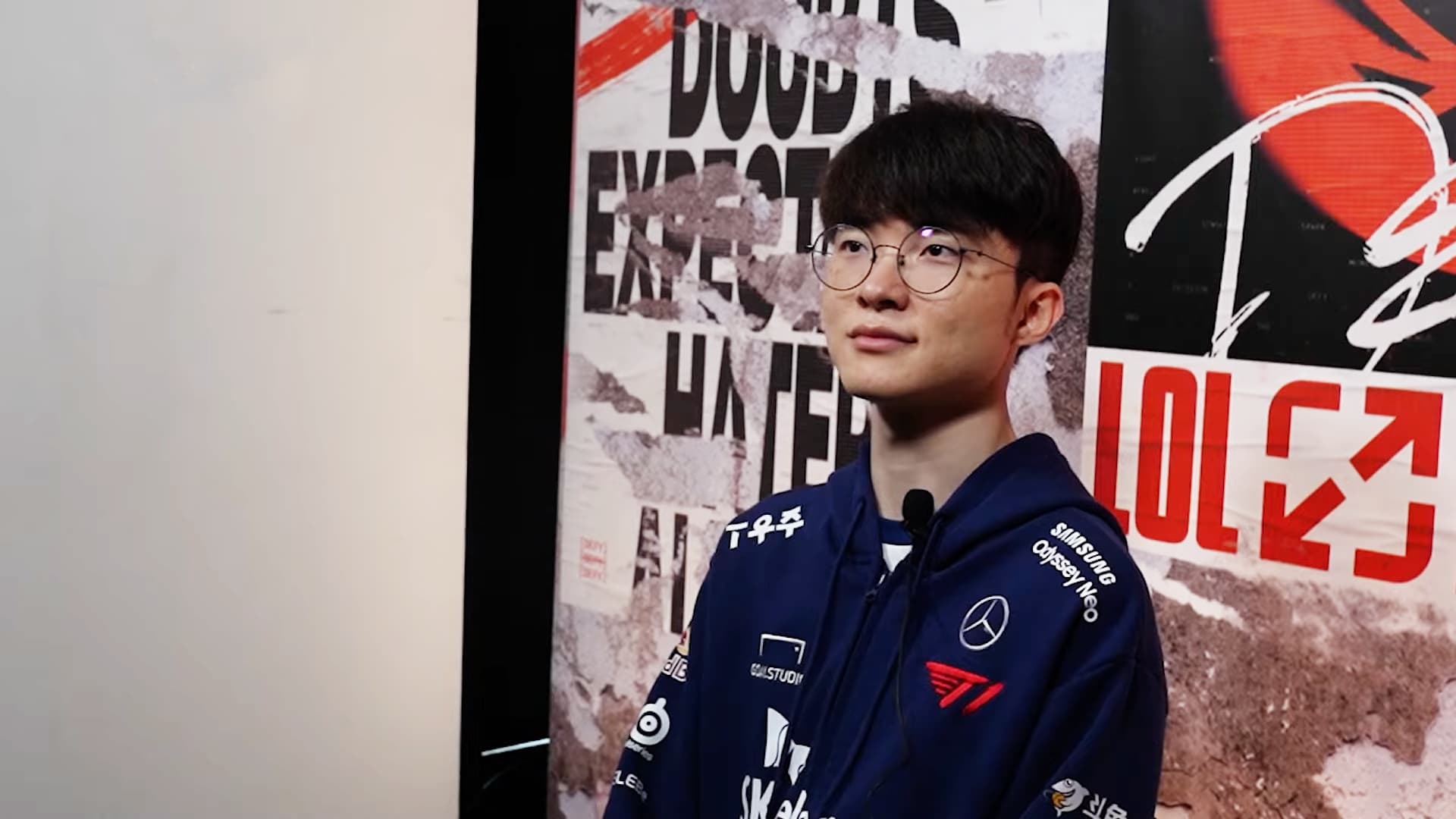
Who is Faker? Lee Sang-hyeok, born in 1996, a League of Legends player who turned professional in 2013 with SK Telecom T1, now T1. He holds the game's greatest international record, with titles won in 2013, 2015 and 2016 and again during T1's consecutive run of victories beginning in 2023, and is one of South Korea's best-known athletes.
Does Korea still dominate today? In League of Legends, yes: Korean teams have won the large majority of world championships, including the most recent editions. China remains the most serious rival, with greater financial firepower and three titles.
Does military service apply to professional players? Yes, as to all Korean men. It arrives when a player is at their peak, unless they obtain the status reserved for Asian Games gold medallists, which substitutes designated service for active duty.
Photo credits: the images in this article come from Wikimedia Commons and are under a free license.
PC Bang: The Cybercafés That Shaped Korean Gaming
Born of the 1997 crisis and the StarCraft wave, Korea's PC bang industrialized a passion and invented modern e-sports.
Cover image: E레기 (Inven) · E레기 (Inven), via Wikimedia Commons · CC BY 3.0