Chimaek: Fried Chicken and Beer, Korea's National Religion
Crisp fried chicken and cold beer: how chimaek became a ritual of Korean sociability and a cultural export of the country.
La rédaction Kotoba Interactive
Studio éditorial
It is ten in the evening on the banks of the Han River in Seoul, and the grass is dotted with little plastic mats where frosted cans stand cooling. A delivery rider on a scooter weaves between the groups, an insulated bag in hand, and sets down a still-warm box: inside, gleaming pieces of fried chicken glazed with red sauce, next to two large bottles of pale beer. They clink cans, bite into a wing whose crust snaps clean, take a cool sip, and start again. No one here would say they are having dinner: they are sharing a , and that is something else entirely.
In South Korea, is far more than a dish: it is a ritual, almost an institution, that of fried chicken paired with beer. The word itself is a transparent portmanteau, forged by contracting and . Around this simple pairing a whole swathe of contemporary Korean sociability has been built, from Han River picnics to World Cup nights, from after-work outings to omnipresent delivery. To understand chimaek is to understand how a country turned a delicious match into a social language, then into an export that the hallyu wave spread across Asia.
Two Syllables for a Ritual#
Chimaek can be read in its name. Korean loves these expressive contractions, where the first syllable of two words is taken to make a third, livelier and more familiar one. Here, comes from , the Korean transcription of the English chicken which, in Korea, never means raw chicken or Western-style roast chicken, but specifically Korean-style fried chicken. And comes from , beer.
contracts and . The word does not name two foods side by side: it names their union, the idea that they form an inseparable whole one would not order separately.
This linguistic fusion says it all: in Korea, fried chicken and beer are not thought of as two things joined by chance, but as a natural duo, in the same way as bread and butter elsewhere. Ordering fried chicken without beer would almost count as a social anomaly, and many specialized restaurants, the , advertise chimaek as their very reason for being.
From Tongdak to Double-Fried Chicken#
Fried chicken is nothing immemorial in Korea: it is a product of the twentieth century, born from the encounter between a local tradition and a foreign influence. Before the chains and the signature sauces, there was , a chicken cooked whole, first roasted then fried, popularized in the 1960s and 1970s in the booming urban markets.
Tongdak was a modest festive food, an affordable luxury in a Korea emerging from war and poverty. It was bought whole and golden for big family occasions, and its sale at the market, cut to order or by the bird, accompanies the memory of a generation. Frying, greedy for oil, remained a small event in households where meat was not a daily thing.
The great transformation came from the technique of double frying. Modern Korean fried chicken stands out for a method in which the pieces are fried once at a moderate temperature, left to rest, then plunged back into very hot oil. This second cooking drives out the residual moisture and melts the fat under the skin: the result is a thin, dry, extraordinarily crisp crust that stays crunchy for a long time, even coated in sauce or brought home after delivery.
Where American fried chicken relies on a thick, rustic batter, the Korean version seeks an almost translucent crust, so thin and so dry that it snaps like glass and defies time.
It is this durable crust that made everything else possible: a chicken that stays crisp an hour after frying is a chicken that travels, that can be delivered across town or carried onto the grass of a park without going soft. The technique came before, and enabled, the culture.
Yangnyeom, Soy-Garlic, and the Galaxy of Sauces#
If double frying gives the texture, it is the sauces that gave Korean chicken its identity and its fame. Two of them dominate and shape the whole menu of the chikin jip.
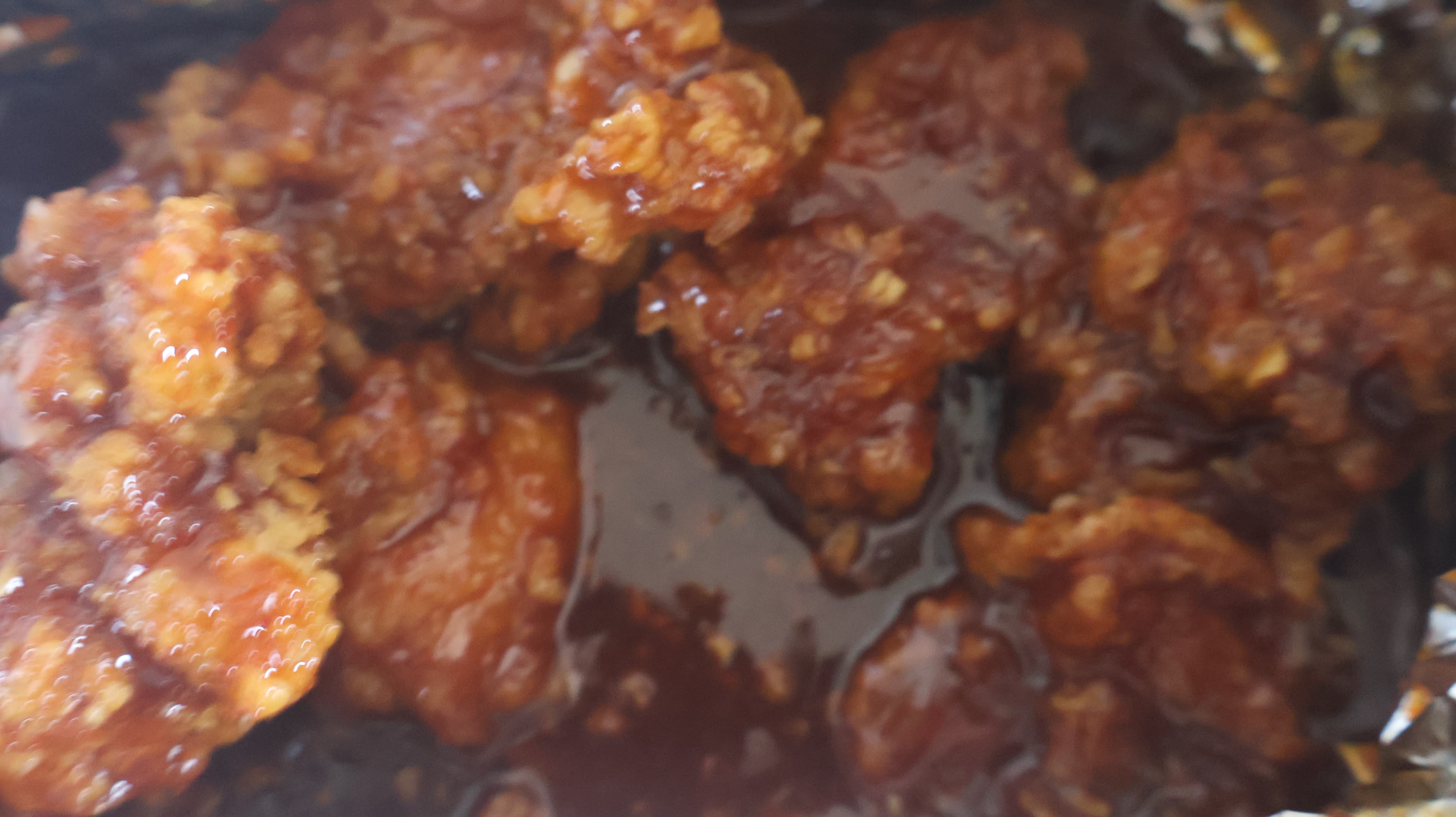
The first is , a red, glossy sauce, both sweet and spicy, built around , lifted with garlic, sugar, syrup, and sesame. Yangnyeom chicken, glazed with this sticky, blazing sauce, is probably the most recognizable image of Korean fried chicken, the one that leaves red fingers and a craving for a cool sip of beer to soothe the heat.
The second is soy-garlic, literally soy and garlic, built on soy sauce (ganjang, 간장) reduced with garlic, sugar, and honey: a brown, glossy, salty-sweet glaze, milder than yangnyeom but just as sticky. Many Koreans in fact order a "half-and-half" chicken (banban, 반반), a portion split between yangnyeom and soy-garlic, so as not to have to choose.
| Type of chicken | Korean term | Description |
|---|---|---|
| Plain, no sauce | 후라이드 (huraideu) | The just-fried classic, dry crust, served with pickled radish |
| Yangnyeom | 양념 (yangnyeom) | Glazed with sweet-spicy red gochujang sauce, the emblem of the genre |
| Soy-garlic | 간장 (ganjang) | Brown soy-garlic glaze, salty-sweet, milder than yangnyeom |
| Half-and-half | 반반 (banban) | Portion split half yangnyeom, half soy-garlic |
| Snow cheese | 스노우 치즈 | Chicken dusted with a creamy, slightly sweet cheese powder |
| Padak | 파닭 (padak) | Buried under a mound of thin raw green-onion strips |
Around this core, Korean inventiveness has made the variations multiply: buried under green onion, cheese-powder chicken (snow cheese), honey versions, smoked soy, green chili, onion sauce, not to mention the unchanging sides, the pickled white radish cubes (chikin-mu, 치킨무) whose acidity cuts the grease, and of course the beer.
The Chains, Delivery, and the Chicken Empire#
Korean fried chicken would not have become a national phenomenon without a formidably efficient business model: that of specialized chains and delivery. From the 1980s and above all the 1990s, brands like BBQ, Kyochon, and BHC industrialized and standardized fried chicken, making it a product available everywhere, at any hour, at an affordable price.
The density of these brands has become a statistical commonplace: it is often repeated that there are more fried chicken restaurants in South Korea than there are branches of a major global fast-food chain in the entire world. Opening a chikin jip has even become, for many Koreans retiring or leaving the corporate world, a classic reinvention project, to the point that analysts speak of a saturated market and fierce competition between outlets.
The second pillar is delivery, , practiced in Korea with uncommon efficiency and scale. Home meal delivery is a long-standing institution there, well predating the apps, and fried chicken is one of its historic pillars: a phone call, or today a few taps on an app, and a warm box arrives within a few dozen minutes, even out in a park or by the river.
In Korea, you don't only get deliveries at home: you can have fried chicken and beer brought directly to the grass of a riverside park. You just give your approximate location, and the rider finds the group sitting on its mat. Delivery has embraced the picnic ritual down to its smallest details.
This combination, brand density and ultra-fast delivery, made chimaek permanently accessible, erasing the boundary between restaurant and home, between city and park. Fried chicken became the convenience food par excellence, the one you share without ceremony.
The vocabulary of chimaek is best savored once you can read it: 치맥 (chimaek, fried chicken and beer), 양념 (yangnyeom, the sweet-spicy sauce), 배달 (baedal, delivery) and 건배 (geonbae, "cheers!"). Learn to decipher hangul and these words of everyday Korean life with KoreanSRS and its spaced repetition.
The River, Football, and After-Work#
Chimaek is not only a food: it is a social backdrop, a pretext for gathering, and three scenes in particular have made it a national ritual.
The first is that of the , which flows through Seoul. On mild evenings, thousands of residents settle on the grass of the great riverside parks, spread out a mat, order chimaek by delivery, and spend the evening drinking, eating, and chatting beneath the illuminated bridges. The Han River picnic has become an urban institution in its own right, a democratic art of living in which fried chicken takes the lead.
The second scene is that of football, and singularly the 2002 World Cup, co-hosted by South Korea, when the national team reached the semifinals amid an unheard-of fervor. Before giant screens, in packed streets and bars, millions of Koreans watched the matches over fried chicken and beer, durably anchoring the association between sport, collective euphoria, and chimaek. Ever since, every big football night mechanically relaunches chicken orders across the country.
The third is that of the after-work gathering, that moment when colleagues and friends prolong the day over a drink. Chimaek offers a lighter, more relaxed version than the long soju-soaked evenings: people meet at a chikin jip, share a chicken and a few beers, and unwind. It is Korean sociability at its most everyday.
Chimaek is not a meal you have, it is a moment you share: it turns a riverbank, a match, or the end of a day into an occasion to come together.
Chimaek, Star of the Hallyu Wave#
A local ritual can, under the effect of popular culture, become a regional phenomenon. That is exactly what happened to chimaek in the early 2010s, carried by the wave, the global export of Korean popular culture, dramas and K-pop at the fore.
The founding episode was the airing, in 2014, of the television series . Its heroine, a famous actress, declares her love of fried chicken paired with beer, especially on snowy evenings. The line and the scene had a spectacular effect, above all in China, where the series was a colossal hit: demand for Korean fried chicken exploded there, restaurants multiplied, and chimaek became overnight a desirable symbol of Korean modernity.
A single line of dialogue was enough to trigger a fried-chicken craze on the scale of an entire country. After "My Love from the Star" in 2014, demand for chimaek soared so much in China that the authorities and media took notice, and the snowy-evening chicken-and-beer scene has remained one of the most cited symbols of Korean soft power.
Since then, chimaek has spread far beyond, carried by dramas, variety shows, and social media, until it became a must for travelers coming to taste Korea on a plate. Chimaek festivals, such as the one in Daegu, draw crowds and institutionalize what was originally only a late-night habit. Fried chicken and beer, born of postwar scarcity and market resourcefulness, have become a cultural ambassador.
Read alsoKorean barbecue: the convivial art of gogi-guiAnother pillar of the Korean table, gogigui barbecue makes tableside cooking an art of conviviality: discover its meats, its embers, and its rituals.
The beer of chimaek has a big sister: soju, the national spirit with its very precise codes of sharing. Dive into the history and customs of the green bottle.
The after-work chimaek is a light cousin of hoesik, that codified corporate meal where Korean hierarchy and professional bonds play out.
From the golden tongdak of postwar markets to the glazed box set down on the grass of the Han River, chimaek tells a Korean story in miniature: that of a country that turned resourcefulness into an art of living, and a simple match between crisp chicken and cold beer into a language of friendship. Perhaps that is the real secret of chimaek: it never claimed to be haute cuisine, only a way of saying, wing in hand and frosted can within reach, that the best of the evening starts now.
FAQ#
What exactly does "chimaek" mean? It is a portmanteau formed from and . It names the pairing of fried chicken and beer, seen in Korea as an inseparable couple rather than two separate foods.
What makes Korean fried chicken different from American? The double-frying technique. The pieces are fried twice, which produces a very thin, dry, and lastingly crisp crust, the opposite of the thick batter of American fried chicken. This crust stays crunchy for a long time, even after delivery or a coating of sauce.
What is the difference between yangnyeom and soy-garlic? is a sweet-spicy red sauce based on gochujang, fermented chili paste. Soy-garlic is a brown glaze based on soy sauce (ganjang) and garlic, milder and salty-sweet. Many order a half-and-half chicken (banban, 반반) to taste both.
Why do people eat chimaek by the Han River? Because Korean delivery, , lets you have chicken and beer brought straight to the grass of a park. Seoul's great riverside parks along the Han have become nocturnal picnic spots where chimaek is the star dish, against a backdrop of illuminated bridges.
How did chimaek become popular in China? Thanks to the 2014 series , whose heroine praises fried chicken and beer. The drama's success triggered a genuine chimaek craze in China, making Korean chicken-and-beer a symbol of the hallyu wave.
Photo credits: images in this article come from Wikimedia Commons and are under free licenses.
In this article
The cultural terms covered here, each with a short definition.
- Hallyu
- The "Korean Wave": the global spread of South Korean pop culture (k-pop, k-dramas, film).
Ramyeon: Korea's Instant Noodle Culture
Ramyeon (라면) is not Japanese ramen: almost always instant and fiery. From Samyang in 1963 to the global Shin Ramyun and the ram-don of Parasite.
Cover image: Startandstar · Startandstar, via Wikimedia Commons · CC0