Minimalist routine or ten steps: which K-beauty to choose
What the Korean ten-step routine actually contains, why Seoul invented skip-care, and how to choose between the two based on your skin and your budget.
La rédaction Kotoba Interactive
Studio éditorial
The number ten was never uttered by a Korean dermatologist. It comes from a book published in New York in 2015, The Little Book of Skin Care, in which Charlotte Cho, co-founder of the retailer Soko Glam, described to an American audience how the women she watched in Seoul layered their products. The format made its fortune: within months, "the Korean ten-step routine" became the label under which the West filed the whole of South Korean cosmetics.
Ten years on, Seoul's brands are selling the opposite. They have a word for it, 스킵케어 (seukip-keeo, from the English "skip-care"), and a simple promise: remove whatever serves no purpose. The two approaches now sit on the same shelves, backed by the same groups, which makes the choice more confusing than it should be. Here is what each one actually holds.
What the ten-step routine puts on your skin#
The full sequence, as it has circulated since 2015, runs in the evening in this order: cleansing oil, foaming cleanser, exfoliant, toner, essence, serum or ampoule, sheet mask, eye cream, moisturiser, and sunscreen in the morning in place of the mask.
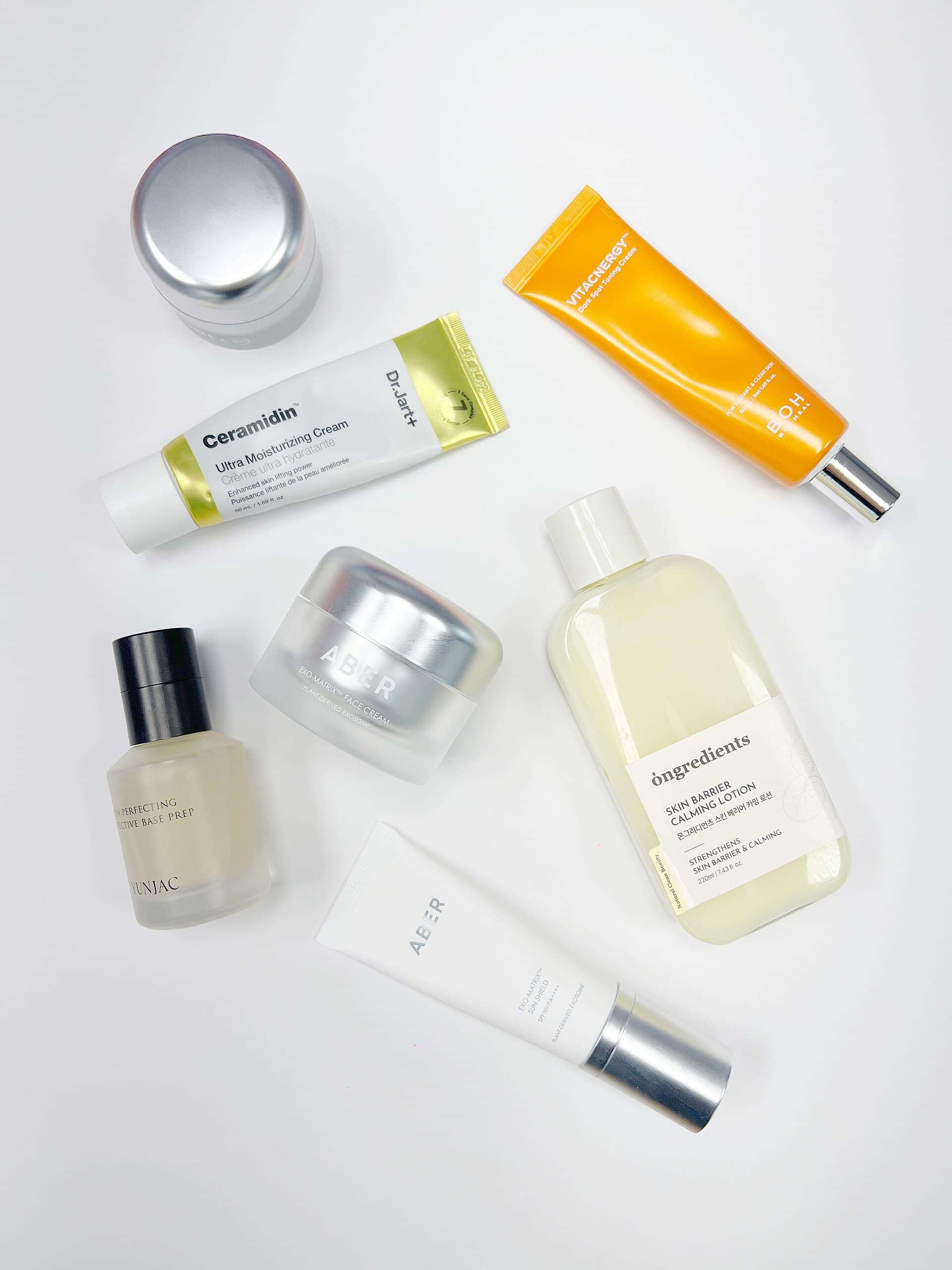
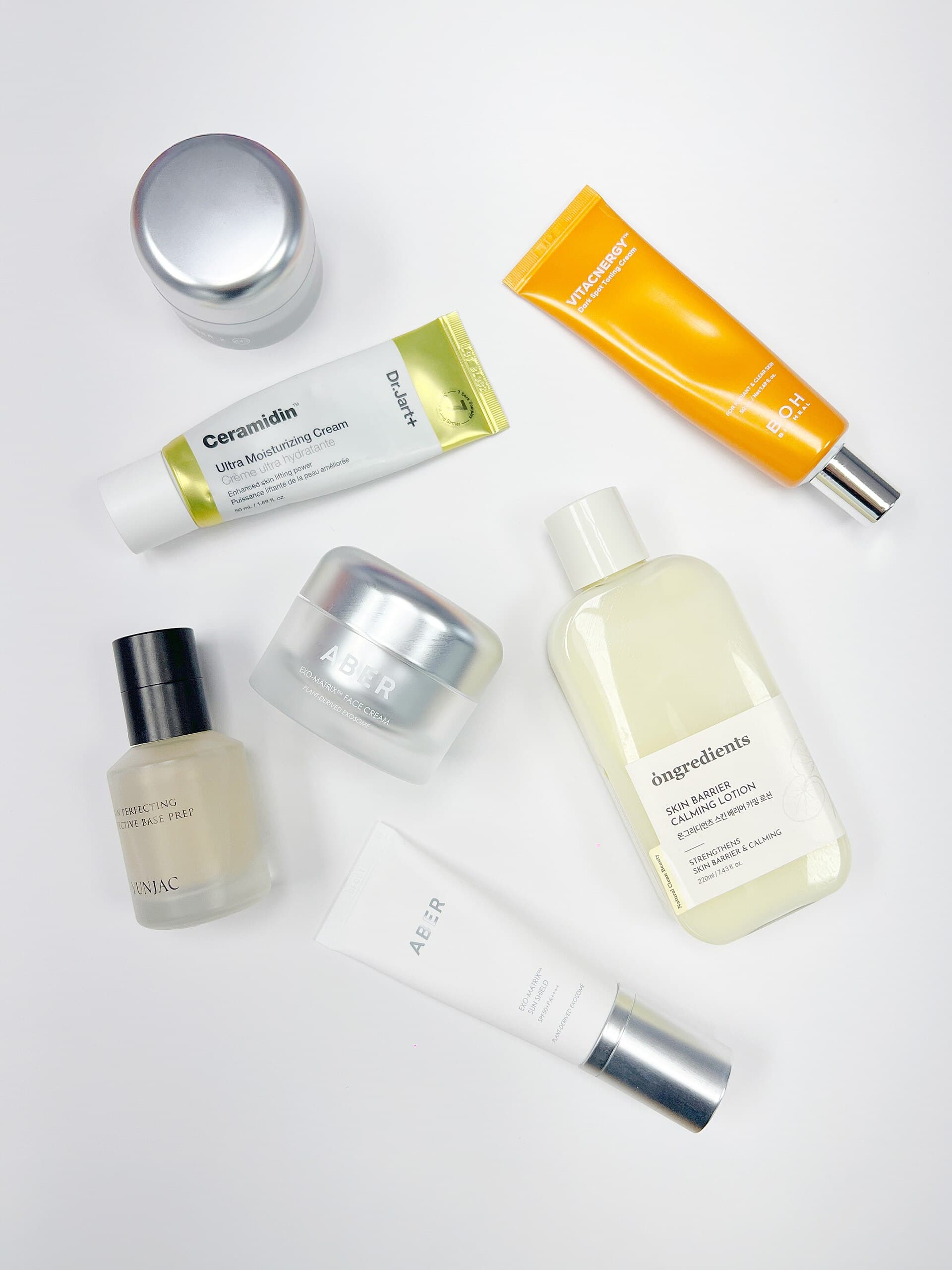
Each product answers a distinct function, and that is where the logic holds up. Oil dissolves make-up and sunscreen, which water alone will not lift. The water-based cleanser removes the oil. Toner, in Korea, is not the alcohol-heavy astringent of the 1990s but a first delivery of water. Essence is the category's signature product: very fluid, loaded with humectants, it prepares the skin for everything that follows.
Serum concentrates the targeted active, vitamin C, niacinamide or hyaluronic acid. Cream closes the sequence by forming a film that slows evaporation. Nothing on that list is absurd. The problem is not the logic, it is the accumulation.
이중세안 (ijung se-an), literally "double cleansing", refers to the pairing of an oil cleanser followed by a water-based one. It is the one step of the long routine that dermatology backs without reservation, on one condition: it is meant for skin wearing make-up or water-resistant sunscreen. On bare skin it becomes needless stripping.
Where the idea that ten beat three came from#
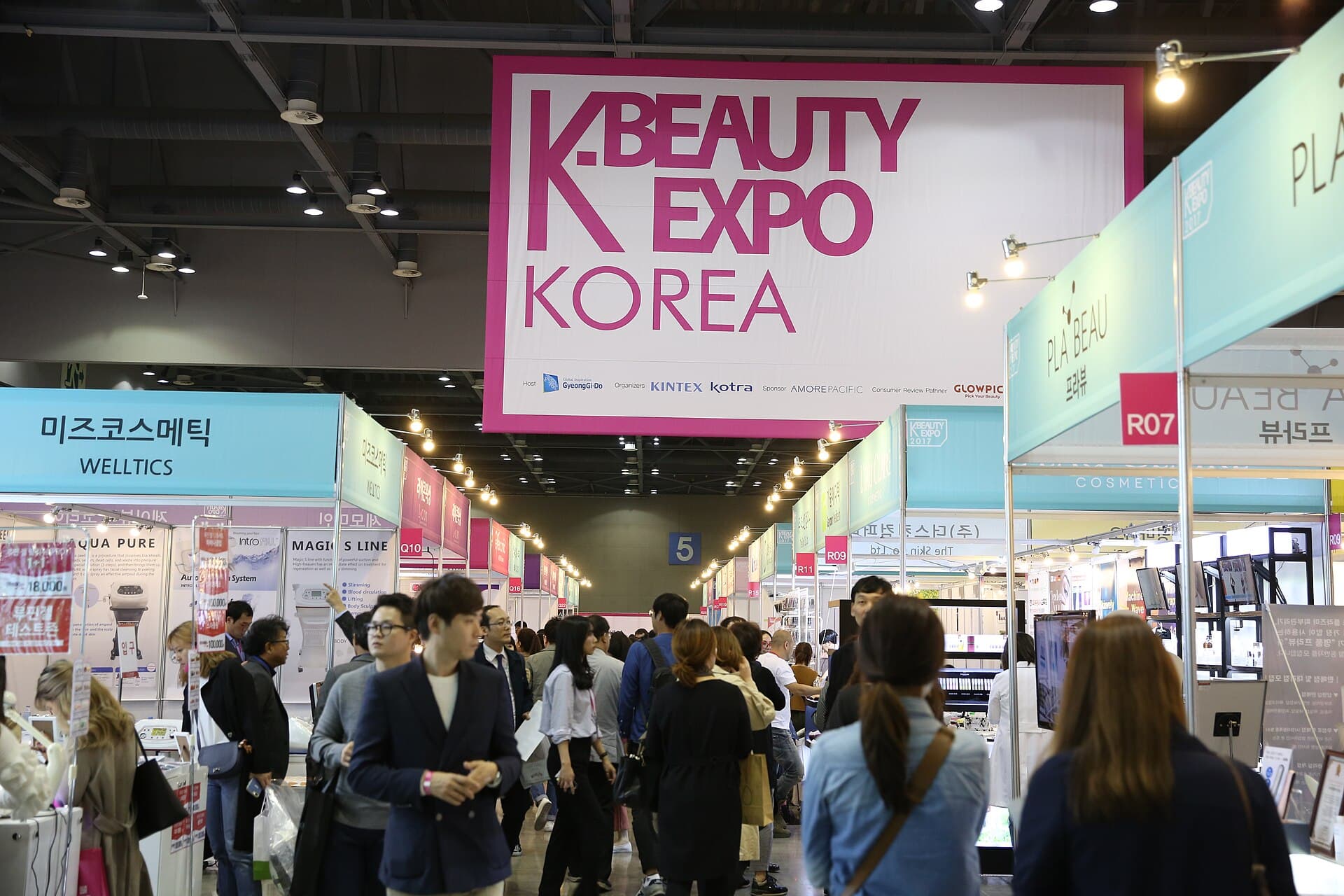
The long routine is not pure marketing invention: it describes a real habit. South Korea has ranked since the 2000s among the countries with the highest cosmetics spending per head in the world, and the 기초화장품 (gicho-hwajangpum, basic skincare) aisle occupies the space Europe reserves for make-up.
What is marketing is the counting. Slicing skincare into ten boxes sells ten references where three would do, and hands the foreign shopper an instant map of an aisle they cannot read. Export success followed: South Korean cosmetics exports reached 11.4 billion dollars in 2025 according to Korean customs data, up 12.3 percent year on year, putting the country second worldwide behind France. Basic skincare alone accounts for 8.54 billion of that total.
A routine is judged by what it leaves on the skin, not by how many bottles it empties.
Why Seoul invented skip-care#
The word surfaces around 2018 in Korean trade publications, at a point when the domestic market was saturating. Amorepacific, the country's largest manufacturer, supplies the reference definition: a method for identifying the ingredients your skin genuinely needs and dropping the products that add nothing, for a routine that is simpler without being less serious.
Three observations explain it. The first concerns the skin barrier, 피부 장벽 (pibu jangbyeok): stacking cleansers, exfoliants and acidic actives weakens the hydrolipidic film, and Seoul dermatologists spent the 2010s receiving a generation of patients whose skin had been damaged by excess care. The second is time: twenty minutes morning and evening does not fit a Korean office worker's day. The third is the layering of actives, whose interactions nobody measures once six of them are involved.
Skip-care therefore does not cut steps at random. It merges them: one product that hydrates and treats replaces essence, serum and cream. The corresponding formats followed, sold as skin serums or cream-essences.
Three words are enough to read a Korean label without a translator: 수분 (subun, hydration), 각질 (gakjil, dead skin cells) and 자외선 차단제 (jaoeseon chadanje, sunscreen). KoreanSRS, our spaced-repetition app, plants that vocabulary in your memory and opens up Seoul's shelves and Korean online stores alike.
The comparison, step by step#
| Step | Long routine | Skip-care | What dermatology says |
|---|---|---|---|
| Oil cleansing | Yes | Evenings only, if make-up or SPF | Useful, conditional |
| Water-based cleanser | Yes | Yes | Essential |
| Exfoliation | 2 to 3 times a week | Once a week or never | Optional, often overdone |
| Toner | Yes | Merged with the moisturiser | Comfort, not necessity |
| Essence | Yes | Merged | Comfort |
| Serum or ampoule | Yes, sometimes two | A single targeted active | The step that earns its place |
| Sheet mask | Daily to weekly | Occasional | Immediate effect, no duration |
| Eye cream | Yes | Face cream suffices | Low added value |
| Moisturiser | Yes | Yes | Essential |
| Sunscreen | Morning | Morning | The highest-return step of all |
Three lines in that table never move from one column to the other: cleanse, moisturise, protect from the sun. That is the shared foundation, and it is also what dermatologists repeat whenever they are asked about twenty-product routines.
Choose by your skin, not by the trend#
Oily or blemish-prone skin#
The long routine often makes things worse. Daily double cleansing and acid exfoliants trigger reactive sebum production, a phenomenon known as compensatory dehydration. A gentle cleanser, one active in serum form and a light non-comedogenic moisturiser keep skin steadier than a stack of ten products.
Dry or mature skin#
This is the one profile for which layering still makes sense. Successive layers of water then lipids limit transepidermal water loss, and a toner, essence and rich cream sequence delivers results a single product rarely matches. The pruning then targets irritating actives rather than the number of layers.
Sensitive or reactive skin#
Skip-care is indicated almost without debate. Fewer products means fewer preservatives, fewer fragrances, and above all the ability to identify the culprit when a reaction shows up. On a ten-product routine, tracing the cause of redness becomes detective work.
Normal skin#
Both work. The real tiebreaker is available time and pleasure: the long routine is a ritual, and a ritual you enjoy keeping beats an optimal protocol you abandon after three weeks.
The share of people actually following a long routine is smaller than the surrounding talk suggests. A YouGov survey conducted in the United Kingdom in 2025 put 39 percent of respondents on a one to three step routine, 11 percent between four and seven steps, and only 3 percent beyond that. The ten-step format remains largely a story people tell.
Cost, time, and the bottle too many#
A full routine built from mid-range Korean brands commonly runs between 120 and 200 euros for a two to three month cycle. Cut to four better products, the same period often costs half that, sunscreen included.
Time counts just as much. Ten products demand fifteen to twenty minutes a day once absorption pauses are included, roughly a hundred hours a year. The calculation is rarely framed that way, but it changes the decision.
Then there is packaging, which Korean brands have begun to address under pressure from their own market: refills, single-material bottles, the end of cardboard oversleeves. A short routine answers that concern mechanically better than a long one.
Read alsoK-beauty: the Korean skincare routine that conquered the worldThe Korean routine as a whole: the philosophy of care, sheet masks, signature ingredients and the economic weight of K-beauty.
What neither camp says out loud#
The long routine promises a transformation that layering alone does not produce. Ten hydrating products in sequence give comfortable, luminous skin the same day, which is not nothing, but the effect stops at the surface and vanishes when you stop.
Skip-care, for its part, promises a simplicity that conceals a shift in spending. A product replacing three steps costs what three steps cost, and the move to minimalism usually comes with a jump upmarket toward high-concentration formulas, PDRN and ferments foremost among them.
Underneath, the two approaches agree: cleanse without stripping, moisturise enough, never go out without sunscreen. Everything else, including what the Korean industry has exported most brilliantly, is comfort and pleasure, which remains a perfectly valid reason to buy it provided you know that is what you are buying.
Read alsoPDRN, exosomes and ferments: the actives of K-beauty in 2026The actives driving the new generation of Korean products, and what the scientific literature really says about them.
FAQ#
Does the ten-step routine really come from Korea? The products do. The number does not. The numbered sequence was formalised for the American market from 2015 onward, notably by Charlotte Cho and the retailer Soko Glam. In Korea people talk about basic skincare without ever fixing a step count.
What exactly is skip-care? A method built on identifying your skin's real needs and merging steps rather than stacking them. The term appears in Korea around 2018, and Amorepacific supplied its most widely quoted definition.
Which steps should you keep if you only keep three? A gentle cleanser at night, a moisturiser suited to your skin type, and a high-factor sunscreen in the morning. That is the shared foundation of both routines.
Is double cleansing compulsory? No. It becomes useful as soon as there is make-up or water-resistant sunscreen to remove. On bare skin a single gentle cleanse is enough and spares the skin barrier.
Can you switch from a long routine to a short one overnight? Better to remove one product at a time over two weeks, starting with exfoliants and essences. Skin takes about a month to show its real response to a change of protocol.
Photo credits: the images in this article come from Wikimedia Commons and are under free licences.
K-beauty: the Korean skincare routine that conquered the world
Understanding K-beauty: the ten-step routine, glass skin, sheet masks, signature ingredients and the philosophy of Korean skincare.
Cover image: Jmh65890 · Jmh65890, via Wikimedia Commons · CC0