Sumo: the rules, the rites and the banzuke hierarchy
Dohyo, banzuke, heya, kimarite: how to read a sumo tournament, understand the wrestlers' ranking and the rites that frame ten seconds of combat.
La rédaction Kotoba Interactive
Studio éditorial
A top-division sumo bout rarely lasts more than ten seconds. What precedes it lasts two hundred and forty: four regulation minutes during which the two wrestlers rise, throw salt, stamp the ground and return to their corner, up to four times. That ratio of one to twenty-four between preparation and action is the first thing to grasp. In sumo, the fight is not the show, it is the show's conclusion.
Those four minutes are not, incidentally, an ancient custom. Before 1928, wrestlers could size each other up for as long as they wanted. Radio broadcasting, and the need to keep to a schedule, imposed a limit: ten minutes at first, seven in 1941, then four minutes in the makuuchi division from 1950. Sumo's most photographed ritual is partly a product of the twentieth century and of programme grids.
The ring, the salt and what they mean#
The is a beaten clay platform 5.7 metres square, topped by a circle 4.55 metres in diameter marked out by half-buried bales of rice straw. It is rebuilt before every tournament, then destroyed afterwards.
Above it hangs a suspended roof, the tsuriyane, a copy of a Shinto shrine roof. This is no mere decoration: on the eve of each tournament, a ceremony called consecrates the fighting area, and offerings are buried at its centre, among them salt, dried rice, kombu and ginkgo nuts. The salt the wrestlers throw before each charge, tens of kilos over a tournament day, follows the same logic of purification.
Two other gestures recur in every bout. The , the raised leg followed by a stamp of the foot, is understood to drive evil spirits from the ground. The , hands opened then rubbed together, is a symbolic ablution: the wrestlers show they conceal no weapon.
The word is written with the characters for "facing each other" and "striking". The wrestlers themselves are not called sumos: the term is , literally "man of strength". A wrestler in the two salaried divisions carries an extra title, , which the others obtain only by climbing.
Banzuke: one sheet of paper that ranks everyone#
Sumo's ranking fits on a single poster, the , published thirteen days before each tournament. It lists every professional wrestler in the country, from the highest rank to the newest apprentice, along with the referees and the announcers.
It is brushed by hand by a referee in a style peculiar to the institution, , with thick, tightly packed strokes. The graphic rule is that the paper should leave almost no white space, which is read as a wish for full houses. Character size shrinks with rank, until it is barely legible for the lower divisions.
Six tournaments, the , pace the year: January, May and September in Tokyo, March in Osaka, July in Nagoya, November in Fukuoka. Each runs fifteen days, and every wrestler in the two top divisions fights fifteen bouts, one a day. The result mechanically determines the next banzuke: above eight wins, a sends you up; below it, a make-koshi sends you down.
Six divisions and the salary line#
The hardest line in sumo does not separate champions from the rest, it separates the paid from the unpaid. It runs between the third and second divisions.
| Division | Japanese name | Indicative size | Status |
|---|---|---|---|
| 1 | Makuuchi (幕内) | 42 | Salaried, silk belt in bouts |
| 2 | Jūryō (十両) | 28 | Salaried, sekitori status |
| 3 | Makushita (幕下) | 120 | Unsalaried, per-tournament allowance |
| 4 | Sandanme (三段目) | 180 | Unsalaried |
| 5 | Jonidan (序二段) | variable | Unsalaried |
| 6 | Jonokuchi (序ノ口) | variable | Unsalaried, beginners |
A makushita wrestler lives in the , the stable, serves his seniors, eats after them and receives a tournament allowance. The day he crosses into jūryō, everything changes: a monthly salary paid by the Japan Sumo Association, the right to wear silk and to tie his hair in the , the ginkgo-leaf topknot, and above all the right to have juniors of his own.
At the top of makuuchi, four ranks stand apart, known collectively as san'yaku: komusubi, sekiwake, ōzeki and yokozuna. Ōzeki is the only rank that can be lost in one go, and even then with a reprieve: an ōzeki who finishes a tournament with a make-koshi becomes kadoban and must win eight bouts at the next one or be demoted.
Yokozuna, the rank nobody can take away#
The is not a reigning champion, it is a rank for life. The Association never demotes a yokozuna: when he is no longer at the level, retirement is what remains, and the pressure of his own world sees to it.
Promotion rests on an opinion rather than a formula. An advisory council, the Yokozuna Shingiinkai, considers the case of an ōzeki who has won two consecutive tournaments, or produced a performance judged equivalent, then recommends the appointment or withholds it. The word "equivalent" does a great deal of work, and the council's debates are covered in the press like political deliberations.
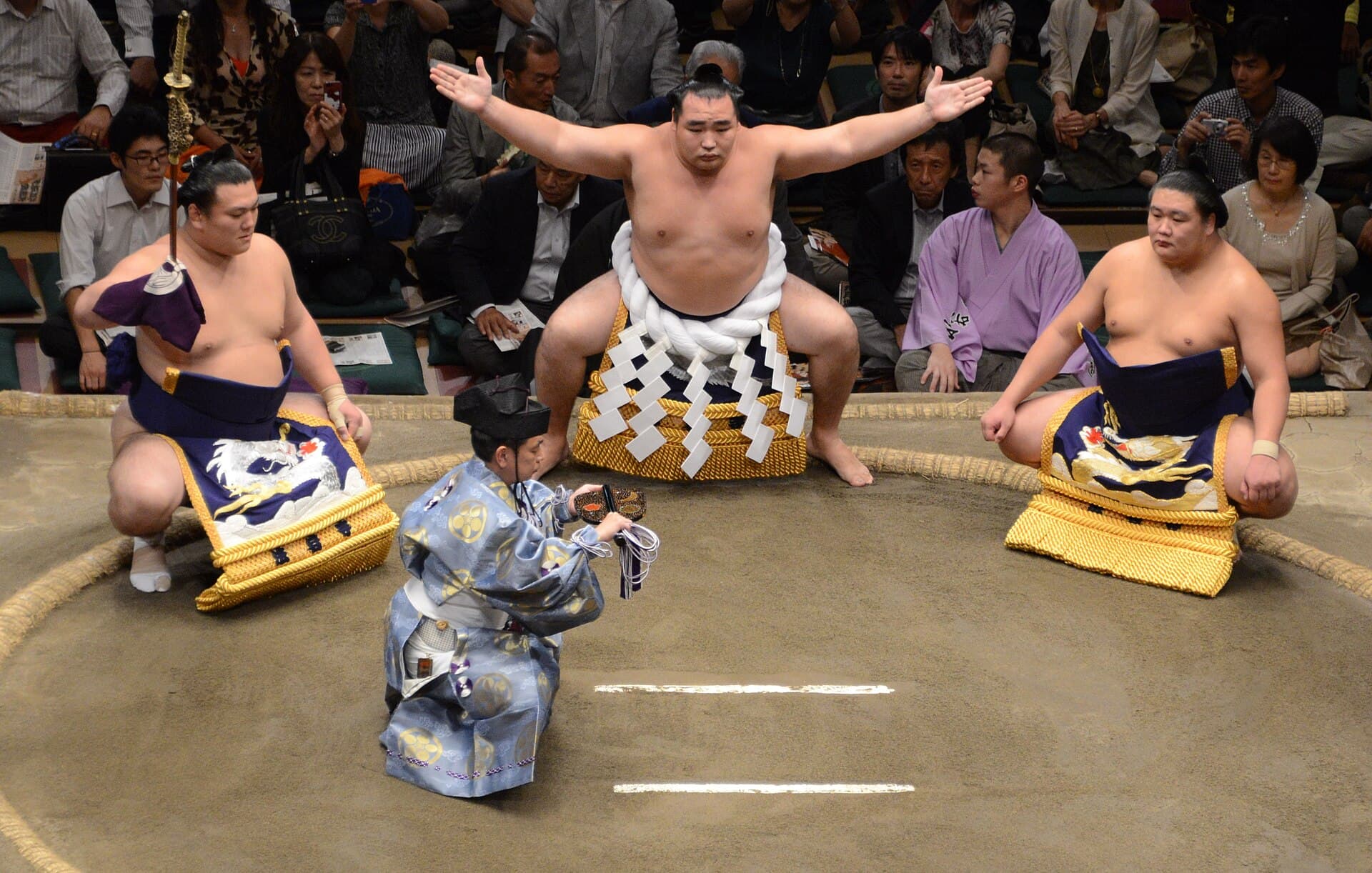
The rank takes its name from the rope. For his ring-entering ceremony the yokozuna wears a white hemp cord, the tsuna, weighing some fifteen kilos and echoing the shimenawa strung at shrine entrances. Two ceremonial styles coexist, unryū and shiranui, distinguished by the number of loops at the back of the rope and by the position of the arms.
A yokozuna does not lose his rank: he loses the right to keep wearing it, and he alone can draw the conclusion.
The heya: school, barracks and kitchen#
A professional wrestler belongs not to a club but to a heya, run by a former wrestler turned oyakata. He sleeps, trains and eats there, often for ten years. Around forty stables are active, grouped into five clusters called ichimon, which structure the alliances, the arbitrations and the marriages of the sumo world.
The day starts around five in the morning for the youngest, on an empty stomach. Higher ranks arrive later, train last, bathe first and eat first. This systematic inversion of the ordinary timetable is sumo's real teaching tool: hierarchy is not announced, it is built into the schedule.
The shared meal is , a pot of broth, vegetables, fish or chicken, served with large quantities of rice. The belief that it fattens wrestlers on its own is wrong: the physique comes from combining a very generous dish, a single massive meal after training and an immediate nap.
An NHK-broadcast tournament is never explained in English. Three words are enough to follow it: 番付 (banzuke, the ranking), 勝ち越し (kachi-koshi, the winning record) and 決まり手 (kimarite, the winning technique). JapaneseSRS, our spaced repetition app, installs that vocabulary along with the everyday Japanese that goes with it.
Winning: 82 techniques and five ways to lose untouched#
The rule fits in one sentence: you lose if you step out of the circle or touch the ground with anything other than the soles of your feet. Everything else is technique.
The Association officially recognises since the 2001 revision, which took the list from 70 to 82. A handful covers most bouts: , the frontal drive with a belt grip until the opponent is out, , the push without a grip, , the slap-down that sends the opponent forward.
Five outcomes that are not techniques complete the list: accidental step-out, accidental fall, forfeit, withdrawal, disqualification. There is also a rare and dreaded category, , the forbidden moves: closed-fist punching, hair pulling, grabbing the part of the belt covering the groin, targeting the eyes or the throat. Open-palm strikes to the face, by contrast, are legal and frequent.
The bout is judged on the dohyō by a in court costume, fan in hand, but his decision is not sovereign: five judges seated around the ring, the shimpan, can challenge it and order a rematch or a reversal.
The long banners paraded around the ring before certain bouts are kenshō, prizes offered by companies. Each banner corresponds to an envelope handed to the winner, part of which goes straight into a locked account held by the Association until his retirement. A much-awaited bout can pile up several dozen of them.
What the institution still refuses to change#
Professional sumo is administered by the Nihon Sumō Kyōkai, a public interest foundation. Its conservatism regularly makes the news.
Women may not step onto the dohyō, which is treated as ritually pure ground. In April 2018 the rule produced a scene reported around the world: in Maizuru, Kyoto prefecture, the city's mayor collapsed while speaking in the ring; women climbed up to help him and the announcer asked them over the loudspeaker to get down. The Association apologised the next day without changing the rule.
Foreign recruitment is capped at one wrestler of foreign origin per stable, a limit brought in at the start of the 2000s and later tightened to stop it being circumvented through naturalisation. Mongolians nonetheless dominated the top of the ranking for close to twenty years, Hakuhō ending his career in 2021 with 45 tournament victories, a record nothing had foreshadowed.
Internal crises have punctuated the last two decades: the death of an apprentice after stable violence in 2007, the match-fixing scandal of 2011 which led to the outright cancellation of the spring tournament, repeated assaults between wrestlers. Each time, the institution punished individuals and preserved the structure.
Read alsoSsireum: the traditional wrestling of KoreaKorean traditional wrestling rests on a belt and a sand circle, with comparable rules and an entirely different history.
Sumo stands on this paradox: a combat sport decided in seconds, framed by a liturgy that takes up most of the time, and administered like a religious order in a largely secular country. That deliberate imbalance, more than the wrestlers' bulk, is what makes it singular.
Read alsoThe 47 Rōnin: history and legend of a revengeProfessional sumo and the popular theatre of Edo were born in the same century and from the same urban public.
FAQ#
How much does a sumo wrestler weigh? There are no weight categories, which makes the gaps spectacular. The makuuchi average is around 160 kilos, but far lighter wrestlers regularly face opponents twice their weight.
How long is a tournament? Fifteen consecutive days, with one bout a day per wrestler in the two top divisions. Lower divisions fight only seven times across the fifteen days.
Is sumo a religion? No, but it borrows the form of one. The dohyō roof, the consecration of the ring, the salt and the yokozuna's rope come from Shinto, while sumo's organisation and economics are those of a professional sporting federation.
Can you watch a training session? Some stables accept morning visitors, usually through a hotel or an agency, under strict rules: total silence, no photographs without permission, seated on the floor. It is not a show staged for an audience.
What does a salaried wrestler earn? The Association pays a monthly salary from the jūryō division upwards, topped up by tournament bonuses, sponsor envelopes and rank-linked allowances. Below jūryō, a wrestler receives only a per-tournament allowance, with board and lodging provided by his stable.
Photo credits: the images in this article come from Wikimedia Commons and are under free licences.
Hanami: The Japanese Art of Cherry Blossom Viewing
A complete guide to hanami in Japan: its thousand-year history, the cultural meaning of sakura, the best viewing spots, picnic etiquette, and blossom forecasts.
Cover image: Jeffrey Pauletto · Jeffrey Pauletto, via Wikimedia Commons · CC BY-SA 2.0