Korean military service: length, exemptions, realities
18 to 21 months depending on the branch, a seven-grade fitness exam, vanishingly rare exemptions: how South Korean conscription works and what it costs.
La rédaction Kotoba Interactive
Studio éditorial
A Korean man's CV carries one line recruiters read first: the dates he entered and left the army. Its absence calls for an explanation, and the explanation is rarely a good one. Eighteen to twenty-one months of almost every man's life in the country are written out in full, between his studies and his first job.
South Korea has technically been at war since 1950: the agreement signed at Panmunjom on 27 July 1953 is an armistice, not a peace treaty. Universal male conscription follows directly from that unfinished legal situation, and the whole society organises itself around it, including an entertainment industry that has turned it into a scheduling problem.
Who is called up, and at what age#
The Military Service Act (병역법) requires every male South Korean citizen to complete his service between the ages of 18 and 28. Women are not conscripted but may serve as career soldiers, and they are present in every branch, combat units included.
The age limit of 28 explains a good deal about Korean life paths. Since deferral is granted for studies, many men break off their degree after a year or two, serve, then resume: a Korean university cohort therefore mixes 19-year-old students with 23-year-old men back from the army, with all the age hierarchy that implies.
An adjustment passed by the National Assembly in December 2020 allows deferral to the age of 30 for popular culture artists decorated by the government for their contribution to the country's international standing. This is the measure the press nicknamed the "BTS law", and it exempts nobody: it postpones.
The fitness exam and its seven grades#
At 19, every man sits the 병역판정검사 (byeongyeok panjeong geomsa), a day-long physical and psychological examination that ends in a seven-grade classification. That grade decides everything.
| Grade | Decision | What it means |
|---|---|---|
| 1 to 3 | Active service (현역) | Barracks, branch by assignment |
| 4 | Supplementary service (보충역) | Social service agent, 21 months |
| 5 | Wartime labour reserve | No peacetime obligation |
| 6 | Exemption (면제) | Established medical unfitness |
| 7 | Re-examination | Deferred for treatment or recovery |
Grade 4 covers men who are fit but with a restriction: severe myopia, a body mass index far from the norm, a medical history. They become 사회복무요원 (sahoe bongmu yowon), social service agents posted to town halls, public hospitals, libraries or centres for disabled people, in civilian clothes, sleeping at home, for longer than those in the army.
Eighteen months, twenty, twenty-one#
Length depends on the branch and has fallen a great deal. It reached three years in the 1950s and was still two years in the early 2010s. A reform launched in 2018 brought it down to today's figures, reached at the end of 2021.
| Assignment | Length | Note |
|---|---|---|
| Army, Marines | 18 months | The most common case |
| Navy | 20 months | |
| Air Force | 21 months | |
| Social service agent | 21 months | Civilian, no barracks |
| KATUSA | 18 months | Attached to US forces |
| Alternative service (objectors) | 36 months | Correctional facilities |
deserves a special mention. The programme attaches Korean conscripts to the US Eighth Army, with a daily routine reputed to be more comfortable and English maintained on the job. Selection is by lottery among candidates with a sufficient English test score, which makes it the most coveted assignment in the country.
Three words structure every conversation on the subject. 군대 (gundae) is the army in general, but in a young man's mouth, "going to the gundae" means leaving for national service. 입대 (ipdae) is enlistment, 전역 (jeonyeok) discharge. The transfer date to the reserve, the 전역일, is counted down on dedicated apps, sometimes for more than five hundred days.
Five weeks, then the barracks#
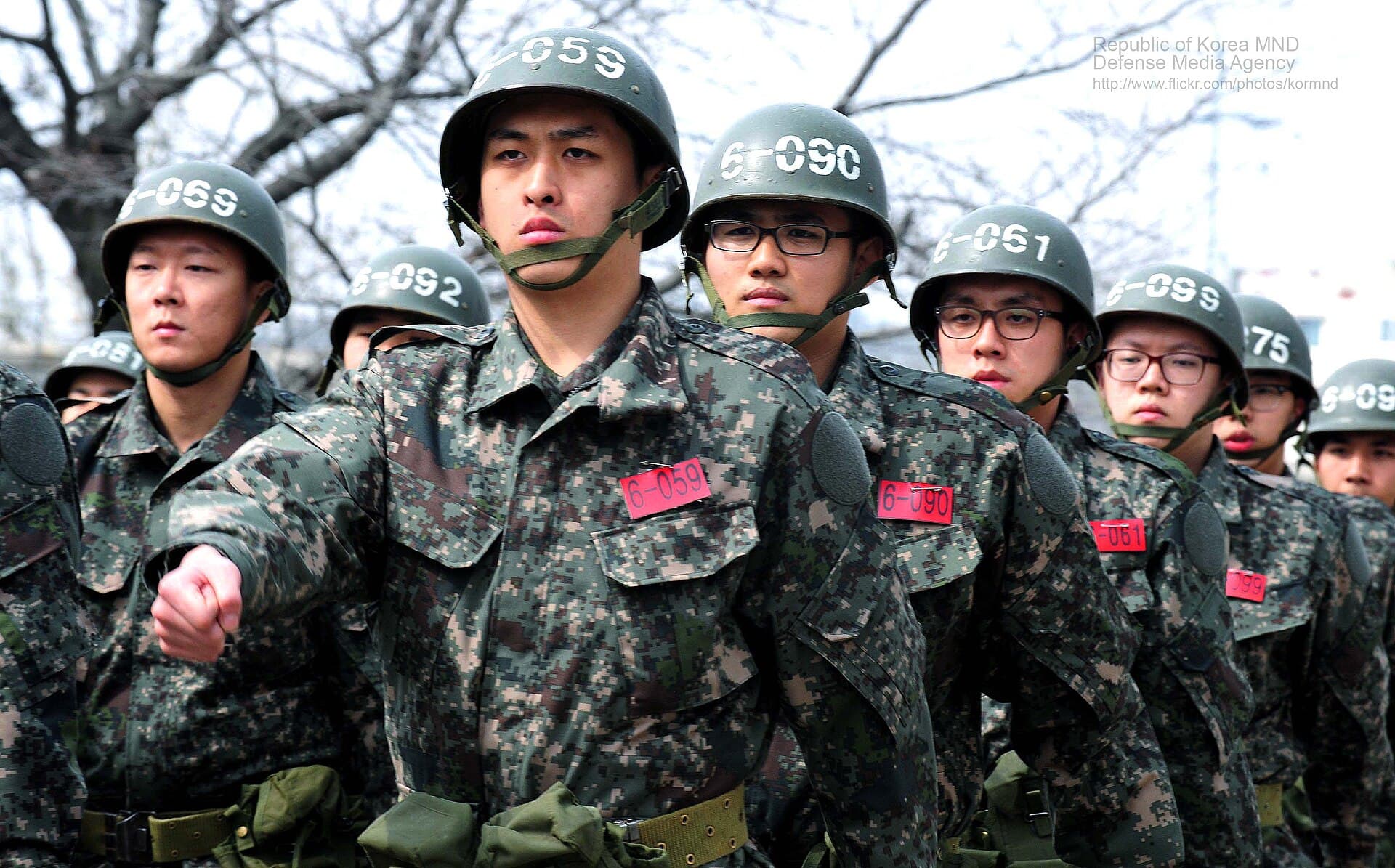
Service opens with about five weeks of basic training at a recruit centre, the largest of which is at Nonsan, in South Chungcheong. Shooting, marches, close combat, formal discipline, shaved heads: this is the sequence Korean television documentaries have made familiar to the general public.
Then comes assignment, where internal hierarchy weighs more than official rank. A conscript rises mechanically from 이등병 (private second class) to 일병, 상병 and then 병장, sergeant, on the basis of time served rather than merit. The consequence is well known: a man's standing in his barrack room depends first of all on his enlistment date, and the violence tied to that seniority hierarchy has produced several national scandals, followed by prevention campaigns and the creation of a military ombudsman.
Pay was symbolic for a long time. It underwent a spectacular catch-up in the 2020s: the government raised a sergeant's monthly pay to around 1.5 million won in 2025, topped up by a state-matched savings scheme designed to bring the total above two million won a month. It is still far from a salary, but the gap with the 100,000 won a month of the early 2010s is considerable.
The vocabulary of service turns up everywhere, in dramas, variety shows and office conversations: 군대 (gundae, the army), 전역 (jeonyeok, discharge) and 예비군 (yebigun, the reserve). KoreanSRS, our spaced repetition app, installs that vocabulary and the everyday Korean around it, with hangul from the very first session.
The ways out are narrow#
Genuine exemptions, medical unfitness aside, fit into a very short list. An athlete is excused active service if he wins an Olympic medal of any colour, or gold at the Asian Games. An artist qualifies by placing first in certain international classical music or dance competitions, or in the national traditional arts competitions.
Beneficiaries are not excused everything: they complete the initial military training, then serve as 예술체육요원, arts and sports personnel, continuing their careers while completing a set volume of community service hours.
That list has a hole which has become political: popular music is not on it. A violinist who wins in Geneva is exempt, a singer who sells tens of millions of albums is not. The public debate ran for years, until the 2020 compromise, deferral to 30 rather than exemption. The seven members of BTS served between December 2022 and June 2025, Jin leading the way and the last of them discharged in June 2025, which ended the controversy by demonstrating that the rule applied.
Korean has invented a whole vocabulary of waiting. A girlfriend waiting for her partner is a 곰신 (gomsin), short for 고무신, "rubber shoe". Breaking up during his service is 고무신 거꾸로 신다, "putting your rubber shoes on backwards". The phrase is old enough that new recruits get it as a ritual joke on the day they leave.
Conscientious objection: the 2018 reversal#
For six decades, refusing to bear arms meant a year and a half in prison. Jehovah's Witnesses accounted for almost all those convicted, with several thousand men serving that sentence since the 1950s, and a criminal record that then shut them out of the civil service and many jobs.
Two decisions changed that in 2018. In June, the Constitutional Court held that the absence of alternative service made the system unconstitutional and ordered lawmakers to create a solution. In November, the Supreme Court acquitted an objector, reversing its own case law.
Alternative service came into force in 2020: thirty-six months, twice the length of armed service, performed in correctional facilities, living on site. Human rights organisations consider that length punitive; the Defence Ministry justifies it as a way of deterring applications made for comfort. The scheme exists, and that alone is a historic break.
The eighteen-month gap in a career#
Korean has a word for it: 군백기 (gunbaekgi), the "military blank", that parenthesis in a professional trajectory. For an actor or a singer it means vanishing at the exact moment fame peaks, then returning to a renewed audience.
The industry has adapted methodically. Agencies record albums in advance, stagger enlistments so a group never disappears entirely, and turn the return into a media event. For an engineer or an office worker the adjustment is more mundane and no less real: two promotions of distance from the women of the same generation, who entered the labour market two years earlier.
Leaving the barracks is not the end either. A discharged man stays enrolled in the reserve, the 예비군 (yebigun), for several years, with compulsory annual exercise periods employers must allow, then moves into civil defence until the age of 40.
Read alsoThe Korean Idol System: Trainees, Agencies, and the Star FactoryThe agency system, from trainee contract to comeback calendars, absorbs conscription as one production constraint among others.
Demography against conscription#
The real challenge comes not from the fairness debate but from births. With a fertility rate that fell below 0.8 children per woman in the mid-2020s, the lowest in the world, the number of men reaching service age drops every year.
Armed forces numbers have already been cut from around 690,000 active personnel in the mid-2000s to a level close to 500,000, with compensation sought through drones, surveillance and professionalisation. Several proposals circulate, from broader voluntary recruitment to opening some form of service to women, the latter idea returning regularly in election debates without ever passing.
Read alsoSuneung: The Day When Korea Holds Its BreathA country short of children ends up short of soldiers, and no reform of service can offset an age pyramid.
The other great ordeal that structures a Korean youth, with its deferrals, its second chances and its social pressure.
Military service thus remains one of the few experiences genuinely shared by Korean men across every social background, which is what makes any hint of special treatment explosive. Until the 1953 armistice becomes a treaty, that eighteen-month parenthesis will keep appearing on CVs, between the degree and the first post.
FAQ#
Do Korean women do military service? No, conscription applies to men only. Women can enlist as career officers or non-commissioned officers, and their share of the forces is growing, but no obligation applies to them. Opening service to women returns regularly in public debate without having been adopted.
Does a Korean living abroad have to come home to serve? A South Korean citizen remains subject to the obligation even while resident abroad, with deferrals available on residence or study grounds. Renouncing Korean nationality to escape it carries lasting consequences, notably on the right to enter the country.
What happens if someone refuses to serve? Outside the alternative service recognised since 2020 for conscientious objectors, refusal remains a criminal offence punishable by imprisonment, with professional restrictions afterwards.
Can you choose your branch or assignment? Partly. Conscripts can apply to certain programmes, including KATUSA or specialised units, subject to criteria and often a lottery. Failing a successful application, the assignment is decided by the military manpower administration.
How long does the obligation last after discharge? Reserve status lasts several years after transfer, with annual exercise periods, after which civil defence enrolment continues until the age of 40.
Photo credits: the images in this article come from Wikimedia Commons and are under free licences.
Palli-palli: The Culture of "Hurry, Hurry" That Keeps Korea Running
Bullet delivery, the world's fastest internet, the Miracle on the Han River: inside palli-palli, the national reflex that built Korea and sometimes broke it.
Cover image: Republic of Korea Armed Forces · Republic of Korea Armed Forces, via Wikimedia Commons · CC BY-SA 2.0