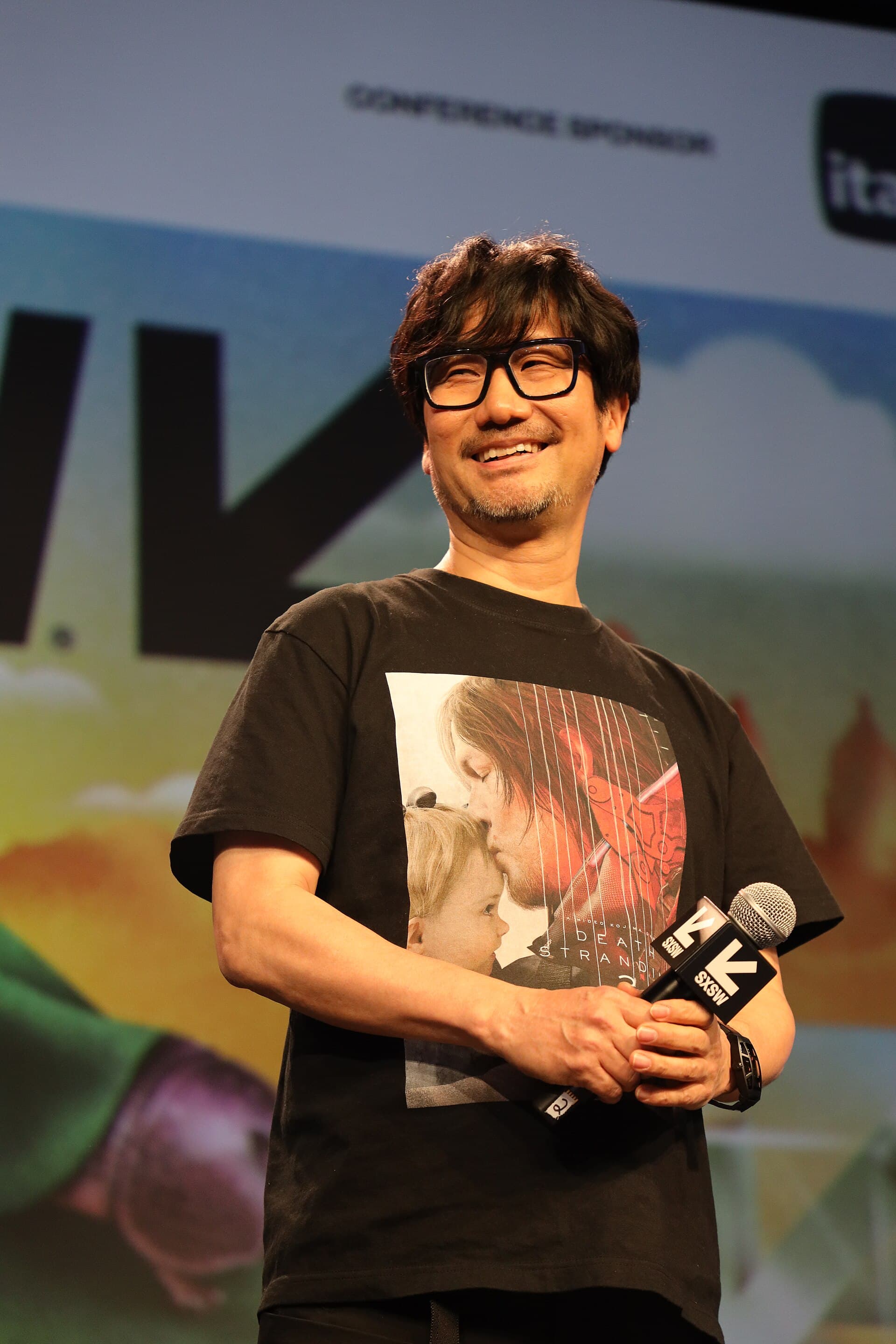
Walking sims and auteur games: what Kojima made of them
From the mocking nickname given to Dear Esther to the strand game of Death Stranding: the history of the walking simulator, the auteur game and walking as a mechanic.
La rédaction Kotoba Interactive
Studio éditorial
"Walking simulator" started life as an insult. The phrase circulated on forums in 2012, when Dear Esther got its commercial release, to describe what looked like a con: a game where you cannot jump, shoot or die, and whose only available action is to walk across a Scottish island while a voice reads out letters. The nickname was meant to disqualify. The developers adopted it.
Seven years later, a Japanese studio released a blockbuster-budget game whose central mechanic was walking while carrying parcels, with Norman Reedus, Mads Mikkelsen and Léa Seydoux in the cast. The connection between the two is neither coincidence nor direct descent, but it says something precise about how video games eventually accepted the idea of the auteur.
A joke that turned into a genre#
Dear Esther began in 2008 as a Source engine mod, developed by Dan Pinchbeck within an academic research project at Portsmouth. The 2012 commercial version, visually rebuilt by Robert Briscoe under the name The Chinese Room, sold more than fifty thousand copies in a few hours and set off the controversy: is this still a game?
The question looks dated now, but it structured a decade. Gone Home, released in 2013 by Fullbright, reintroduced object handling and set its entire story inside an empty house. Firewatch, released in 2016 by Campo Santo, added a voice at the other end of a walkie-talkie. What Remains of Edith Finch, signed by Giant Sparrow in 2017, stacked playable vignettes and won the BAFTA for best narrative.
The genre therefore built itself by successive additions to an initial stripping-back. What it keeps throughout: no possible failure, no combat, slow movement, and a story deposited in the scenery rather than told through cutscenes.
What the genre removes, and what that frees#
Removing failure changes the nature of attention. In a game where you can die, the player reads space as a tactical map: cover, angles, resources. In a walking sim, that same space becomes scenery to interpret, what English-language criticism calls environmental storytelling.
That economy has an accepted cost: without mechanical tension, pacing rests entirely on writing, sound and light. The genre's failures are always the same, a stakeless stroll through scenery that is too clean. Its successes share a point rarely made: they all have an identifiable author.
Japanese has a word for that quality: 作家性 (sakkasei), literally "author-ness". The term is standard in criticism of manga, cinema and video games, describing what in a work comes from a personal signature rather than a commission. A game is said to have sakkasei the way a film is said to bear its director's mark.
The word "auteur" and its transfer from cinema to games#
The notion comes from Cahiers du cinéma and François Truffaut's 1954 article, arguing that a film carries a director's vision rather than a screenplay's or a studio's. The transfer to video games is later and more contested, for an obvious reason: a big-budget game mobilises several hundred people, and attributing Metal Gear Solid V to one man erases an entire team.
Criticism has nonetheless settled on three working criteria: a recognisable style, themes that recur from one work to the next, and real control over production. A handful of Japanese creators meet them, each with a distinct signature. Fumito Ueda has been working with emptiness and scale since Ico in 2001. Suda51 cultivates a pop, self-aware violence at Grasshopper Manufacture. Yoko Taro blows up his own structures across the NieR series. Hidetaka Miyazaki has imposed at FromSoftware a relationship to difficulty that founded a school.
And then there is the case that made the phrase common currency.
Kojima, the auteur before the divorce#
Hideo Kojima joined Konami in 1986 and by 1987 had signed Metal Gear on MSX2, an action game built on avoiding combat. The series went global with Metal Gear Solid in 1998 on PlayStation, which imposed an unprecedented cinematic grammar: framing, long dialogue sequences, characters addressing the player through the screen.
The themes never moved afterwards. The transmission of information, manipulation by media, genetic inheritance and the soldier's solitude run through Metal Gear Solid 2 in 2001 as much as The Phantom Pain in 2015. The signature became so legible that in 2012, a trailer published under the name of an unknown Swedish studio was attributed to Kojima by players within hours. That studio did not exist.
The break with Konami was confirmed in October 2015, after twenty-nine years at the company. Kojima re-established Kojima Productions as an independent studio that December, with the Ludens, an astronaut in white armour, as its emblem.
The most revealing episode of that divorce played out in public. In December 2015, The Phantom Pain won several prizes at the Game Awards, but Kojima could not walk on stage: Konami's lawyers prevented him. Host Geoff Keighley announced it at the microphone in front of the room, and the moment did more for Kojima's reputation as an auteur than any communications campaign could have.
Death Stranding: walking as a mechanic, at blockbuster scale#
Death Stranding released on 8 November 2019 on PlayStation 4. The player is a courier crossing a devastated America to reconnect isolated cities, with a stack of parcels on their back whose weight and distribution alter the character's balance.
The game's first act is therefore managing the walk itself: slope, river crossings, load, centre of gravity. Where the independent walking sim removed all resistance from movement, Kojima turned it into the principal system, with real failure states and a mastery curve.
The second act is social. Structures placed by one player, ladders, ropes, bridges, appear in other players' games, who can use them and leave a token of approval. Nobody ever meets. Kojima named this the social strand system and claimed a new genre, the strand game, from the English word for a thread, a fibre, something that links.
| Independent walking sim | Strand game | |
|---|---|---|
| Landmark work | Dear Esther (2012) | Death Stranding (2019) |
| Budget | A handful of people | Several hundred |
| Walking | A way of reaching the story | A full game system |
| Failure | Impossible | Falls, damaged cargo, death |
| Other players | Absent | Present asynchronously |
| Length | 2 to 6 hours | 40 hours and up |
Critical reception was frankly divided, which may be the best evidence the gamble worked: a game that divides that sharply is a game that holds a position. The casting added to the project's strangeness, with Norman Reedus, Mads Mikkelsen, Léa Seydoux and, in supporting roles, filmmakers Guillermo del Toro and Nicolas Winding Refn.
Three words open up the Japanese games world in its own language: 繋がり (tsunagari, the link, the connection), 配達 (haitatsu, delivery) and 作家 (sakka, author). JapaneseSRS, our spaced-repetition app, installs that vocabulary for good and makes readable the interviews, credits and Japanese forums that machine translation mangles.
What 2025 and 2026 changed#
Death Stranding 2: On the Beach released on 26 June 2025 on PlayStation 5. Analyst firm Ampere Analysis estimated sales at 1.4 million copies over June alone, even though the game was only available for five days in that period, placing the sequel in a commercial bracket the first instalment took months to reach.
Kojima Productions marked its tenth anniversary in December 2025 and has since been communicating about a second phase built on two projects. OD, a horror game developed with filmmaker Jordan Peele and published by Xbox Game Studios, explores captured acting performance. Physint, announced at the State of Play of 31 January 2024 with Sony, returns to action espionage, the ground Kojima left at the same time as Konami.
Both titles say the same thing: the auteur has not mellowed, he has simply obtained what he had been after for thirty years, the freedom to treat a game like a film without having to ask permission.
Read alsoSega: the rise and fall of a video game giantThe other Japanese history of video games, that of a hardware maker who bet everything on machines before becoming a publisher.
What the genre left to mainstream games#
The walking sim was never a mass market, and its output thinned out after 2018. Its influence is everywhere: the combat-free contemplative passages of The Last of Us, the slow walking sequences that pace most current narrative games, the idea that scenery can carry a story without dialogue.
Kojima pushed that lesson to its logical conclusion. He did not make a walking sim, he built a game of dozens of hours around the single verb the genre had isolated, then added back what the genre refused, difficulty and other players. That is the most useful definition of the auteur game: taking seriously an idea everyone else treated as a limitation.
Read alsoNintendo: from hanafuda cards to global video gamesHow a Kyoto playing-card maker became the company that sets the rules of video games.
FAQ#
Where does the term walking simulator come from? From player forums around 2012, at the commercial release of Dear Esther. The term was mocking and targeted the absence of classic mechanics. Developers in the genre later reclaimed it as a neutral description.
Is Death Stranding a walking simulator? Not strictly. It shares the centrality of movement but reintroduces failure, resource management and a length of dozens of hours. Kojima claims a distinct genre, the strand game, founded on asynchronous mutual aid between players.
What is an auteur game? A game whose design carries the recognisable signature of one creator, with recurring themes and real control over production. The notion is borrowed from 1950s French film criticism and remains debated in an industry where teams number in the hundreds.
Why did Kojima leave Konami? The disagreement concerned costs and the publisher's strategic direction as it refocused on mobile. Konami confirmed the departure in October 2015 after twenty-nine years of collaboration, and Kojima re-established his studio independently in December 2015.
Which games should you start with to discover the genre? Gone Home for domestic narrative, Firewatch for its dialogue writing, What Remains of Edith Finch for formal invention. Dear Esther remains the point of origin, but it is the most austere of the four.
Photo credits: the images in this article come from Wikimedia Commons and are under free licences.
Japanese figures explained: Nendoroid, scale and prize
Three families, three industries: how to tell a scale figure from a Nendoroid and a prize, at what price, and why Japanese law caps crane-game prizes at 1,000 yen.
Cover image: Kolby Ari · Kolby Ari, via Wikimedia Commons · CC BY-SA 4.0