Japanese figures explained: Nendoroid, scale and prize
Three families, three industries: how to tell a scale figure from a Nendoroid and a prize, at what price, and why Japanese law caps crane-game prizes at 1,000 yen.
La rédaction Kotoba Interactive
Studio éditorial
The same character, in the same pose, often exists as three objects with almost nothing in common. The first stands twenty-three centimetres tall, costs 27,000 yen and is ordered nine months in advance. The second fits in one hand, costs a quarter of that and arrives with three spare faces in a square box. The third is won from a crane game, and Japanese law forbids it from being worth more than a thousand yen.
All three go by the same English word, figure, which explains most of the misunderstandings Western buyers run into. In Japan they are three distinct markets, each with its own manufacturers, sales channels and quality conventions. Telling them apart saves you from paying scale money for a prize, and above all from hunting in shops for an object that will never be sold there.
Three families, three industrial logics#
The is a fixed piece, sold at retail, whose price covers original sculpting work. The Nendoroid and its deformed cousins follow a product-line logic: a standard format, partly reused moulds, interchangeable accessories. The is not sold at all: it is made to be won.
That last distinction is the most poorly understood outside Japan, because it rests on a regulatory constraint rather than an aesthetic choice.
ねんどろいど (nendoroido) is a portmanteau of 粘土 (nendo, modelling clay) and android. The name says exactly what the object is: a silhouette reduced to a mouldable paste, oversized head on a tiny body, whose parts swap out like pieces of clay being reworked.
Scale figures: when the scale is a fraction#
A scale figure reproduces a character at a fraction of their supposed height in the fiction. At 1/7, a heroine meant to stand 1.60 m yields an object 23 centimetres tall; at 1/8, a little under 20. Common scales run from 1/8 to 1/4, the latter producing pieces over 40 centimetres that cost as much as furniture.
The cost comes from the human work upstream. A 原型師 (genkeishi), the prototype sculptor, builds the original, today often through digital modelling and printing, before the licence holder signs it off. Production in PVC and ABS then moves to China or Vietnam, with hand-applied paint on the areas machines cannot handle. That last point explains the quality gap between two copies of the same reference.
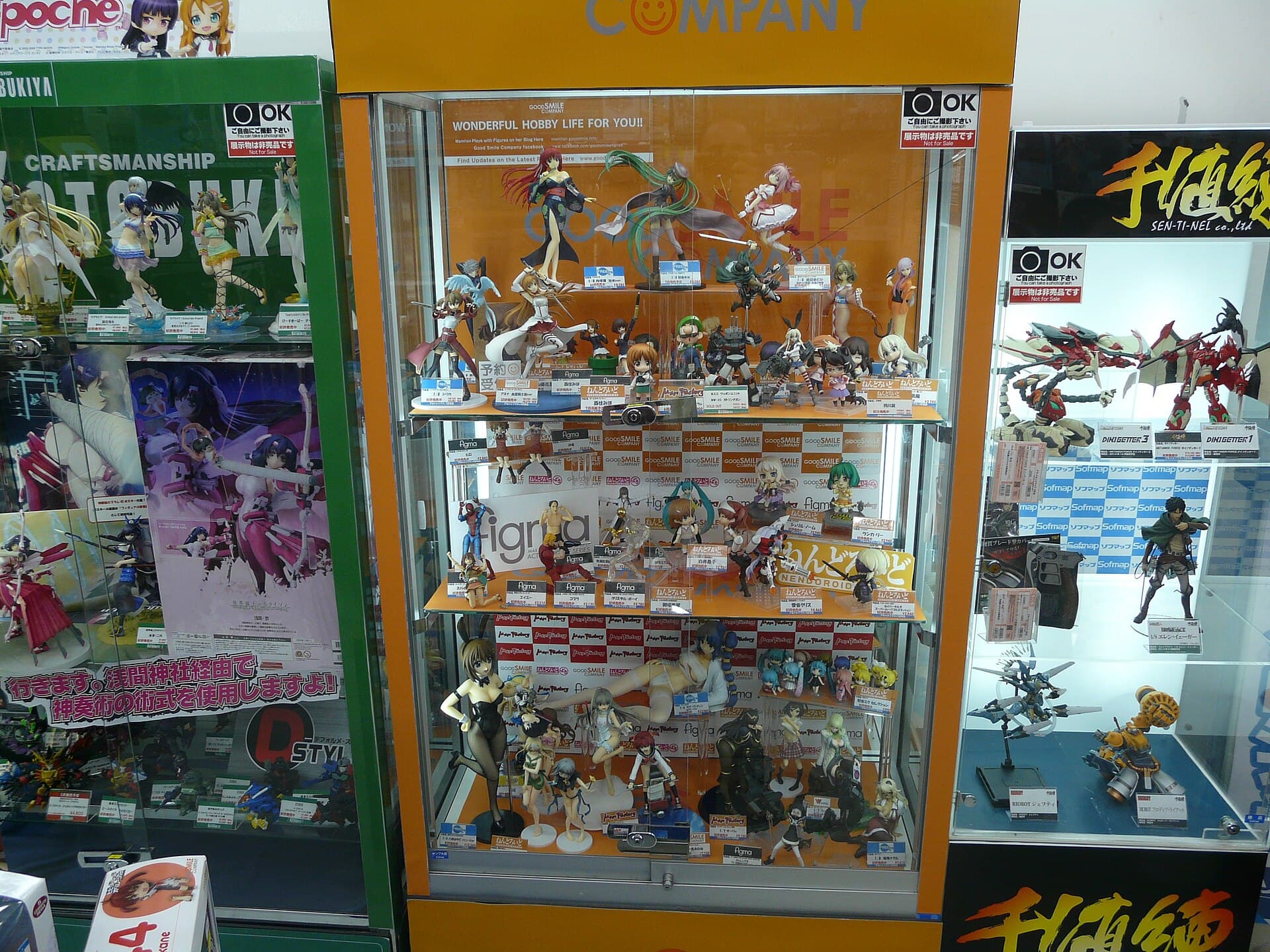
The houses that matter in this segment are Good Smile Company, founded in 2001, along with Alter, Kotobukiya, Max Factory and Aniplex. The channel is pre-order: announcement at Wonder Festival, a few weeks of 予約 (yoyaku, reservations), delivery six to twelve months later. Once the window closes, the object exists only on the second-hand market, at whatever price that market decides.
The Nendoroid: the format that built an industry#
Good Smile Company launched the Nendoroid line in 2006 under Tsuyoshi Oda, known in the trade as Oda-P. The first piece, shown at that year's Wonder Festival, was a Neko-Arc from the Tsukihime universe. The principle rests on three decisions: a fixed height of roughly 100 millimetres, an oversized head, and detachable faces, hands and accessories.
The standard format changes everything industrially. Bodies are reused from one reference to the next, which divides development cost and makes it viable to release secondary characters no scale figure could ever pay for. The line has passed two thousand numbered references and now covers anime, video games, Western cinema and even corporate mascots.
Max Factory opened the complementary path in 2008 with figma, articulated figures around a dozen centimetres tall with realistic proportions, built for posing rather than for the display cabinet. Between those two formats sits the whole market of so-called chibi figures, deformed and affordable.
A handful of words is all it takes to read the figure aisle: 予約 (yoyaku, pre-order), 中古 (chūko, second-hand), 景品 (keihin, crane-game prize) and 原型師 (genkeishi, prototype sculptor). JapaneseSRS, our spaced-repetition app, fixes that vocabulary in memory and makes Akihabara shops and Japanese auction sites readable.
The prize: an object the law prevents from being sold#
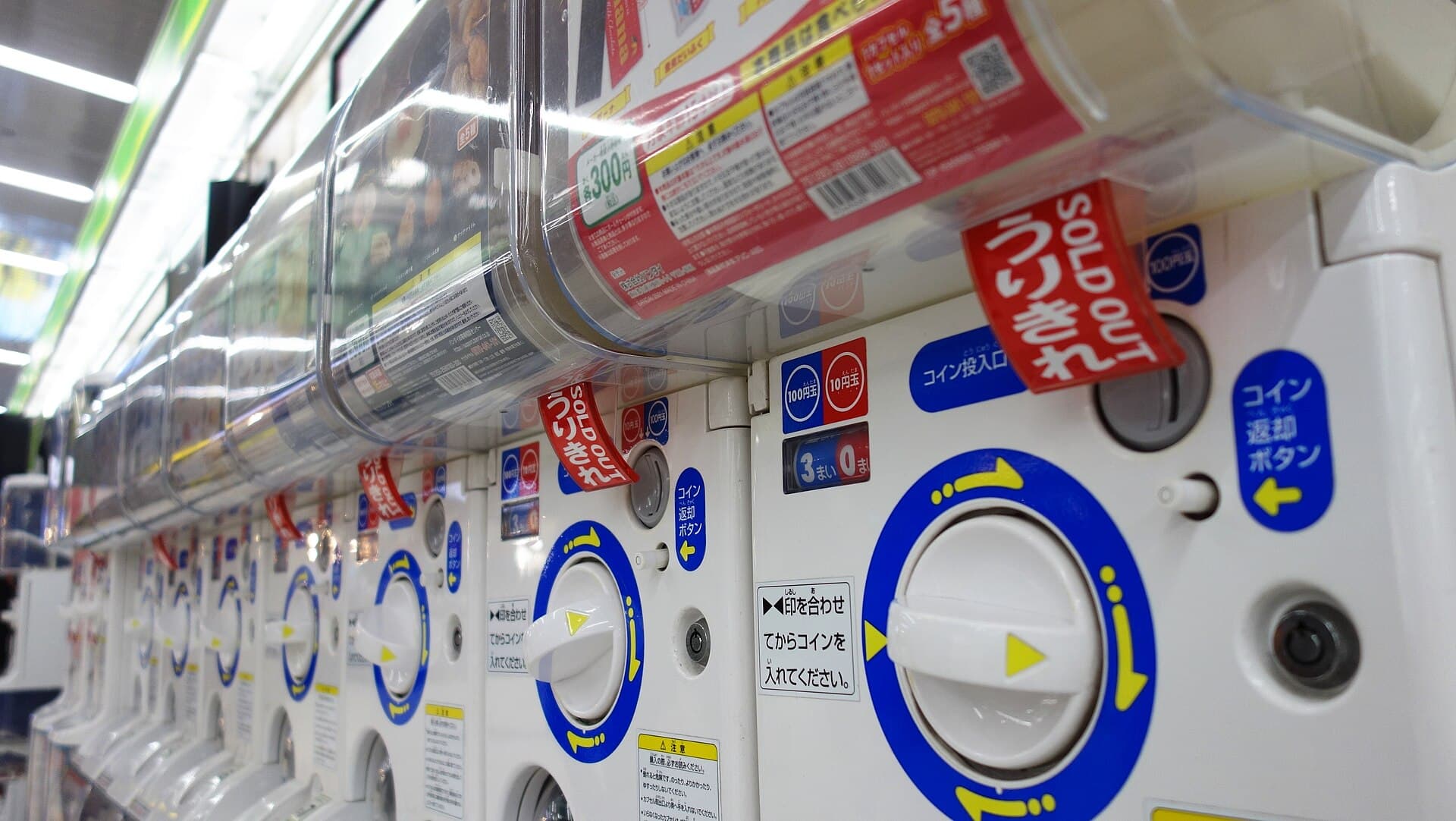
Crane-game figures fall under a specific legal regime. Japan's entertainment establishment law, known as 風営法 (fūeihō), only permits such machines if the prize stays low in value. An interpretive criterion set in 2001 capped that value at roughly 800 yen; a National Police Agency circular dated 1 March 2022 raised it to 1,000 yen, the first increase in twenty years.
The whole design of the category follows from that ceiling. Prizes are produced in very large runs, with fewer separate parts, simplified paint applications and minimal bases. They skip pre-orders and carry no retail price, since they are not meant to be sold over the counter in Japan. The copies found in specialist shops or online come from the secondary market.
Quality in this segment has improved enormously since the 2010s, to the point where some prizes from Banpresto, the division that became BANDAI SPIRITS, or from SEGA hold their own visually against entry-level scale figures. It is the best value on the market, provided you accept uneven finishing from one copy to the next.
A neighbouring scheme escapes the crane-game ceiling: 一番くじ (ichiban kuji), the no-loser lottery. Born in November 1996, it took its current shape in June 2003 with a Pokémon series sold at 7-Eleven. Buy a ticket, always win something, from a keyring to the large A-prize, and the format turned Japanese convenience stores into a figure aisle in their own right.
| Family | Size | Indicative price | Channel | What defines it |
|---|---|---|---|---|
| Scale 1/8 to 1/4 | 20 to 45 cm | ¥15,000 to ¥60,000 | Pre-order, specialist shops | Original sculpt, fixed pose |
| Nendoroid | around 10 cm | ¥5,000 to ¥8,000 | Pre-order, possible reissue | Interchangeable parts, multiple faces |
| figma | 13 to 16 cm | ¥7,000 to ¥12,000 | Pre-order | Articulated, built for posing |
| Prize | 15 to 25 cm | Legal value capped at ¥1,000 | Crane games only | Mass run, variable finishing |
| Ichiban kuji | Variable | Ticket price, ¥700 to ¥1,200 | Convenience stores, bookshops | Lottery with no losing ticket |
| Garage kit | Variable | ¥8,000 to ¥30,000 | Events, self-assembled | Resin, unpainted, tiny run |
The garage kit and the festival that made it legal#
Before the industry there were amateurs. A ガレージキット (garēji kitto) is a resin figure sold unassembled and unpainted, produced in a few dozen copies by an independent sculptor. Making it raised an obvious problem: reproducing a licensed character without permission.
Japan invented a mechanism for this with no equivalent anywhere else, 当日版権 (tōjitsu hanken), the same-day licence. An event's organising committee negotiates with rights holders an authorisation valid only for the day of the event and for a declared print run. The system was born at Wonder Festival, created by General Products and taken over by Kaiyōdō in 1992, which has run it twice a year at Makuhari Messe ever since.
The result is a convention where thousands of individual sellers clear in a single day pieces they have no legal right to offer the next morning. It is also the talent pool manufacturers recruit from: several of the industry's star prototype sculptors started out on a stand with ten pieces.
The same-day licence imposes a constraint collectors know well: an unsold garage kit cannot simply be put back on sale the following month. Stock therefore clears in the closing hours of the event, which explains the morning queues as much as the end-of-day haggling.
What the market actually weighs#
The Association of Japanese Animations valued the worldwide anime market at 3.84 trillion yen for 2024, an all-time record published in its October 2025 report. Merchandise is the largest single component, and figures hold the leading share within it, ahead of apparel and stationery.
That weight explains publisher strategy: an anime adaptation is no longer only a cultural product, it is the commercial prototype for a range of objects. Figure announcements now follow broadcasts by a matter of weeks, and some series are partly financed on those receipts.
Read alsoGachapon: Japan's Capsule Toy CultureThe miniature sold at random inside a capsule, Japan's other great school of figure-making, with Kaiyōdō as the link between the two.
Buying without getting burned#
Three habits are enough. The first is to check the manufacturer and reference number, the only information separating an original from a counterfeit: unauthorised Chinese copies, known as bootlegs, reuse official visuals but never the authentication codes printed on the box.
The second is to know the original retail price before looking at a second-hand listing. A 2019 scale figure resold at three times its price is only justified by genuine scarcity, which collector databases let you verify in a minute.
The third concerns prizes: a figure advertised as new and sealed at 4,000 yen on a marketplace is still an object whose legal value in Japan does not exceed 1,000 yen. That is not a scam in itself, it is the price of import and service, but it is worth knowing.
Read alsoJapanese game centers: arcade culture and its declineThe halls where prizes circulate, the mechanics of crane games and the real economics of the Japanese game centre.
FAQ#
What does the 1/7 scale on a figure box mean? It indicates that the object reproduces the character at one seventh of their supposed height in the fiction. A heroine of 1.60 m therefore gives a figure around 23 centimetres tall. The smaller the denominator, the bigger and more expensive the piece.
Why are prizes not sold in shops in Japan? Because they are made as crane-game prizes, a category governed by the entertainment establishment law. Prize value has been capped at 1,000 yen since a circular issued in March 2022, and the intended channel is the game, not retail.
Is a Nendoroid worth as much as a scale figure? They are different objects. The Nendoroid bets on interchangeable faces and accessories, the scale figure on sculptural fidelity. Collectors choose depending on whether they want to play with the pose or freeze an image.
What is a garage kit? A resin figure sold unassembled and unpainted, produced in very small runs by an independent sculptor, generally at an event such as Wonder Festival thanks to the same-day licence system.
How do you spot a counterfeit? The classic signs are a missing authentication code on the box, colours slightly off compared with official visuals, moulding flash, and a price well below market. When in doubt, compare with the photographs on the manufacturer's official product page.
Photo credits: the images in this article come from Wikimedia Commons and are under free licences.
Walking sims and auteur games: what Kojima made of them
From the mocking nickname given to Dear Esther to the strand game of Death Stranding: the history of the walking simulator, the auteur game and walking as a mechanic.
Cover image: Piotr Konieczny (User:Piotrus) · Piotr Konieczny (User:Piotrus), via Wikimedia Commons · CC BY-SA 3.0