Nintendo: from hanafuda cards to global video games
The story of Nintendo, from the hanafuda card workshop founded in Kyoto in 1889 to the Famicom, Wii and Switch consoles. A century of pivots.
La rédaction Kotoba Interactive
Studio éditorial
On September 23, 1889, a Kyoto craftsman named Yamauchi Fusajiro (山内房治郎) opened a small shop near the Shijo bridge. He sold neither consoles nor mustachioed plumbers, but decks of cards hand painted on mulberry bark. The company was called Nintendo (任天堂), and for nearly seventy years it would make nothing but playing cards.
That longevity makes Nintendo's story unusual among tech giants. Where Sony, Apple and Microsoft were born in the twentieth century out of electronics, Nintendo began as a craft workshop of the Meiji era. Its ability to survive by changing trades several times, from the playing card to the taxi, from instant rice to video games, says something valuable about how a company reinvents itself without betraying itself. The common thread, claimed by the company itself, comes down to a single word: asobi (遊び), play.
A hanafuda card workshop in Meiji-era Kyoto#
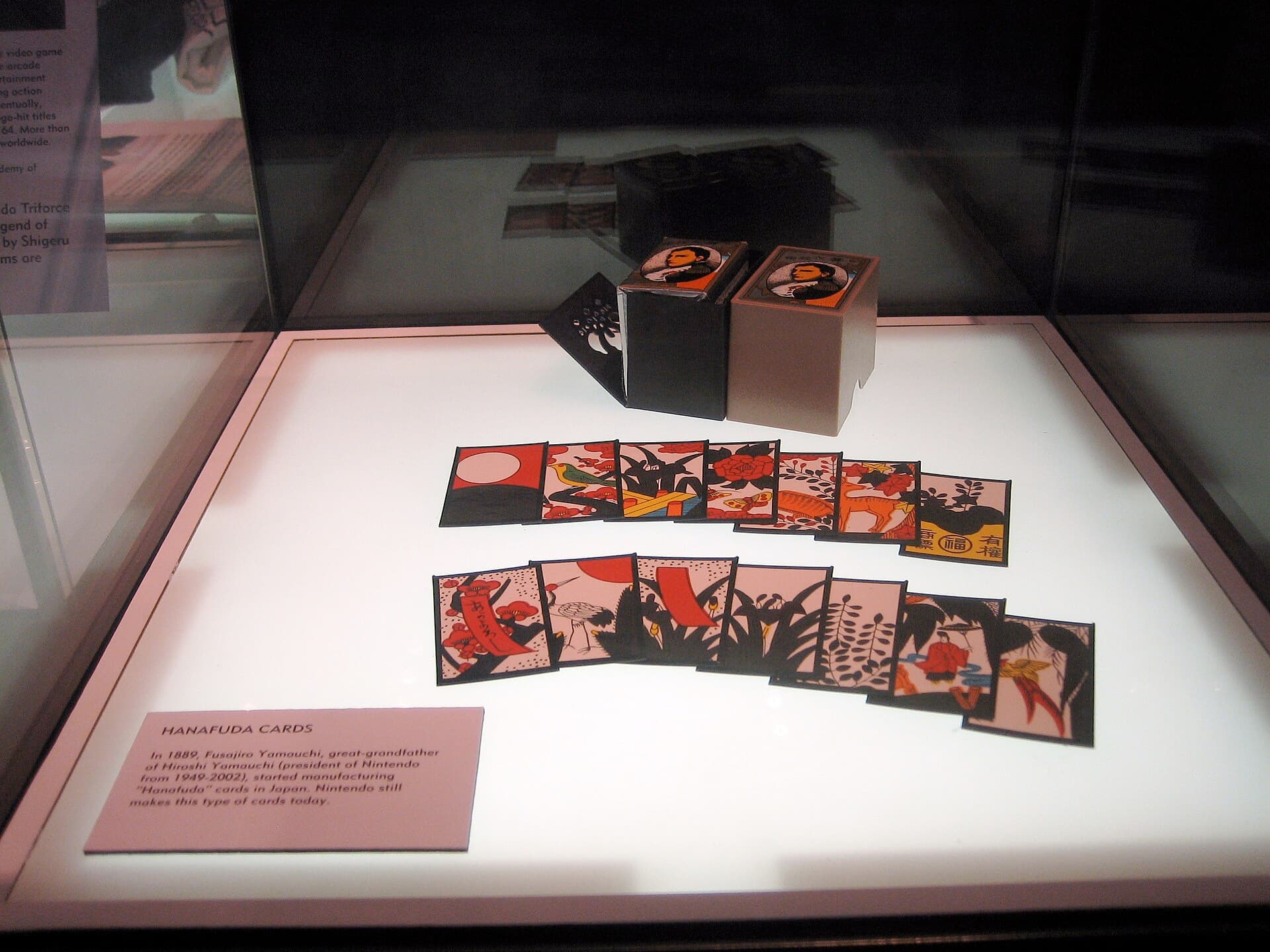
Nintendo was born from a ban on gambling. The Meiji government had prohibited most games of chance in 1882, but tolerated hanafuda (花札), literally "flower cards," a game of 48 cards decorated with floral motifs spread across twelve months. Yamauchi Fusajiro, a passionate gambler and a skilled craftsman, sensed the opportunity and began producing his own decks, cut from mulberry bark and printed with wood blocks.
Hanafuda (花札) from hana (花, flower) and fuda (札, card, label). These Japanese "flower cards," structured into twelve suits corresponding to the months of the year, descend from the Portuguese playing cards introduced in the sixteenth century, then reinvented to get around the successive bans on gambling.
The company's very name remains debated. The most widespread reading interprets 任天堂 as "leave luck to heaven" or "entrust your fortune to heaven," a motto well suited to a maker of gaming cards. Nintendo itself has admitted that it does not know for certain the exact intention of its founder, and several historians urge caution about this appealing etymology. What is established is the commercial success: Nintendo's decks took hold in the gambling dens of Kyoto, including those run by the yakuza, who liked to switch to a fresh pack for every game.
In 1953, the company became the first Japanese manufacturer to produce plastic cards. Four years later, a licensing deal with Disney opened the family market: card decks illustrated with Mickey sold by the hundreds of thousands, and Nintendo shifted from the shady world of gaming halls to the family living room. The card maker was prosperous, but its market had hit a ceiling.
Yamauchi Hiroshi's failed diversifications#
In the 1960s, Yamauchi Hiroshi (山内溥), the founder's grandson by marriage and president since 1949, understood that cards would not be enough to grow the company. He launched a wide-ranging series of diversifications that remain, even today, the most comical failures in the company's history.
Nintendo went into taxis with Daiya Kotsu, a firm it eventually sold off. It opened "love hotels" in Kyoto, where legend, unverifiable but persistent, has it that Yamauchi himself came to inspect the occupancy rate. It sold instant rice and a vacuum cleaner, the Chiritory. None of these ventures took root. Around 1964, Nintendo's stock fell to a historic low, and the company came close to going off the rails.
Nintendo tried to sell rice, taxis and rooms by the hour before it understood that its only real expertise was play.
The rescue came from an intuition and from one man. Yamauchi noticed a young engineer on the card assembly line who, in his idle moments, was tinkering with an articulated arm made of crossed wooden lattices. He asked him to turn it into a toy for the end-of-year holidays.
Gunpei Yokoi and "withered technology"#
The man's name was Yokoi Gunpei (横井軍平), and his tinkered creation, the Ultra Hand, an extending arm that grabs objects when you squeeze its handles together, sold roughly 1.2 million units in 1966. Nintendo had its toy division, and above all its engineer-philosopher.
Yokoi would later formalize his method under the name kareta gijutsu no suihei shiko, rendered in English as "lateral thinking with withered technology." The idea: rather than chase after the latest, expensive and fragile component, it is better to repurpose mature, cheap and reliable technologies to give them a fresh and entertaining use. It is a philosophy of the frugal engineer that became company doctrine.
It gave birth in 1980 to the Game & Watch, a pocket console with a liquid crystal display. Yokoi had noticed the surplus of cheap LCD panels and semiconductors left over from the calculator war being waged by Sharp and Casio. By recycling them into a toy, he created a worldwide hit and, along the way, invented the directional cross, the famous D-pad, that would equip every controller to come.
Behind these names are kanji: 任天堂 (Nintendo), 花札 (hanafuda, the flower cards) and 遊び (asobi, play). Learn to read these words in their original script with JapaneseSRS, the spaced repetition that anchors kana and kanji for good.
In 1981, an arcade game changed everything. Handed to a young designer with no engineering training, Miyamoto Shigeru (宮本茂), Donkey Kong featured a mustachioed carpenter, dubbed Jumpman, who has to rescue his girlfriend from a gorilla. The character would become Mario. The game, exported to the United States, saved the American subsidiary from bankruptcy and established Miyamoto as the in-house creator who would matter for the next forty years.
The name "Mario" does not come from Japan but from an American real estate incident: Mario Segale, owner of the warehouse that Nintendo of America rented in Tukwila, reportedly burst in to demand overdue rent. The team, looking for a name for their carpenter, is said to have kept that of the furious landlord.
Famicom, Game Boy and the conquest of the living room#
On July 15, 1983, Nintendo launched the Family Computer in Japan, shortened to Famicom (ファミコン). Sold at an aggressive price, the cartridge console moved tens of millions of units and became, under the name NES (Nintendo Entertainment System), the machine that revived the American video game industry after the crash of 1983.
The NES set a template: the "seal of quality," a strict editorial control over third-party games, and above all in-house franchises that became cultural pillars. Super Mario Bros. in 1985, The Legend of Zelda in 1986, Metroid the same year, produced by Yokoi. These series have carried on for forty years without faltering.
Read alsoThe Legend of Zelda: the story of a cult sagaHow a single series invented open-world adventure: a deep dive into the Zelda saga, from the golden cartridge of 1986 to the floating kingdoms of the Switch.
In 1989, Yokoi struck again with the Game Boy, a pure application of his "withered technology." Where competitors Sega Game Gear and Atari Lynx bet on power-hungry color screens, Yokoi insisted on an olive-green monochrome screen: less spectacular, but battery life multiplied tenfold and an unbeatable price. The Game Boy sold more than 118 million units and crushed the competition. The bet on a modest, well-thought-out component won out over the technical arms race.
The Super Famicom in 1990, then the Nintendo 64 in 1996 with its move to 3D and its analog stick controller, extended the dominance. Not every innovation was a triumph: the Virtual Boy of 1995, a red-and-black virtual reality headset also signed by Yokoi, was a stinging commercial failure. Yokoi left Nintendo soon after; he died in a road accident in 1997, at 56, leaving the most lasting mark on the company's engineering culture.
Iwata Satoru and resilience through play#
On May 24, 2002, Iwata Satoru (岩田聡) became Nintendo's fourth president, and the first person outside the founding Yamauchi family to lead the company since 1889. A programmer by training, former president of the HAL Laboratory studio where he had coded Kirby and rescued the development of Pokémon Gold and Silver, Iwata embodied a break: a leader who codes himself.
Facing the firepower of Sony and Microsoft, Iwata refused the race for graphics power and adopted a so-called "blue ocean" strategy: aiming at non-gamers rather than fighting over the saturated market of enthusiasts. The Nintendo DS in 2004, with its dual touchscreen, then the Wii in 2006, with its motion-sensing controller, broadened the video game audience to families and seniors. The Wii sold more than 100 million units.
Success did not erase the failures. The Wii U, released in 2012, sold poorly, a victim of confused positioning, and sent results plunging. Iwata, a rare gesture for a Japanese boss, then imposed on himself a fifty percent pay cut rather than lay off his teams. He died on July 11, 2015, at 55, of a bile duct tumor, before seeing through the hybrid project he had launched.
My business card says CEO. In my head, I am a game developer. But in my heart, I am a gamer.
That project was the Nintendo Switch, launched on March 3, 2017. A hybrid console, playable on a television or as a handheld, it reconciled the company's two historic lineages, the living room of the Famicom and the pocket of the Game Boy. Carried by The Legend of Zelda: Breath of the Wild and Animal Crossing: New Horizons, it surpassed 140 million units and became one of the best-selling consoles in history.
Over a century and a half, the company's great pivots read like a chronology of reinvention:
| Year | Pivot | Milestone |
|---|---|---|
| 1889 | Founding in Kyoto | hanafuda cards painted on mulberry bark |
| 1953 | Modernization | first Japanese maker of plastic playing cards |
| 1966 | Entry into toys | Yokoi's Ultra Hand, roughly 1.2 million units |
| 1980 | Pocket console | Game & Watch and the invention of the D-pad |
| 1983 | Living-room console | Famicom, the future NES |
| 1989 | Handheld triumph | Game Boy, more than 118 million units |
| 2006 | "Blue ocean" strategy | Wii, more than 100 million units |
| 2017 | Hybrid console | Switch, more than 140 million units |
Born on the Game Boy in 1996, the Pokémon franchise became the most profitable in the world. A look back at a phenomenon that Nintendo co-carried without being its sole owner.
FAQ#
When and by whom was Nintendo founded? Nintendo was founded on September 23, 1889, in Kyoto by the craftsman Yamauchi Fusajiro. The company originally made hanafuda (花札) playing cards painted on mulberry bark. It remained a card maker for nearly seventy years before turning to toys and then video games in the 1960s and 1970s.
What does the name Nintendo mean? The name 任天堂 is often translated as "leave luck to heaven" or "entrust your fortune to heaven," a reading that fits a maker of gaming cards. Nintendo has, however, admitted that it does not know for certain the exact intention of its founder, and this etymology remains debated by historians.
Who was Gunpei Yokoi at Nintendo? Yokoi Gunpei was the engineer behind the Ultra Hand, the Game & Watch and the Game Boy. He theorized "lateral thinking with withered technology": repurposing mature and cheap components to create new products. He also produced Metroid and supervised the Virtual Boy, the 1995 failure, before leaving Nintendo.
Which is Nintendo's best-selling console? The Nintendo Switch, released in 2017, has surpassed 140 million units, placing it among the best-selling consoles in history. Before it, the Game Boy (more than 118 million) and the Wii (more than 100 million) held records in their respective categories.
Does Nintendo still make hanafuda cards? Yes. Nintendo continues to produce hanafuda (花札) decks, including special editions featuring Mario. It is a deliberate nod to its 1889 origins, and a reminder that Japan's most profitable video game company began as a playing card workshop.
From mulberry bark cut by hand in the Kyoto of 1889 to the open kingdoms of the Switch, Nintendo has changed its product a dozen times without ever changing its reason for being. That is perhaps its most lasting lesson: a company does not survive by defending its objects, but by staying faithful to the idea that runs through them, here the pure pleasure of play.
Photo credits: images in this article come from Wikimedia Commons under free licenses.
Sega: the rise and fall of a video game giant
The story of Sega (セガ): from slot machines on American bases to Sonic, from the Dreamcast to leaving hardware behind. The rise and fall of a giant.
Cover image: fuzzcat · fuzzcat, via Wikimedia Commons · CC BY 2.0