Gacha: the psychology and the Japanese vocabulary
爆死, 天井, すり抜け: Japanese invented an entire lexicon for random draws. What those words reveal about gacha mechanics and the psychology they exploit.
La rédaction Kotoba Interactive
Studio éditorial
Japanese has a verb for spending a significant sum on a random draw and getting nothing out of it: 爆死 (bakushi), literally "death by explosion". The word comes from military vocabulary, where it means dying in a bombing, and millions of players now use it to describe a bad evening on a mobile game.
It is not an isolated case. Around the , Japanese has produced in about fifteen years a dense, precise vocabulary, largely absorbed into everyday speech, naming situations no other language distinguishes. That lexicon is the best available guide to how the genre works: each word answers an identified psychological lever, and together they map, with uncomfortable accuracy, the way these systems are designed.
A vocabulary manufactured by chance#
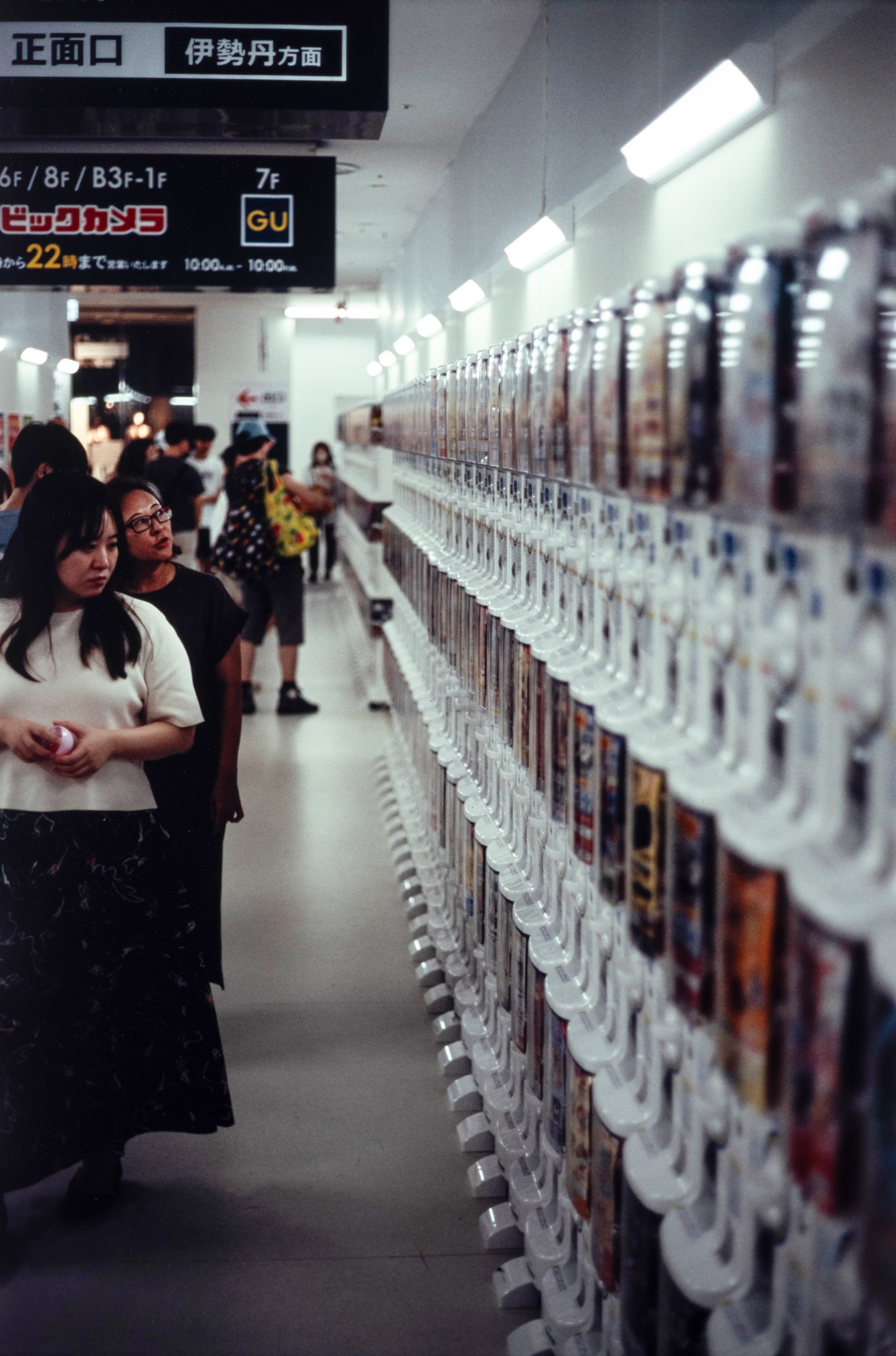
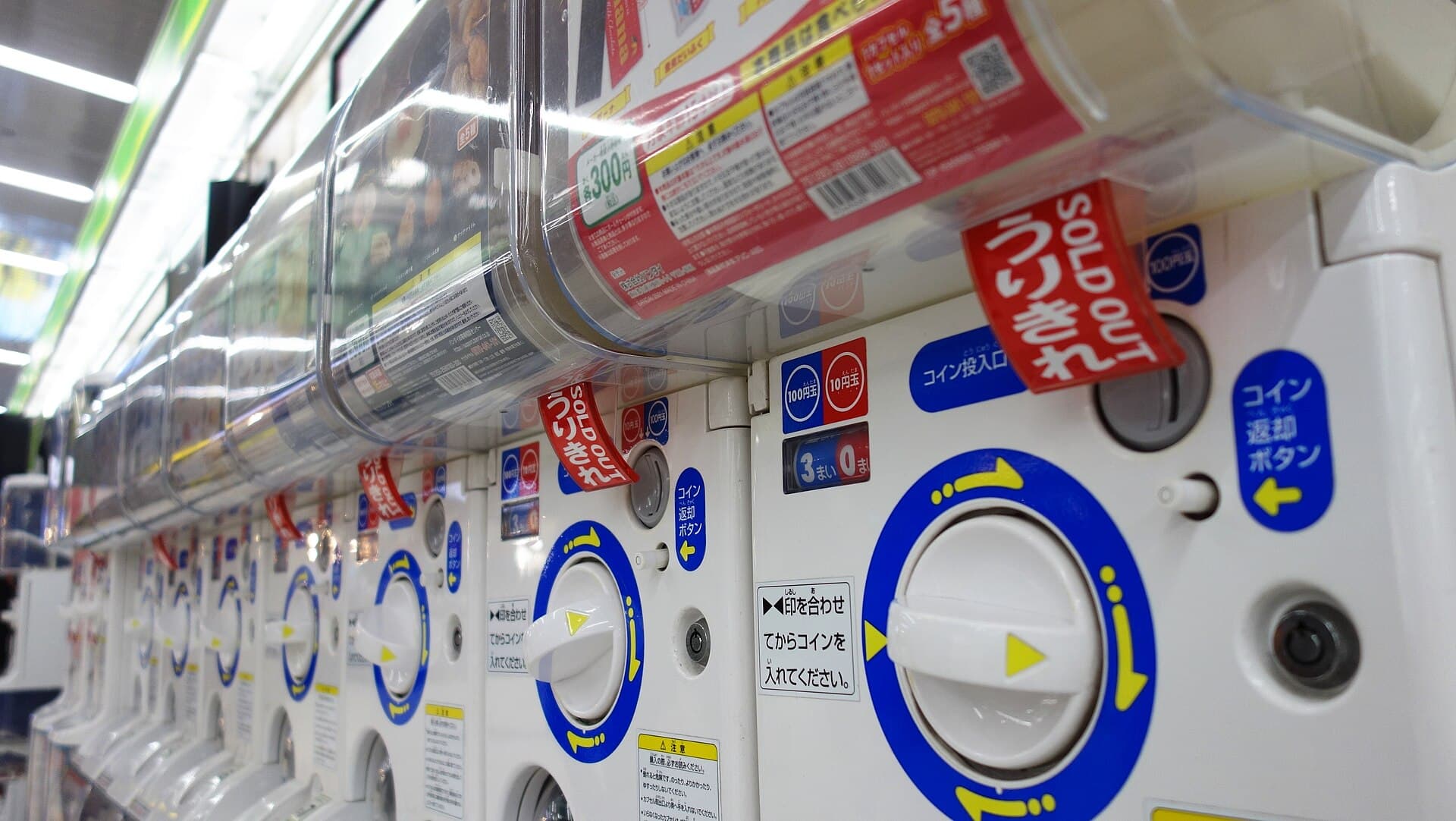
The word ガチャ is onomatopoeia. It reproduces the sound of the crank on the capsule dispensers that have stood in Japanese streets since the 1960s, whose full name, ガチャポン, adds the pon of the capsule dropping. When Japanese mobile gaming transposed the principle to a screen around 2010, it kept the word and then built everything else around it.
What makes this vocabulary distinctive is that it came from players, not publishers. Official commercial terms exist, in neutral, reassuring language; the terms actually used are violent, vivid, often self-deprecating, and they circulate on social networks before being picked up by the specialist press and, sometimes, by publishers themselves.
Pulling: the vocabulary of the act#
ガチャを回す (gacha wo mawasu), "to turn the gacha", preserves the crank even though nothing is left to do but press a button. Players also say simply 引く (hiku), "to pull".
A single draw is a 単発 (tanpatsu), literally "single shot". A batch of ten is a 10連 (jūren), and it almost always carries an advantage: a guaranteed minimum rarity on the tenth, or a small discount. That advantage is not generosity, it is anchoring: it makes a batch of ten more rational than ten singles, and therefore fixes the spending increment at ten.
The 排出率 (haishutsuritsu) is the drop rate, displayed since regulators and app stores began requiring it. The ピックアップ (pikkuappu) is the limited-time banner that raises the probability of one specific character without ever making it certain.
Failing: the vocabulary of pain#
This is the richest part of the lexicon, which is no accident.
すり抜け (surinuke), "slipping through", names the genre's most maddening outcome: the player does get the top rarity they were hoping for, but the character drawn is not the one the banner advertised. The word exists because the situation is frequent by design, the advertised rarity rate covering an entire back catalogue.
沼 (numa), "the swamp", names the losing streak you cannot climb out of and sink deeper into by continuing. 爆死 crowns the set. Conversely, 神引き (kamibiki), "divine pull", names the improbable success, and ガチャ運 (gacha-un) names luck at drawing, treated as a durable personal trait.
The 爆死報告 (bakushi hōkoku), the "explosive death report", is a genre of post in its own right on Japanese social networks: a screenshot of the results, the amount spent, a fatalistic comment. It performs a precise social function, normalising loss by making it collective and comic.
Paying: the vocabulary of money#
The central word is 課金 (kakin), which means "levy, billing", and which players repurposed to mean "spending in a game". A whole social scale has grown around it.
The 無課金 (mukakin) pays nothing. The 微課金 (bikakin) pays little, often only the monthly pass. The 重課金 (jūkakin) pays heavily, and the 廃課金 (haikakin) pays to the point where the first character, 廃, evokes ruin and dereliction. These categories structure players' identities, their communities and their conversations.
One detail of vocabulary does most of the work: you never buy a draw, you buy 石 (ishi), "stones", or crystals, orbs, quartz depending on the game. That intermediate currency, sold in bundles whose amounts never align with the price of a draw, separates the act of paying from the act of playing, exactly as casino chips do.
天井 (tenjō) means "ceiling" in the architectural sense. In gacha vocabulary it names the number of draws after which the coveted item is guaranteed, often between one hundred and fifty and three hundred. The term came from pachinko players, where it already marked the point beyond which a machine turns favourable, before crossing over to mobile games.
The safety net, and its perverse effect#
The 天井 is presented as a player protection, and it is one: it caps the maximum spend required. But it produces an effect publishers understand perfectly well. By turning a bet with an unknown outcome into a known price, it shifts the decision from one register to another: the player stops asking "will I be lucky?" and starts asking "am I willing to pay that much for this character?". Many answer yes, and spend more than they would have under uncertainty.
The other guarantees follow the same logic. 確定 (kakutei), "certain", marks a slot with guaranteed rarity. 限定 (gentei), "limited", marks a character available for a few days only, sometimes never reissued. 復刻 (fukkoku), "reissue", marks the return of an old banner, whose mere possibility sustains the hope of everyone who missed the first one.
| Term | Script | Reading | Meaning |
|---|---|---|---|
| Single draw | 単発 | tanpatsu | One draw paid individually |
| Ten-pull | 10連 | jūren | Ten draws with a guaranteed bonus |
| Drop rate | 排出率 | haishutsuritsu | Published probability per rarity |
| Rate-up banner | ピックアップ | pikkuappu | Boosted odds on one character |
| Ceiling | 天井 | tenjō | Number of draws guaranteeing the item |
| Slipping through | すり抜け | surinuke | Right rarity, wrong character |
| Swamp | 沼 | numa | Losing streak you cannot leave |
| Death by explosion | 爆死 | bakushi | Big spend, no result |
| Divine pull | 神引き | kamibiki | Highly improbable success |
| No spending | 無課金 | mukakin | Player who never pays |
| Ruinous spending | 廃課金 | haikakin | Very heavy spender |
| Reroll marathon | リセマラ | risemara | Restarting until the right opening draw |
This lexicon is not confined to games: 確定 (kakutei, certain), 限定 (gentei, limited) and 課金 (kakin, billing) are ordinary Japanese words you will meet on a contract, a shop poster or an invoice. JapaneseSRS, our spaced repetition app for learning Japanese, is coming soon: join the waiting list.
What the psychology explains#
Gacha is not a conceptual invention. It applies a mechanism described in the laboratory as early as the 1950s.
Variable ratio reinforcement. B. F. Skinner's work on reinforcement schedules established that a reward delivered at unpredictable intervals produces more sustained behaviour, far more resistant to extinction, than a regular one. That is the principle of the slot machine, and it is exactly the principle of the draw.
Prediction error. Wolfram Schultz's work published in Science in 1997 showed that dopamine neurons do not encode pleasure but the gap between expected and obtained reward. The signal peaks when uncertainty peaks, around fifty-fifty, which is why a draw animation deliberately prolongs the moment of indeterminacy.
The near miss. A study by Luke Clark and colleagues, published in Neuron in 2009, showed by imaging that narrow failures activate the same reward circuits in gamblers as wins do, and increase the urge to continue. The ten-pull animation, which hovers for several seconds on a colour that might still upgrade, is a near-miss machine.
Sunk cost. The more a player has spent without obtaining, the more economic logic says stop, and the more they are actually pushed to continue so as not to "lose" what they have already committed. The word 沼 describes precisely that mechanism.
Scarcity and other people's eyes. 限定 banners create a closing window, draw reports on social networks provide the social comparison, and live-streamed pulls by creators establish high volume as the norm.
The generic word ガチャポン is in fact a trademark: Bandai registered ガシャポン back in the 1970s for its capsule machines. Competitors and the general public therefore say ガチャガチャ or ガチャ, and it is that unregistered form which ended up naming a multibillion-dollar corner of the games industry.
The safeguards, and what they actually changed#
Japan regulated once, forcefully, and on one narrow point. In May 2012 the Consumer Affairs Agency (消費者庁) held that コンプガチャ (konpu gacha), a system requiring players to collect a complete set of randomly drawn items to unlock another, breached the Act against Unjustifiable Premiums and Misleading Representations. Publishers withdrew it within weeks. The simple draw itself has never been banned.
In January 2016, a widely discussed case involving a Granblue Fantasy player who spent a very large sum without obtaining the advertised character reopened the debate. Japanese industry bodies published recommendations in spring 2016 on rate disclosure and on capping expected spend, with no binding force.
Elsewhere, decisions came faster. China has required publication of probabilities for all paid draws since 2017. The Belgian Gaming Commission classified paid loot boxes as gambling in 2018, prompting several publishers to remove the feature in that country. Apple wrote odds disclosure into its App Store rules as early as 2017, which has had more global effect than most national legislation.
How to read a banner#
Three pieces of information are enough to assess an offer, and they are almost always displayed, often in small print.
The 排出率 of the top rarity, generally between 0.6 and 3 percent depending on the game. The share of that rate actually attributed to the ピックアップ, which is sometimes half the total and sometimes much less, the remainder going to すり抜け. And the existence, value and conditions of the 天井, checking whether it resets between banners, which changes everything.
A player who reads those three numbers before pulling does not get a better draw, but does make an informed choice. It is probably the only safeguard entirely in their own hands, and the Japanese vocabulary of gacha, with its blunt honesty, says more about what is at stake than any publisher's communication.
Read alsoGacha Games: The Mechanics and Controversies ExplainedThe economic history of the model, from the komp-gacha scandal to the global regulation of paid loot boxes.
The physical ancestor, still going strong: the capsule machines that gave the genre its name and its sound.
FAQ#
What exactly does "gacha" mean? It is the onomatopoeia of the crank on Japanese capsule dispensers, which became the name of the paid random-draw system in video games, and by extension of the genre that uses it.
What is a tenjō? A ceiling on the number of draws beyond which the targeted item is guaranteed. It protects against unlimited spending, but also turns the draw into a purchase at a known price, which pushes some players to go all the way rather than stop.
Are published rates reliable? They are mandatory in China and required by app stores, which limits discrepancies. Disputes bear less on the truth of the numbers than on their legibility: the overall rate for a rarity is prominently displayed, while the share genuinely going to the advertised character is far less so.
Is gacha gambling? Legally, the answer varies by country. The decisive criterion is usually whether the prize can be converted back into money: where it cannot, most jurisdictions decline the classification. Belgium is a notable exception.
Why is this vocabulary Japanese? Because the model was invented and industrialised in Japan between 2010 and 2012, on a mobile market ahead of everyone else's. International communities adopted the Japanese terms as they were, for lack of equivalents, and tenjō, pity and rate-up now coexist in the same conversations.
Photo credits: the images in this article come from Wikimedia Commons and are under a free license.
In this article
The cultural terms covered here, each with a short definition.
Gacha Games: The Mechanics and Controversies Explained
Gacha (ガチャ) explains the economics of mobile gaming. Drop rates, tenjō pity, the 2012 komp-gacha scandal, and the worldwide loot-box regulation battle.
Cover image: Ka23 13 · Ka23 13, via Wikimedia Commons · CC BY 4.0