Sega: the rise and fall of a video game giant
The story of Sega (セガ): from slot machines on American bases to Sonic, from the Dreamcast to leaving hardware behind. The rise and fall of a giant.
La rédaction Kotoba Interactive
Studio éditorial
The name that millions of children screamed in front of their televisions in the 1990s is an accounting contraction. Sega, whose full name is セガ (Sega), comes from "Service Games", a company founded in Honolulu that rented slot machines to American military bases. Nothing about these origins, made of tokens and gaming tables, hinted that it would give birth to a blue hedgehog capable of standing up to Mario.
The story of Sega is that of a company that won every technical battle and lost the commercial war. For a decade it dominated the arcade, took on Nintendo head-on, invented online console gaming, then walked away from the hardware market in a single spring. To understand its trajectory is to understand how engineering talent is not enough when your opponent is called Sony and players' wallets have a limit.
From Hawaiian tokens to Tokyo arcades#
Sega is born twice, two decades apart. In May 1940, Americans Martin Bromley, Irving Bromberg and James Humpert founded Standard Games in Honolulu, a company that supplied coin-operated machines, including slot machines, to military bases that were expanding rapidly as war approached. Demand was mechanical: bored soldiers, wages to spend, few distractions. After the war, the founders sold Standard Games in 1945 and the following year launched "Service Games", whose name says everything about the business model.
When the Transportation of Gambling Devices Act banned slot machines in American territories in 1951, Bromley sent his employees Richard Stewart and Ray LeMaire to Tokyo to open a new distribution channel. There the company supplied slot machines to American bases in Japan and took the name "Service Games of Japan" around 1953. The word "Sega", a contraction of Service Games, appeared for the first time in 1954, engraved on a slot machine called the Diamond Star.
Sega (セガ) is a contraction of the English SErvice GAmes, the slot machine distributor founded for American bases. The name, purely commercial, predates the brand's first video game by twenty years.
The pivot toward electronic entertainment happens in 1965, when Nihon Goraku Bussan absorbed Rosen Enterprises to form Sega Enterprises, Ltd. The company gradually abandoned renting to military bases and turned toward coin-operated leisure machines. The following decades made it a queen of the アーケード (aakeedo, arcade). Its cabinets became global standards: Out Run (1986) and its red convertible launched at full speed along a sunny coast, After Burner (1987) and its hydraulic seat that tilted like a cockpit, then Daytona USA (1993), one of the first textured 3D racing cabinets to enjoy worldwide success. This mastery of the arcade would be Sega's technical foundation and identity throughout its history.
The Mega Drive and the birth of a hedgehog#
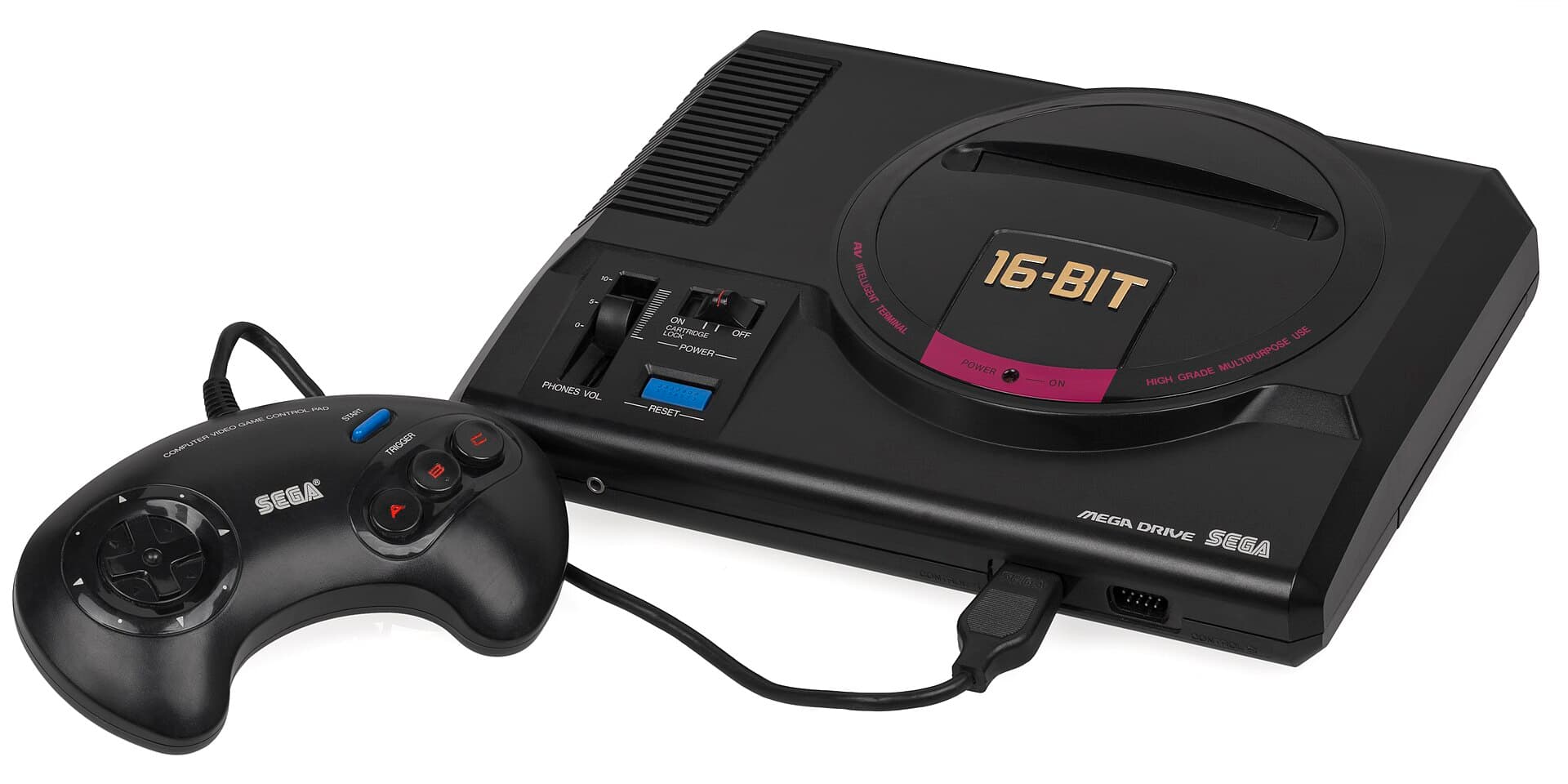
The real shift into the living room dates to October 29, 1988, the day Sega launched the Mega Drive in Japan (sold under the name Genesis in North America from 1989). The console arrived after the Master System, an honest competitor to the NES that had never worried Nintendo in Japan. The Mega Drive, by contrast, armed Sega with a 16-bit processor and a clear marketing argument: "Genesis does what Nintendon't", an aggressive slogan hammered home in the United States to pit the machine's power against the aging NES.
It was missing a mascot. That arrived on June 23, 1991 with Sonic the Hedgehog, a blue hedgehog drawn by Naoto Ōshima and programmed by Yuji Naka. ソニック (Sonic) is conceived as the anti-Mario: where Nintendo's plumber advances methodically, the hedgehog rushes forward, takes loops at full speed and turns velocity into a gameplay sensation. The character became the emblem of a more rebellious, more teenage brand identity, tailored for the American market.
Sega understood before anyone else that a console is not sold with technical figures, but with an attitude.
The strategy worked. In the early 1990s, carried by aggressive marketing and a solid game library, the Genesis captured a considerable market share in the United States and, for a time, ran neck and neck with the Super Nintendo. The "console wars" between Sega and Nintendo shaped that entire generation: each camp had its mascot, its exclusives, its ads that openly mocked the rival. It is one of the rare moments in video game history when Nintendo truly trembled on American soil.
Want to read セガ (Sega), ソニック (Sonic) and ドリームキャスト (Dreamcast) in the original text? Mastering katakana opens up manuals, game credits and Japanese magazines. Learn kana, kanji and vocabulary with JapaneseSRS, the spaced repetition platform that anchors them for good.
Saturn, Dreamcast and the strategic self-sabotage#
Sega's hardware decline begins with an ill-born console: the Sega Saturn. Powerful but complex to program, launched in the United States in 1995 in a rush, without enough stock or games at the time of a now-famous E3 show, the Saturn was overtaken by a newcomer, Sony's PlayStation. Sega lost on its historical turf, 3D, and squandered part of the credit built up with the Mega Drive. As for the trust of third-party developers, it never fully returned.
The counterattack was called Dreamcast, ドリームキャスト (Dreamcast), launched in Japan on November 27, 1998 then in North America on September 9, 1999, a marketing date chosen for its "9.9.99". The machine was ahead of its time: a built-in modem as standard allowed online gaming and web browsing when the competition was still stuck with cables and optional add-ons. Its American launch, backed by a vast campaign, broke sales records at the start. Sonic Adventure, Shenmue and Soulcalibur showed what the console could do.
The Dreamcast carried a miniature screen inside its memory card, the VMU (Visual Memory Unit), a small battery-powered gadget that displayed mini-games and the state of your monsters when you unplugged it from the controller. A "second screen" idea that the industry would rediscover years later.
The problem was not the Dreamcast. It was the PlayStation 2, announced by Sony with a promise the Dreamcast could not match: a built-in DVD player, at a moment when DVD was booming in households. Many buyers preferred to wait for Sony's machine, both a game console and a movie player. Dreamcast sales, brilliant at the outset, collapsed. On March 31, 2001, Sega announced the end of production of its console. Around 9.13 million units had been sold, a respectable figure that did not repay the accumulated losses.
Third-party publisher: Sega's second life#
March 31, 2001 marks the end of Sega as a console maker. The decision was brutal but clear-eyed: rather than bleeding out on a hardware market where Sony, then Microsoft and Nintendo, imposed their machines, Sega reinvented itself as a third-party publisher. It now released its games on the consoles of its former rivals, PlayStation 2 included. The irony was complete: Sonic, a mascot born to fight Mario, soon appeared on Nintendo consoles.
In October 2004, Sega merged with the pachinko and arcade cabinet maker Sammy to form Sega Sammy Holdings. The operation brought the financial health it had lacked and anchored the company durably in publishing and arcade rather than in the hardware race. Freed from the obligation to sell a console, Sega could focus on what it knew how to do: games.
This second life proved fruitful. The Yakuza series, renamed Like a Dragon internationally, turned the underbelly of Tokyo into a novelistic stage and won a global audience in the 2010s. Through the Atlus studio, bought in 2013, Sega publishes the Persona saga, one of the jewels of contemporary Japanese RPGs. And Sonic, far from buried, returned to the cinema: the film trilogy launched in 2020 earned considerable sums at the box office and proved that the brand retains an intact emotional power.
Sega stopped selling consoles, but never stopped existing in the memory of players.
The legacy of a magnificent loser#
Seen at a glance, Sega's trajectory fits into a handful of dates:
| Year | Event |
|---|---|
| 1940 | Standard Games founded in Honolulu, coin-operated machines for military bases |
| 1954 | The name "Sega" appears on the Diamond Star slot machine |
| 1965 | Birth of Sega Enterprises, Ltd., a pivot to coin-operated leisure machines |
| 1988 | Launch of the Mega Drive in Japan (Genesis in North America in 1989) |
| 1991 | Release of Sonic the Hedgehog, the anti-Mario mascot |
| 1995 | Rushed US launch of the Saturn, overtaken by the PlayStation |
| 1998 | Launch of the Dreamcast in Japan, online gaming as standard |
| 2001 | End of console production, reinvention as a third-party publisher |
| 2004 | Merger with Sammy: birth of Sega Sammy Holdings |
Thirty years after the console wars, Sega occupies a singular place: that of a defeated party whose defeats are celebrated. Retro nostalgia has made the Mega Drive a cult object, reissued as a mini-console in 2019, and the Dreamcast a symbol of a sacrificed avant-garde. Collectors fight over its games, the speedrun scene keeps dissecting Sonic, and the arcade catalog of the 1980s and 1990s is regularly compiled for new generations.
The legacy comes down to a fruitful contradiction. Sega invented or popularized things the industry took years to catch up with: online console gaming as standard, the mascot with personality, head-on marketing. It lost because it faced opponents with deeper pockets, Nintendo then Sony, and because it sometimes sabotaged its own launches. But its DNA, speed, boldness, a taste for spectacle, survives in every game it publishes today.
FAQ#
What does the name Sega mean? Sega (セガ) is a contraction of "Service Games", a company founded in Honolulu in 1940 that supplied slot machines to American military bases. The name appeared in 1954 on a slot machine called the Diamond Star, twenty years before the brand's first video game in Japan.
Why did Sega stop making consoles? On March 31, 2001, after the commercial failure of the Dreamcast against Sony's PlayStation 2, Sega announced the end of its hardware business. The losses accumulated since the Saturn made pursuing the hardware war untenable. The company reinvented itself as a third-party publisher.
Was the Dreamcast a good console? Technically, yes. The Dreamcast (ドリームキャスト), released in 1998-1999, included a modem for online gaming well before its competitors and offered excellent games such as Shenmue and Soulcalibur. It failed for lack of a DVD player, the PlayStation 2's decisive selling point with buyers.
Does Sega still exist today? Yes. Since its merger with Sammy in 2004, Sega operates as a publisher within Sega Sammy Holdings. It publishes hit series such as Yakuza / Like a Dragon and Persona (through Atlus), continues to exploit Sonic in both video games and cinema, and remains active in the arcade business.
Who created Sonic the Hedgehog? ソニック (Sonic) was born in 1991 from the work of designer Naoto Ōshima, who drew the character, and programmer Yuji Naka, responsible for the ultra-fast gameplay of the first game. The blue hedgehog was designed to embody a mascot rival to Mario, more rebellious and tailored for the American market.
Sega did not win the console wars, but it wrote some of their finest pages, and the video game industry owes part of its boldness to it.
Read alsoPokémon: The Story of Japan's Greatest Pop PhenomenonHow another Japanese giant built the most profitable media franchise in the world.
Sega's great rival, from playing cards to consoles: the complete story of Nintendo.
Dive into the other saga that defined the golden age of the Japanese console.
Photo credits: images in this article come from Wikimedia Commons under free licenses.
Nintendo: from hanafuda cards to global video games
The story of Nintendo, from the hanafuda card workshop founded in Kyoto in 1889 to the Famicom, Wii and Switch consoles. A century of pivots.
Cover image: Evan-Amos · Evan-Amos, via Wikimedia Commons · Public domain