Nigiri, maki, chirashi: the great families of sushi
From fermented narezushi to Edo fast food, the neta, the shari, the itamae's ten years and the etiquette of the counter: everything the word sushi covers.
La rédaction Kotoba Interactive
Studio éditorial
Behind the cypress counter, the itamae presses a warm ball of rice into his palm, lays on a slice of tuna cut in a single stroke, then places the nigiri on the bare wood. This gesture, repeated millions of times daily across Japan, holds centuries of history.
is the most recognized Japanese dish in the world. Yet the slice of raw fish on vinegared rice most people picture is only a fraction of a far vaster universe, a story of permanent transformation from fish fermented in the ancient provinces to the starred counters of Tōkyō.
A Thousand-Year History: From Narezushi to Edo-Era Fast Food#
Narezushi: Preserving Fish Through Fermentation#
is a fish preservation technique based on lactic fermentation. It originated in Southeast Asia and reached Japan between the third and fifth centuries CE, through southern China. Gutted, salted fish is wrapped in cooked rice, then pressed in a sealed container for months, sometimes over a year. The rice ferments and produces lactic acid, whose acidity preserves the fish while giving it a tangy, umami flavor.
The crucial detail: the rice is not eaten, serving only as a fermentation medium, discarded once the fish is ready. Narezushi is fermented fish, not "fish on rice." The method still exists: , a specialty of Shiga Prefecture on Lake Biwa, is its direct descendant. Made with the lake's funa carp (鮒) and fermented one to three years, it ranks among Japan's regional treasures, with prices reaching tens of thousands of yen.
From Namanare to Hayazushi: Speeding Up the Process#
Starting in the Muromachi era (1336-1573), the Japanese shortened fermentation. was sushi stopped earlier, while the rice was still edible: for the first time, people ate it along with the fish, and rice shifted from preservation tool to food in its own right.
, which appeared during the Edo period (1603-1868), added rice vinegar to cooked rice to reproduce the acidity that fermentation took months to develop. Sushi was ready in hours.
The first pressed sushi (oshi-zushi, 押し寿司) and boxed sushi (hako-zushi, 箱寿司) emerged, particularly in Kansai around Ōsaka: marinated or cooked fish over vinegared rice, pressed in a wooden mold, then cut. , the Ōsaka pressed mackerel sushi, is a direct heir.
Hanaya Yohei and the Birth of Nigiri-zushi#
The turning point came in the 1820s in Edo, today's Tōkyō. placed a slice of fish directly on a hand-shaped ball of vinegared rice. This , quick and easy to eat with the fingers, fit the culture of , the street food stalls that fed Edo, then one of the largest cities in the world.
For lack of refrigeration, the fish was not yet raw: it was marinated in soy sauce (zuke, 漬け), cooked, grilled, or cured in vinegar. Bluefin tuna, today king of the counter, was considered second-rate; people preferred sea bream, cooked shrimp, grilled eel, or kohada (gizzard shad). Raw fish took its central role only in the twentieth century, with refrigeration and cold-chain transport.
Sushi was not born of abundance, but of necessity. Preserving fish, feeding a city, eating on the go between errands: every step of its history answered a concrete need, and that original simplicity is what makes it great.
The Great Families of Sushi#
The word "sushi" refers to a family of preparations united by one common denominator: vinegared rice, known as or . It is the rice, not the fish, that defines sushi: raw fish without rice is .
| Family | Form | Assembly | Typical occasion |
|---|---|---|---|
| Hand-shaped rice ball | Neta laid over the rice | Counter, following the day's catch | |
| Sliced roll | Rice and filling rolled in nori | Everyday, festivals (Setsubun) | |
| Topped rice bowl | Toppings scattered over the rice | Celebrations (Hinamatsuri) | |
| Pressed, cut block | Fish layered on rice, molded | Kansai tradition (Ōsaka) | |
| Stuffed fried tofu pouch | Rice enclosed in aburaage | Bentō, picnics |
Nigiri-zushi: The Centerpiece of the Counter#
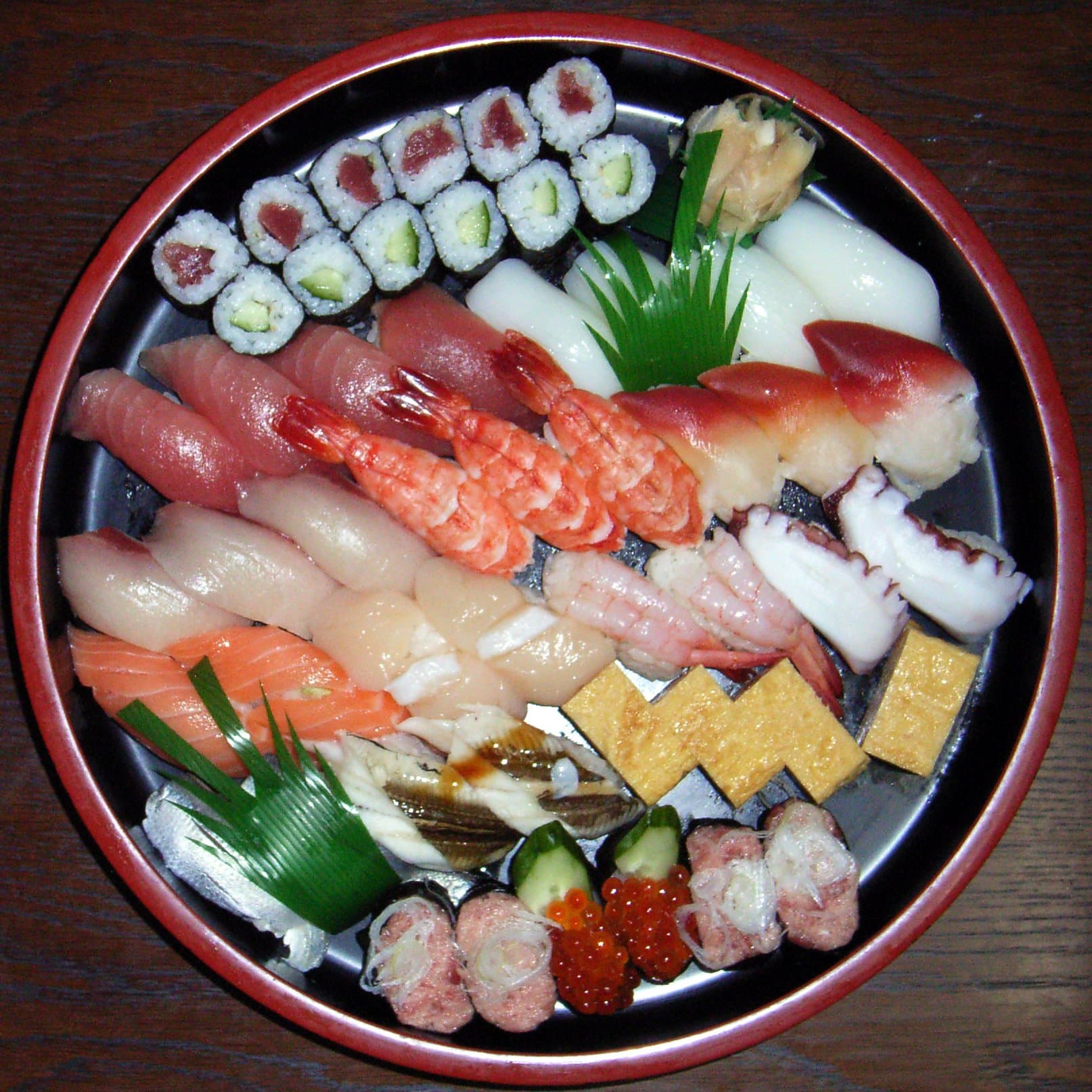
is the most iconic form: an oval ball of vinegared rice (around twenty grams), hand-shaped, topped with a slice of fish or seafood called , sometimes with a dab of fresh wasabi. It is eaten in a single bite, fish side down.
Every nigiri is an exercise in balance: rice temperature (warm, never cold), shaping pressure, thickness of the cut, amount of wasabi. The itamae adjusts to each fish: fatty tuna (ōtoro, 大トロ) is not handled like amaebi shrimp (甘海老) or .
Maki-zushi: The Art of the Roll#
wraps rice and filling in a sheet of toasted nori seaweed (海苔), rolled on a bamboo mat, the . Several formats:
- : a single ingredient, cucumber (kappa maki, 河童巻き), tuna (tekka maki, 鉄火巻き), or pickled daikon (shinko maki). Often an interlude between two nigiri.
- : several fillings (omelette, shiitake, kanpyō, shrimp, cucumber), cut into thick rounds. Served at celebrations, notably in February, when people eat a whole futomaki facing the year's lucky direction, called .
- places the rice outside and the nori within. A recent invention popularized in the United States, best known as the California roll.
Temaki: The Generous Hand Roll#
is a cone of nori stuffed with rice and filling, eaten with the fingers. At home temaki parties, each guest assembles their own cone from ingredients on the table.
Chirashi-zushi: The Festive Bowl#
is a bowl of vinegared rice topped with arranged ingredients. The Edomae chirashi of Tōkyō features raw fish over the rice, close to sashimi on shari; the of Kansai mixes cooked and marinated ingredients (mushrooms, lotus root, omelette strips, shrimp) into the rice. Served for and major family occasions.
Oshi-zushi and Battera: The Pressed Sushi of Ōsaka#
is Kansai's tradition, predating Edo's nigiri: rice and fish layered in a rectangular wooden mold (oshibako, 押し箱), pressed, unmolded, and sliced. is the most famous Ōsaka version: vinegar-marinated mackerel topped with a thin layer of kombu kelp (昆布), pressed onto rice.
Inari-zushi: The Sweetness of Fried Tofu#
is a pouch of fried tofu (aburaage, 油揚げ) simmered in a sweet-salty broth of dashi, soy sauce, and mirin, then stuffed with vinegared rice. Its name refers to , Shintō deity of rice and fertility, whose fox messengers are said to love fried tofu. A classic of bentō boxes and picnics.
Narezushi and Funazushi: Ancestors Still Alive#
The of Shiga remains a living witness to the original ancestor, with an acidic, umami complexity and cheesy notes reminiscent of aged Roquefort. Other regions have variants, like from Ishikawa, pairing fish with fermented turnip. These sushis recall that sushi was born of fermentation, not freshness.
The Neta: A World of Fish and Toppings#
refers to the topping over the rice. Its selection follows , the moment when an ingredient reaches its peak.
is the modern king of the counter, in three cuts: , lean red flesh; , moderately fatty; , the ultra-fatty belly. In January 2019, a 278-kilogram bluefin sold for 333.6 million yen (around 3 million US dollars) at the first Toyosu market auction, bought by restaurateur of the Sushi Zanmai chain.
is today the most popular neta in Japan, though virtually absent forty years ago. Norway introduced it: in the 1980s and 1990s, the Project Japan campaign convinced Japanese distributors to adopt farmed Atlantic salmon, fattier and milder than Pacific salmon.
Other classic neta: , , , , , , , , , , , and .
The techniques vary as much as the ingredients. wraps fish in kombu to transfer the seaweed's umami. , a soak in soy sauce, gives amber color and depth. sears the surface with a flame, the caramelized exterior against the raw interior.
Reading a sushi menu becomes a pleasure once you can pick out 鮪 (maguro, tuna), 鮭 (sake, salmon), and 雲丹 (uni, sea urchin) in the text. With JapaneseSRS and spaced repetition, learn to recognize these counter kanji and order like a regular in Japan.
The Shari: Rice, the Invisible Heart of Sushi#
If the neta catches the eye, it is the shari that makes the sushi. It represents 60 to 70 percent of a nigiri's volume, and its seasoning, temperature, and texture determine the eating experience.
The rice is a short-grain Japanese rice, like or , sticky yet firm. After cooking, it is transferred into a large cypress tub, the , mixed with a seasoning of vinegar, sugar, and salt, and fanned to cool it and give it a pearly sheen.
Every restaurant guards its vinegar recipe (awasezu, 合わせ酢), and every itamae adjusts it by season: more vinegar in summer, milder in winter. Ideal shari sits at body temperature, 36 to 38 degrees Celsius: warm enough to release the aromas without cooking the fish.
Sushi is often judged by its fish. But a master itamae knows the real test is the rice. Mediocre neta on perfect shari still makes a decent sushi; exceptional neta on bad rice is a failure.
The Itamae: Ten Years to Become a Master#
The is the sushi chef, far more than a cook: a craftsman whose traditional training stretches across a decade or more, inherited from the Japanese artisan guilds.
The path begins with : in the first years, the apprentice touches neither fish nor rice; he cleans, washes dishes, prepares secondary ingredients, and watches. Then he learns to cook and season the rice, roll maki. Only after several years does he cut fish, later still shape nigiri at the counter.
His knives are his most precious tools. The , long and thin, slices fish in a single stroke. The , heavy and thick, fillets whole fish. The is the vegetable knife. All are traditionally beveled on one side only (kataba, 片刃), for cleaner cuts demanding superior mastery.
The relationship with the customer at the counter (kauntā, カウンター) is essential to high-end sushi. At an omakase restaurant (お任せ, "I leave it up to you"), the customer entrusts the selection to the chef, who composes a menu in real time according to the day's catch and the season.
The Art of Eating: Etiquette and Know-How#
Nigiri can be eaten with fingers or chopsticks, even in the most prestigious restaurants. You flip it to dip the neta in soy sauce, never the rice: shari would absorb too much and fall apart, masking the chef's seasoning. , the vinegar-pickled ginger, is eaten between bites to cleanse the palate, not placed on the sushi. is already placed by the itamae between rice and fish; adding more to the soy sauce is considered unnecessary in a quality restaurant.
The order of eating goes from lighter flavors (white fish, squid) to richer, more intense ones (fatty tuna, sea urchin), ending with tamago or a maki.
From Kaiten-zushi to the World: Sushi Reinvented#
In everyday life, sushi is eaten in accessible forms. , invented in 1958 by in Ōsaka, circulates plates on a conveyor belt; the bill is calculated by the color and number of stacked plates. Chains like , , and serve hundreds of millions of customers a year, with plates from 100 yen.
At the opposite end, Tōkyō's omakase restaurants reach the heights. The most famous, , run by , became world-renowned through David Gelb's documentary Jiro Dreams of Sushi (2011): twenty seats, a fixed menu of about twenty nigiri served in thirty minutes, a price near 40,000 yen per person.
Sushi Outside Japan: Adaptation and Reinvention#
International expansion began in the 1960s and 1970s, with the first Japanese restaurants in the United States, particularly Los Angeles. The turning point was the California roll of the early 1970s, credited to chef of the Tokyo Kaikan in Los Angeles (authorship disputed). By flipping the roll to hide the nori (uramaki) and replacing raw fish with avocado and crab (often imitation crab), he created a sushi accessible to Western palates.
The California roll opened the floodgates: the rainbow roll, dragon roll, spicy tuna roll, tempura-fried rolls, sushi drenched in mayo and teriyaki. In Brazil, the largest sushi-consuming country outside Asia thanks to its Japanese diaspora, chefs developed the hot roll (fried sushi) and combinations with cream cheese and mango. In France, takeaway chains turned maki into everyday supermarket and station fare.
These adaptations irritate purists but speak to the vitality of the concept. With its modular structure (rice plus topping), sushi is inherently adaptable, and even the boldest creations have introduced it worldwide, pushing millions to discover the traditional forms.
In 2013, was inscribed on UNESCO's Intangible Cultural Heritage list, recognizing the culinary philosophy for which sushi is the most visible ambassador. The inscription protects not a fixed recipe but a set of values: respect for seasonal ingredients, harmony of flavors, aesthetics of presentation, and the bond between food and nature.
In this article
The cultural terms covered here, each with a short definition.
- Edomae sushi
- Style of sushi born in Edo (Tokyo), based on fresh fish prepared to be eaten right away.
- Itamae
- Japanese sushi master, a chef trained for years in cutting and plating fish.
- Maki
- Sushi rolled in a sheet of nori seaweed around rice and fillings, then sliced.
- Nigiri
- Sushi made of a hand-pressed mound of rice topped with a slice of fish.
- Sushi
- Japanese dish pairing vinegared rice with raw fish, seafood or vegetables.
- Washoku
- Traditional Japanese cuisine, recognized by UNESCO for its balance and seasonality.
The Okinawa diet: what the centenarians actually ate
Purple sweet potato, goya, tofu, pork: the traditional Okinawan diet as the surveys measured it, and why it had already vanished by the time its legend began.
Cover image: chidorian from Japan · Wikimedia Commons · CC BY-SA 2.0