The Okinawa diet: what the centenarians actually ate
Purple sweet potato, goya, tofu, pork: the traditional Okinawan diet as the surveys measured it, and why it had already vanished by the time its legend began.
La rédaction Kotoba Interactive
Studio éditorial
In 1949, a Japanese nutrition survey produced a figure nobody knew how to read at the time: in Okinawa prefecture, sweet potato supplied close to seven tenths of daily calories. Rice was marginal, meat rare, fish eaten less than on the main islands despite the ocean on every side. Thirty years later, when demographers noticed that those same islands held a density of centenarians unmatched in Japan, it was that austere survey they went back to.
became a public health argument before it was recognised as heritage. It deserves both readings: an island diet shaped by a kingdom that paid tribute to China, and a food model its own population abandoned within a single generation.
A kingdom with a mixed table#
Okinawan cooking grows out of a political status. The , unified in 1429 and annexed by Japan in 1879, lived off trade between Ming China, Japan, Korea and Southeast Asia. Every few years its court received the Chinese imperial envoys, the , and had to feed them for months: banquet cooking was codified for them, borrowing Chinese slow braising and clear broths.
That dependency produced the founding ingredient. In 1605, an official named brought sweet potato cuttings back from Fujian. The plant thrives on poor coral soil, survives typhoons, and spared the archipelago the famines that swept the rest of Japan. For three centuries was the base of the meal, while rice served mainly as tax and currency.
The second structuring import is pork, also Chinese. Okinawa raised, salted, braised and cured pigs at a time when Buddhist Japan officially abstained. The local formula has stayed proverbial: everything of the pig is eaten except its squeal.
literally means "medicine of life" in the Okinawan language. It is said in front of a restorative dish, and condenses the local view of the table as a daily pharmacy. It extends the Chinese principle of , "medicine and food share one origin".
The traditional diet, as the surveys measured it#
The numbers behind Okinawa's reputation describe an older state of the diet, not today's. Work started in 1975 by cardiologist Makoto Suzuki and continued with Bradley and Craig Willcox, gathered under the name Okinawa Centenarian Study, reconstructed eating patterns from 1949 to 1960: roughly 85 % of calories came from carbohydrates, sweet potato first, with a daily energy intake about a tenth below the Japanese average.
That diet combined high nutrient density with a low calorie load: green and yellow vegetables in quantity, soy in every form, seaweed, very little refined sugar, very little dairy, small amounts of collagen-rich pork, fish depending on the day. Researchers read it as a natural case of moderate calorie restriction, one of the few protocols whose effect on lifespan is documented in animals.
To that picture popular literature added a rule: , stopping at eight tenths of fullness. The precept is Confucian in origin and known across Japan, but its daily use in Okinawa struck the fieldworkers, because it acts exactly where the diet is fragile, on quantity.
The Okinawan diet was not a diet of deprivation: it was a diet of plant volume, where people ate a great deal for very few calories.
The dishes that make the table#
Chanpurū, the cooking of mixture#
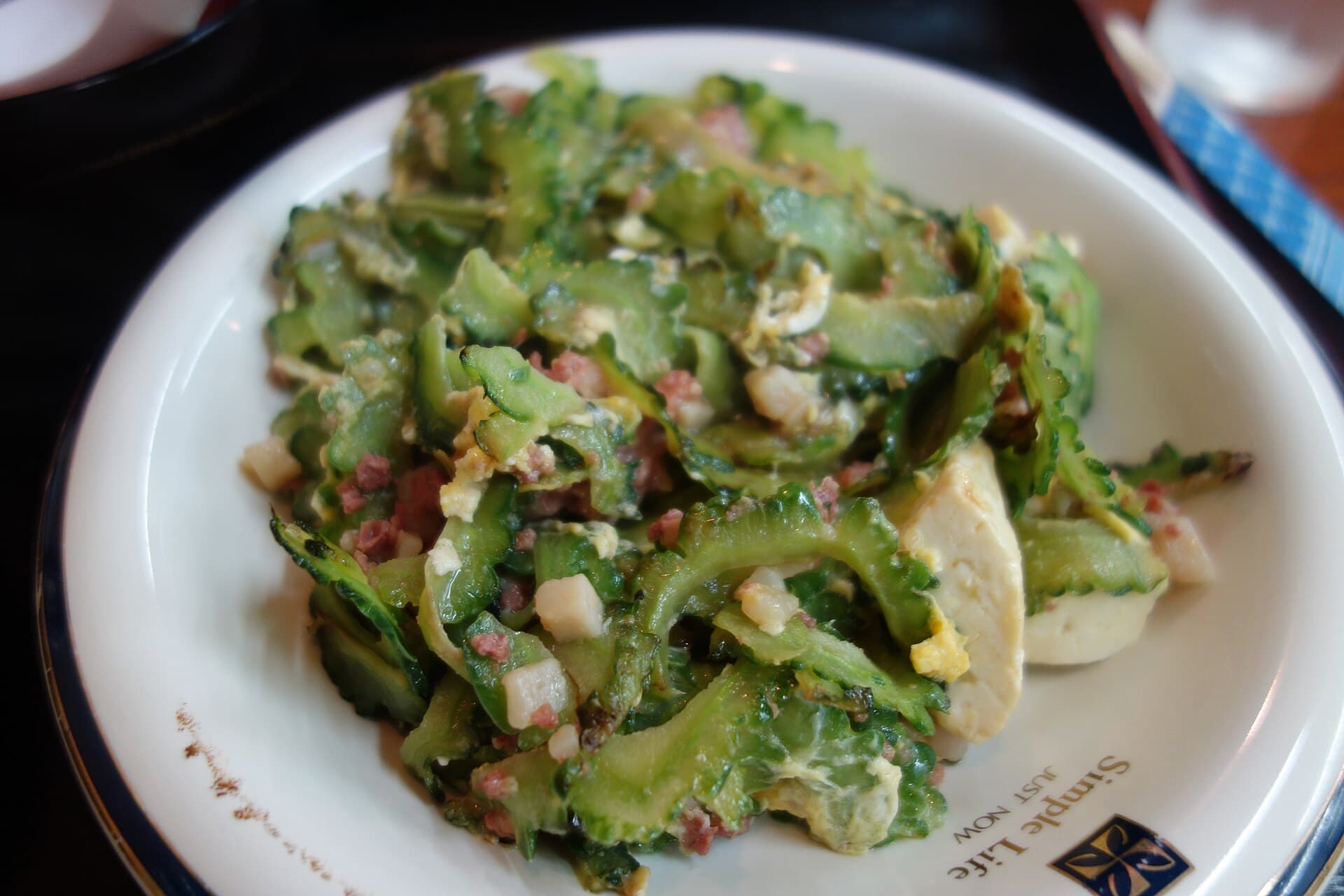
is a stir-fry combining a vegetable, crumbled firm tofu, a little pork or tinned meat, and egg. The word means "mixture", and its etymology is debated: it has been traced to Malay campur, "to mix", and to Chinese culinary vocabulary, without a settled answer.
The best known version, , uses bitter melon, the warty green gourd whose blunt bitterness is the signature taste of the archipelago. The tofu used is , island tofu, pressed and dense, which holds in the pan where mainland tofu falls apart.
Pork, from snout to trotter#
is pork belly braised slowly in awamori, soy sauce and brown sugar, a direct cousin of Chinese dongpo rou. serves pig ears in thin crunchy strips, simmers trotters down to gelatine. The long cooking, always preceded by blanching, removes part of the fat and explains the local paradox: high pork consumption, but a pork dish low in residual grease.
The sea without much fish#
Okinawa eats seaweed above all. , a mucilaginous filament seaweed, is produced there in an overwhelming share of the Japanese harvest and served in vinegar dressing. , which does not grow in these warm waters, arrived by the kitamaebune shipping route from Hokkaidō, to the point that Okinawa long ranked among Japan's heaviest consumers of a seaweed it never produced.
A menu in Naha reads in Japanese tinted with Okinawan: 豆腐 (tōfu), 豚肉 (butaniku, pork), 海藻 (kaisō, seaweed), 命薬 (nuchi gusui). JapaneseSRS, our spaced repetition app for learning Japanese, is coming soon: join the waiting list and order without relying on the photos.
The Okinawan table lexicon#
| Dish or product | Writing | What it is |
|---|---|---|
| Gōyā | ゴーヤー | Bitter melon, the emblem vegetable of the islands |
| Chanpurū | チャンプルー | Mixed stir-fry with tofu and egg |
| Shima-dōfu | 島豆腐 | Island tofu, firm and dense |
| Jīmāmi-dōfu | ジーマーミ豆腐 | Peanut "tofu", no soy, custard texture |
| Tōfuyō | 豆腐よう | Tofu fermented with red koji and awamori |
| Rafutē | ラフテー | Pork belly braised in awamori |
| Mimigā | ミミガー | Pig ear salad |
| Tebichi | てびち | Simmered pig trotters |
| Mozuku | もずく | Filament seaweed served with vinegar |
| Beni-imo | 紅芋 | Purple sweet potato, now the star of local pastry |
| Shīkwāsā | シークヮーサー | Small sour citrus, used as juice and seasoning |
| Sanpin-cha | さんぴん茶 | Jasmine tea, the everyday drink |
| Awamori | 泡盛 | Spirit distilled from indica rice with black koji |
What the diet owes to social life#
Reducing Okinawan longevity to a shopping list is a misreading the researchers themselves flagged. Two local institutions come up in every field survey. , neighbourhood mutual aid inherited from collective farm work, keeps reciprocal obligations alive into old age. , a rotating savings club of friends who meet and contribute monthly, creates groups that hold together for decades: people join for the money and stay for the table and the conversation.
One more factor escapes nutrition data: the subtropical climate allows kitchen gardening and walking all year, and home market gardening long supplied a significant share of the vegetables eaten.
Aged awamori is called . Tradition held that a jar be filled at each birth and topped up without ever being emptied, a cascade ageing method known as shitsugi. The Battle of Okinawa in 1945 destroyed nearly all those century-old jars: the oldest kūsū available today almost all date from after the war.
The diet vanished before its legend did#
Okinawa's best documented paradox is its reversal. In 2000, the prefectural life table published by Japan's health ministry dropped Okinawan men to twenty-sixth place nationally, after years at the top. The Japanese press kept the episode under the name . Later surveys extended the decline, and women's life expectancy, long first in the country, slipped in turn across the five-yearly figures.
The causes are as much military history as food industry. Under American administration from 1945 to 1972, the islands acquired bases, supermarkets and fast food well before the rest of Japan. Tinned pork became an everyday product, to the point that , a slice of luncheon meat with omelette, is now served at breakfast and inside rice balls. , taco filling over white rice, appeared in 1984 in the town of Kin, next to Camp Hansen, to feed American servicemen: it is now claimed as a local dish.
The result is measurable in Japanese health statistics: Okinawa regularly ranks at the top of prefectures for obesity, with vegetable consumption below the national average and heavy car dependence in a territory where public transport remains limited. Living centenarians were born before the war and ate the old diet; the generations after them ate something else.
What needs qualifying#
Caution also applies to the legend itself. Okinawa's civil registers were largely destroyed during the 1945 battle, which makes age verification harder there than elsewhere. From 2024, demographer Saul Justin Newman published work showing that regions famous for concentrations of supercentenarians often coincide with regions of poor record keeping, a result that earned him an Ig Nobel prize the same year and that invites method when handling centenarian statistics.
None of this invalidates the nutritional observation, which rests on dietary records rather than declared ages: a diet dense in plants, low in calories and sugar, paired with moderation at the table, remains defensible. It simply argues for reading Okinawa as what it is, a cuisine of necessity that became a cuisine of taste, rather than selling it as a miracle.
Read alsoThe haenyeo: the sea women of JejuAnother Asian island where women's work, the sea and food draw a singular pattern of longevity.
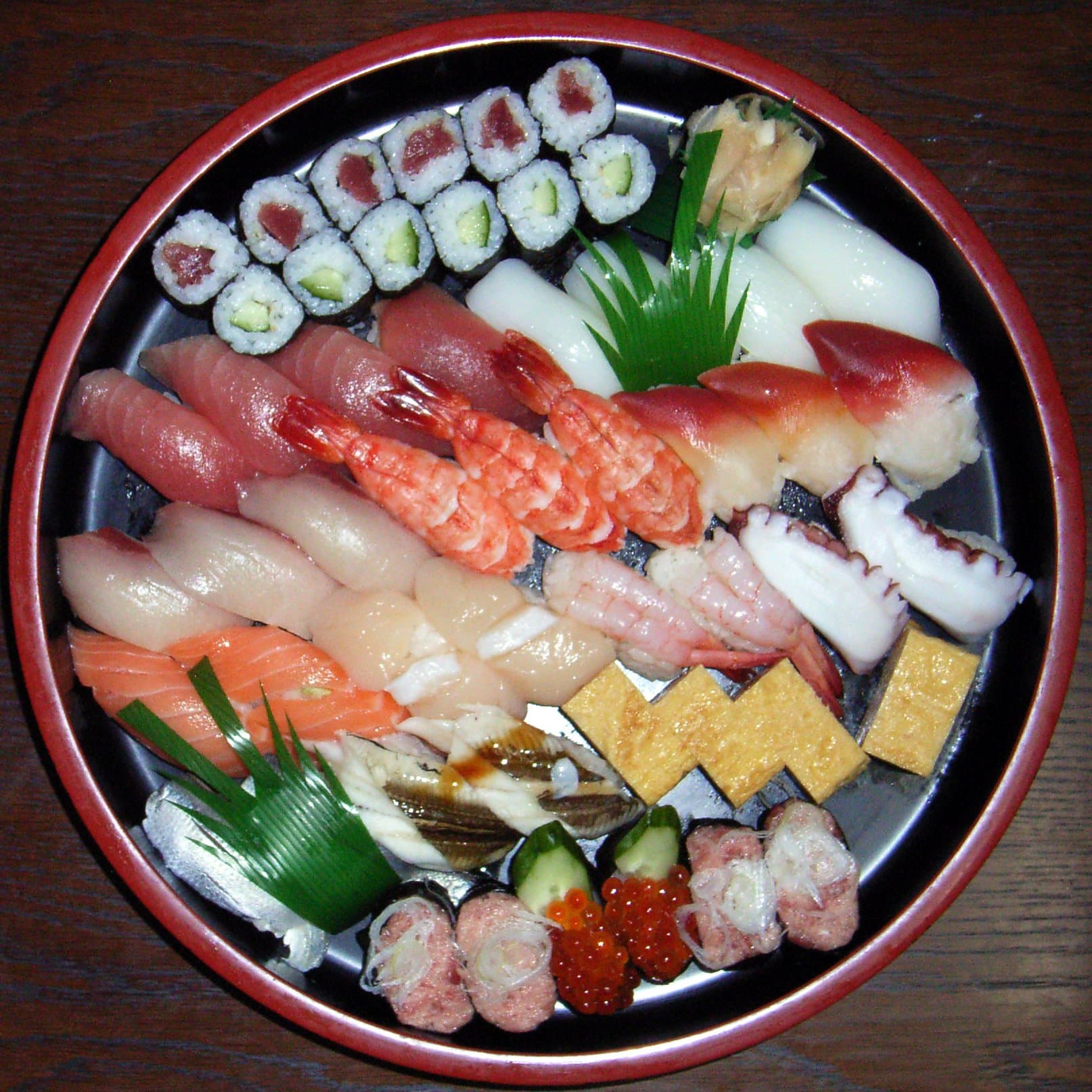
The contrast is telling: mainland Japan built its most famous cuisine on rice and raw fish, a long way from Okinawan sweet potato and braised pork.
Cooking Okinawan today#
Bringing the traditional diet back depends less on rare products than on three moves. Replace part of the white rice with sweet potato, including the purple beni-imo variety. Treat firm tofu as an ingredient in a hot dish rather than a cold side. Introduce a green bitterness, bitter melon if an Asian grocer stocks it, kale or chicory otherwise, because bitterness is what gives chanpurū its structure.
The least reproducible move requires no ingredient at all: putting the chopsticks down before feeling full. Jars of kūsū waited decades before being opened; their owner did not take a second helping.
FAQ#
What does the Okinawan diet consist of? In its traditional form, recorded between 1949 and 1960, it rests on sweet potato as the main calorie source, abundant green and yellow vegetables, soy in every form, seaweed, little sugar, little dairy, small quantities of braised pork, and a moderate overall calorie intake.
What does hara hachi bu mean? means "belly at eight tenths": stopping before complete fullness. The precept is Confucian in origin and known throughout Japan, but its daily practice in Okinawa was noted by the Okinawa Centenarian Study researchers.
Is bitter melon really good for you? Bitter melon is rich in vitamin C and fibre, and has been studied for effects on blood sugar, though that work does not justify presenting it as a treatment. Its main virtue in the local diet is simpler: it makes a very plant-heavy dish appetising.
Why did life expectancy in Okinawa fall? Because the diet changed. The American administration from 1945 to 1972 installed fast food, tinned pork and car dependence early. Japanese prefectures publish life expectancy by sex every five years: Okinawa has been slipping since the 2000 survey, especially among men.
Can you eat Okinawan outside Japan? Yes, if you aim at the structure of the meal rather than unobtainable products: sweet potato instead of part of the rice, firm tofu cooked hot, a regular seaweed, a bitter vegetable, simmered and degreased pork rather than grilled, and portions stopped before fullness.
Photo credits: the images in this article come from Wikimedia Commons and are under a free license.
Ramune: the marble soda of Japan
The full history of ramune, Japan's iconic marble soda. Victorian origins, the Codd bottle, flavours, the opening ritual, and its enduring place in Japanese pop culture.
Cover image: pelican from Tokyo, Japan · pelican from Tokyo, Japan, via Wikimedia Commons · CC BY-SA 2.0