Soju: The History and Etiquette of Korea's National Spirit
The history of soju, Korea's national spirit: its Mongol origins, the rice ban, the Jinro brand, the etiquette of the glass and soju's place in Korean culture.
La rédaction Kotoba Interactive
Studio éditorial
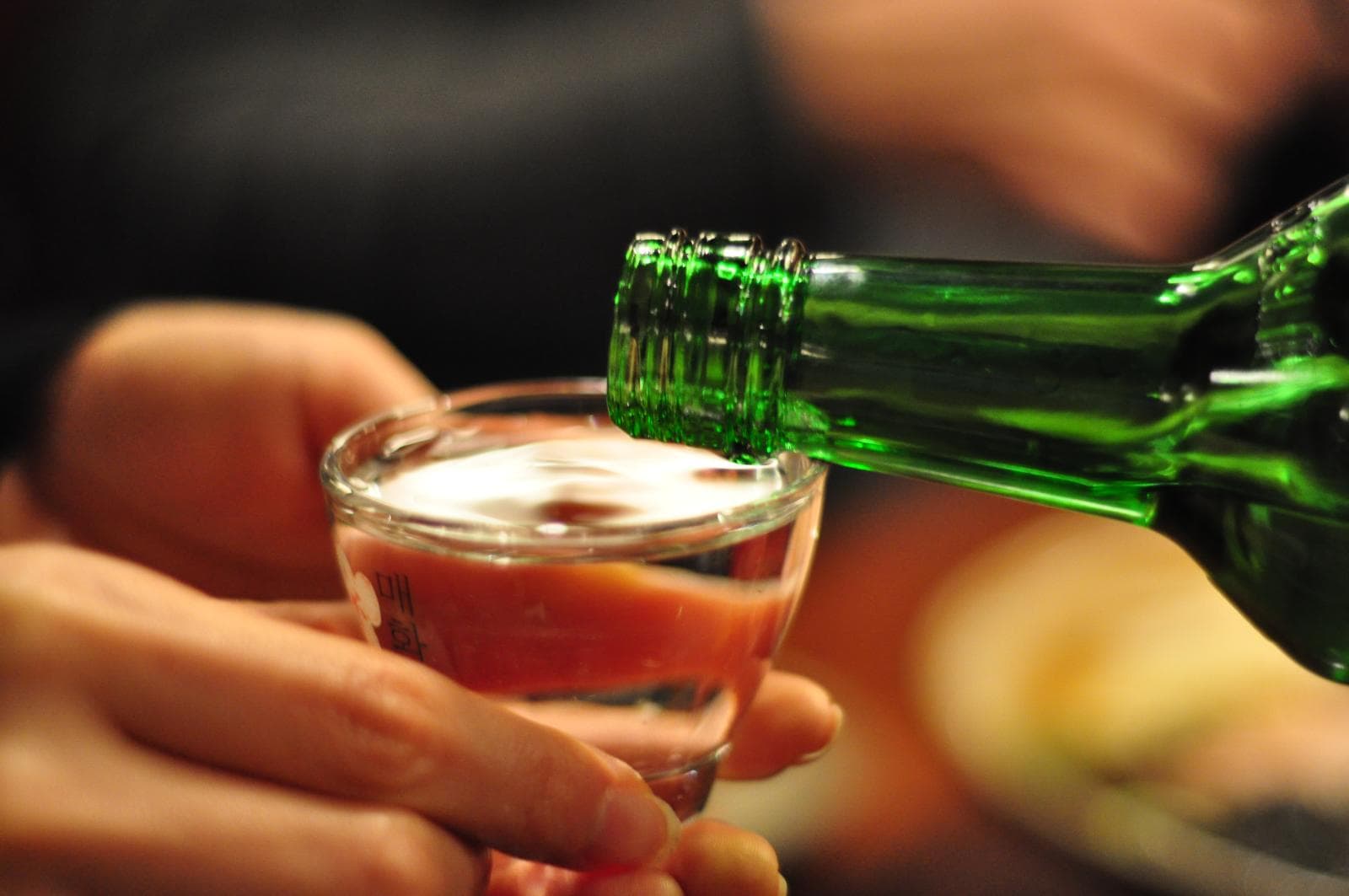
The little green bottle arrives at the table, ice-cold, barely bigger than a can. You roll it between your palms, tap the bottom with your elbow, then unscrew the cap with a practiced gesture. The youngest takes the bottle in both hands and serves the elders first, never filling their own glass. You toast, turn your head slightly to drink, and the Korean meal suddenly takes on a different rhythm. It is soju time.
is Korea's national spirit and one of the best-selling liquors in the world. Clear, inexpensive, traditionally around 20 percent alcohol, it accompanies meals, seals friendships and lubricates the country's social life. But behind its apparent simplicity lie an eventful history, a precise etiquette and a central place in Korean culture.
Origins: a spirit from afar#
Soju was not born in Korea. The distillation technique from which it derives is said to have arrived there in the thirteenth century, during the Mongol invasions. The Mongol Empire, which had discovered distillation through contact with the Persian and Arab world, introduced it to the peninsula, where production centers developed, notably around Kaesong and Andong.
The very term soju literally means "burned alcohol," in reference to the heat of distillation. Originally, soju was distilled from rice (or other grains), yielding an artisanal and relatively strong spirit. Andong soju, traditionally distilled, still carries on this heritage of quality today.
To drink soju in Korea is never a solitary act: it is a social ritual, a language of respect and connection in which the way you pour matters as much as what you drink.
The 1965 turning point: from rice to industry#
The modern history of soju shifted in 1965. Faced with food shortages after the Korean War, South Korea banned the use of rice for distilling spirits, in order to preserve grain reserves.
Producers then turned to diluted spirits obtained from sweet potato, tapioca, wheat or molasses, flavored and sweetened. This was the birth of the cheap industrial soju we know today, very different from traditional rice-based soju. The rice ban was lifted in the 1990s, but the industrial model had taken hold.
The Korean brand , with its Chamisul soju, regularly tops the world rankings of best-selling spirits, ahead of major vodka and whisky brands. A success owed to massive consumption in the Korean market alone.
Soju etiquette: an art of respect#
Drinking soju in Korea follows precise rules, inherited from Confucianism and its respect for hierarchies of age and status. To ignore them is to risk seeming ill-mannered.
These table gestures have their own words in Korean: 건배 (geonbae, "cheers!"), 소주 (soju, the national spirit) and 회식 (hoesik, the after-work drinking outing). With KoreanSRS and spaced repetition, commit this vocabulary of sharing to memory and grasp the codes behind every sip.
Pouring and receiving#
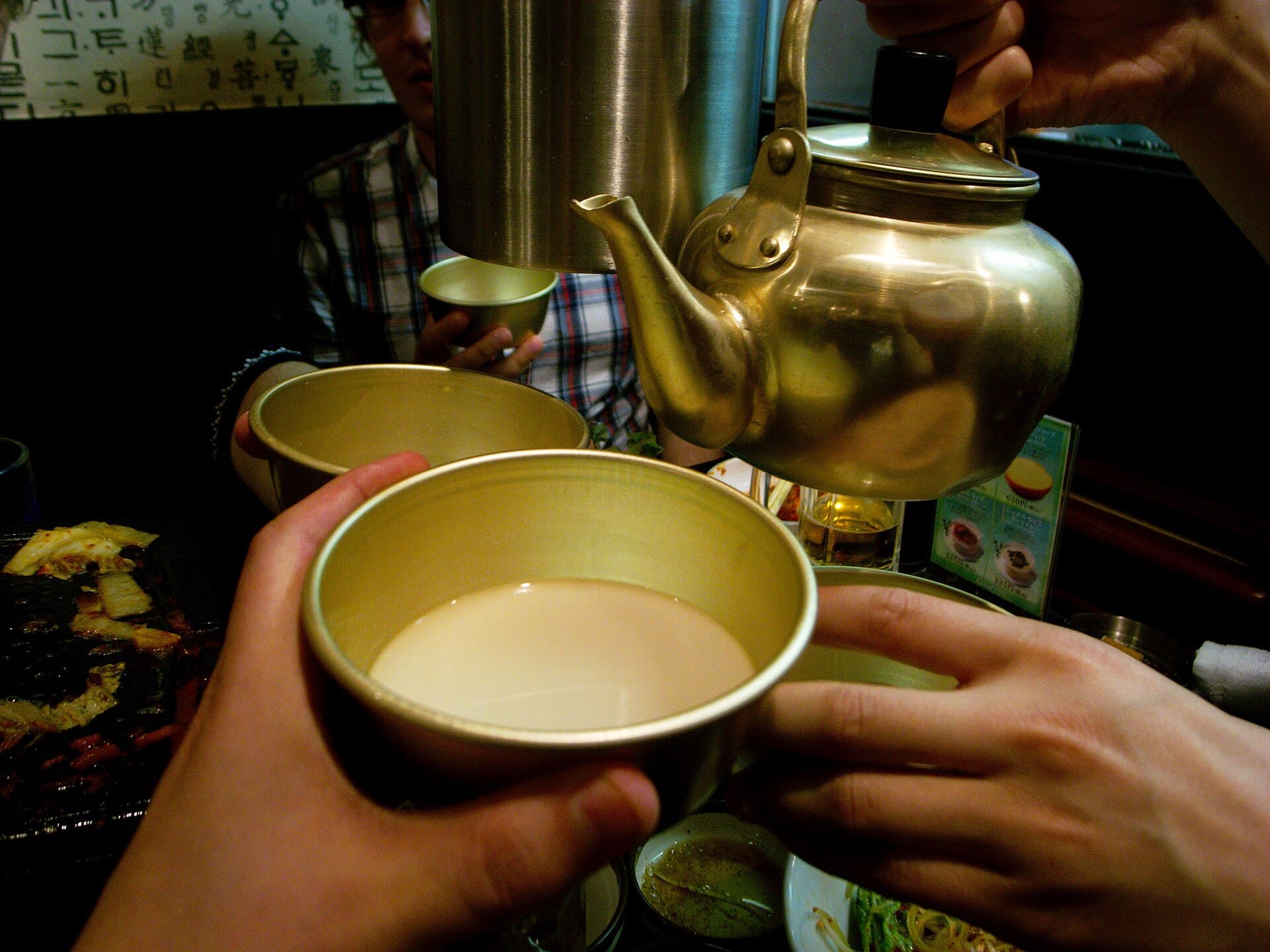
You never serve yourself: it is for others to fill your glass, and for you to fill theirs. You always serve the elders first, and you hold the bottle with both hands (or the right hand supported by the left) as a sign of respect. Likewise, you receive your glass with both hands.
Drinking before an elder#
When drinking in the presence of someone older or of higher rank, custom dictates that you turn your head slightly to the side and sometimes shield your glass with your hand, out of deference. The first glass is often emptied in one go ("one shot").
is written with the characters so (燒, "to burn") and ju (酒, "alcohol"): "burned alcohol," named for the distillation process. The same second character appears in Japanese shōchū and Chinese jiǔ, witnesses to a culture of alcohol shared across East Asia.
Soju in daily life#
Soju is inseparable from the hoesik (회식), those company outings where colleagues and superiors drink together, and more broadly from all conviviality. It is readily drunk mixed with beer to make somaek (soju + maekju, beer), a popular cocktail measured out with sometimes spectacular techniques.
Omnipresent in K-dramas and films, soju has become a cultural marker exported with the Korean wave. Flavored, sweeter versions (grapefruit, peach, yogurt) have won over a young, international audience, broadening its reach still further.
Read alsoBanchan: The Small Dishes That Define Korean DiningSoju is never drunk alone: it calls for the banchan, those little dishes that cover the Korean table and accompany every sip.
Soju today: tradition and revival#
Soju lives a double life. On one side, the cheap, omnipresent industrial soju remains the companion of meals and evenings for a whole country. On the other, there is a revival of artisanal soju, distilled from rice using ancient methods, carried by distilleries seeking to restore the drink's prestige.
| Type | Base and making | Strength | Character |
|---|---|---|---|
| Andong soju (안동소주, andong soju) | Rice, traditional distillation | 40 to 45% | Artisanal, heritage |
| Industrial soju (희석식 소주, huiseoksik soju) | Sweet potato, tapioca or wheat, diluted | 16 to 20% | Cheap, omnipresent |
| Flavored soju (과일 소주, gwail soju) | Industrial base, fruit flavorings | 12 to 15% | Sweet, young crowd |
| Somaek (소맥, somaek) | Soju mixed with beer (maekju) | 8 to 12% | Convivial, festive |
This tension between mass production and craft, between everyday alcohol and heritage, tells in itself the recent history of Korea: a country that, after shortage and forced industrialization, is rediscovering and revaluing its traditions.
To learn about soju is to learn a little Korean and a great deal of social code: "one shot," somaek, geonbae ("cheers!"), the hand supporting the bottle, the head that turns away. Behind the little green bottle, a whole Korean art of connection reveals itself, sip after sip.
FAQ#
What is soju? Soju (소주) is Korea's national distilled spirit, clear and traditionally around 20 percent alcohol. Long made from rice, it is today often produced from sweet potato, tapioca or wheat.
Why is soju no longer made from rice? In 1965, South Korea banned the use of rice for distillation to preserve food reserves after the war. Producers turned to other starches, giving rise to today's industrial soju.
How do you drink soju in Korea? According to a precise etiquette: you never serve yourself, you serve elders first with both hands, and you turn your head to drink in front of an older person, out of respect.
What is somaek? Somaek is a mix of soju and beer (maekju), a very popular cocktail in Korea, often prepared and measured out with codified techniques during evenings among friends or colleagues.
Photo credits: the images used in this article come from Pexels and Unsplash and are royalty-free.
Pojangmacha: under Korea's orange street food tents
Discovering Korean pojangmacha: history, atmosphere, signature dishes (tteokbokki, odeng, somaek) and their place in popular culture and K-dramas.
Cover image: /Repository/2022/11/29/thiet-ke-chua-co-ten-17.png · Wikimedia Commons · CC BY 2.0