Banchan: The Small Dishes That Define Korean Dining
Banchan, the small shared dishes at every Korean meal, carry centuries of philosophy, fermentation science and seasonal wisdom. A deep dive.
La rédaction Kotoba Interactive
Studio éditorial
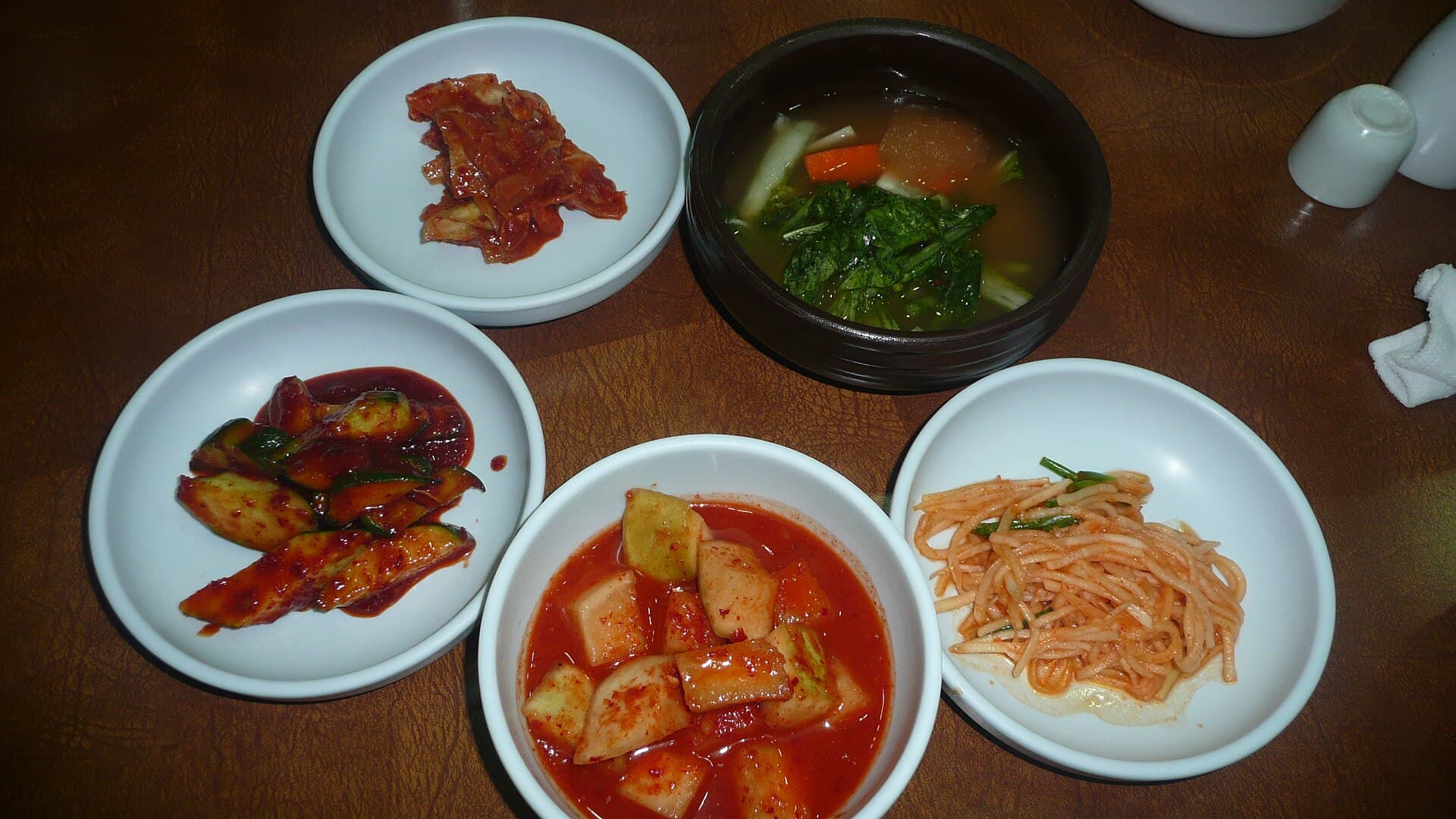
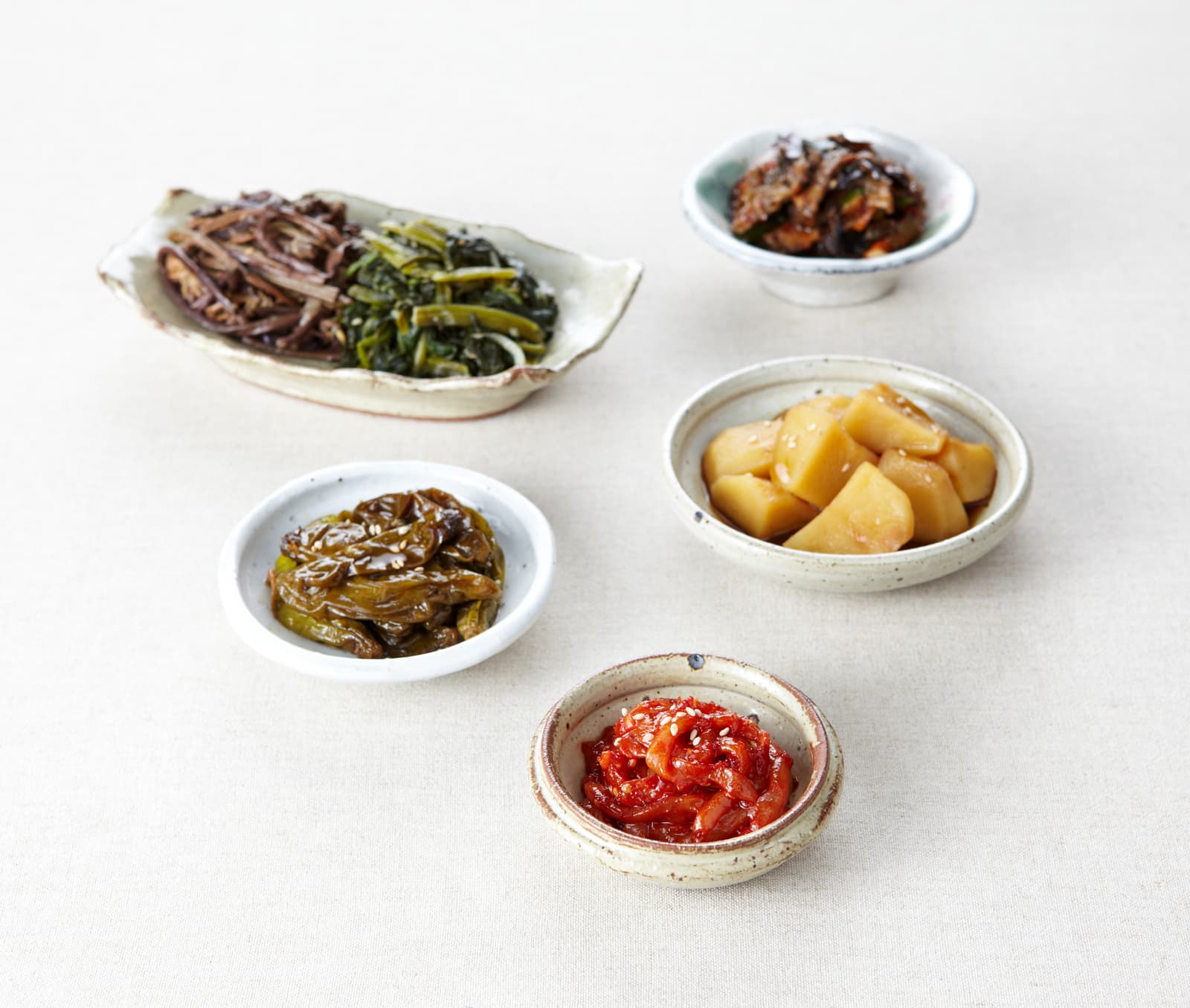
Push open the door of any neighborhood restaurant in Seoul. Before the rice even arrives, the table fills with small plates: five, eight, sometimes twelve. Bright red kimchi, sesame spinach, caramelized anchovies, cubes of radish, braised tofu. Nobody ordered them, nobody will pay extra for them. These dishes are , and without them, a Korean meal is not a meal.
Banchan are not appetizers, not tapas, not mezze. They do not precede the main dish: they accompany it, are shared without ceremony, and are refilled on request. Eating without banchan would be as unthinkable as eating without rice. Behind this daily habit lies a culinary system forged over centuries of Buddhist, Confucian and peasant influence, and by the science of fermentation.
Bap-sang: The Architecture of a Korean Table#
In Korean, people do not say "a meal" but , and everything revolves around it. The table set for a meal is called , literally "the rice table." Rice is the geographic and philosophical center of the meal, and banchan are the satellites orbiting around it.
Tradition classifies meals by the number of banchan served alongside rice and soup. This system, codified during the dynasty, has precise names: a features three banchan, an five, a seven, and the nine. The royal table, the served to the kings of Joseon, could reach twelve banchan. The number reflected the guest's social rank, the formality of the occasion, and the concern for a nutritionally complete meal.
| Table (bap-sang) | Number of banchan | Context |
|---|---|---|
| Sam-cheop (삼첩) | 3 | Everyday commoner meal |
| O-cheop (오첩) | 5 | A careful ordinary occasion |
| Chil-cheop (칠첩) | 7 | Receiving guests |
| Gu-cheop (구첩) | 9 | Well-off families, ceremony |
| Sura-sang (수라상) | 12 | Royal table of Joseon |
The Balance of Five#
Korean culinary philosophy rests on , the five cardinal colors inherited from Sino-Korean cosmology. Each corresponds to a cardinal point, an organ, a season, and a flavor. White (west, lungs, autumn) appears in rice, radish, and tofu; black (north, kidneys, winter) in seaweed and mushrooms; green (east, liver, spring) in , the seasoned vegetables; red (south, heart, summer) in kimchi and ; yellow (center, spleen, transitional seasons) in zucchini pancakes and eggs.
A well-composed meal brings together these five colors and the five flavors: salty, sweet, sour, bitter, and spicy. This is an intuitive skill, passed from mother to daughter. When a home cook feels that "there is not enough green," she knows through decades of practice that the table is not yet complete.
Ancient Origins: From the Kingdom of Silla to Red Chili#
The earliest written traces of side dishes on the peninsula date back to the Three Kingdoms period (57 BCE to 668 CE), when , , and developed distinct culinary traditions. Chinese chronicles note that the people of Goguryeo, in the north, were "skilled in fermentation" and produced soybean pastes and vegetables preserved in salt: it is here that banchan find their deepest origins.
The Buddhist Imprint#
The adoption of Buddhism as the state religion (Goguryeo in 372, Baekje in 384, Silla in 528) transformed Korean cuisine. Precepts forbidding the killing of animals encouraged a plant-based cuisine of exceptional richness, and monks perfected the art of namul. Korean temple cuisine, , recognized as one of the most refined culinary heritages in Asia, excludes meat and fish but also the five pungent vegetables (garlic, green onion, chives, Chinese chives, and wild leek), considered stimulants that disturb meditation.
It was in these temples that some of the most iconic banchan were born: fern namul, braised lotus root , white kimchi, and vegetables preserved in soy sauce. Monastic discipline, which forced cooks to extract maximum flavor from minimal ingredients, founded the techniques of banchan cuisine.
The Chili Revolution#
For centuries, Korean cuisine did without chili: the dominant flavors were salty (salt, fermented soy), sour (vinegar, lactic fermentations), and Sichuan pepper . Everything changed with the arrival of , the red chili pepper. The most widely accepted theory places its arrival in the late 16th or early 17th century, possibly via Japan in the wake of invasions of 1592-1598, or through trade with the Portuguese in East Asia.
The first Korean text to mention chili is the Jibong yuseol (지봉유설, 1614) by , who describes it as a plant from Japan; the Jeungbo sallim gyeongje (증보산림경제, 1766) later documents its integration into everyday cooking. In two centuries, chili transformed the Korean palate and gave birth to and . Kimchi, until then fermented in brine, became red and complex; Korean cuisine acquired its fiery signature.
Banchan carry within them the layers of Korean history: Buddhist frugality, Confucian rigor, the shock of chili arriving from overseas, and that stubborn peasant determination to transform necessity into art.
Every banchan carries a name that tells you how it is made. Learn to read and remember these words with KoreanSRS and spaced repetition: 반찬 (banchan, the small dishes), 밥상 (bapsang, the rice table), and 나물 (namul, seasoned vegetables) will soon feel familiar.
Kimchi: King of the Banchan#
is the most famous of the banchan. It is not a single dish but an entire family of fermented vegetable preparations. The Kimchi Museum in Seoul catalogs over two hundred, but some researchers estimate the real number, counting regional and family variants, exceeds three hundred.
A World of Varieties#
The best known is , whole napa cabbage seasoned with gochugaru, garlic, ginger, fish sauce , fermented shrimp , and scallions. But the family is vast:
- : cubes of white radish coated in chili, the companion to , the milky beef bone broth.
- : whole radish in a clear brine without chili, whose icy broth serves as the base for , Korean cold noodles.
- : small radishes with their green tops, sharp and vibrant.
- : cucumber stuffed with chili seasoning, the summer specialty.
- : mustard leaves, a specialty of Jeolla, intensely bitter and hot.
- : white kimchi, without chili, a reminder of the pre-chili origins of the tradition.
The Science of Fermentation#
Kimchi is a living microbial ecosystem. Its fermentation relies on lactic acid bacteria, primarily Leuconostoc, Lactobacillus, and Weissella, which convert the sugars in the vegetables into lactic acid. This process, at low temperatures, produces the acidity that balances heat and saltiness, and generates vitamins (B1, B2, B12, C), probiotics, and aromatic compounds.
Fresh, is eaten the same day, crunchy and bright. After a few days, it reaches the stage, "ripe," with fully developed acidity. Pushed further, it becomes , "aged," stored for a year or more, whose deep, almost cheese-like flavor is prized in stews.
Kimjang: A Collective Ritual#
Every autumn, millions of households come together for , the great collective preparation of winter kimchi. This tradition, inscribed on UNESCO's Intangible Cultural Heritage list since 2013, mobilizes families, neighbors, sometimes whole neighborhoods: people buy hundreds of cabbages, prepare dozens of kilograms of seasoning, and work together for hours. The kimchi produced feeds the family through the winter.
It is also a moment of transmission, where mothers teach daughters the dosage of salt, the right degree of cabbage ripeness, the amount of fish sauce that separates ordinary kimchi from extraordinary kimchi. Every family guards its recipe, and a mother's kimchi remains for many the most powerful taste of childhood.
Beyond Kimchi: The Diversity of Banchan#
Kimchi represents only a fraction of the banchan universe, divided into several major categories.
Namul: The Art of Seasoned Vegetables#
are vegetables, herbs, or wild plants, blanched or sauteed, then seasoned with sesame oil, salt, garlic, and sometimes soy sauce. Hundreds exist.
transforms simple blanched spinach, lifted with toasted sesame and garlic. , crunchy soybean sprouts, appears on nearly every table. , made from dried ferns that are rehydrated and sauteed, recalls the mountain origins of Korean cooking. , bitter bellflower root, is a classic of .
Wild plant namul, , form a seasonal tradition rooted in rural culture. , , and appear at markets with the first days of spring.
Jorim and Bokkeum: Braised and Stir-Fried#
is slow braising in a liquid of soy sauce, sugar, and garlic, until the ingredients absorb the broth. , tofu braised in a spicy soy sauce, is one of the most popular banchan. braises potatoes in a sweet-salty sauce. , beef simmered in soy sauce with quail eggs, was the quintessential reserve banchan: stored in its sauce, it could feed a family for weeks.
refers to dishes stir-fried over high heat. , small dried anchovies tossed with rice syrup and sesame, accompanies rice with a balance of sweet, salty, and bitter. , strips of dried squid stir-fried in gochujang, offers a chewy texture.
Jeon and Twigim: Pancakes and Fritters#
are pancakes: an ingredient is coated in flour and beaten egg before pan-frying until golden. , zucchini rounds; , scallion and seafood pancakes; and , mung bean pancakes, appear on everyday tables and at celebrations such as and . are fritters closer to Japanese tempura.
Jeotgal and Jangajji: Fermented Seafood and Preserves#
are seafood fermented in salt, both a banchan and an ingredient. and are indispensable to kimchi. and are eaten on their own, with hot rice.
are vegetables preserved in soy sauce, doenjang, or vinegar, sometimes for months: , garlic cloves marinated in sweetened soy sauce, and , preserved perilla leaves.
Jang: The Mother Sauces of Korean Cuisine#
If banchan are the stars of the table, are the solar system. Korean cuisine rests on three fermented pillars.
is the oldest. Unlike Japanese or Chinese soy sauce, it starts from a single fermented ingredient, , a block of cooked, crushed soybeans left to ferment outdoors for weeks, naturally colonized by Aspergillus molds and Bacillus bacteria. The meju is then submerged in brine and fermented for months in earthenware jars: the resulting brown liquid is ganjang, the solid residue becomes doenjang.
is the Korean counterpart to Japanese miso, more raw and powerful. Its earthy, umami-rich flavor forms the base of , the stew that is, alongside kimchi-jjigae, the ultimate comfort food.
is the youngest, appearing after the introduction of chili in the 17th century. It combines chili, fermented glutinous rice, meju, and salt into a dark red paste where spicy, sweet, salty, and umami intertwine. It is the essential seasoning for bibimbap, tteokbokki (떡볶이, spicy rice cakes), and numerous banchan.
The Jangdokdae: A Vanishing Landscape#
Traditionally, jang ferment in earthenware jars called , arranged on an outdoor platform known as a . The microporous walls of these jars allow gases to escape while blocking contaminants. A well-maintained jangdokdae could hold dozens of jars: one-year ganjang, three-year ganjang, doenjang, gochujang, kimchi, jeotgal. It was the pantry and the pride of every household.
With the massive urbanization of South Korea from the 1960s, jangdokdae disappeared from rooftops and courtyards, and industrial sauces replaced homemade fermentations. Yet in the countryside and in many artisanal restaurants, the tradition endures, and some families keep ganjang several decades old.
In every jar of doenjang lies the imprint of a hand, a season, a terroir. Two neighboring families, using the same soybeans and the same salt, will produce different flavors. That is the invisible signature of living things.
Banchan Today: Between Tradition and Renewal#
The Culture of the Free Refill#
One of the most surprising customs for foreign visitors is the free, unlimited banchan. An empty plate held out to the server comes back full. Banchan are not a product for sale but a component of hospitality: their number, variety, and quality are often the first criterion by which Korean diners judge an establishment.
This culture has its unspoken rules. A good restaurant serves at least five banchan; major traditional restaurants, , may offer fifteen or twenty. Kimchi is an absolute minimum. Regular customers sometimes choose a place for the quality of one particular banchan.
Banchan in Modern Life#
In the 1960s, the typical homemaker spent several hours a day preparing banchan. Today, supermarkets and markets overflow with prepared banchan, sold by weight. The market in Seoul devotes entire aisles to ready-to-go banchan, from kongnamul to japchae (잡채, stir-fried sweet potato noodles).
The , a refrigerator designed for kimchi fermentation, has become a standard appliance. Launched in the 1990s by , it maintains constant temperatures slightly higher than a standard refrigerator, replicating the conditions of onggi jars once buried in the ground.
Banchan and the World#
The has propelled Korean cuisine onto the international stage. The global success of kimchi, recognized by Time magazine in 2024 among the most influential fermented foods on the planet, has fed curiosity about other banchan. Korean restaurants in New York, Paris, London, and Sao Paulo now offer experiences that rival those in Seoul.
But this export raises questions of authenticity. Is kimchi fermented in France with local ingredients still kimchi? The question touches on the tension between tradition and globalization. One thing is certain: banchan continue to define the Korean table, at home and abroad. They are proof that a meal is not the sum of its dishes but a system, a balance, a conversation between flavors, textures, and colors.
In this article
The cultural terms covered here, each with a short definition.
Baechu, dongchimi, kkakdugi: the varieties of kimchi
Kimchi is not one dish but a family: whole cabbage, cubed radish, winter brine, summer versions. The edible atlas of a national fermentation.
Cover image: 국립국어원 · Wikimedia Commons · CC BY-SA 2.0 kr