Seoul: the district guide that makes the city legible
Gangbuk and Gangnam, gu and dong, subway exits: how Seoul is organised, what each district is for, and how to read a Korean address without getting lost.
La rédaction Kotoba Interactive
Studio éditorial
Koreans almost never arrange to meet in Seoul by naming a street. They name a subway station and an exit number: "Hongdae, exit 9". Streets have carried official names since the addressing reform came fully into force in 2014, but the city still thinks in districts and underground access points. Grasping that reflex is the first step to moving around a municipality of roughly nine and a half million people.
Seoul reads at three scales. The , the district, twenty-five of them. The , the neighbourhood, several hundred. And the shopping street, the , which is administratively nothing but names, in ordinary conversation, the exact place you are going.
The river splits the city, and so does its history#
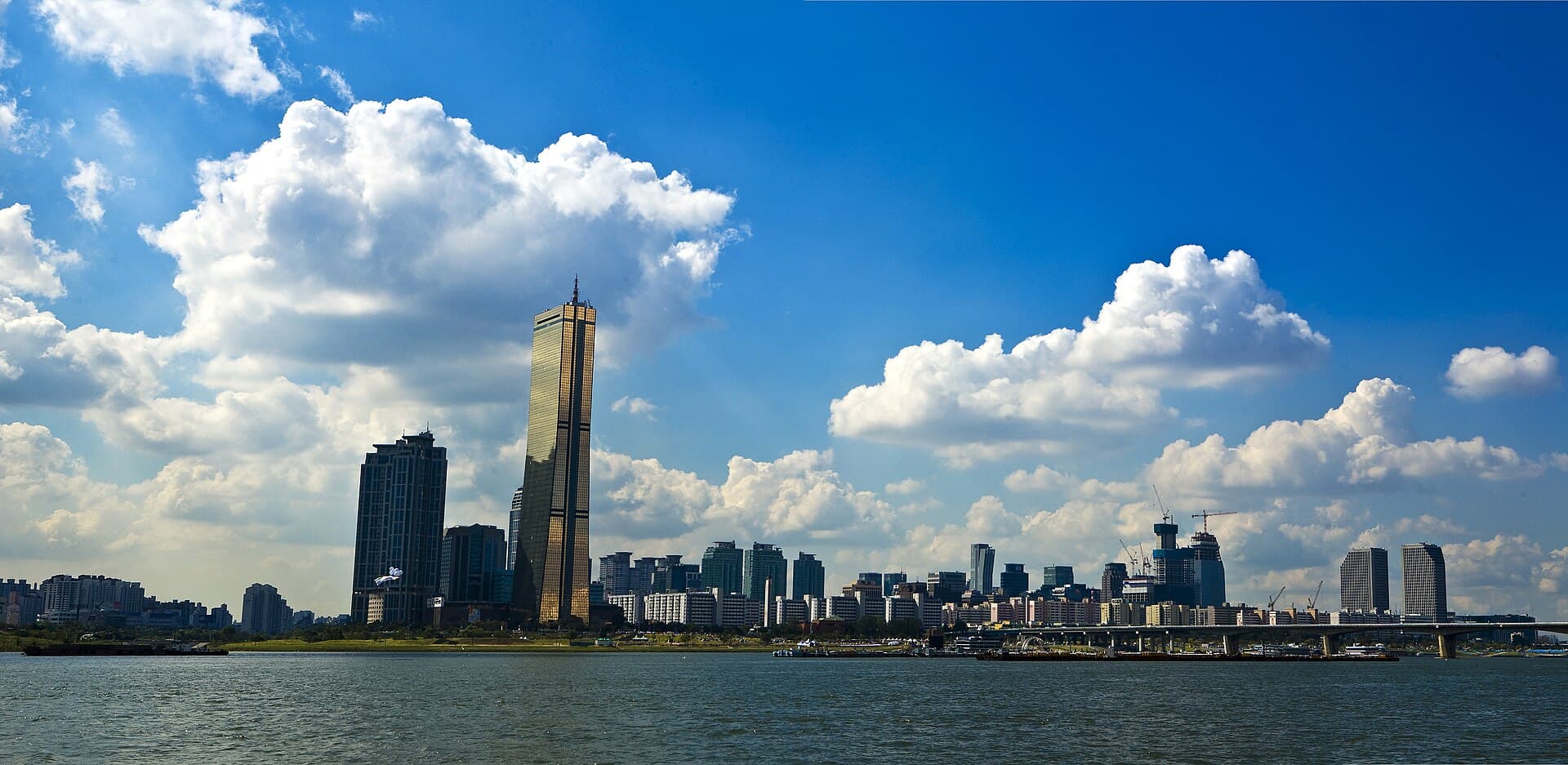
The crosses Seoul from east to west, a kilometre wide in places. It separates two cities of different ages and different designs.
North of it, is the historic city. King Taejo established his capital there in 1394 under the name , ringed by an eighteen-kilometre wall of which long stretches are still walkable. The streets are irregular, the hills numerous, the palaces central.
South of it, is a planned city. Still rural in the 1960s, the area was developed from the 1970s on an orthogonal grid of very wide avenues, with the deliberate relocation of prestigious schools and corporate headquarters. The contrast between the two banks is therefore not only aesthetic: it tells fifty years of planning policy.
The suffixes in Korean place names are words. 구 (gu) means district, 동 (dong) neighbourhood, 로 (ro) an avenue, 길 (gil) a smaller street. So Jongno-gu is the district of the "bell", Yeonnam-dong is a neighbourhood, and Garosu-gil literally means "the street of roadside trees".
The historic north: Jongno and Jung-gu#
holds most of what existed before the twentieth century. Gyeongbokgung palace (경복궁), founded in 1395 and rebuilt after several destructions, occupies its centre, flanked by and its secret garden, inscribed on the UNESCO World Heritage list.
Four neighbourhoods of distinct character surround it. lines traditional houses along a hill between two palaces, and draws crowds heavy enough that the city has imposed pedestrian rules. , west of the palace, offers the same building stock with fewer people and more local shops. concentrates galleries, paper shops and tea houses. , a 1920s development of traditional houses, has since the mid-2010s become the densest dining quarter in the historic city.
, open since 1905, completes the set with its aisles of mung bean pancakes and beef tartare.
, the central district, holds commerce. is the street of cosmetics and international chains, the great popular market, the textile quarter that does not sleep, dominated by the Dongdaemun Design Plaza designed by Zaha Hadid and opened in 2014. , formerly a district of printing and metalworking workshops, has been nicknamed since bars moved into its upper floors, behind unmarked doors.
The , a stream buried under an expressway in the 1960s and reopened in 2005, crosses the whole district below street level.
The student west: Mapo and Seodaemun#
is the district of the night out. , named after Hongik University, is the historic home of the Korean independent music scene, with its venues, pedestrian streets and street performers. The zone has spilled into three neighbouring quarters that each extend it their own way: along a former railway turned linear park, Sangsu and Hapjeong towards the river, and , more residential, with a busy neighbourhood market.
holds and the Ewha University quarter, whose student population sets prices and opening hours.
Yongsan, the hinge#
occupies the north bank facing Gangnam and concentrates the contrasts. grew around the American military garrison and remains the city's most international quarter, with restaurants from everywhere. , on the flank of Namsan hill, keeps a population of expatriates and artists. is by contrast one of the most expensive addresses in Korea, with its art foundations and residences.
The American garrison has moved to Pyeongtaek, and the released land is the subject of a large urban park project, opening in stages. It is the most significant construction site in central Seoul.
Above it all, and its television tower, completed in 1971 and opened to the public in 1980, serve as a visual marker from both banks.
The planned south: Gangnam, Seocho, Songpa#
is less a district than a brand. Around Gangnam station spreads the quarter of private cram schools, clinics and offices. and line up luxury boutiques and entertainment agencies. , in Sinsa, is the ginkgo-lined street that became a retail benchmark. The COEX complex holds a library open onto its atrium, installed in 2017 and now a meeting point in its own right, while Bongeunsa temple (봉은사) faces it across the avenue.
is more residential, with the French quarter of and the Supreme Court.
holds the south-east around : the Lotte World Tower, completed in 2017 at 555 metres and 123 floors, the indoor theme park, Seokchon lake lined with cherry trees and the 1988 Olympic site.
, an administrative island within Yeongdeungpo-gu, brings together the National Assembly, the financial district and a spectacular shopping centre. Its banks fill with cherry blossom in spring, which makes it one of the city's seasonal appointments.
The rising east: Seongsu#
, in Seongdong-gu, was the shoemaking quarter. Its brick industrial buildings have been converted into cafés, studios and above all pop-up stores: brands stage their launches there more than in any other district in Korea. The comparison with Brooklyn appears systematically in the Korean press, and the nearby completes the picture.
| Neighbourhood | District | What to go for | Station |
|---|---|---|---|
| Bukchon, Seochon | Jongno-gu | Traditional houses, palaces | Anguk |
| Ikseon-dong | Jongno-gu | Dining inside hanok | Jongno 3-ga |
| Euljiro | Jung-gu | Hidden bars, print workshops | Euljiro 3-ga |
| Myeongdong | Jung-gu | Cosmetics, street food | Myeongdong |
| Hongdae | Mapo-gu | Live music, nightlife | Hongik Univ. |
| Yeonnam-dong | Mapo-gu | Linear park, cafés | Hongik Univ. |
| Itaewon | Yongsan-gu | World cuisines, nightlife | Itaewon |
| Hannam-dong | Yongsan-gu | Art foundations, design | Hangangjin |
| Garosu-gil | Gangnam-gu | Fashion, terraces | Sinsa |
| Apgujeong Rodeo | Gangnam-gu | Luxury, K-pop agencies | Apgujeong Rodeo |
| Jamsil | Songpa-gu | Lotte Tower, lake, theme park | Jamsil |
| Yeouido | Yeongdeungpo-gu | Finance, cherry blossom, mall | Yeouido |
| Seongsu | Seongdong-gu | Pop-up stores, workshop cafés | Seongsu |
Three words are enough to read a Seoul map: 역 (yeok, station), 출구 (chulgu, exit) and 거리 (geori, street). KoreanSRS, our spaced repetition app for learning Korean, is coming soon: join the waiting list and stop guessing exit numbers.
Getting around: what to understand once#
The subway decides everything. The network covers the metropolitan area with a regularity that makes a car pointless for a visitor. Stations have dozens of numbered surface exits, and a meeting is always arranged with the number. Taking the wrong exit at Gangnam can cost ten minutes of walking above ground.
One card for everything. The rechargeable T-money card is bought in convenience stores and works on the subway, buses, some taxis and part of the retail network. Transferring from bus to subway within a short window applies a fare transfer.
Buses read by colour. Blue (간선) links districts over long distances, green (지선) serves locally and feeds the subway, red (광역) runs to the outer suburbs, yellow (순환) circles the centre.
A place name contains its position. A neighbourhood ending in -dong is administrative, a place ending in -gil is a shopping street, and a station followed by -ipgu (입구) means "entrance to", indicating that the site itself is a few minutes' walk away.
The success of , in Yongsan, produced a national linguistic phenomenon: the suffix -리단길 detached itself from the original name to label any provincial street that has become fashionable. There is now a Hwangnidan-gil in Gyeongju and a Bongnidan-gil in Busan, with no connection whatever to the military supply corps that gave the Seoul quarter its name.
Three days, three readings of the city#
The old city. Gyeongbokgung in the morning, the changing of the guard, then Seochon for lunch, up to Bukchon in the early afternoon as the groups disperse, Insadong, and the end of the day at Gwangjang market.
The young city. Yeonnam-dong and the linear park, lunch in Mangwon, an afternoon in Hongdae, dinner in Sangsu, and Euljiro in the evening for the full change of atmosphere.
The recent city. Seongsu and its pop-ups in the morning, across to Apgujeong, Garosu-gil and Cheongdam in the afternoon, then Jamsil at sunset for the view from the tower.
Seoul does not give itself up as a list of monuments. It gives itself up in contrasts: two banks, two centuries, and a subway that links them in twenty minutes.
Read alsoThe hanok: the genius of the traditional Korean houseWhat you are actually looking at while walking through Bukchon: the Korean house, room by room.
The orange tents that go up on the pavements at night are a district of their own.
FAQ#
Where should you stay in Seoul on a first visit? Jongno-gu and Jung-gu put you within walking distance of the palaces, the markets and the centre, with the best subway connections. Mapo-gu suits those who want nights out, Gangnam those coming for business or shopping.
How many days do you need for Seoul? Three full days cover the historic city, the student west and part of the south. Five days add Seongsu, Yeouido, a walk along the fortress wall and a trip outside the city.
Do you need Korean to get around? No. Subway signage is trilingual, local navigation apps work in English and younger generations understand it. Knowing the hangeul alphabet, which takes a few hours to learn, does completely change how you read shop signs and menus.
Is Gangnam worth a traveller's time? Yes, but not for the same reasons as the north. You go for the urban scale, the retail architecture, the entertainment agencies and the view from Jamsil, not for old heritage, which sits almost entirely north of the river.
How do subway exit numbers work? Each station numbers its surface accesses, sometimes up to fifteen or more. Koreans always give that number when arranging to meet. Maps posted inside the station list the businesses and landmarks served by each exit.
Photo credits: the images in this article come from Wikimedia Commons and are under a free license.
Jeong: understanding Korean affective attachment
Jeong (정), the Korean affective bond said to be untranslatable: definition, miun jeong, uri and the culture of we. Understanding the feeling that weaves society.
Cover image: USAGI_POST · USAGI_POST, via Wikimedia Commons · CC0