Templestay: sleeping in a Korean Buddhist temple
Born from a hotel room shortage in 2002, templestay now runs in nearly 150 Korean temples. The schedule, the rules, the monastic kitchen and the vocabulary.
La rédaction Kotoba Interactive
Studio éditorial
The Korean cultural experience most visited by foreign travellers began as a logistics problem. In 2002, South Korea co-hosted the football World Cup with Japan and faced a shortage of hotel rooms. The Jogye Buddhist order offered to open mountain temples to visitors. On 11 May 2002, fifty members of the diplomatic corps spent the night at Jikjisa temple (직지사), and around thirty temples followed within weeks.
Twenty-four years later, the is no longer a stopgap. Close to a hundred and fifty temples take part, some thirty run programmes in English, and the format has settled around a simple promise: spend one or two nights on a monastic community's schedule, without being a monk and without becoming one.
Who runs it, and under what rules#
The programme belongs to the , the majority branch of Korean Buddhism and heir to the tradition, the Korean counterpart of Japanese Zen and Chinese Chan. Its dedicated body, the Cultural Corps of Korean Buddhism (한국불교문화사업단), handles temple listings, centralised booking and programme standards.
That centralisation explains how consistent the experience is from one temple to another. Schedules, the loaned clothing, the shape of the day and the pricing follow common frameworks, while each temple adds what is its own: a martial art, a forest, a craft, a library of carved wood.
Two formats, not to be confused#
The first decision to make before booking concerns the type of stay, and getting it wrong is common.
follows the full monastic timetable. Rising before dawn, liturgical service, seated meditation, meals in silence, communal work, early bed. It is the format that teaches something, and the most demanding.
provides a room, meals and access to common areas, with no obligation to attend anything. Korean participants choose it overwhelmingly: in Korea the templestay works as an answer to burnout as much as a religious practice.
Some temples offer a third route, called free (자율형), sitting between the two.
What a two-day stay looks like#
| Moment | Korean | What happens |
|---|---|---|
| Arrival, mid-afternoon | 입재 | Welcome, clothing handout, guided tour of the temple |
| Late afternoon | 사물 | Striking of the four ritual instruments, including the great bell |
| Before dinner | 저녁예불 | Evening liturgical service in the main hall |
| Dinner | 발우공양 | Monastic meal in four bowls, in silence |
| Evening | 차담 | Conversation with a monk over tea |
| Lights out | 취침 | Bed, usually around nine in the evening |
| Waking | 도량석 | A monk walks the grounds striking the moktak |
| Dawn | 새벽예불 | Morning liturgical service |
| Then | 108배 | One hundred and eight bows, often while threading a rosary |
| Morning | 참선 | Seated meditation, then walking meditation |
| Late morning | 울력 | Light communal work, then departure |
The rhythm is not negotiable in the experience format, but nobody is compelled: a participant who stays in bed will not be woken twice.
is an English word manufactured in Korea, one of those Konglish coinages that became official. The programme has no purely Korean name: it is written in phonetic hangeul, which says enough about its being designed from the start for an international public before Koreans adopted it themselves.
The five acts that shape the day#
. Twice a day, before dawn and in late afternoon, the community chants in the main hall. Participants stand at the back, copy the bows or simply remain standing. No knowledge of the texts is expected.
. The number matches the hundred and eight afflictions counted by Buddhist tradition. Many temples hand out a thread and a hundred and eight beads: you string one bead per bow and leave with the rosary you made. The exercise is physical, and it is compulsory nowhere.
. The Seon tradition works on a , a question with no logical answer given by a master. For a short stay, instruction is limited to posture, breath and stillness, in sessions of twenty to thirty minutes.
. The most memorable of the rituals. Each participant receives four nested bowls, for rice, soup, water and side dishes. You serve exactly what you will eat, you eat in silence, then you clean your bowls with the water from the fourth and a piece of radish or kimchi, before drinking that water. Nothing may be left, not one grain of rice.
. Walking meditation follows the temple paths with no destination, and the tea conversation, usually in the evening, is the one moment when you can question a monk freely. It is generally the memory participants name first.
Temple food, a discipline of its own#
, Korean monastic cooking, is vegan and follows one further rule: it excludes the , namely garlic, spring onion, garlic chives, wild chives and asafoetida. Tradition holds them disruptive to concentration, raw or cooked. Removing garlic and onion from Korean cooking amounts to removing its base: temples compensate with mushrooms, seaweed, sesame, house-made soy sauce and long practice in fermentation.
This cuisine gained unexpected international visibility when the nun , of the Chunjinam hermitage attached to Baekyangsa temple, was the subject of an episode of the documentary series Chef's Table in 2017. Several leading chefs have claimed her influence since, and some templestay programmes now specialise in teaching these dishes.
Three words come back throughout the stay: 절 (jeol, the temple, and also the bow), 스님 (seunim, the monk or nun) and 공양 (gongyang, the offering, and by extension the meal). KoreanSRS, our spaced repetition app for learning Korean, is coming soon: join the waiting list and understand what is said to you before the translation arrives.
Where to go, depending on what you want#
| Temple | Region | What sets it apart |
|---|---|---|
| Golgulsa (골굴사) | Gyeongju | The only temple teaching , a monastic martial art |
| Haeinsa (해인사) | South Gyeongsang | Home of the Tripitaka Koreana, over 81,000 wooden blocks carved in the thirteenth century |
| Woljeongsa (월정사) | Gangwon | An avenue of century-old firs, winter stays in the snow |
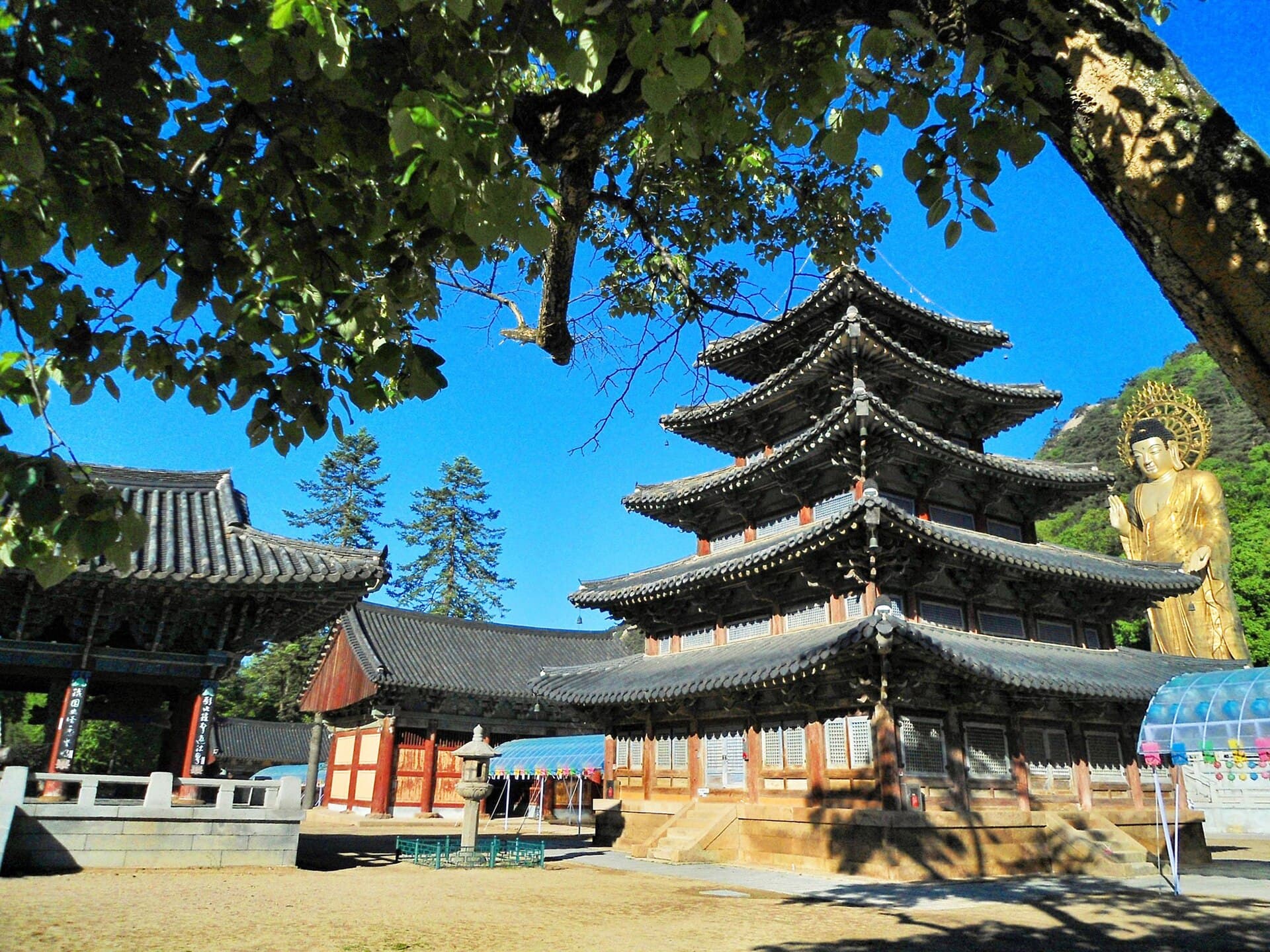
| Beopjusa (법주사) | North Chungcheong | Five-storey wooden pavilion, World Heritage listed |
| Magoksa (마곡사) | South Chungcheong | A riverside temple, also World Heritage listed |
| Bongeunsa (봉은사) | Seoul, Gangnam | Short English-language programme, at the foot of the office towers |
| Jogyesa (조계사) | Central Seoul | The order's head temple, reachable without leaving the city |
Seven Korean mountain monasteries, Beopjusa and Magoksa among them, were inscribed on the UNESCO World Heritage list in 2018 as "Sansa, Buddhist Mountain Monasteries in Korea". The criterion turned on their being living communities, in continuous operation since their founding.
The Sunmudo taught at Golgulsa is presented as a martial art of monastic tradition, combining postures, breathing and sequences. Its present form was codified in the twentieth century, and the temple offers stays built entirely around learning it, which makes it the most physical templestay in the country.
What to know before booking#
Clothing is provided. A loose vest and trousers, usually grey or maroon, worn throughout the grounds. Bring warm layers underneath: mountain temples are not heated everywhere, and the halls used for services rarely are.
You sleep on the floor. A thin mattress on a Korean underfloor-heated floor, shared and single-sex rooms in most temples. A few offer individual rooms at a higher price.
Alcohol, tobacco and meat are excluded from the grounds for the whole stay. Phones are not confiscated but their use is discouraged, and forbidden during services.
You take your shoes off often, and bowing means putting knees, hands and forehead on the floor. Clean socks and soft trousers make the day considerably more comfortable.
The price generally falls between 50,000 and 100,000 won a night, meals included, varying with the temple, the format and the season. Booking goes through the programme's official portal, which centralises English-speaking temples and availability.
Read alsoDancheong: The Colors of Korean Temples DecodedThe patterns painted under the eaves are not decorative: they follow a precise colour code.
What a templestay is not#
It is not an intensive meditation retreat. Two days allow neither deep practice nor structured teaching; the temples say so themselves and point those who ask towards longer formats.
Nor is it a disguised conversion. No religious commitment is expected, and non-Buddhist participants form the majority. The monks who run these programmes speak of them as hospitality work, separate from their own practice.
Finally, it is not a budget hotel. The price matches a decent guesthouse, the comfort is lower, and the silence is compulsory. What you gain lies elsewhere: a whole day paced by gestures you did not choose, in a place that ran exactly this way long before you arrived.
Read alsoThe jjimjilbang: the Korean sauna that never sleepsThe other Korean place where you sleep in loaned clothing, on exactly the opposite logic.
FAQ#
Do you have to be Buddhist to do a templestay? No. The programme was designed in 2002 for foreign visitors, the vast majority of them non-Buddhist. No religious commitment is asked, and temples adapt their explanations to an audience discovering all of it.
How much does a templestay cost? Most often between 50,000 and 100,000 won a night, meals and clothing included. Rest stays are sometimes cheaper than experience stays, and individual rooms, where they exist, cost considerably more.
Can you do a templestay in English? Yes, in roughly thirty temples, several of them in Seoul and Gyeongju. The official portal lets you filter for English-language programmes. Elsewhere the stay runs in Korean, which does not prevent you from following the gestures.
Are the 108 bows compulsory? No. They are part of the experience programme but no temple imposes them. Doing part of them, stopping, or staying seated is all accepted. Participants who finish generally leave with the rosary they threaded.
Can you go with children? Yes, several temples run family programmes with a lightened schedule and no pre-dawn wake-up. The classic experience stay, with its hours and its silence, suits young children poorly.
Photo credits: the images in this article come from Wikimedia Commons and are under a free license.
Kimjang: Korea's great collective winter kimchi rite
Every autumn, families and neighbors salt dozens of cabbages together. Meet kimjang, the communal kimchi-making listed by UNESCO in 2013.
Cover image: MeganYoungmee · MeganYoungmee, via Wikimedia Commons · CC BY-SA 3.0