Han: Korean Melancholy, Between Grief and Pride
Han (한, 恨), that Korean sorrow made of swallowed resentment and endurance, is it an age-old essence or a colonial invention? An honest inquiry.
La rédaction Kotoba Interactive
Studio éditorial
One word keeps coming up whenever someone tries to explain Korea to foreigners: han. It is presented as untranslatable, engraved into a people's soul, the sediment of a thousand years of invasions and humiliations. Tour guides invoke it, film critics wave it in front of every shot of driving rain, and even government ministers have cited it to narrate the nation. And yet, when you open a Korean dictionary printed before 1920, han does not appear there as a national feeling. It mostly denotes a personal grudge, a grievance between neighbors.
That gap is the real subject. Han (한, 恨) exists, it is felt, it nourishes an immense part of Korean art. But the idea that it is the eternal essence of a people sad by nature is a recent construction, forged in part under the occupation, then turned by Koreans themselves into an instrument of dignity. To understand han is to follow the journey of an emotion that became a political argument, an aesthetic, then an export-grade source of pride.
What the word han covers#
Han denotes an emotional complex of sorrow, contained resentment, and grief that never fully closes. The Sino-Korean character 恨 is read across all of East Asia (hen in Chinese, kon in Japanese) and carries the idea of regret or grudge. In Korean, han (한) has taken on a particular color over time: a pain endured in silence, mixed with a capacity to hold on regardless.
Koreans themselves distinguish nuances. Won-han (원한) is the burning grievance, the thirst for redress in the face of a specific injustice. Jeong-han (정한) is softer, tinged with nostalgia and resigned tenderness. This gradation says something important: han is not a mere free-floating melancholy but a spectrum of states that runs from swallowed anger to melancholic gentleness.
Han (한, 恨) comes from the Chinese character 恨, "grudge, regret." In Korean, the word shifted toward a broader feeling: unfinished grief, unspoken resentment, and endurance, often described as a pain one carries without crying it out.
The writer and pastor Suh Nam-dong, a figure of minjung theology (민중, "the oppressed people") in the 1970s, defined han as an "unresolved feeling of injustice" accumulated by the weak against the powerful. In his hands, the word becomes collective and political: the suffering of peasants, workers, and women, transformed into an energy of resistance rather than mere dejection.
A national essence, or a colonial invention?#
Here caution is required, because the origin of han as the "soul of the people" is today debated by scholars. Several academics argue that this idea is not age-old but crystallized during the Japanese colonization (1910-1945), before being reappropriated by Koreans after 1945.
The thread often traces back to Yanagi Muneyoshi (柳宗悦), also spelled Yanagi Sōetsu, a Japanese art critic and founder of the mingei movement. In a 1922 text on Korean art, Yanagi develops the idea of a "beauty of sorrow" (hiai no bi) that he believes he reads in the white ceramics and the lines of the Joseon dynasty. According to him, the peninsula, victim of repeated invasions, produced an art of melancholy. The thesis is seductive, but it locks Korea into a painful passivity convenient for colonial power.
To make a people the people of sorrow is already to deny them the history they choose for themselves.
As early as 1974, the poet Choe Harim attacked Yanagi head-on, calling it an "aesthetic of colonialism." More recently, the researcher Sandra So Hee Chi Kim, in a 2017 article on the "afterlives of the beauty of sorrow," argues that contemporary han was born of the contradictions of coloniality before being absorbed into Korean ethnonationalism and then spread by the diaspora. The historian Michael Shin, for his part, describes han as the result of a "traumatic loss of collective identity," a refusal to mourn. None of these authors deny that Koreans suffer or feel; they contest the idea of a genetic, eternal, essential sadness.
This reading is still debated. Other scholars point out that the word han and its resonances existed in the language and poetry well before 1910, and that colonization did less to invent the feeling than to freeze it into a national stereotype. The honest position lies in this nuance: han is not a lie, but its status as "the key to the Korean soul" is a dated historical product, not a timeless truth.
The nuance between 한 (han, restrained pain) and its luminous opposite 흥 (heung, joyful momentum) is felt first in the language. Learn 한글 (hangeul) and the vocabulary of Korean emotions with KoreanSRS, the spaced repetition that anchors them for good.
The roots that are invoked#
When Koreans tell where han comes from, they list a series of historical wounds. The list is real, even if its link with a single feeling remains interpreted after the fact.
Invasions punctuate the peninsula's history: the Mongol campaigns in the 13th century, the Imjin wars launched by Hideyoshi's Japan between 1592 and 1598, the Manchu incursions in the 17th century. Then comes the long Japanese occupation from 1910 to 1945, with the gradual banning of the language, forced mobilization, and the "comfort women." The 1945 liberation led not to unity but to division at the 38th parallel, then to the Korean War (1950-1953), which killed millions and separated families for generations.
To these collective wounds are added more intimate sufferings: postwar poverty, the rural exodus, and the weight of a Confucian patriarchal order that long crushed women. Female han even has its name in literature, that of submissive daughters-in-law and silent widows. The minjung of the 1970s and 1980s drew from it an imaginary of revolt: from workers' songs to student marches against the dictatorship, han becomes the fuel of democratic protest.
The shamanic ritual of the gut (굿), still practiced by mudang (무당, shamans, often women), long served to "untie" the han of the dead and the living. People speak of han-puri (한풀이), literally "undoing the knot of han": dance, trance, and song there soothe a resentment that society failed to repair.
Han on stage: pansori, trot, and cinema#
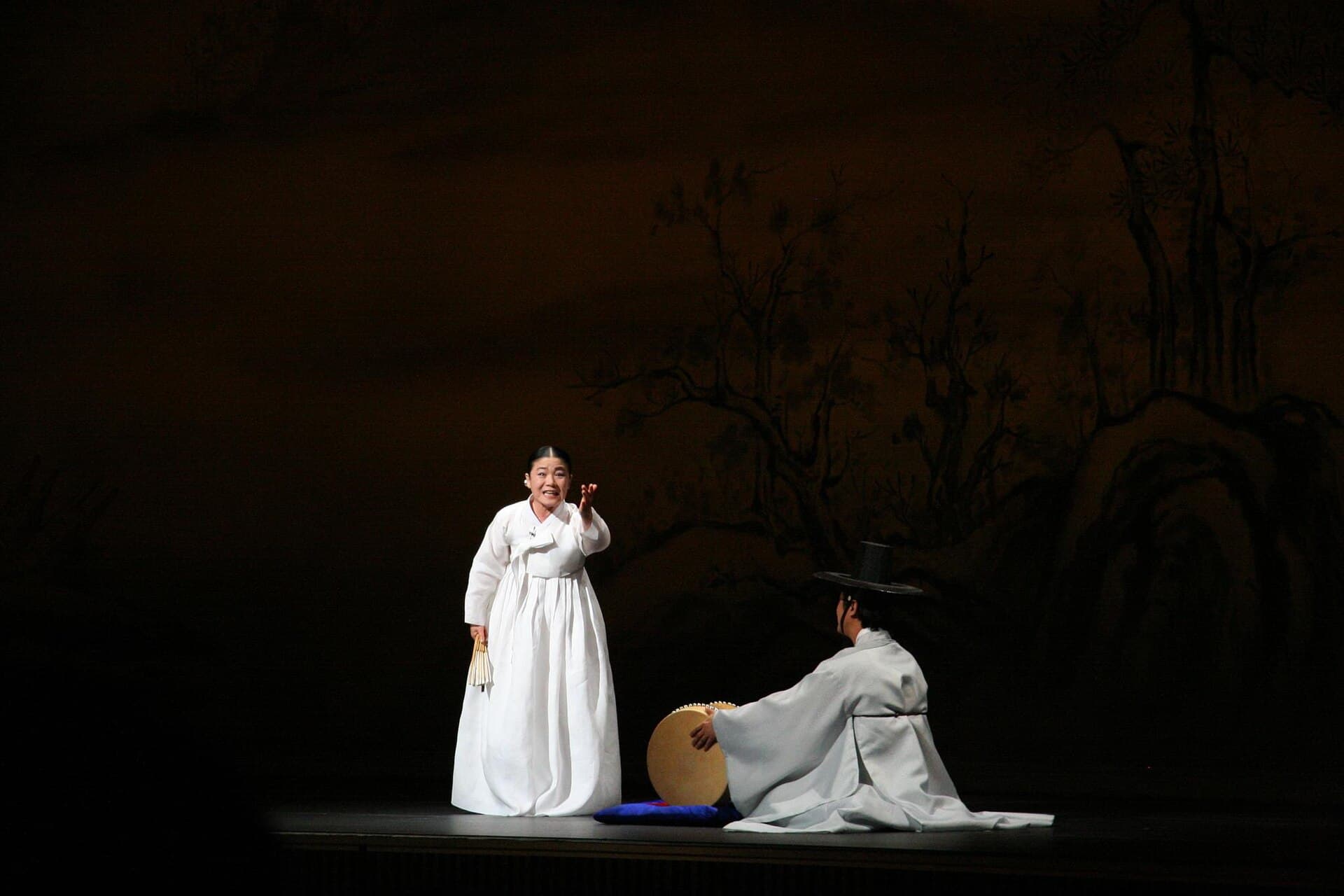
Han is heard first in pansori (판소리), that opera sung by a single performer accompanied by a player of the buk drum. Inscribed in 2003 on UNESCO's list of intangible heritage, pansori stretches out narratives lasting several hours in which the voice, deliberately hoarse and broken, seems torn from the throat. Master singers say that one only "finds" one's true voice after crossing a long ordeal, sometimes years of crying until it bleeds. This raspy voice is often described as the very sound of han.
The filmmaker Im Kwon-taek made it the subject of Sopyonje (서편제, 1993), a surprise box-office success following a family of wandering pansori singers. The film contains a scene that became famous, in which a father blinds his own daughter, so the story goes, so that a deeper han might feed her singing. The cinematic legend says everything about the bond forged, in the modern imagination, between pain and vocal art.
From traditional song to popular music#
Trot (트로트), a genre of popular music born in the 1920s and 1930s under Japanese and Western influences, extends this melancholic vein in a more sentimental register. Its ballads of separation, lost love, and abandoned homeland accompanied the generations of the exodus and the war. The song Arirang (아리랑), a folk tune with countless regional variants, also listed by UNESCO in 2012, is its most universal symbol: a lament of departure that every Korean carries, in the North as in the South.
Contemporary South Korean auteur cinema has drawn extensively on this register. The films of Lee Chang-dong, from Peppermint Candy (1999) to Burning (2018), or the work of Park Chan-wook, gave han a global legibility, at the risk of making it too convenient a lens for foreign critics.
Heung, the forgotten counterweight#
Han has a luminous twin that is cited far too rarely: heung (흥). Where han is restrained pain, heung is liveliness, vital momentum, the contagious joy that makes you rise and dance. The two are not opposed like black and white; they cohabit in the same culture, often in the same drink-fueled meal, the same village festival, the same concert.
Many Koreans annoyed by the cliché of national sadness point out that their culture is also made of noise, laughter, overflowing tables, and karaoke until dawn. The noraebang (노래방, "singing room"), shared makgeolli, and the frenzied energy of K-pop concerts belong far more to heung than to han. Add jeong (정, 情), that affectionate attachment which durably binds people together, and the Korean emotional picture becomes far richer than melancholy alone.
Read alsoJeong: understanding Korean affective attachmentJeong (정, 情), that attachment woven over time, sheds light on the other side of the Korean heart: discover how it complements and softens han.
Reducing Korea to han is a little like reducing Portugal to saudade or Japan to mono no aware: you grasp a dominant color while forgetting the whole spectrum. Korean artists themselves now play with this back-and-forth, moving from the gravest sorrow to the most unbridled euphoria in a few bars.
To find your way through the emotional vocabulary encountered across this article:
| Term | Script | Meaning |
|---|---|---|
| han | 한 (恨) | pain endured in silence, a grief that never fully closes |
| won-han | 원한 | burning grievance, thirst for redress in the face of a specific injustice |
| jeong-han | 정한 | softer han, tinged with nostalgia and resigned tenderness |
| heung | 흥 | liveliness, contagious joy that makes you rise and dance |
| jeong | 정 (情) | affectionate attachment that durably binds people together |
| han-puri | 한풀이 | "undoing the knot of han," ritual soothing during the gut |
| pansori | 판소리 | opera sung in a hoarse voice, often described as the very sound of han |
From han to pride: the reinvention by hallyu#
Since the 2000s, han has changed function. The Korean wave, or hallyu (한류), has turned a narrative of suffering into a narrative of resilience and cultural conquest. The implicit message is powerful: a country ravaged by colonization and war, one of the poorest in the world in 1953, became in two generations a global technological and cultural power.
This reinterpretation gives han an almost heroic value. Endured pain is no longer a fate but the proof of a strength that made the miracle possible. K-pop groups, dramas, and cinema have exported this narrative, in which han becomes a sellable emotional depth, a surplus of soul said to set Korean output apart from its competitors. Bong Joon-ho's film Parasite, Palme d'Or 2019 then Oscar 2020, or the worldwide success of Squid Game in 2021, are often read, in Korea and elsewhere, through this prism of sublimated social suffering.
Read alsoHallyu: How the Korean Wave Conquered the WorldFrom the melancholy of han to triumphant soft power: hallyu turned Korean sorrow into an export argument. Here is how the wave broke.
We must stay clear-eyed about this shift. Making han a national brand, a label of depth, means taking up for oneself the essentialism that scholars criticize, simply repainting it in a positive light. The young Korean generation, connected and cosmopolitan, moreover recognizes itself less and less in this image of a grieving people. For many, han has become a word for tourists and grandparents, more than an emotion lived day to day.
Read alsoNunchi: The Korean Art of Reading the RoomHan is rarely read aloud: it is sensed. Nunchi (눈치), that Korean art of feeling the mood and the unspoken, is the key to perceiving these restrained emotions.
FAQ#
Is han really untranslatable? No French or English word covers it exactly, but "untranslatable" is an exaggeration. Han (한) blends unfinished grief, contained resentment, and endurance. Notions like Portuguese saudade or melancholy come close. The idea of its unique and incommunicable character is itself, in fact, part of the national myth built around the term.
Was han invented by the Japanese? No, not invented out of whole cloth. The word and the feeling existed before 1910. But several scholars, including Sandra So Hee Chi Kim and Michael Shin, show that its status as "national essence" crystallized under the Japanese colonization, notably via Yanagi Muneyoshi's "beauty of sorrow," before being reappropriated by Koreans.
What is the difference between han and heung? Han (한) is restrained pain, the sorrow endured in silence. Heung (흥) is its luminous counterpoint: liveliness, contagious joy, the momentum that makes you sing and dance. The two coexist in Korean culture, often at the same moment. Reducing Korea to han alone forgets the vibrant half of the picture.
Where do you hear han in Korean art? First in pansori (판소리), an opera sung in a hoarse voice, listed by UNESCO in 2003. Then in trot, the song Arirang (아리랑), and the auteur cinema of Lee Chang-dong or Im Kwon-taek. These forms give han a sensitive expression, sometimes heartbreaking, sometimes transfigured into pride.
Do young Koreans still feel han? Less and less as a central emotion. For the connected, cosmopolitan generation, han is often a word from another age, associated with grandparents and war stories. Hallyu recycled it into a brand of national resilience, but its intimate weight is declining among the new generations.
Han is neither an eternal truth nor a simple colonial misunderstanding: it is a real emotion turned into a mirror held up to a nation, where each generation projects in turn its pain, its dignity, and, now, its pride.
Photo credits: images in this article come from Wikimedia Commons under free licenses.
In this article
The cultural terms covered here, each with a short definition.
- Hallyu
- The "Korean Wave": the global spread of South Korean pop culture (k-pop, k-dramas, film).
Boys Over Flowers: How a Japanese Manga Became a Korean and Global Phenomenon
From Hana Yori Dango to Boys Over Flowers, a look back at the history of a franchise that crossed borders, languages, and screens, from shojo manga to the most widely exported K-drama of the 21st century.
Cover image: bdnegin (Brian Negin) · bdnegin (Brian Negin), via Wikimedia Commons · CC BY-SA 3.0