Jeong: understanding Korean affective attachment
Jeong (정), the Korean affective bond said to be untranslatable: definition, miun jeong, uri and the culture of we. Understanding the feeling that weaves society.
La rédaction Kotoba Interactive
Studio éditorial
An ajumma has run a tteokbokki stall in a Seoul alleyway for twenty years. A regular orders his usual portion and, without his asking for anything, she slips two extra fish balls into the bag. That gesture has no name in English. In Korean it does: it is , and it explains why this same customer will come back to eat there rather than anywhere else, year after year.
Jeong is one of those words that Koreans themselves present as untranslatable, so much so that it regularly appears on lists of cultural concepts that English or French struggle to render in a single term. It describes an affective attachment that settles slowly, between people, but also toward familiar places and objects. To understand jeong is to grasp a key for reading Korean sociability: the way people bond, the way they give, the way they stay attached even when the relationship grates. This article explores its definition, its everyday manifestations, the tensions it carries, and its place in contemporary Korea.
An affective bond that settles over time#
Jeong (정, from the character 情 meaning "feeling," "affection") describes a deep attachment that is woven over the long term between people. Unlike love at first sight or a declared friendship, it is not chosen all at once: it accumulates, almost without those involved noticing, through sharing the same daily life. Two neighbors who greet each other every morning for years end up bound by jeong without ever having decided to be.
Korean cross-cultural psychology has worked extensively on the notion. Researchers such as Choi Sang-Chin and Kim Ki-Bum, at Chung-Ang University from the 1990s onward, proposed describing jeong as a specifically Korean relational feeling, distinct from romantic love (sarang, 사랑) as well as from simple liking. Jeong requires neither passion nor even chosen affinity: it can bind colleagues one did not pick, in-laws, a neighborhood. What creates it is duration, the repetition of contacts, and the sharing of ordinary experiences.
Jeong is not declared like love. It is realized, one day, when you understand that you can no longer do without someone you never really chose.
This long timescale explains its sturdiness. You can quarrel with a person you are bound to by jeong without the bond breaking: it was laid down layer after layer, and a passing falling-out does not dissolve it. This is also what makes it hard to translate, because Western languages tend to file affects into neat boxes (love, friendship, affection), whereas jeong overflows those categories.
Jeong (정, 情) comes from the Sino-Korean character 情, "feeling" or "affection." In Korean, it does not name a fleeting emotion but a sedimented attachment, the kind that lastingly connects people, places, and even familiar objects.
The grammar of giving in daily life#
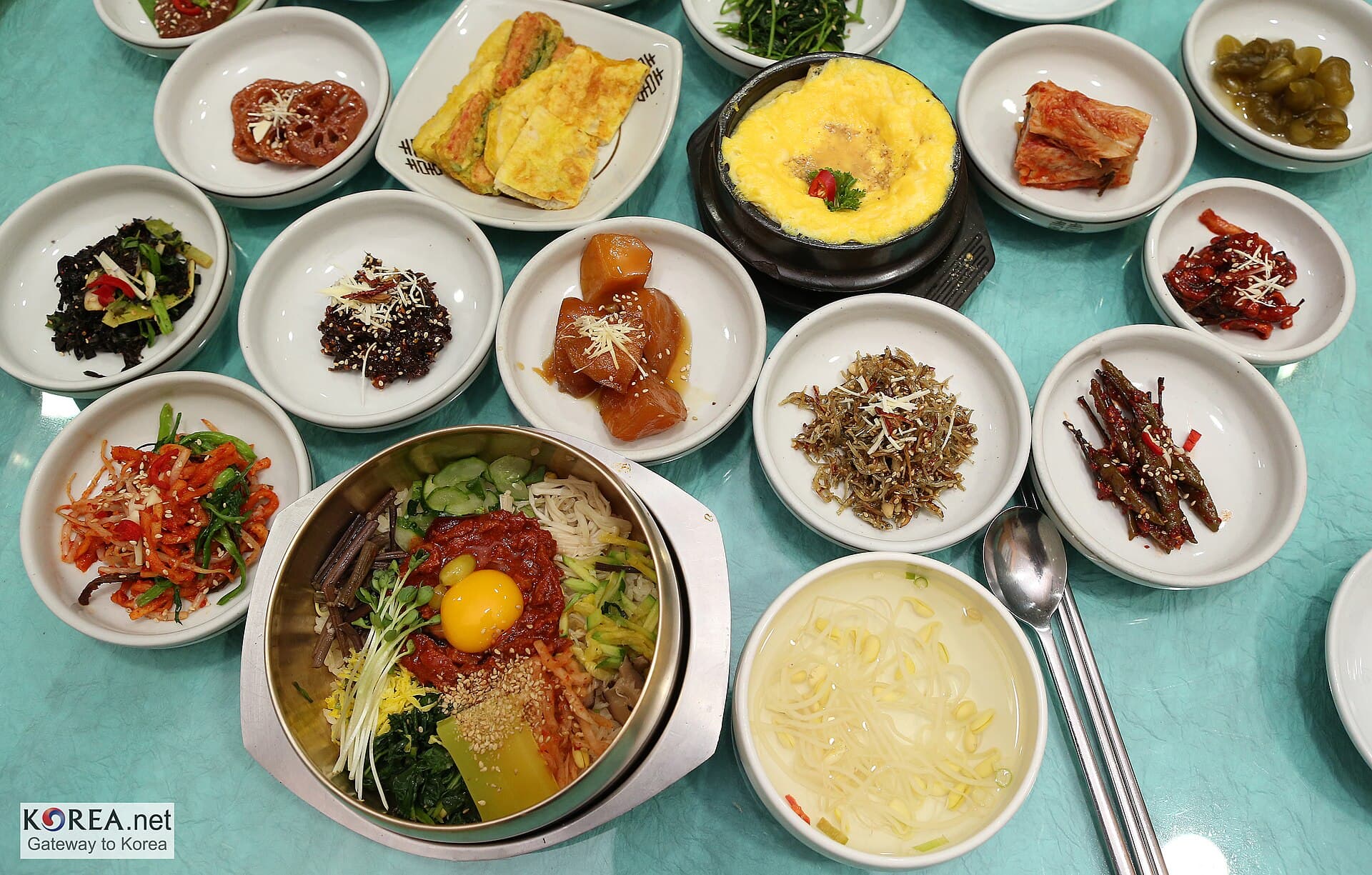
Jeong shows up first in shared food. In Korea, offering something to eat is the most immediate expression of attachment: the shopkeeper who adds a portion, the colleague who brings fruit for the whole office, the neighbor who leaves banchan (반찬), those small side dishes, at a door. Refusing to share your food, or eating alone without offering any around you, can be seen as a lack of jeong, a coldness.
This generosity does not operate on a calculating basis. You do not give in order to receive back immediately; you give because the bond exists and needs tending. The Korean table, with its dishes set in the middle and picked at by everyone, embodies this logic: the food is not portioned out into separate individual plates, it circulates. The meal becomes the concrete space where jeong is made and replayed.
From the 정 (jeong) slipped into a tray of 반찬 (banchan) to the "we" of 우리 (uri), the vocabulary of the Korean bond is read in its own language. Learn hangeul and the words of daily life with KoreanSRS, the spaced repetition that anchors them for good.
Uri: saying "we" before saying "I"#
The language itself carries this collective orientation. Where an English speaker would say "my house" or "my company," a Korean spontaneously says or , even when speaking of their own family or their own employer. The pronoun replaces the possessive "I" in a host of everyday expressions, even down to "our country" (uri nara, 우리 나라) and, more surprising to an outsider, "our wife/husband."
This usage is not trivial: it embeds the individual within a whole before setting them apart. Jeong thrives on that ground, the ground of a "we" that comes first, where belonging to the group precedes the assertion of the self. Linguists point out that this grammatical trait reflects a conception of the person as connected by default, rather than as an autonomous subject who would then choose their bonds.
Miun jeong: loving despite the irritation#
Korean distinguishes several shades of jeong, the most telling of which is , literally "hateful jeong" or "attachment despite irritation." It is the paradoxical bond that is woven precisely through friction: an old couple who bicker endlessly, siblings who exasperate one another, colleagues who have grumbled at each other for years and yet would be at a loss if they were separated.
Miun jeong stands opposite , "beautiful jeong," the kind born of pleasant affection. The fixed Korean expression, "goun jeong miun jeong da deureotda" (고운 정 미운 정 다 들었다), means roughly "we have accumulated both beautiful jeong and hateful jeong": in other words, we are bound by everything, the best as well as the worst. It is a very Korean way of saying that a relationship has lasted long enough to fold the quarrels themselves into the attachment.
In Korean, saying you have "accumulated miun jeong" with someone is almost a compliment in disguise: it means the relationship has gone through enough friction to become unbreakable. The shared irritation is part of the mortar.
To find your way among these shades, here are the key terms encountered so far:
| Term | Script | Meaning |
|---|---|---|
| jeong | 정 (情) | attachment sedimented through duration and shared daily life |
| sarang | 사랑 | romantic love, distinct from jeong |
| goun jeong | 고운 정 | "beautiful jeong," born of pleasant affection |
| miun jeong | 미운 정 | attachment woven despite irritation and friction |
| uri | 우리 | "we," "our": the pronoun that comes before "I" |
| banchan | 반찬 | small side dishes that are shared and given |
A warmth that also has its flip side#
Jeong nourishes a warm sociability, but it also creates obligations that are hard to shed. Because the bond commits you, it calls for reciprocity: returning invitations, accepting the drinks poured for you, taking part in team meals, not withdrawing from the group. What charms the foreign observer, the spontaneous generosity, the door always open, has as its reverse a real social pressure, especially in the world of work.
The contrast with Western individualism is stark. In a culture where "we" precedes "I," pulling back, setting a limit, declining a collective request can be experienced as an offense against jeong, a betrayal of belonging. Younger Korean generations, more attached to the private sphere and to work-life balance, are in fact renegotiating this heritage: the debate over hoesik (회식), those near-mandatory company dinners, is its most visible symptom. There, jeong appears by turns as a precious warmth and as a heavy constraint.
Read alsoHoesik: the company dinner that seals bonds in KoreaThe Korean company dinner, caught between imposed conviviality and group pressure, perfectly illustrates the tensions of jeong at work.
One should be wary of idealizing jeong as a pure virtue of generosity. Anthropologists remind us that it also works as a mechanism for integration into the group, with all the conformity that implies. You give, but you expect loyalty in return; you include, but you keep watch. Jeong binds as much as it obligates, and it is this ambivalence, more than warmth alone, that makes it such a central concept for understanding Korean society.
Nunchi, dramas, and global spread#
Jeong does not operate on its own: it is bound up with , the art of reading other people's unspoken emotions and expectations. If nunchi is the skill that lets you sense what the other person feels, jeong is the feeling that makes you want to respond to it. One perceives, the other attaches. Together they form an important part of Korean relational grammar, the part that governs how you adjust your behavior within the group.
Read alsoNunchi: The Korean Art of Reading the RoomNunchi, the Korean art of reading the unspoken, is the indispensable companion of jeong in social life.
It was no doubt through dramas that the world first felt jeong without naming it. The Korean wave, hallyu (한류), has exported since the late 1990s series in which characters bond through the repetition of daily life, shared meals, and quiet acts of care, more than through grand declarations. The foreign viewer senses a particular warmth in these stories without always being able to name it: it is often jeong at work, that way of showing affection through ordinary, repeated acts.
Read alsoHallyu: How the Korean Wave Conquered the WorldHallyu has spread across the world a relational warmth that owes a great deal to Korean jeong.
FAQ#
What exactly does the word jeong (정) mean? Jeong describes a deep affective attachment that is woven slowly, over time, between people, but also toward familiar places and objects. Made of warmth, loyalty, and shared habit, it presupposes neither romantic love nor chosen affinity. It is a bond that settles through shared daily life.
Why is jeong said to be untranslatable? Because Western languages file affects into neat categories (love, friendship, affection), whereas jeong overflows them all. It can bind people who irritate one another, colleagues one did not choose, or plain neighbors. No English word captures at once this slowness of accumulation and this sturdiness in the face of conflict.
What is miun jeong (미운 정)? Miun jeong, literally "hateful jeong," is the attachment that forms despite irritation, through repeated friction. An old couple who bicker or colleagues who have grumbled for years are prone to it. The expression "goun jeong miun jeong" describes a bond old enough to encompass the best as well as the worst.
What is the connection between jeong and the pronoun uri (우리)? The word uri ("we," "our") replaces the possessive "I" in many Korean expressions: uri jip (our house), uri hoesa (our company). This collective orientation of the language creates the ground where jeong thrives, that of a "we" that comes first, where belonging to the group precedes the assertion of the individual.
Does jeong have drawbacks? Yes. Because it commits you, the bond calls for obligations: returning invitations, taking part in team meals, not withdrawing from the group. This warmth has as its reverse a real social pressure, especially at work, which younger Korean generations are renegotiating today in the name of private life.
From the fish ball slipped in on the sly to the neighbor's door that is never quite locked, jeong sketches a Korea where one is never entirely alone, for better and, sometimes, for the more constraining. Learning to recognize it is the start of hearing what Korean society says about itself when it speaks of "we."
Photo credits: images in this article come from Wikimedia Commons under free licenses.
In this article
The cultural terms covered here, each with a short definition.
- Nunchi
- Korean art of subtly reading the moods and unspoken cues of a social situation.
Han: Korean Melancholy, Between Grief and Pride
Han (한, 恨), that Korean sorrow made of swallowed resentment and endurance, is it an age-old essence or a colonial invention? An honest inquiry.
Cover image: Korea.net / Korean Culture and Information Service (Jeon Han) · Korea.net / Korean Culture and Information Service (Jeon Han), via Wikimedia Commons · CC BY-SA 2.0