Ichiju-sansai: the structure of a Japanese breakfast
One soup, three dishes: the ichiju-sansai rule that organises the Japanese breakfast. Rice, miso, grilled fish, natto, tsukemono, and how to rebuild it at home.
La rédaction Kotoba Interactive
Studio éditorial
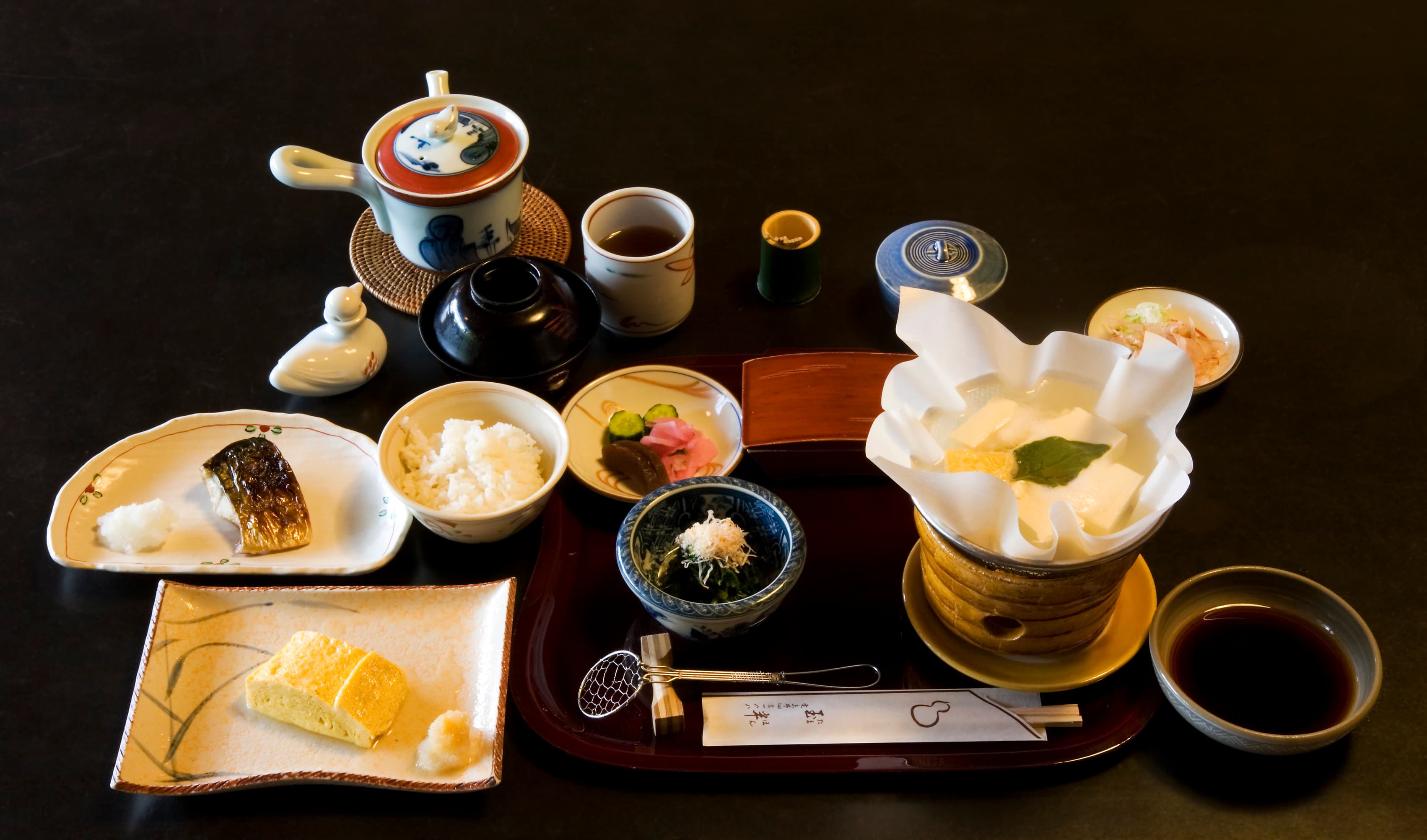
A lacquered tray set in front of you, and on it an entire meal: that is how a traditional Kyoto inn serves the morning. Steaming white rice. A bowl of miso soup with cubes of tofu and wakame floating in it. A fillet of grilled salmon, skin crisp. A raw egg in a small dish. Brightly coloured pickled vegetables. Natto, those fermented soybeans that stretch into sticky threads. Green tea. This is the traditional Japanese breakfast, a real meal where the West often makes do with a coffee drunk standing up.
That tray has a name: 一汁三菜 (ichijū-sansai), "one soup, three dishes". It is the compositional rule inherited from temple cooking and court service, and it still organises a ryokan breakfast as much as a school canteen tray: rice, a soup, a main dish and two side dishes.
The is a genuine moment of preparing body and mind for the day ahead, built around a nutritional balance that modern dietitians keep rediscovering.
The word ご飯 (gohan) means both "cooked rice" and "meal". That double meaning reveals the central place of rice in Japanese eating. A meal without rice is not really a meal. The morning is no exception.
The components of the traditional breakfast#
Rice (ご飯, gohan)#
The heart of the meal. Not any rice: japonica, a short, sticky grain, steamed to a pearly, faintly glossy texture. Morning rice is made fresh: reheating yesterday's would be a breach of the ritual.
Some add an , a salted, sour plum with digestive virtues. Others pour over a beaten raw egg to make , a dish of deceptive simplicity that inspires genuine culinary devotion.
Miso soup (味噌汁, misoshiru)#
Unavoidable. Miso soup warms the body and gets the metabolism going. Miso, a fermented soybean paste, brings natural probiotics that support digestion.
| Type of miso | Region | Flavour | Best for |
|---|---|---|---|
| 白味噌 (shiro miso, white) | Kyoto | Mild, faintly sweet | Mornings, delicate soups |
| 赤味噌 (aka miso, red) | Nagoya | Strong and salty | Robust dishes |
| 八丁味噌 (hatchō miso) | Aichi | Intense, almost meaty (fermented three years) | Stews, sauces |
Every household has its recipe. The ingredients vary: silken tofu, wakame, mushrooms, spring onions, clams in coastal regions. Dashi, a broth of bonito and kombu, is the base. The soup is drunk straight from the bowl, the solid pieces caught with chopsticks.
There are more than a thousand varieties of miso in Japan. Kyoto's shiro miso is mild and sweet, ideal in the morning. Nagoya's aka miso is stronger. Hatchō miso from the same region, fermented for three years, reaches an almost meaty intensity.
Grilled fish (焼き魚, yakizakana)#
Japan is an archipelago. Fish has always been the main source of protein. In the morning, a shiozake (salted salmon) or a grilled saba (mackerel) is often served. Grilling gives crisp skin and tender flesh.
Fish in the morning is not a recent luxury: Japanese fishermen and artisans always needed solid protein before a day of physical work.
Pickled vegetables (漬物, tsukemono)#
A selection of fermented or pickled vegetables: cucumber, daikon radish, aubergine, cabbage. Their role is twofold: to bring fibre and a diversity of flavours, and to stimulate appetite through acidity or salty crunch.
, yellow radish pickled in rice bran, is a classic. The umeboshi mentioned above also belongs to this category.
Natto (納豆)#
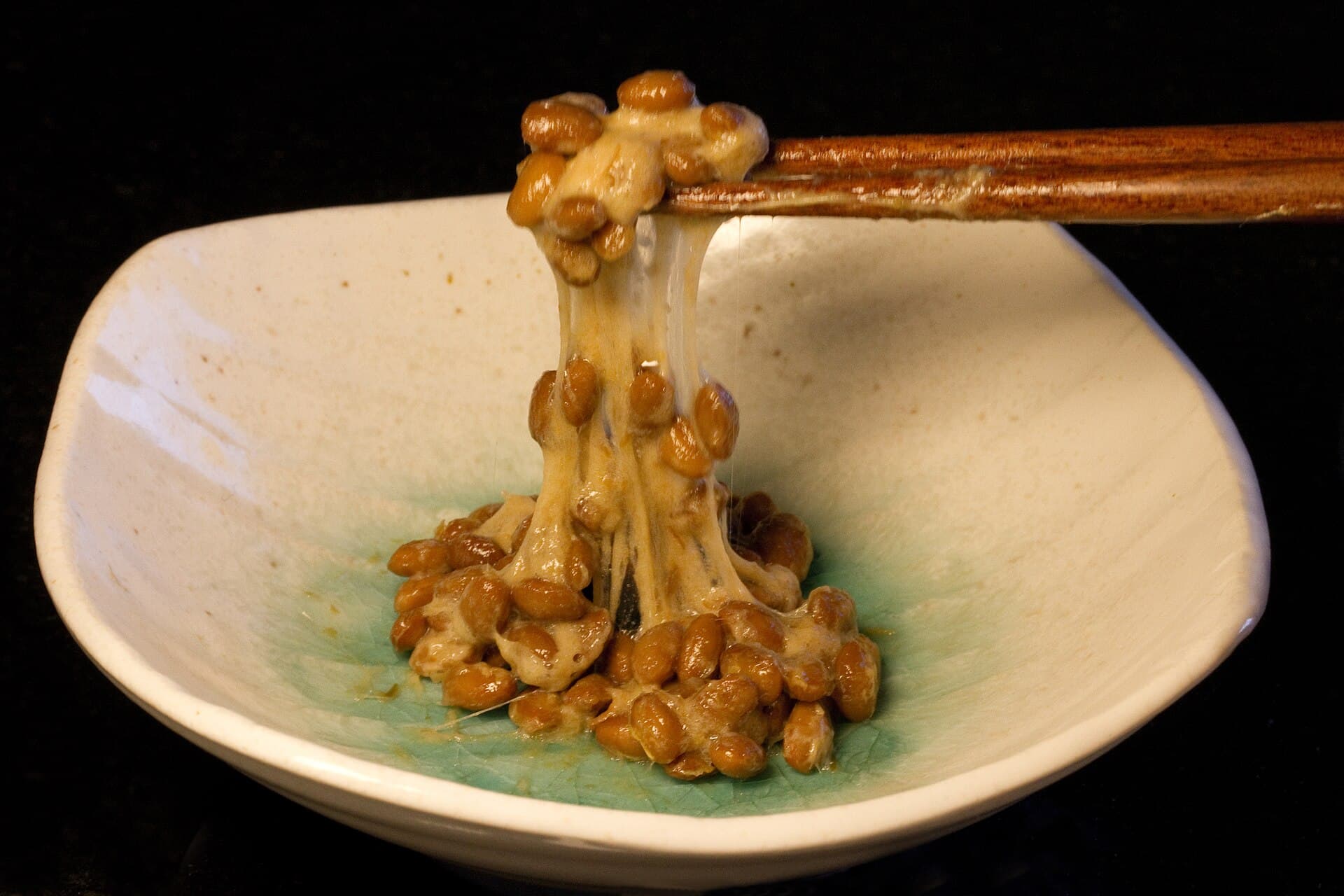
Here is the dividing line. Natto, fermented soybeans, sticky, stringy and strong smelling, divides even Japanese people. Kantō, around Tokyo, loves it. Kansai, around Osaka and Kyoto, tolerates it less. Foreigners often flee.
Yet natto is a superfood: rich in protein, in vitamin K2, excellent for bones, and in probiotics. Mixed with soy sauce and karashi mustard, spooned onto hot rice, it makes a nourishing dish on its own.
The word 納豆 (nattō) combines the characters for "to offer" and "bean". Legend has it that natto was born by accident in a Buddhist temple, when cooked soybeans offered to the monks fermented inside their straw wrapping.
The egg (卵, tamago)#
Raw, as a rolled omelette, or soft-boiled. A beaten raw egg poured over hot rice, tamago kake gohan, is enormously popular: restaurant chains are devoted entirely to it.
, the sweet-savoury Japanese omelette rolled in several layers, often appears in bento boxes and inn breakfasts. Its sweetness balances the salt of the fish and the soup.
The modern breakfast#
Daily reality in Japan in 2026 differs from that idyllic picture. Between packed trains and long working hours, many people skip breakfast or make do with an onigiri, a filled rice ball, bought at the konbini.
Fast food chains such as Yoshinoya and Matsuya offer "morning sets": a bowl of rice, a soup, an egg, some salmon, all served in a few minutes for under 500 yen.
Bread is gaining ground. , the extraordinarily soft Japanese milk loaf, toasted and buttered with a coffee, is breakfast for many hurried city dwellers. Kissaten, traditional cafés, and chains such as Komeda serve a "morning service" with toast, a boiled egg and coffee, sometimes for the price of the coffee alone.
Japanese shokupan is so prized that it has spawned specialist bakeries. The Nogami chain draws queues for its plain, additive-free loaf. A single loaf there can top 1,000 yen.
Why it works nutritionally#
Nutritionists agree: the traditional Japanese breakfast is a model of balance. Complete proteins from fish, egg and natto, complex carbohydrates from rice, fibre from vegetables and seaweed, probiotics from miso, tsukemono and natto, healthy fats from fish. Little added sugar. A diversity of nutrients first thing in the morning.
Japanese epidemiological studies comparing traditional and westernised diets, published regularly since the 2000s, associate the former with a lower cardiovascular risk. Isolating breakfast alone is harder, but the composition of the morning tray is consistent with what that research describes.
Want to read an inn's menu without a translation? With JapaneseSRS and its spaced repetition you will learn to read 朝ご飯 (asa gohan, the morning meal), 味噌汁 (misoshiru, miso soup) and 焼き魚 (yakizakana, grilled fish) directly in their original script.
How to rebuild an asa gohan at home#
The Japanese breakfast is achievable outside Japan, with a few adjustments.
- Rice: invest in japonica rice, Koshihikari if possible, and a rice cooker.
- Miso soup: buy miso paste, available in Asian or health food shops, and instant dashi. Five minutes of work.
- Fish: a salmon fillet baked or pan-fried does the job.
- Pickles: takuan and other tsukemono come in jars in Japanese grocers.
- Natto: available frozen in Asian shops. Thaw it the night before.
- The egg: fried or soft-boiled. Tamago kake gohan needs very fresh eggs.
The whole thing takes twenty to thirty minutes, or less if the rice is set to cook overnight.
Read alsoMatcha: History and Secrets of Japanese Green TeaGreen tea, the silent companion of the Japanese breakfast, deserves its own attention. From daily sencha to ceremonial matcha, it accompanies every meal and every moment of the day.
FAQ#
Is Japanese breakfast savoury? Mostly, yes. There is nothing sweet in the Western sense: no jam, no sugary cereal, no pastries. The dominant taste is umami, with salty, sour and faintly bitter notes.
Can you eat a Japanese breakfast every day outside Japan? Yes, with a little organisation. Rice can be cooked the night before, miso takes five minutes, pickles keep for a long time. The demanding part is fresh fish every day.
Is natto really that hard to eat? Its taste and texture can put people off at first. The trick is to mix it thoroughly with soy sauce and mustard, then spoon it onto very hot rice. Most people get used to it after a few attempts.
Why do Japanese people eat rice in the morning? Rice has been the base of Japanese eating for millennia. Its moderate glycaemic index provides steady energy. In a culture where rice equals a meal, not eating it in the morning would be incongruous.
Photo credits: freely licensed images, Wikimedia Commons.
Nattō, kimchi, doubanjiang: three schools of Asian fermentation
Bacteria, moulds, salt and time: what really separates Japanese nattō, Korean kimchi and Sichuan doubanjiang, and the common ancestor that links them.
Cover image: MichaelMaggs · MichaelMaggs, via Wikimedia Commons · CC BY-SA 3.0