Izakaya: how the Japanese small-plates bar actually works
Otōshi, nomihōdai, toriaezu nama: how an izakaya runs, where it came from in Edo's sake shops, and what to order without getting it wrong.
La rédaction Kotoba Interactive
Studio éditorial
A red paper lantern hangs above a sliding door. On the globe, often a single character: 酒. This is Japan's oldest shop sign, the , and since the Edo period it has advertised the same promise: here you may drink sitting down.
The word says it literally. 屋 is the shop, 酒 is sake, and 居 is the act of staying. A sake shop where you stay: the name preserves the exact way these places came into being, by drift, out of a business that never sold food.
How a sake shop turned into a place to have dinner#
The shift happens in Edo, present-day Tokyo, during the eighteenth century. , sake merchants, sold their product to take away, by the barrel or by the measure. Some began letting customers drink on the premises, standing at the counter. The practice took the name , literally "drinking while staying". Once you stay, you get hungry, and the shops added something to go with it: salted vegetables, dried fish, tofu.
There is nothing exceptional about that mechanism in urban history, but Edo offered ideal conditions. The shogunal capital had a heavily male population of artisans, day labourers and samurai on duty, often housed without a kitchen. Street food boomed there in the same decades as the sushi, soba and tempura stalls. The izakaya settled into that landscape as the place where drink comes first and the plate follows.
The model survives Meiji modernisation, then transforms twice in the twentieth century. Postwar reconstruction fills the areas around stations with black markets that would become alleys of bars, the . Then the high-growth decades from the 1960s to the 1980s industrialise the format: national chains, with photo menus, centralised kitchens and rooms seating several hundred, make the izakaya the compulsory setting for the , the company drinking outing.
breaks into three characters: 居 (i, to stay, to dwell), 酒 (saka, sake, alcohol) and 屋 (ya, shop). The shift in meaning happened in Edo, when sake merchants let customers drink on the spot instead of carrying the bottle home.
The three families of izakaya#
The word now covers places with neither the same prices nor the same codes. Knowing which door you are pushing avoids most of the unpleasant surprises.
The chain#
National brands, semi-private booths, photo menus, often a tablet for ordering, and sometimes an English version. Prices are low and is almost always on offer. This is the most accessible format without the language, and the one groups use.
The neighbourhood izakaya#
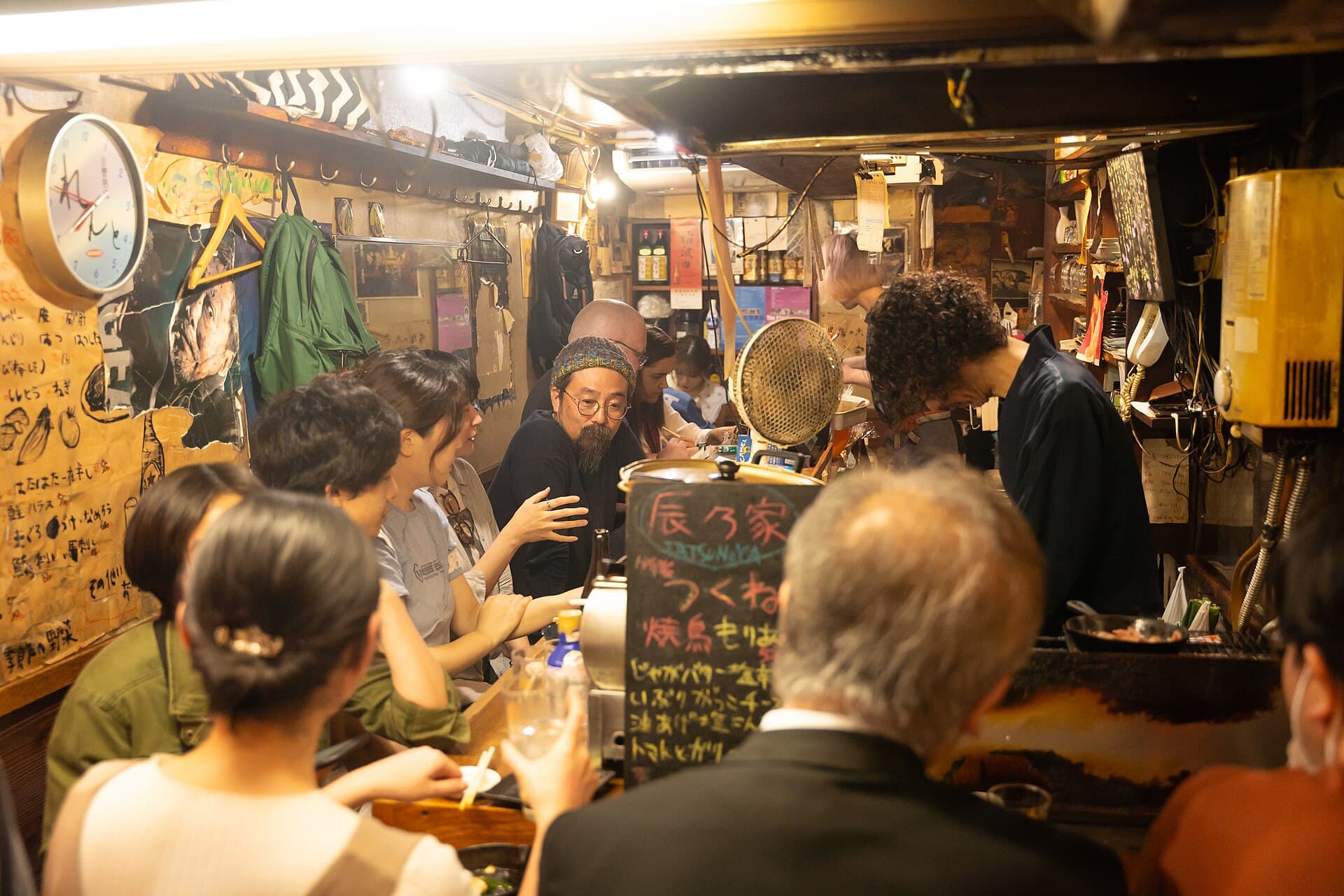
Twenty seats, a counter, an owner cooking in front of you, a handwritten menu on a board or on paper strips pinned to the wall. The list follows the season and the market. This is where the best plates are, and also where writing becomes the obstacle: nothing is illustrated, nothing is translated.
The specialist#
One product, in variations. The grills only chicken skewers, the kushiage-ya only deep-fried skewers, the cooks over charcoal in front of the customer, the oden-ya simmers its broth all evening. Standing bars, or , revive the original Edo formula: no chairs, quick drinking, the lightest bill in town.
What arrives without you ordering it#
A few minutes after you sit down, a small dish lands on the table that nobody asked for. This is the , called in western Japan: a mouthful of pickled vegetables, simmered roots or seafood, billed at three to five hundred yen per person.
It is not a gift and it is not a mistake. The otōshi works as a cover charge: it pays for the seat and signals that your order has been registered. It is rarely refused, and some places announce it in small print by the door. Chains sometimes apply an explicit , a table fee, instead.
The second thing that arrives unordered is the , the rolled damp towel, warm in winter and cold in summer. It is for cleaning your hands, and your hands only.
Ordering in the right order#
An izakaya evening follows a progression the staff anticipate. Understanding it is enough to pass for a regular.
The first round comes before anything else. The phrase , "a draught to start with", is so widespread that it functions as a collective reflex: everyone orders the same thing so the can go off together. Nobody is obliged to follow, but custom says you do not keep the table waiting while you pick a complicated cocktail.
Dishes are ordered in waves, not all at once. Three or four plates first, for two to four people, then more as the evening goes. Everything is shared in the middle of the table; the individual plates, the , are for serving yourself.
You start cold and finish filling. The usual order runs from raw and cured through fried, then grilled, and closes with a shime (〆), the dish that settles the meal: a bowl of rice, noodles, or a grilled onigiri.
Three words are enough to run a whole evening: 生 (nama, draught), お通し (otōshi, the compulsory starter) and お会計 (o-kaikei, the bill). JapaneseSRS, our spaced repetition app for learning Japanese, is coming soon: join the waiting list and read a neighbourhood izakaya's handwritten board instead of pointing at photos.
The menu, in the order it is read#
| Dish | Writing | What it is |
|---|---|---|
| Edamame | 枝豆 | Young soy beans, boiled and salted |
| Hiyayakko | 冷奴 | Cold tofu, ginger, spring onion, soy sauce |
| Tsukemono | 漬物 | An assortment of pickled vegetables |
| Sashimi moriawase | 刺身盛り合わせ | Raw fish platter, the day's selection |
| Karaage | 唐揚げ | Marinated fried chicken, the genre's centrepiece |
| Dashimaki tamago | だし巻き卵 | Rolled omelette with dashi, served warm |
| Yakitori | 焼き鳥 | Chicken skewers, salted (shio) or glazed (tare) |
| Motsunikomi | もつ煮込み | Pork offal simmered in miso |
| Agedashi-dōfu | 揚げ出し豆腐 | Fried tofu in a light broth |
| Yakisoba | 焼きそば | Stir-fried noodles, often near the end |
| Ochazuke | お茶漬け | Rice with tea poured over, the plainest shime |
Two words come back when ordering skewers: , salt seasoning, and , sweet-savoury glaze. The server always asks, and "omakase" (おまかせ), "your choice", is an acceptable answer.
What goes in the glasses#
Draught beer dominates, but an izakaya's drinks list is wider than it looks.
, which foreigners call sake, is ordered hot or cold. means served hot, around fifty degrees, at room temperature, chilled. Cold brings out the aromas of the finer brews, heat rounds off the rustic ones. The words and often appear on the list.
, distilled from barley, sweet potato or rice, is drunk cut with hot water (oyuwari) or cold (mizuwari). Its long fizzy version, the , mixes shōchū, soda water and fruit syrup; it is the most ordered drink after beer. The , Japanese whisky and soda, owes its comeback to an advertising campaign of the early 2000s aimed explicitly at younger drinkers.
You never fill your own glass: you fill your neighbour's, and your neighbour fills yours.
That gesture, , quietly structures the evening. It is done with both hands towards a senior, and it lets everyone keep an eye on how much the others are drinking without having to say so.
The chain long sold its entire menu, skewers and drinks included, at a single price posted in the window. That flat price became an informal indicator of Japanese inflation: its first rise in nearly thirty years, in 2017, was covered by the national business press.
The alleys where the izakaya fossilised#
Some districts kept the pre-chain format. , near Shinjuku station, lines up around sixty six-seat counters in alleys a metre and a half wide, a direct legacy of the postwar black market. , a few hundred metres away, applies the same density to tiny bars, many of which charge newcomers a cover. , in Shibuya, survives on a strip wedged against the railway.
These alleys survived because the land is split between dozens of owners, which makes property buyouts difficult. They remain workplaces rather than reconstructions: most owners have held the same counter for decades.
Read alsoHoesik: the company dinner that seals bonds in KoreaKorea built a stricter ritual on the same principle: the company dinner there commits your career as much as your appetite.
The customs that keep you out of trouble#
The izakaya is loud and relaxed, but a few rules are firm.
- Never stand chopsticks upright in a bowl of rice: the gesture reproduces a funeral offering.
- Never pass food chopstick to chopstick, for the same reason.
- Serve others before yourself, and hold your glass slightly lower than a senior's when you clink.
- Tipping does not exist. It is refused, and insisting embarrasses the staff.
- The bill is asked for in one phrase, o-kaikei onegaishimasu (お会計お願いします), and is usually settled at the register near the door, not at the table.
- Splitting is equal, the , unless a senior announces they are taking the bill.
The evening does not always end there. The , "second party", continues elsewhere, often at a karaoke box; the sanjikai exists too, and nobody recommends it on a weeknight.
Read alsoKaraoke: From Japan to the World, the Art of Singing TogetherThe nijikai almost always ends in a booth: karaoke is the compulsory second act of a Japanese night out.
What the izakaya says about Japan today#
The format has been taking hits since the 2010s. Alcohol consumption per head has been falling in Japan since the 1990s, and Health Ministry surveys show the drop is sharpest among the under-thirties. Administrative closures and restricted opening hours in the early 2020s accelerated the disappearance of many small establishments, and the compulsory nomikai has become contested inside companies, under the name , alcohol harassment.
The industry's answers are visible on the menus. Alcohol-free drinks now occupy space they never had, chains open lunch formats, and neighbourhood izakaya bet on produce rather than volume. The place is changing function: less drinking, better eating.
The original mechanism remains intact since Edo. You come in for a drink, you sit down, and the plate follows.
FAQ#
Is the otōshi compulsory? In the vast majority of izakaya, yes. This small starter, billed at 300 to 500 yen per person, works as a cover charge and pays for the seat. A few chains have dropped it in favour of a posted table fee, and a handful of places accept a refusal, but you should treat it as included.
Can you go to an izakaya alone? Yes, and the counter exists for that. Standing bars, the tachinomi, and yakitori specialists take solo customers as a matter of course. Big booth chains suit a single diner less well, because their layout assumes groups.
What does nomihōdai actually mean? The deal gives access to a defined drinks list for a fixed period, most often 90 or 120 minutes, for a flat fee. The list usually excludes the more expensive bottles, and last orders come ten minutes before the end. It often comes paired with , its equivalent for food.
Do you need to book? On Friday nights and the eve of public holidays, yes, especially for a group. Small neighbourhood places run mostly on walk-ins and sometimes refuse reservations to keep their counter seats free.
What is the difference between an izakaya and a Japanese restaurant? The izakaya puts drink at the centre: dishes exist to accompany it, are shared in the middle of the table and arrive as they are ready. A conventional Japanese restaurant serves complete individual meals, and alcohol is incidental.
Photo credits: the images in this article come from Wikimedia Commons and are under a free license.
Wagashi: Japan's Traditional Confectionery, Explained
History, ingredients and types of wagashi, Japan's tea confections. Nerikiri, yokan, daifuku, dorayaki: a complete, sensory guide to Japanese sweets.
Cover image: Dick Thomas Johnson · Dick Thomas Johnson, via Wikimedia Commons · CC BY 2.0