Kit Kat in Japan: the limited-edition frenzy
How a British chocolate bar became a Japanese cultural phenomenon. More than 400 flavours, a good-luck charm for exams, and regional limited editions.
La rédaction Kotoba Interactive
Studio éditorial
In a Tokyo konbini, a foreign visitor stares at an entire shelf devoted to Kit Kat. Matcha. Sakura. Sake. Wasabi. Purple sweet potato. Yubari melon. Tokyo cheesecake. The colours are loud, the flavours beggar belief. That shelf is perfectly ordinary in Japan, where a plain British chocolate bar has become a cultural phenomenon with no equivalent anywhere else.
With more than 400 flavours created since 2000 and annual sales exceeding four million boxes for limited editions alone, the Japanese Kit Kat has gone from snack to institution.
Kit Kat's success in Japan rests on an accidental pun. In Japanese, キットカット (kitto katto) sounds like きっと勝つ (kitto katsu), meaning "you will surely win" or "you are bound to succeed". That homophony turned Kit Kat into a good-luck charm for Japanese students before exams.
From British chocolate to Japanese talisman#
Kit Kat was born in 1935 at the Rowntree factory in York, England. Bought by Nestlé in 1988, it reached Japan the same year. For a decade it was a product like any other. Then, in the early 2000s, the marketing department at Nestlé Japan noticed something odd: sales spiked every January and February.
Investigation revealed that parents were giving Kit Kats to their children before the university entrance exams, the decisive tests that shape a Japanese school career. The kitto katsu pun had spread on its own, turning chocolate into a charm for success.
Nestlé Japan seized the opportunity. In 2003 the company launched its first regional edition: a matcha green tea Kit Kat inspired by the sweets of Kyoto. Success was immediate. The local flavour strategy was born.
Behind the pun きっと勝つ (kitto katsu, "you will surely win") lies a whole logic of homophony and kanji that makes Japanese so flavourful. Learn to read 抹茶 (matcha, powdered green tea), 桜 (sakura, cherry blossom) and お土産 (omiyage, travel souvenir) with JapaneseSRS and its spaced repetition.
The omiyage strategy#
To understand the explosion of Kit Kat flavours, you have to understand , the Japanese tradition of the souvenir brought back from a trip. When a Japanese person travels, they are socially obliged to bring edible gifts for colleagues, family and neighbours. Every region has its specialities, and stations are packed with dedicated shops.
Nestlé Japan realised that Kit Kat could become the universal omiyage: a recognisable, affordable product, endlessly adaptable to local produce. As a result, every Japanese region now has its exclusive Kit Kats.
Some Kit Kat flavours are sold in a single prefecture. The Kit Kat exists only in Hokkaido. The momiji manju Kit Kat, after the maple-leaf cake filled with red bean paste, exists only in Hiroshima. That planned scarcity feeds the urge to collect.
The flavours that made history#
Of the 400-plus flavours created, a few have become legendary.
| Flavour | Region of origin | Taste profile |
|---|---|---|
| 抹茶 (matcha, green tea) | Uji, Kyoto | Bittersweet, the exported best-seller |
| 桜 (sakura, cherry blossom) | National (spring) | Floral, slightly salty |
| 日本酒 (nihonshu, sake) | Selected breweries | 0.8 % alcohol, not sold to minors |
| 山葵 (wasabi, Japanese horseradish) | Shizuoka | Heat tempered by white chocolate |
| 紫芋 (murasaki-imo, purple sweet potato) | Okinawa | Earthy, sweet, mauve coloured |
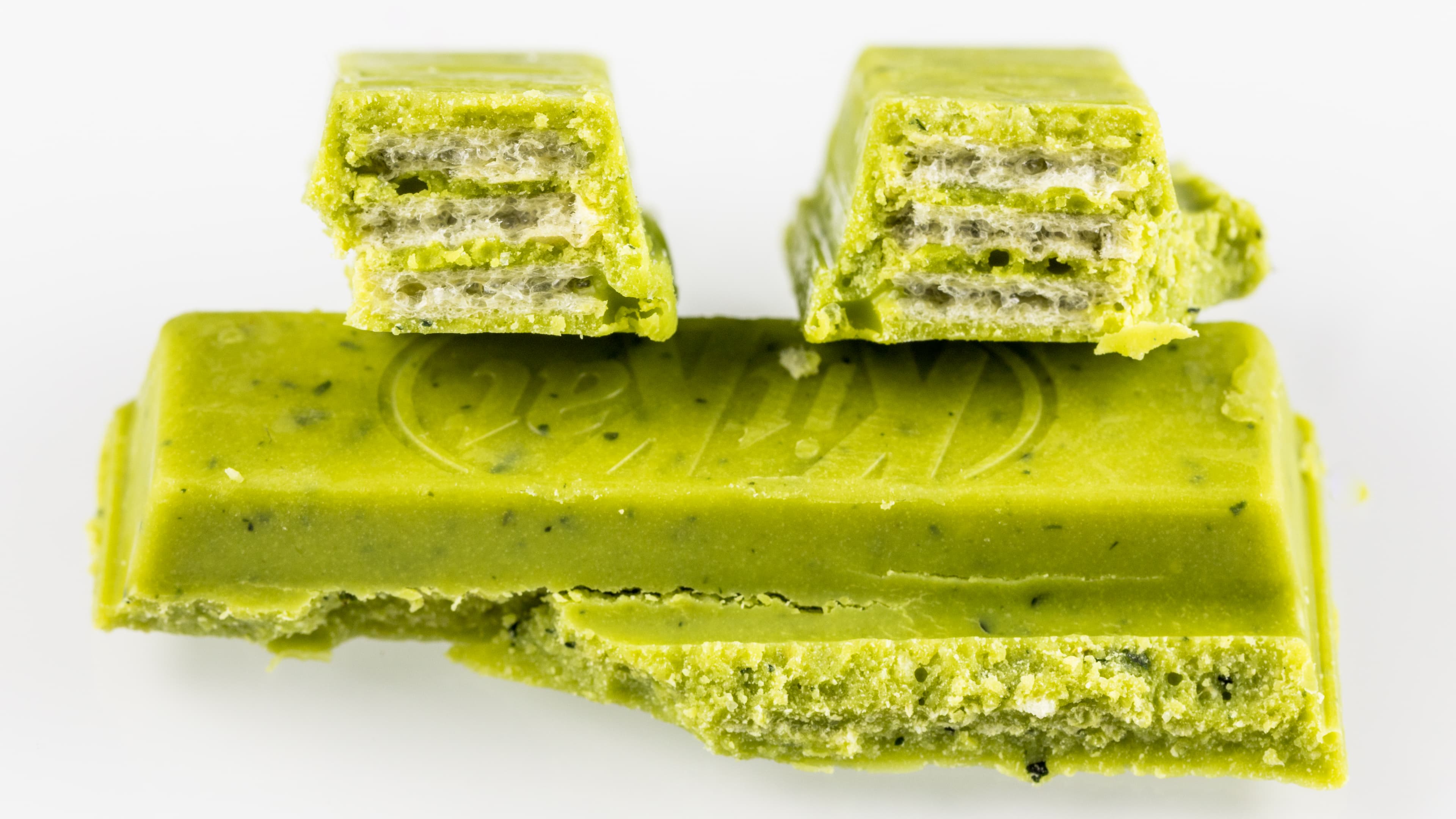
. Launched in 2003, it is the outright best-seller apart from the classic bar. Powdered green tea from Kyoto coats a wafer whose bittersweet taste won over the world. It is now the most exported flavour.
. Every spring, the pink cherry blossom Kit Kat accompanies hanami. The flavour is faintly salty, recalling the pickled cherry leaves used in Japanese confectionery.
. Launched in 2016, this Kit Kat contains 0.8 % real alcohol from selected breweries. It is not sold to minors in Japan.
Wasabi. The green Kit Kat made with Shizuoka wasabi surprises by its balance: white chocolate tempers the heat of the Japanese horseradish.
Amaou strawberry. Strawberries from Fukuoka prefecture, among the most expensive in the world, flavour this bright pink Kit Kat.
. Okinawa's purple sweet potato gives this Kit Kat a deep mauve colour and a subtly earthy sweetness.
The luxury Kit Kat#
In 2014 Nestlé took a further step with the first Kit Kat Chocolatory in Tokyo, a shop and workshop where pastry chef Yasumasa Takagi creates high-end Kit Kats. Bars there sometimes cost more than 2,000 yen each.
These luxury creations use Valrhona couverture chocolate, rare ingredients such as fresh yuzu, Japanese whisky and Hokkaido cheese, and French pastry techniques. The packaging is treated like jewellery.
In 2017 Nestlé launched the Kit Kat Cacao Fruit Chocolat, made with the pulp of the cacao fruit normally discarded. It was the first premium eco-conscious Kit Kat.
Read alsoMatcha: History and Secrets of Japanese Green TeaThe matcha in the most famous Kit Kat comes from Uji, near Kyoto, where green tea has been grown since the twelfth century. Understanding the history of matcha is understanding why that flavour carries so much meaning in Japan.
An export phenomenon#
Tourists have turned the Japanese Kit Kat into an essential travel souvenir. Social media amplifies it: tasting videos rack up millions of views, collectors catalogue the rare flavours, resellers offer imports at steep prices.
Nestlé eventually answered global demand. Matcha Kit Kat is now produced in several countries. Japanese airports have dedicated shops. Narita's duty-free sells collector boxes.
But the charm of the Japanese Kit Kat remains tied to the ephemeral. Many flavours are made in limited quantities, for one season or one collaboration. The Sublime Bitter Kit Kat lasted only a few months. The Tokyo Banana Kit Kat, a collaboration with the famous cake maker, was limited to 2020. That programmed scarcity keeps the Japanese Kit Kat a permanent object of desire.
Kit Kat and the exams#
Every January, Nestlé Japan runs a special campaign for students sitting entrance exams. Wrappers carry calligraphed messages of encouragement. Some Kit Kats come with a postcard to send to a temple for a blessing. Vending machines near universities stock "exam special" Kit Kats.
The ritual has become institutional: giving a Kit Kat to a student before the national common university entrance test, which replaced the Center Test in 2021, is now as natural as wishing them luck. Marketing has met superstition, and chocolate has become a talisman.
FAQ#
How many Kit Kat flavours exist in Japan? More than 400 have been created since 2000, but only a fraction is available at any given moment. Most are seasonal or regional limited editions.
Can you buy Japanese Kit Kats abroad? Some flavours, matcha and strawberry in particular, turn up in Asian grocers or online. The rare ones need a direct import or a trip to Japan.
Why is Kit Kat a good-luck charm in Japan? The Japanese name kitto katto sounds like kitto katsu, "you will surely win", which made it a traditional gift before exams.
What is the most expensive Japanese Kit Kat? Creations from the Kit Kat Chocolatory can exceed 2,000 yen for a single bar, with premium ingredients and luxury packaging.
Photo credits: freely licensed images, Wikimedia Commons.
In this article
The cultural terms covered here, each with a short definition.
- Pop culture
- Mainstream popular culture (manga, idols, games, series) shared worldwide.
Lolita fashion: the origins and styles of a Japanese look
Inside Japanese Lolita fashion. From the streets of Harajuku to communities worldwide: the origins, the substyles and the strict codes of a singular aesthetic.
Cover image: Raimond Spekking · Raimond Spekking, via Wikimedia Commons · CC BY-SA 4.0