KTX: how South Korea's high-speed train works
Seoul to Busan in 2h15, technology born from the TGV, the rival SRT, standing tickets: how the KTX works and how to travel on it without slipping up.
La rédaction Kotoba Interactive
Studio éditorial
Four hundred and seventeen kilometres separate Seoul from Busan, roughly the distance from Paris to Lyon. The KTX covers it in two and a quarter hours, stops included. For a country the size of Portugal, that means one simple thing: since 2004, no major Korean city has been more than half a day from the capital, and the very notion of the provinces has been redrawn.
The is operated by KORAIL, the national company. Its history is also that of a French technology transfer which, in twenty years, became a Korean export industry.
A TGV that became Korean#
In 1994, after a competition between the French TGV, the Japanese Shinkansen and the German ICE, South Korea chose Alstom. The contract covered forty-six trainsets: twelve built in France, the rest assembled in Korea, with know-how transferred to the local manufacturer, today Hyundai Rotem.
The line opened on 1 April 2004 between Seoul and Busan on the Gyeongbu axis, and towards Mokpo on the Honam axis. The southern section of the Busan line, long run on conventional track, was only completed in 2010, which explains the sharp cut in journey times that year.
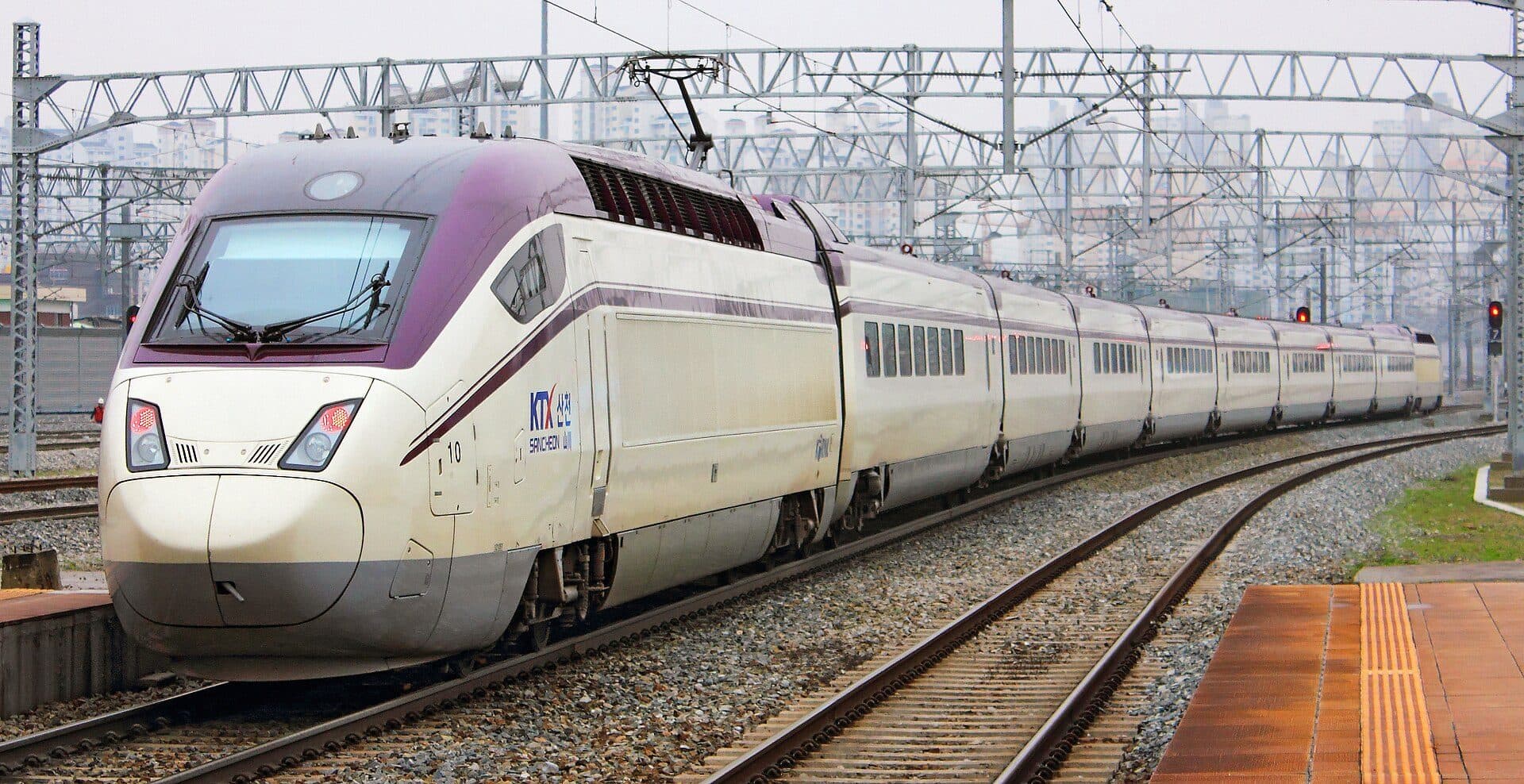
The transfer bore fruit. The , designed by Hyundai Rotem, entered service in 2010: the first Korean-designed trainset. Its name comes from the sancheoneo, a mountain trout said to have inspired the shape of the nose. In 2021, the launched a distributed-power generation, on the Japanese model rather than the French one with power cars at each end.
means "the joining, the link" in Korean. The train's name plays on the idea of connecting the regions, but also on the abbreviation EMU (electric multiple unit), the distributed-power technology it introduces. Korean speakers read both meanings without effort.
What to know before booking#
| Item | Korean term | Useful detail |
|---|---|---|
| Standard class | 일반실 (ilbansil) | Four seats across, the norm |
| First class | 특실 (teuksil) | Three seats across, water and a snack |
| Standing ticket | 입석 (ipseok) | Sold when full, around 30% cheaper |
| One way | 편도 (pyeondo) | To be specified when booking |
| Return | 왕복 (wangbok) | Often booked separately |
| Platform | 승강장 (seunggangjang) | Numbered, with car markers on the ground |
Tickets are booked on the Korail Talk app, available in English, or at station machines. A tourist package, the KORAIL PASS, reserved for foreign visitors, gives a number of free travel days; it becomes worthwhile from three long journeys, rarely below that.
The standing ticket deserves an explanation. It is not an unguaranteed seat: the traveller stays in the corridors and end vestibules, for two hours if necessary. It is common practice during holiday periods, when seats sell out within minutes.
The rival that pushed prices down#
Since December 2016, a second operator has run on the same high-speed lines: the SRT, operated by SR Corporation, a public-sector subsidiary created to introduce competition. It departs from Suseo station in south-eastern Seoul rather than from the central station.
For the traveller, the difference comes down to three things: the departure point, a slightly lower fare, and newer trainsets. For anyone staying in southern Seoul, particularly around Gangnam, the SRT avoids crossing the city.
Two operators on the same rails: Korea introduced competition without building another line.
Three words are enough to take a train in Korea: 기차 (gicha, the train), 역 (yeok, the station) and 표 (pyo, the ticket). KoreanSRS, our spaced repetition app, installs that vocabulary and the everyday Korean that goes with it.
The lines that matter#
The Gyeongbu axis links Seoul to Busan via Daejeon and Dongdaegu. It is the country's spine, concentrating traffic and frequencies.
The Honam axis serves the south-west, as far as Gwangju-Songjeong and Mokpo, with a high-speed section opened in 2015. It ended a long-standing imbalance between the two halves of the country.
The Gangneung line, opened in December 2017 for the PyeongChang Winter Olympics, puts the east coast a little over two hours from Seoul. It transformed access to the East Sea and the ski resorts, until then a matter of car or coach.
Eating, staying quiet, arriving#
There is neither a dining car nor onboard service on today's KTX. Snack trolleys disappeared over the 2010s, and passengers buy before boarding: rolled , a sandwich, an iced coffee from a chain. Daejeon station turned that constraint into an attraction, with the bakery, a local institution whose queues sometimes spill into the concourse.
Silence on board is a strong social rule. You do not take a call at your seat: you stand and walk to the vestibule between two cars. Conversations are held quietly, and headphones are expected by default.
Two periods escape all planning: Seollal, lunar New Year, and Chuseok, the harvest festival. Tickets go on sale on a fixed date several weeks ahead, and most are gone in the first minutes. Travelling on those days without a booking means travelling standing, or not at all.
In 2013, a Korean test train, the HEMU-430X, reached 421.4 kilometres per hour, making South Korea the fourth country in the world to exceed 420 km/h in testing, after France, Japan and China. Commercial speed, meanwhile, remains capped at 305 km/h.
KTX, Shinkansen, TGV: three families#
| KTX | Shinkansen | TGV | |
|---|---|---|---|
| First line | 2004 | 1964 | 1981 |
| Commercial speed | 305 km/h | 320 km/h | 320 km/h |
| Traction | End power cars, then distributed | Distributed | End power cars |
| Network | Two main axes | Dense national mesh | Star around Paris |
| Onboard catering | None | Trolley and bentō | Bar car |
The KTX takes after both parents. It has the original French design, and since 2021 it has adopted the distributed traction that gives Japanese trains their flexibility. Its singularity lies elsewhere: in a country where more than nine people in ten live in cities, two axes are enough to serve almost everyone.
Read alsoSeoul: the district guide that makes the city legibleWhat awaits at the end of the line, district by district.
The equivalent Japanese pass, and the question of whether it pays off.
FAQ#
How long does Seoul to Busan take by KTX? About two and a quarter hours on the most direct trains, a little over three hours on those with more stops. A standard class fare is around sixty thousand won.
Is the KORAIL PASS worth it? It becomes worthwhile from three long journeys within the validity period. For a single Seoul to Busan return, buying individual tickets is usually cheaper.
Do you need to book in advance? On weekdays outside holidays, no: seats remain on the day. During Seollal, Chuseok and long weekends, booking as soon as sales open is essential.
What is the difference between KTX and SRT? They are two separate operators on the same lines. The SRT leaves from Suseo station in south-eastern Seoul, with slightly lower fares. The choice mostly depends on where you start from in the city.
Can you eat on board? Yes, but you have to bring your own: there is no service. Stations offer bakeries, coffee chains and gimbap counters, and nothing forbids eating at your seat as long as you keep it discreet.
Photo credits: the images in this article come from Wikimedia Commons and are under free licences.
Busan: a guide to the neighbourhoods, Haeundae to Gamcheon
Nampo, Seomyeon, Haeundae, Gwangalli, Gamcheon: how Busan is laid out, what the war left in its street plan and where to go for what.
Cover image: Minseong Kim · Minseong Kim, via Wikimedia Commons · CC BY-SA 4.0