Korean convenience stores: GS25, CU and the pyeonuijeom empire
GS25, CU, 7-Eleven, Emart24: why Korea holds the world record for convenience stores per capita, what to eat there and what "hyeja" means.
La rédaction Kotoba Interactive
Studio éditorial
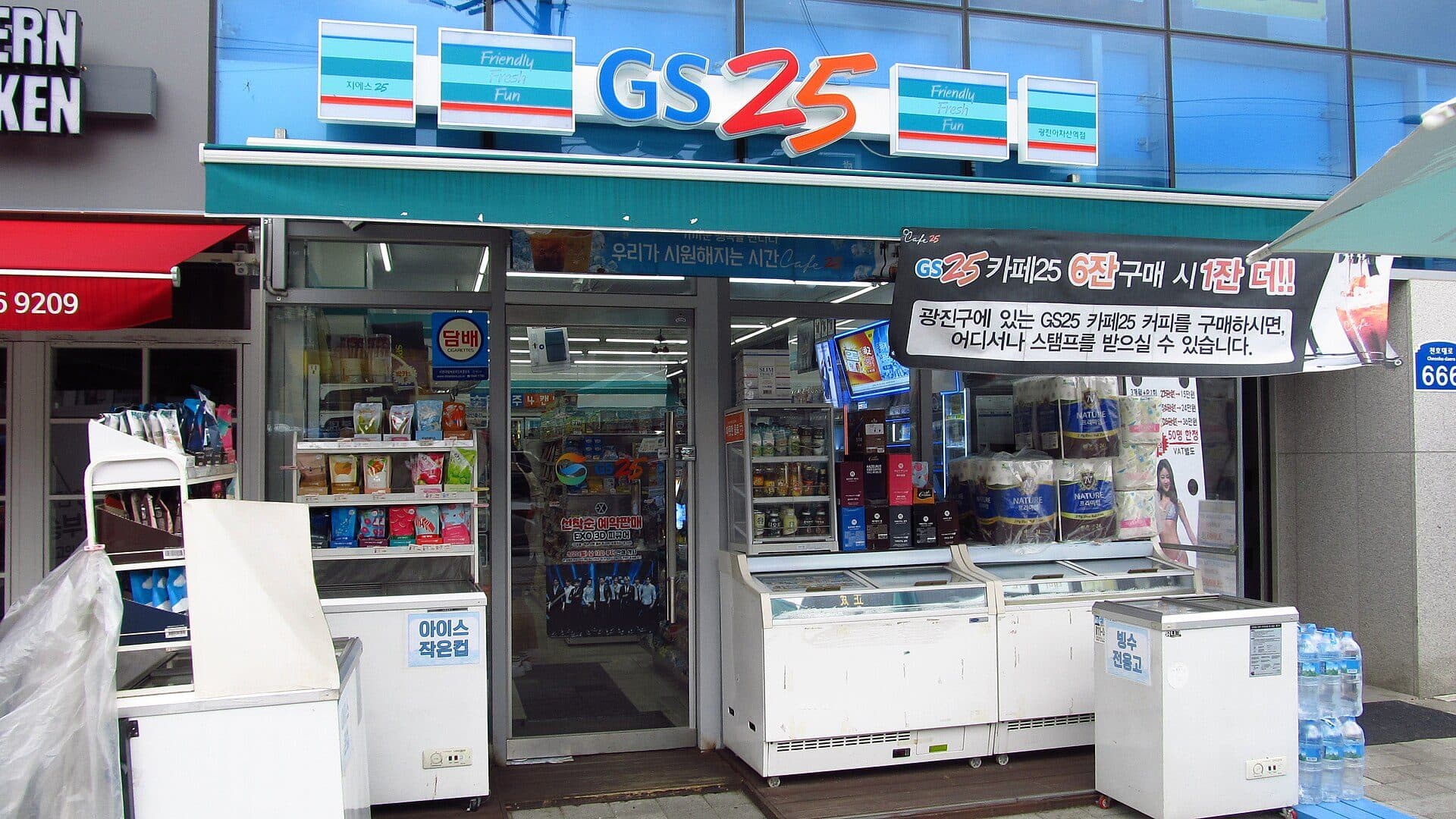
Outside a Seoul convenience store, four plastic stools and a low table: two office workers in shirtsleeves share a lunchbox at eleven at night, with a bottle of soju between them. Nobody finds the scene odd. In Korea the is not just a shop, it is an extension of the living room in a country where more than one household in three is a single person.
South Korea has around fifty-five thousand convenience stores for fifty-one million inhabitants, the highest density per capita in the world, ahead of Japan and Taiwan. That saturation is no accident: it results from a very aggressive franchise model and from rapid demographic change.
Four banners, two giants#
| Banner | Group | Origin of the name | Distinctive feature |
|---|---|---|---|
| CU | BGF Retail | "CVS for you" | Formerly FamilyMart Korea until 2012 |
| GS25 | GS Retail | Formerly LG25, renamed in 2005 | Branded lunchboxes and coffee |
| 7-Eleven | Lotte | American banner under licence | Absorbed Ministop Korea in 2022 |
| Emart24 | Shinsegae | Formerly With Me | More flexible franchise model |
CU and GS25 dominate the market with more than seventeen thousand outlets each, a figure worth comparing with the fifteen hundred or so restaurants of a major fast-food chain in the same country. The country's first modern convenience store opened in 1989 in Songpa, southern Seoul, under the 7-Eleven banner, a few months after the Olympics.
is made of 편의 (pyeonui), "convenience", and 점 (jeom), "shop". From it Koreans derived the neologism 편세권 (pyeonsegwon), modelled on 역세권 (yeoksegwon), "the area around a station". A pyeonsegwon flat is within walking distance of a convenience store, and estate agents mention it in listings.
What people actually eat there#
The 삼각김밥 (samgak gimbap), a triangular rice ball, is the emblematic item. Its wrapper tears in three numbered stages so the seaweed stays crisp until the last moment. A Korean opens it without looking; a tourist needs two attempts.
The 도시락 (dosirak), the lunchbox, is where the banners really fight. As early as 2010, GS25 launched a range bearing the name of actress Kim Hye-ja, known for her generous-mother roles. CU retaliated in 2015 with a range from television chef Baek Jong-won. The lunchbox war ran for years and left two words in the language.
The rest of the shelf follows fixed habits: instant noodles in a pot, with a boiling water dispenser and a microwave provided; Binggrae banana milk in its pot-bellied bottle; energy drinks; beer and soju, whose takeaway sale is not restricted in the evening.
The two words convenience stores gave Korean#
혜자스럽다 (hyejaseureopda) is an adjective built on actress Kim Hye-ja's given name. It means "generous for the price", and is said of a well-filled lunchbox, but also of a phone plan or a hotel buffet.
Its antonym, 창렬하다 (changnyeolhada), comes from the name of singer Kim Chang-ryul, associated with a snack assortment judged expensive and disappointing. It describes any product whose packaging promises more than its contents.
Neither word appears in any official dictionary, and yet a whole generation understands both. They say the essential thing about the Korean relationship to convenience stores: a permanent assessment of value for money.
In Korea, a slang word serves as the unit of measurement for judging a lunchbox.
Three words are enough to shop at a convenience store: 편의점 (pyeonuijeom, the store), 도시락 (dosirak, the lunchbox) and 봉투 (bongtu, the bag). KoreanSRS, our spaced repetition app, installs that vocabulary and the everyday Korean that goes with it.
1+1, the engine of the whole system#
The 1+1 promotion (buy one, get one) and its 2+1 variant shape Korean shopping far more than the shelf prices do. The chains' apps list the eligible items each month, customers plan around them, and there are online communities devoted entirely to those lists.
This mechanism has a practical consequence: the Korean convenience store is not systematically dearer than the supermarket, unlike the Japanese rule. On promoted items it is often cheaper, which is why people do real shopping there and not only emergency purchases.
A shop that does everything else#
Beyond food, the counter serves as a universal desk: parcel drop-off and collection, cash machine, topping up the T-money transport card, event ticket sales, phone charging, sometimes laundry collection. Some banners have added home delivery from the nearest store.
The eat-in space, with a window counter and stools, clearly separates the Korean model from the Japanese one, where eating inside the shop remains rare. In Korea the outdoor tables are an accepted social space, especially in the evening and especially among students.
The novel 불편한 편의점 (The Uncomfortable Convenience Store), published in 2021 by Kim Ho-yeon, tells the story of a homeless man who becomes a night clerk in a Seoul convenience store. It sold more than a million copies in Korea and has been translated into some twenty languages, making the pyeonuijeom a literary setting in its own right.
Korea versus Japan: same word, two models#
| Korea | Japan | |
|---|---|---|
| Density | Highest in the world per capita | Very high, but lower |
| Eating in | Tables and stools, alcohol tolerated | Rare, often discouraged |
| Promotions | Permanent 1+1 and 2+1 | Few promotions, stable prices |
| Lunchboxes | Celebrity ranges, fast turnover | Wide range, highly seasonal |
| Services | Parcels, T-money, ticketing | Parcels, bill payment, printing |
The Korean model has been exporting since the 2010s. CU has become the dominant banner in Mongolia, where it runs several hundred stores, and GS25 has set up in Vietnam and Malaysia. It is a notable reversal: Korea imported the American format via Japan, and now re-exports it with its own codes.
There remains the social question. The model rests on franchisees who carry the risk and on poorly paid night work, a recurring debate at every minimum wage revision. Extreme density also means two competing banners facing each other at the same junction, with tight margins on both sides.
Read alsoKonbini: why Japan's convenience stores are legendaryThe Japanese model everything started from, and its fundamental differences.
The other Korean fast food, the one on tents and carts.
FAQ#
Which banner is best? None dominates on every front. GS25 is known for its lunchboxes and coffee, CU for its variety of noodles and its collaborations, 7-Eleven for its coverage in tourist areas. Price differences between them are minimal.
Can you eat inside? Yes, it is designed for it: most stores have a counter, a microwave and a hot water dispenser. The outdoor tables come alive in the evening, and drinking alcohol there is common.
Do stores take foreign bank cards? Almost always, and contactless payment is universal. Loyalty apps, however, require a Korean phone number.
What does "hyeja" mean on a package? It is a compliment: the product is judged generous for its price. The adjective comes from the given name of actress Kim Hye-ja, whose name was attached to a particularly well-filled lunchbox range.
Are convenience stores open 24 hours? Most in city centres, but not all. Since the 2010s, a growing number of franchisees close at night for cost and safety reasons, especially in residential areas.
Photo credits: the images in this article come from Wikimedia Commons and are under free licences.
Ulzzang: the style born from a Korean photo contest
Ulzzang, aegyo-sal, circle lenses, V-line: where this Korean style comes from, what it actually requires and why the word has aged in Korea.
Cover image: LERK · LERK, via Wikimedia Commons · CC BY-SA 4.0