PC Bang: The Cybercafés That Shaped Korean Gaming
Born of the 1997 crisis and the StarCraft wave, Korea's PC bang industrialized a passion and invented modern e-sports.
La rédaction Kotoba Interactive
Studio éditorial
It is two in the morning on a Seoul street, and behind a window fogged by the air conditioning, a hundred screens flicker in the half-light. Rows of reclining chairs, headsets over ears, the frantic clatter of mechanical keyboards; on a counter, a bowl of instant noodles steams beside a mouse. A high-schooler runs game after game, an office worker in a suit loosens his tie, two soldiers on leave comment on a match in low voices. No one is sleeping, and no one seems in a hurry to leave. Welcome to a , one of the most singular institutions of contemporary South Korea.
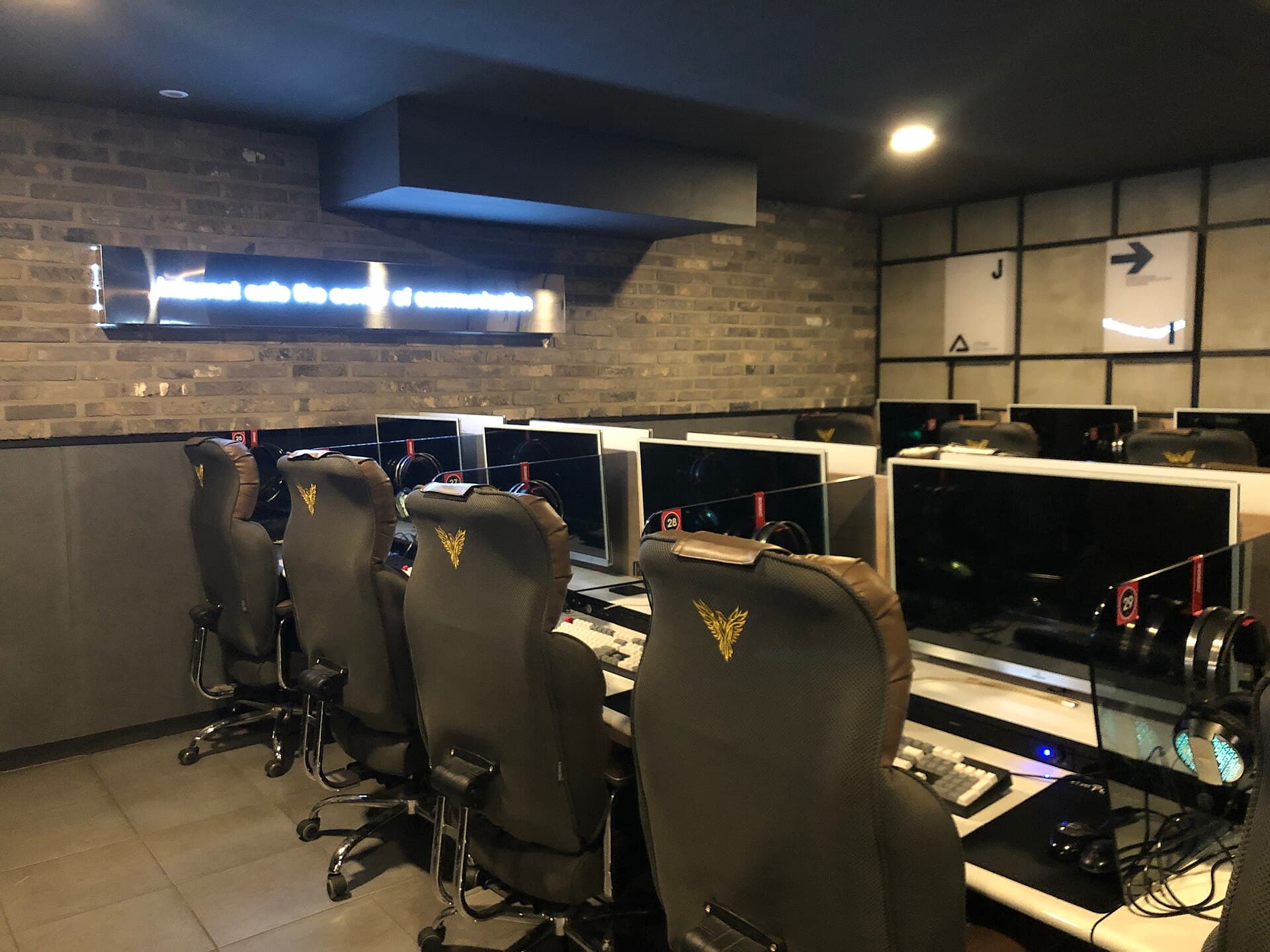
The PC bang, literally "PC room," is a high-speed gaming cybercafé where, by the hour and for a few hundred won, you rent a powerful machine in comfort designed for long sessions. But to reduce the to a mere cybercafé is to miss its historical role: it was from these dim rooms that modern e-sports sprang, that StarCraft became a national sport, and that an entire generation turned video gaming into a social practice in its own right. To understand the PC bang is to understand how a physical place industrialized a passion and exported a cultural model.
What Is a PC Bang?#
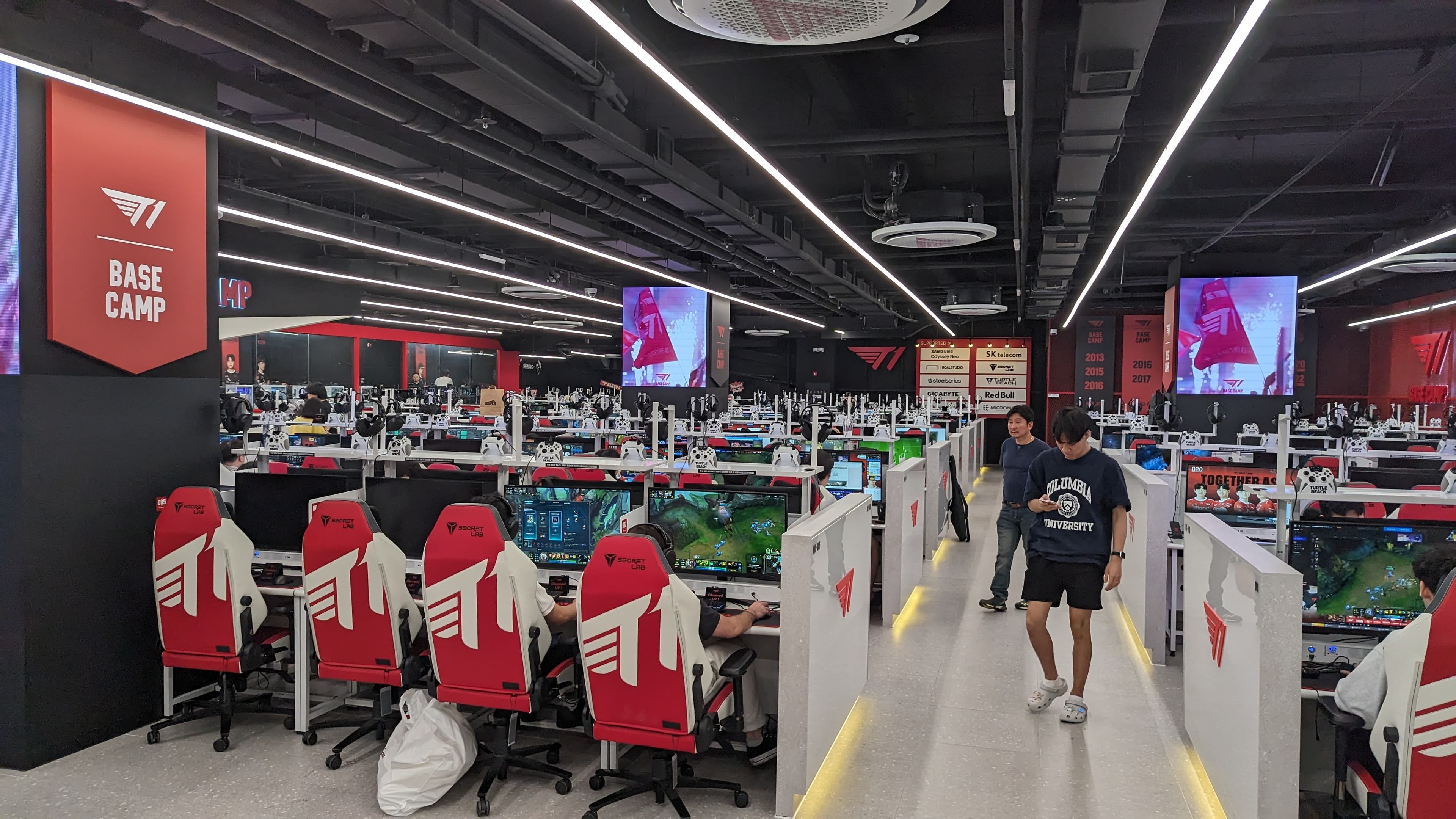
The word is a productive suffix of Korean urban life: it appears in the noraebang (노래방, the karaoke room) and the jjimjilbang (찜질방, the public sauna). The PC bang applies this principle to leisure computing: a large room, often in a basement or on an upper floor of a building, lined with dozens, sometimes more than a hundred identical stations.
joins the English PC (transcribed in hangul as 피시, pisi) with bang (방, "room, chamber"). The name soberly describes what the place is: a room full of computers. The logic of the suffix bang is the same as in noraebang (노래방, "song room").
What sets a PC bang apart from an ordinary cybercafé is its obsession with performance and comfort. The machines are upgraded regularly, fitted with high-end graphics cards, large high-refresh screens, mechanical keyboards and competition-grade mice. The seats are ergonomic, reclining, designed to keep you seated for six hours at a stretch. The air conditioning runs constantly, the lighting is dim, and a counter serves drinks, snacks and, above all, hot dishes ordered straight from the screen and brought to the player's seat. The hourly rate, long around a thousand won an hour, remains trivial next to the power on offer.
A PC bang is not a place you go to because you lack a computer at home. It is a place you go to because the machine is better there, the chair more comfortable, and because the others are there too.
A Birth in the 1997 Crisis#
The PC bang was not born of a concerted plan, but of the improbable meeting of three phenomena at the very end of the 1990s. The first was an economic catastrophe.
In 1997, South Korea was hit head-on by the Asian financial crisis. The country had to place itself under the tutelage of the IMF (International Monetary Fund), which Koreans still refer to with the bitter phrase "the IMF crisis" (IMF 위기). Thousands of managers and employees were laid off overnight. Many of these unemployed, holding a severance payout and seeking to reinvent themselves, turned to a business with a low barrier to entry: opening a PC bang. All it took was a premises, a batch of computers and an Internet subscription. The wave of forced career changes thus fueled a dazzling proliferation of rooms.
The second phenomenon was technological. At the same moment, Korea was rolling out one of the fastest and densest broadband networks in the world, backed by a determined public policy. In a country where vertical housing concentrates the population, very-high-speed cabling became a national asset. The PC bang, heavy consumers of bandwidth, were both the showcases and the beneficiaries of this revolution.
At its peak, in the early 2000s, South Korea had roughly 20,000 PC bang, a density without equal in the world. In some student districts of Seoul, several competing rooms could be found within a hundred meters.
The third phenomenon, the decisive one, was a game.
StarCraft, the Spark#
In 1998, the American publisher Blizzard released StarCraft, a real-time strategy game in which three species (Terrans, Protoss, Zerg) clash in space battles demanding reflexes, planning and moves of formidable precision. Nowhere in the world did the game meet with a success comparable to the one it found in South Korea, where it very quickly became a genuine national phenomenon.
The alignment was perfect: a competitive, high-strung game, spectacular to watch, arriving in a country suddenly covered with rooms equipped with machines able to run it and linked by the best broadband in the world. StarCraft played better and was shared better in a PC bang than in a living room. People came to take on others, on the local network first, online later, and to watch over the shoulders of the best.
In Korea, StarCraft was not one video game among many. It was the sport that gave the PC bang their stadiums, their heroes and their audience.
From this ground a new figure quickly emerged: the professional player. The best from the PC bang, spotted in the rankings, became salaried athletes, members of teams sponsored by major corporations. Structured leagues took shape, and above all, television channels devoted entirely to video gaming appeared. OnGameNet (OGN), launched in 2000, broadcast StarCraft matches with commentators, replays and analysis, like a traditional sport. Finals were played before tens of thousands of spectators gathered in stadiums. Modern e-sports, in its professionalized and mediatized form, was born right there, between the chairs of a PC bang and the cameras of a cable channel.
The PC Bang, Factory of E-sports#
The link between the PC bang and e-sports was never purely symbolic: the room was, very concretely, the first link in the chain. The internal and online rankings, fed by games played in PC bang, formed an immense pool where talent revealed itself. A gifted teenager, noticed for his statistics, could climb the ranks all the way to the professional teams.
This mechanism outlived the decline of StarCraft. When Riot Games' League of Legends took hold from the early 2010s, it conquered the PC bang in turn, to the point of massively dominating the ranking of the most-played games in Korean rooms. Korea became the most feared nation in the discipline, its teams seizing world title after world title. Later, , developed by the Korean studio Krafton, extended the lineage by installing the battle royale genre in the same rooms.
| Game | Year | Role in the PC bang |
|---|---|---|
| StarCraft | 1998 | Foundation of Korean e-sports, dedicated TV |
| StarCraft II | 2010 | Continuity of the professional leagues |
| League of Legends | 2011 | Lasting domination of the rooms' rankings |
| Battlegrounds (PUBG) | 2017 | Battle royale born from a Korean studio |
The PC bang also played a subtle commercial role. Publishers offered players specific perks when they logged in from an affiliated room: bonuses, items, accelerated experience. Playing in a PC bang became more advantageous than playing at home, which boosted the rooms' footfall and tied the gaming industry ever more tightly to this network of physical places.
The vocabulary of Korean gaming becomes clear once you can read hangul: 피시방 (pisibang, "PC room"), 게임 (geim, "game") and 배틀그라운드 (Battlegrounds) dot the country's digital life. Learn to read and remember these words with KoreanSRS and its spaced repetition.
A Place of Sociability#
To reduce the PC bang to a factory of champions would nonetheless be to miss its most everyday dimension. Above all, the room is a place of social life, a rallying point for Korean youth.
People rarely go alone. After class or work, among friends, they book a row of neighboring stations to play the same game together, to tease one another, to put the world to rights between rounds. For students whose housing is cramped and shared, the PC bang offers a space of one's own, heated or air-conditioned, where you can spend hours for the price of a meal. Soldiers on leave, briefly returned to civilian life, find their games and their friends there again. The room is an airlock, midway between public space and intimacy, where the friendships of adolescence are tied and untied.
Food holds a central place there. You eat without leaving your seat: , those Korean instant noodles served scalding hot, is its absolute emblem, to the point that PC-bang ramyeon has become a shared taste memory for an entire generation. From the screen you order snacks, drinks, fried chicken, brought straight to your seat. Eating, playing, chatting: the PC bang condenses into a single place what other cultures scatter between the café, the arcade and the spare room.
Read alsoThe jjimjilbang: the Korean sauna that never sleepsAsk a Korean in their thirties for their sharpest memory of adolescence, and the odds are good it will feature a screen, a row of friends and a steaming bowl of ramyeon in the half-light of a PC bang.
The PC bang is not the only "bang" where Korea turned shared time into an institution: push open the door of the jjimjilbang, the public sauna where people eat, sleep and gather.
Decline, Regulation and Moving Upmarket#
The golden age of twenty thousand rooms did not last. From the late 2000s, the number of PC bang began a slow retreat, under the combined effect of several factors. The democratization of powerful personal computers and smartphones offered alternatives for gaming at home. The saturation of the market, with too many rooms waging a price war, cut into profitability and drove many operators to close.
Regulation accelerated the shift. In 2013, the smoking ban was extended to PC bang, ending the smoky atmosphere that had long characterized the rooms. While the measure drove away part of the most dedicated clientele in the short term, it also helped to clean up and rejuvenate the place's image. Other debates, notably over the excessive gaming time of minors, accompanied this period of maturation.
Far from disappearing, the PC bang reinvented itself upward. A new generation of premium rooms emerged: cutting-edge machines, giant curved screens, competition chairs, careful decor. The food offering, long limited to ramyeon and snacks, grew sophisticated, some rooms acquiring genuine kitchens serving elaborate dishes, to the point of blurring the line between PC bang and restaurant. Hybrid formats appeared, mixing café, gaming room and coworking space. The PC bang of 2020 is no longer the smoky, cheap room of the year 2000: it is an unabashed leisure space, where the quality of the equipment and service justifies a higher ticket.
An Exported Cultural Model#
The influence of the PC bang reaches far beyond Korea's borders. By laying the foundations of professional e-sports, inventing its televisual grammar and training the first world champions, Korea exported a model that the rest of the planet eventually adopted. Packed arenas, over-excited commentators, sponsored teams, star-player transfers: this multi-billion economy, now global, owes part of its DNA to the dim rooms of Seoul.
The very concept of the high-end gaming cybercafé spread, adapted under other names and other forms in China, in Southeast Asia, as far as the West, where gaming lounges inspired by the Korean model flourish. More deeply, the PC bang illustrates a distinctly Korean way of making video gaming a collective, spatialized, social practice, running counter to the Western image of the solitary player shut in their room.
The PC bang belongs to that family of places which, in Korea, turn a private activity into a shared ritual. Like the karaoke room or the public sauna, it offers a space where time is consumed together, sheltered from prying eyes and from the price of housing. That is perhaps its most lasting legacy: to have proved that a digital passion, reputed to be solitary, could become the cement of a generation.
Read alsoHallyu: How the Korean Wave Conquered the WorldFrom e-sports to K-dramas, Korea exports its popular culture: trace it back to the source, the Korean wave, or hallyu.
The PC bang makes the digital a place of sociability; conversely, the Japanese hikikomori makes it a refuge of withdrawal. Two opposite relationships to the screen and to the world.
FAQ#
What exactly does "PC bang" mean? The term joins the English PC (computer) with the Korean word bang (방), which means "room" or "chamber." A PC bang is thus literally a "PC room," that is, a gaming cybercafé where you rent a powerful computer by the hour. The suffix bang appears in other Korean places, such as the noraebang (karaoke room).
Why did PC bang appear in Korea in the late 1990s? Three factors converged: the 1997 financial crisis, which pushed many unemployed people to open a low-investment business; the rollout of exceptional broadband across the country; and the phenomenal success of the game StarCraft in 1998, which gave the rooms their purpose and their audience.
What is the link between PC bang and e-sports? The PC bang were the cradle of modern e-sports. The rooms' rankings served as a pool for professional players, dedicated leagues and television channels such as OnGameNet appeared as early as 2000, and Korea became the reference nation, first on StarCraft, then on League of Legends and Battlegrounds (PUBG).
Can you eat in a PC bang? Yes, and it is even an essential part of the experience. From the screen you order drinks, snacks and hot dishes, brought straight to your seat. Ramyeon (라면), those instant noodles served scalding hot, is its symbol, associated for a whole generation of Koreans with long sessions in the room.
Do PC bang still exist today? Yes, though their number has fallen markedly since the peak of roughly 20,000 establishments in the early 2000s. The sector has cleaned up, notably after the 2013 smoking ban, and has moved upmarket: premium rooms, cutting-edge hardware and a sophisticated food offering.
Photo credits: images in this article come from Wikimedia Commons and are under free licenses.
The Starleague: how Korea invented the professional gamer
The PC bang as a laboratory, a television channel that created a profession, the state stepping in: the five reasons Korea's grip on e-sport has lasted.
Cover image: Wvdp · Wvdp, via Wikimedia Commons · CC0