Baechu, dongchimi, kkakdugi: the varieties of kimchi
Kimchi is not one dish but a family: whole cabbage, cubed radish, winter brine, summer versions. The edible atlas of a national fermentation.
La rédaction Kotoba Interactive
Studio éditorial
Inside an earthenware jar the color of scorched clay, an , something breathes. Its microporous wall lets a thread of gas escape, a smell of garlic, chili and sea that barely rises yet no Korean would mistake for anything else. What sits inside is never quite the same: here a whole head of cabbage split and stuffed with red paste, there cubes of radish that snap, elsewhere a chilled pink broth with translucent slices adrift. All of it is called , and that is precisely the trap of the word. There is not one kimchi, but a family of nearly two hundred documented members.
Seoul's Kimchi Museum lists more than two hundred, and some scholars, counting regional and family variants, climb past three hundred. Kimchi is not a dish, then: it is a method, that of lactic fermentation applied to almost any vegetable on the peninsula, declined by season, by region, by what grows in the garden and by the hand that prepares it. This article sets aside the single napa cabbage the West knows in order to lay out the full typology: the leaf kimchis, the radish kimchis, the seasonal ones, the chemistry that turns them sour and the regional map that sets them apart. A geography you can eat.
One word, one method, two hundred dishes#
Kimchi names a technique first, not a recipe. At the root of the whole family lies one gesture: salt a vegetable to draw out its water, coat it in a seasoning paste, then let it ferment away from the air. What changes from one kimchi to the next is the main vegetable, the harvest season, the amount of salt, and above all the makeup of the paste. From this combinatorial play come the two hundred varieties.
The most common Korean classification sorts kimchi by dominant ingredient: cabbage baechu-kimchi, radish kimchis, kimchis of greens or of the season. A second grid distinguishes them by water content, from the near-dry kimchi to the liquid kimchi you drink by the ladle. A third, finally, arranges them by season, for each vegetable has its month and the calendar rules the table. These three readings overlap: a single dish is at once a radish kimchi, watery and summery.
is thought to derive from , a vegetable plunged into brine. The name states the method before the ingredient: what makes kimchi is not the cabbage but the immersion and the fermentation.
The leaf kimchis: the reign of cabbage#
Napa cabbage kimchi rules the Korean table, but it comes in several versions, including one without a trace of chili. Chinese cabbage, , long and headed, has been the most common base ever since its cultivation spread in the nineteenth century. Its thick, ribbed leaf holds the seasoning paste in its folds, and its flesh softens as it ferments without falling apart.
Baechu-kimchi (배추김치), the classic#
is the default kimchi, the one meant when you simply say "kimchi." The cabbage is split in two or four, salted for several hours, rinsed, then each leaf is coated with a paste of , garlic, ginger, scallion and fermented seafood brine. The whole stuffed head, , ferments in quarters that are sliced at serving time. This is the kimchi of the , the great winter making.
Baek-kimchi (백김치), the white kimchi#
does without chili entirely and recalls what kimchi was before the seventeenth century. Before red chili reached Korea, all kimchi was white, fermented in brine alone. Baek-kimchi keeps that memory alive: salted cabbage stuffed with pear, jujube, chestnut, mushroom and scallion, bathing in a clear, faintly sweet brine. Mild, fresh, without heat, it suits palates sensitive to spice and serves as a soothing counterpoint to fiery dishes.
Bossam-kimchi (보쌈김치), the wrapped kimchi#
is a festive kimchi in which the cabbage wraps a trove of fillings. The name comes from , "to wrap in a bundle": broad cabbage leaves enclose a rich stuffing of pear, chestnut, pine nuts, jujube, seafood and oysters, folded into a small parcel. A specialty of the region, the old capital, it was a ceremonial kimchi served on great occasions, each bundle revealing its treasures on opening.
The radish kimchis: from crisp bite to iced broth#
The mu radish gives rise to a family of kimchi running from the dense cube to a liquid you drink. This large white Korean radish, denser and sweeter than the turnip, lends itself to textures the cabbage cannot offer: the clean snap, the drinkable brine.
Kkakdugi (깍두기), the radish cubes#
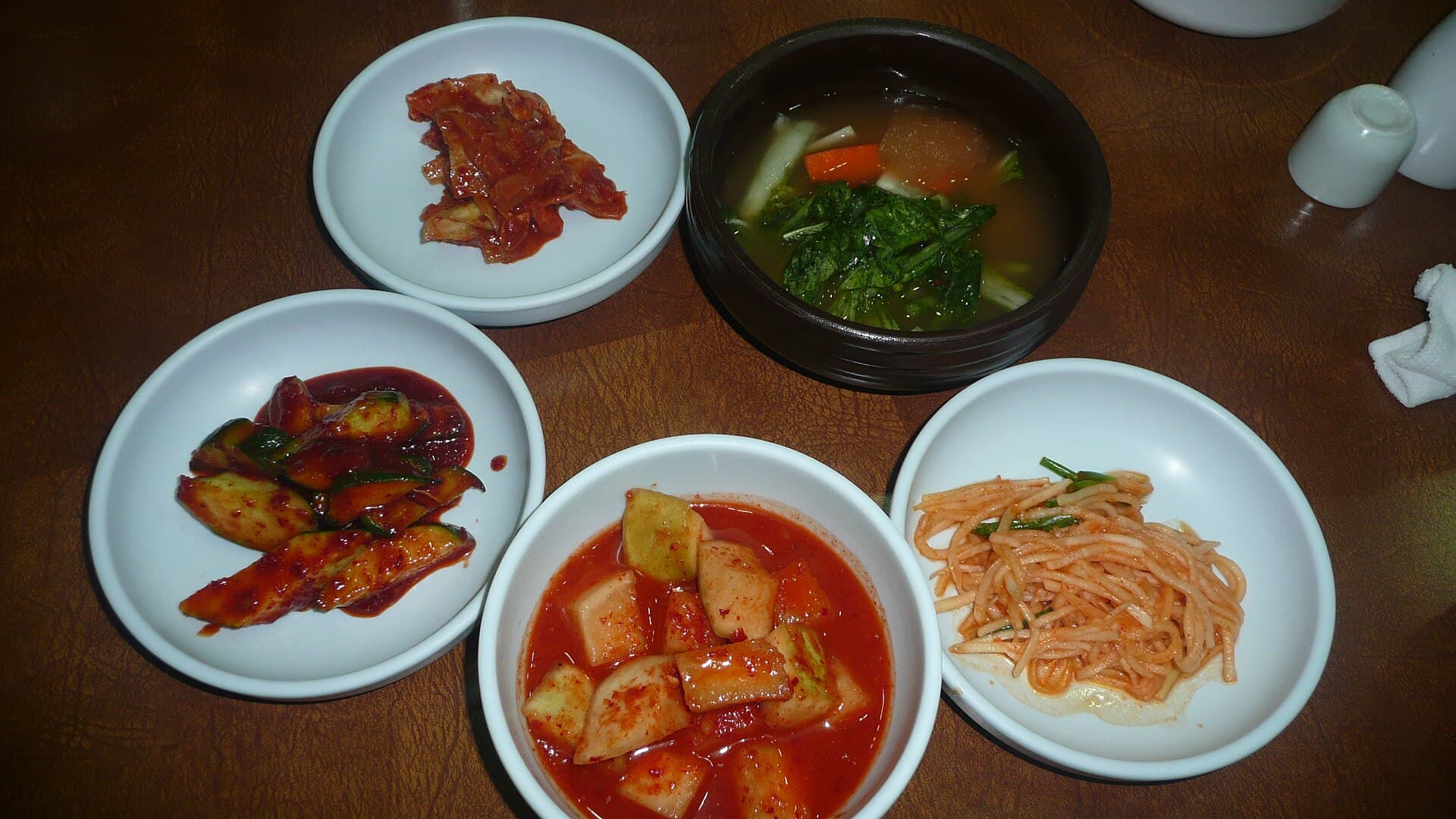
cuts the radish into even cubes coated in chili paste. The word evokes the act of dicing. Firm, juicy, sweet and hot, it snaps under the tooth in a way cabbage never does, and it traditionally accompanies , the milky beef-bone broth whose roundness it cuts.
Chonggak-kimchi (총각김치), the ponytail radish#
ferments small whole radishes with their green tops. The , a tapered radish the size of a hand, is prepared unpeeled, long greens included, each radish left in one piece. The name, literally "bachelor radish," is said to refer to the shape of the root recalling the topknot worn by unmarried young men in old Korea. Sharp and crisp, it is grabbed by the greens.
Dongchimi (동치미), the water kimchi#
is a liquid kimchi, almost a fermented drink, without chili. The name means "winter kimchi": whole radishes bathe in a clear brine brightened with pear, scallion, garlic and ginger, souring slowly in the cold. Its iced, faintly fizzy broth is drunk, and that liquid serves as the base for , cold noodles. Nothing red, nothing fiery: dongchimi is the thirst-quenching face of kimchi.
Nabak-kimchi (나박김치), the pink watery one#
is a water kimchi tinged pink, milder and more springlike than dongchimi. Radish and cabbage are sliced thin into small squares left afloat in a light brine colored by a hint of gochugaru. Its fermentation is short, its flavor clear and fresh, halfway between a dish and a cold soup. It is served in a small bowl, with a spoon.
A kimchi can be a dish you crunch or a broth you drink. Between the kkakdugi that snaps and the dongchimi you raise to your lips, it is the same art of fermentation simply changing form.
Kimchi vocabulary tastes better once you can read it: 김치 (kimchi), 배추 (baechu, napa cabbage), 무 (mu, radish), 고춧가루 (gochugaru, chili flakes). KoreanSRS, our spaced-repetition app for learning Korean, is coming soon: join the waitlist to decode hangul and these table words from day one.
The seasonal kimchis: the garden in fermentation#
Beyond cabbage and radish, almost any leafy vegetable can become kimchi, and the calendar dictates which. These seasonal kimchis, often quick to ferment, follow the harvest closely and give the Korean table its yearly rhythm.
Oi-sobagi (오이소박이), summer's stuffed cucumber#
is a split, stuffed cucumber, the star kimchi of summer. The cucumber is cut crosswise without being severed, a filling of minced scallion, garlic and chili is slipped into the slits, and it ferments for only a few days. Crisp, refreshing, faintly sour, it is eaten young, while the cucumber still holds its water and bite, exactly when the heat dulls the appetite.
Yeolmu-kimchi (열무김치), young summer greens#
ferments young summer radishes with their tender stems and leaves. The is a radish picked young, of which everything is kept, thin root and green tops alike. Light, barely spicy, often barely watery, it crowns , spicy cold noodles, and summer rice. It is the refreshing kimchi of the warm months, when a heavy kimchi would weigh too much.
Pa-kimchi (파김치), whole scallion#
is a whole-scallion kimchi, intense and pungent. Long scallions are seasoned with a paste heavy in anchovy brine and gochugaru, without prolonged salting. As it ferments, the scallion sheds its bite and gains an almost sweet depth. Bold and forthright, it is a kimchi for enthusiasts, pairing as well with rice as with grilled meat.
Gat-kimchi (갓김치), the mustard leaf of Yeosu#
ferments mustard leaves and signs the cooking of the region in the south. , a brown mustard with ribbed leaves, brings a peppery bitterness and natural heat that fermentation softens without erasing. The Yeosu gat-kimchi, rich in fish brine, dark and powerful, is a regional pride, one of the most sharply defined kimchis on the entire peninsula.
Buchu-kimchi (부추김치), garlic chives#
seasons garlic chives without long salting or a long wait. , Chinese chives with a pronounced garlicky scent, are simply mixed into a paste of gochugaru and fish brine and eaten almost fresh. Pungent and fragrant, often tied to the southern regions, it shows just how readily kimchi takes to the smallest leaf of the garden.
| Kimchi (hangul + romaja) | Main ingredient | Season / region | Character |
|---|---|---|---|
| 배추김치 (baechu-kimchi) | Napa cabbage | Year-round, winter kimjang | Spicy, melting, the classic |
| 백김치 (baek-kimchi) | Napa cabbage, no chili | Year-round | White, mild, clear brine |
| 보쌈김치 (bossam-kimchi) | Cabbage-wrapped bundle | Festivals, Gaeseong region | Rich, dried fruit and seafood |
| 깍두기 (kkakdugi) | Cubed mu radish | Year-round | Crunchy, sweet-hot |
| 총각김치 (chonggak-kimchi) | Small ponytail radish | Autumn, winter | Sharp, crisp, whole |
| 동치미 (dongchimi) | Radish in clear brine | Winter | Watery, no chili, drinkable |
| 나박김치 (nabak-kimchi) | Sliced radish and cabbage | Spring | Watery, pink, mild |
| 오이소박이 (oi-sobagi) | Stuffed cucumber | Summer | Crisp, refreshing |
| 열무김치 (yeolmu-kimchi) | Young radish greens | Summer | Light, barely spicy |
| 갓김치 (gat-kimchi) | Mustard leaf | Yeosu (south) | Bitter, peppery, powerful |
The chemistry of sour: what happens inside the jar#
Kimchi's flavor comes from a lactic fermentation led by a succession of bacteria. Once the vegetable is salted and coated, oxygen runs out in the jar and lactic-acid bacteria take over. They turn the vegetables' sugars into lactic acid, and it is this rising acidity that balances the salt and heat and gives mature kimchi its characteristic bite.
The order of the procession matters. At first, Leuconostoc, salt-tolerant and gas-producing, leads the dance: it acidifies gently and generates the fizz of young kimchi, still fresh and crisp. As the medium turns more acidic, it yields to Lactobacillus, more acid-resistant, which pushes fermentation further toward a frank sourness. It is this microbial handover that carries a kimchi from lively crunch to deep and tart.
This ripening reads in the names of the stages. Fresh that day, crisp and barely fermented, it is . After a few days of full fermentation it becomes , "ripe," with rounded acidity. Pushed a year or more, it turns into , "aged," whose deep, almost cheesy flavor works wonders in stews like . The same cabbage thus passes through three different dishes depending on the time it is given.
The paste and the sea: gochugaru, garlic and jeotgal#
What gives kimchi its identity, beyond the vegetable, is a seasoning paste built around chili, garlic and a fermented product of the sea. The heart of almost any red kimchi is the same: , crushed garlic, ginger, scallion, sometimes a glutinous rice porridge that aids fermentation and binds the paste. On this common base, each variety and each region adjusts the proportions.
The ingredient that most strongly signs a kimchi is , the seafood fermented in salt that brings umami and feeds the bacteria. Two great families stand opposed. , tiny fermented shrimp, yields a delicate, saline, discreet taste prized in the north and center. , fermented anchovy brine, offers instead a dark, deep power typical of the south. Choosing one or the other, or blending them, already tilts a kimchi toward a region.
Before chili, kimchi was white. reaches Korea only at the end of the sixteenth or the start of the seventeenth century. For centuries, then, all kimchi resembled today's baek-kimchi, fermented in brine alone. The red color, now the absolute emblem of kimchi, is a recent invention on the scale of its history.
The regional map: from watery North to fiery South#
Kimchi shifts character with latitude, from the mild, liquid north to the salty, flaming south. The rule comes first from climate. In the colder north of the peninsula, keeping requires less salt, and kimchi there is more watery, milder, less spicy, with abundant brine and discreet jeotgal. It is home to the water kimchis and the clear versions, where freshness outweighs power.
The farther south you go, the more the kimchi loads up. The southern regions of and , with a mild climate that speeds fermentation, salt more and spice harder to keep it longer. Jeotgal, often the myeolchijeot anchovy, is generous there, and the kimchi comes out dense, dark, intensely umami. The Yeosu gat-kimchi, in Jeolla, embodies this southern school: deep, salty, robust.
A kimchi betrays its region the way an accent betrays a town. Mild and clear, it comes from the north; dark, salty and burning with chili, it comes from the south. The whole peninsula fits inside one fermented bite.
This geography is not fixed. Internal migration, industrialization and trade have mixed the recipes, and a Seoul family may today make a southern kimchi handed down from a Busan grandmother. But the founding logic remains legible: climate drew a map of salt and chili that kimchi still carries.
The kimchi calendar: a year in fermentation#
Each season has its kimchis, and the Korean year reads inside the jar. In spring the kimchis are clear and short: pink nabak-kimchi, the first greens, tender vegetables barely fermented. Summer calls for freshness and speed: cucumber oi-sobagi, yeolmu of young radishes, pa-kimchi and buchu-kimchi, all quick to ferment, made to be eaten young before the heat turns them.
Autumn prepares for winter. It is the season of leafy radishes, of chonggak, and above all of the great rite of the , the communal making of winter kimchi, inscribed on the UNESCO Intangible Cultural Heritage list in 2013. Families, neighbors, sometimes whole districts gather to salt hundreds of cabbages and coat each leaf with red paste, building the store that will feed the winter. Sealed in the onggi, the kimjang baechu-kimchi ripens slowly in the cold, and the previous years' mugeunji joins the stews. The loop closes, ready to begin again in spring.
Kimchi and health: probiotics, with nuance#
Kimchi is rich in probiotics and vitamins, but it is no miracle cure. Its lactic fermentation produces live bacteria beneficial to gut flora, along with B-group vitamins and vitamin C, and the vegetables in it bring fiber and antioxidants. In 2024, Time magazine ranked it among the most influential fermented foods on the planet, and Korean research has long studied its effects on digestion.
The caveat still stands. Kimchi is also salty, sometimes very salty, especially in its southern versions, and heavy consumption raises sodium intake. Its virtues rest on daily, measured use, as a side dish, as it appears on the Korean table, not on massive quantities. As so often in nutrition, wisdom lies in moderation: kimchi is an excellent everyday food, not a wellness pill.
An atlas you can eat#
From the northern jar where a radish floats in its clear brine to the fiery Jeolla cabbage weighed down with anchovy, kimchi draws a map of Korea where each region, each season and each hand leaves its signature. The two hundred varieties are not two hundred rival recipes: they are the dialects of one language, that of fermentation, spoken from one end of the peninsula to the other. Learning to tell them apart means learning to read a territory in a single bite. To open an onggi is to open an edible atlas, and to understand that Korea tells its story not only in its history books but in the tart silence of a jar that breathes.
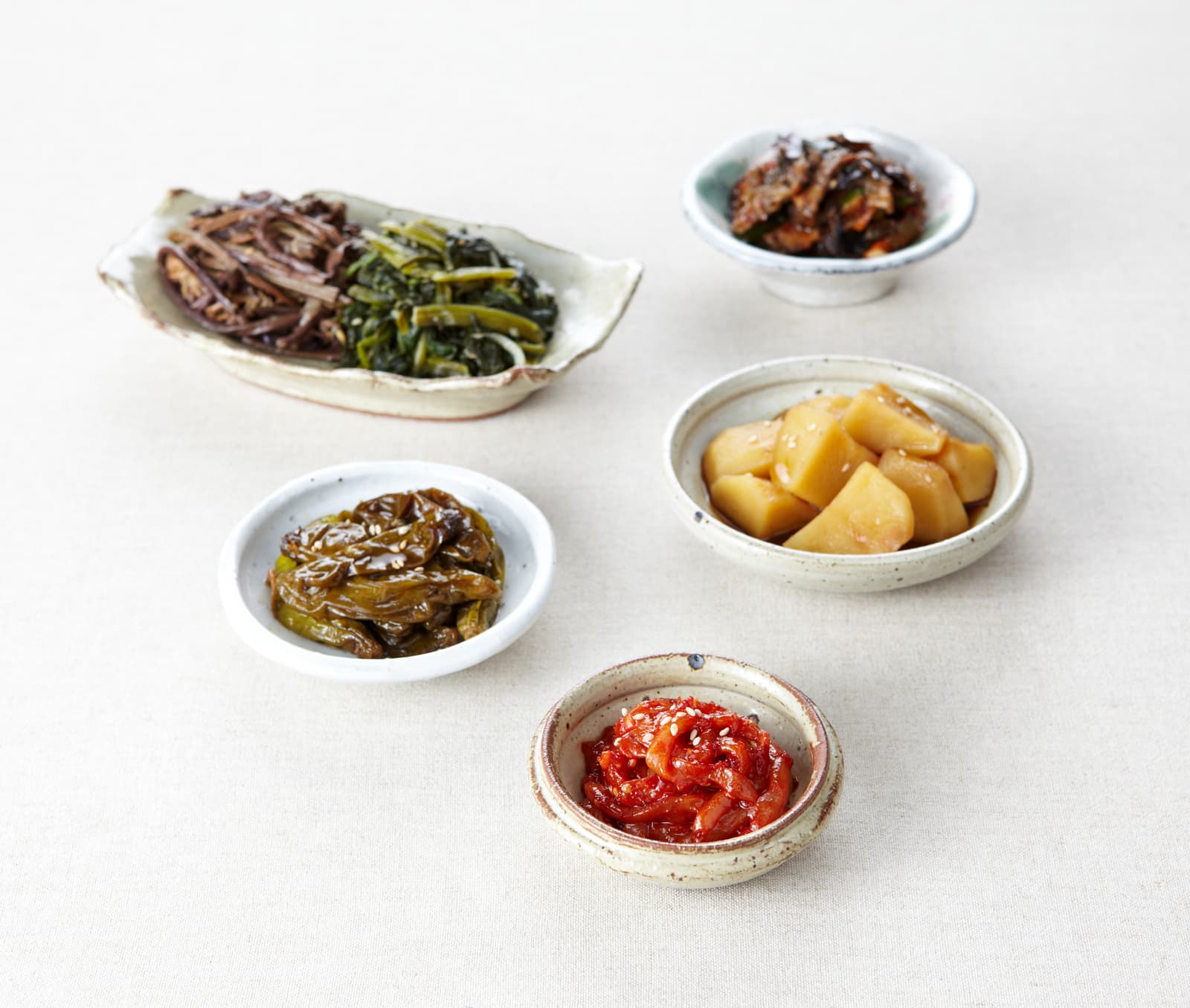
Read alsoBanchan: The Small Dishes That Define Korean DiningKimchi is only the most famous of the banchan, the dozens of small dishes that make up the Korean table. Discover the whole world that surrounds it.
Another pillar of Korean gastronomy, chimaek pairs crisp fried chicken with cold beer in a ritual of sociability that became national.
FAQ#
How many kimchi varieties are there? Seoul's Kimchi Museum lists more than two hundred, and some scholars, counting regional and family variants, exceed three hundred. Kimchi is less a recipe than a method of fermentation that can be applied to almost any vegetable.
What is the difference between cabbage and radish kimchi? is made of napa cabbage, melting and spicy. The radish kimchis run from the crisp cubes of to , a chili-free liquid kimchi whose iced brine is drunk.
Why are some kimchis not red? Because they do without chili, like or . Before chili reached Korea around the turn of the seventeenth century, all kimchi was white, fermented in brine alone.
What sets northern kimchi apart from southern kimchi? Climate. In the colder north, kimchi is less salty, more watery and less spicy. In the south, in Jeolla and Gyeongsang, it is saltier, spicier and heavier in fermented seafood brine, .
Is kimchi really good for you? It is rich in probiotics, vitamins and fiber, and ranks among the most studied fermented foods. But it is also salty: its benefits rest on daily, measured use as a side dish, not on large quantities.
Photo credits: the images in this article come from Wikimedia Commons and are under a free license.
In this article
The cultural terms covered here, each with a short definition.
Banchan: The Small Dishes That Define Korean Dining
Banchan, the small shared dishes at every Korean meal, carry centuries of philosophy, fermentation science and seasonal wisdom. A deep dive.
Cover image: Brücke-Osteuropa · Brücke-Osteuropa, via Wikimedia Commons · CC0