Ramyeon: Korea's Instant Noodle Culture
Ramyeon (라면) is not Japanese ramen: almost always instant and fiery. From Samyang in 1963 to the global Shin Ramyun and the ram-don of Parasite.
La rédaction Kotoba
Studio éditorial
It is eleven at night in a Seoul PC bang, and the screens are still flickering. On the counter, a dented yellow pot steams, its lid set aside as a plate, a raw egg sliding into the scarlet broth. No one would guess this dish came out of a packet opened thirty seconds earlier, yet it did: it is a bowl of ramyeon, the most Korean meal there is, born industrial and grown into ritual.
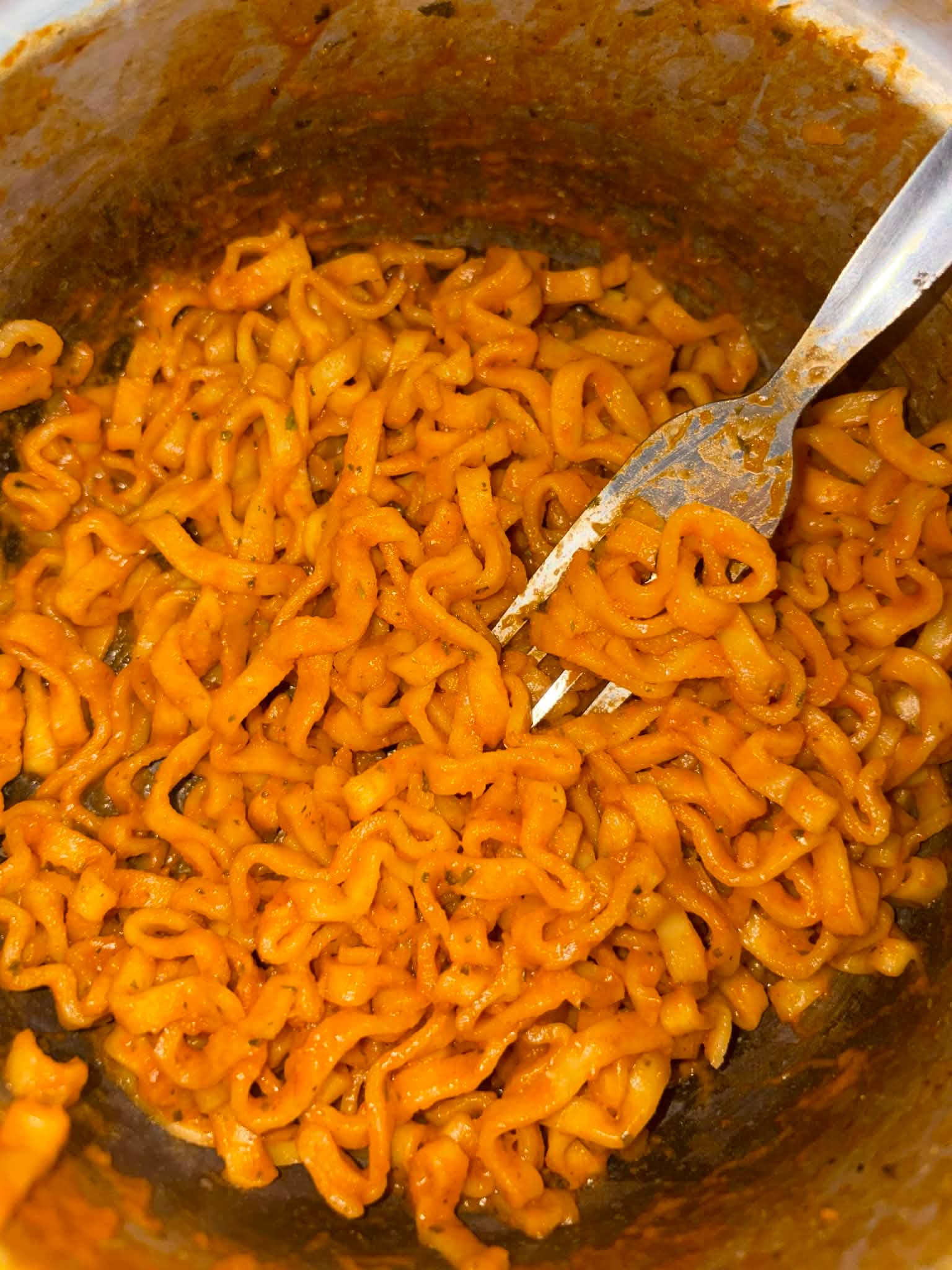
is the Korean word for instant noodles, a cultural object that has almost nothing left in common with the hand-crafted ramen of Japan. Where Japanese ramen is a restaurant dish, simmered for hours, Korean ramyeon is a packet, a pot, five minutes and a heat that rises to the forehead. To understand ramyeon is to go back to a post-war shortage, a public policy of flour, a brand turned national flag, and an Oscar-winning film that, in a single shot, made it known around the world.
Ramyeon or ramen: what exactly is the difference#
Korean ramyeon and Japanese ramen share a root but name two distinct realities today. Japanese is most often a restaurant dish: fresh noodles, a broth simmered at length from bones or miso, carefully arranged toppings. Korean , by contrast, refers in the vast majority of cases to instant noodles: pre-cooked noodles then dried or fried, sold with a sachet of seasoning powder, to be rehydrated in boiling water. The latter is not a downgraded version of the former: it is a genre in its own right, with its own codes, its signature heat and its own culture.
The word itself betrays the journey. Both terms descend from Chinese 拉麵 (lāmiàn), the hand-pulled noodles of a tradition centuries old. Japan turned them into ramen, then in the 1950s invented the instant noodle. Korea, finally, adopted the industrial process and gave it its local name, ramyeon, while pushing the heat dial far beyond the original.
Three words, one shared origin, three different dishes. 拉麵 (lāmiàn, Chinese): hand-pulled noodles, often in a clear broth. ラーメン (ramen, Japanese): a restaurant dish with a simmered broth. 라면 (ramyeon, Korean): almost always instant noodles, spicy, cooked at home in a few minutes. The drift in meaning tracks the drift in preparation, from the artisan's kitchen to the industrial packet.
Born in 1963: hunger, flour and Japanese help#
The first Korean ramyeon appeared in 1963, launched by the firm in a South Korea still scarred by post-war famine. A decade after the 1953 armistice, the country was among the poorest in the world and rice, the staple food, was in cruelly short supply. Samyang's founder, struck by the sight of people queuing for a bowl of soup, sought a food that was cheap, filling and easy to mass-produce. He found it in Japan, where the instant noodle had just been invented.
Samyang secured technical help from the Japanese firm , which passed on the know-how of frying and drying noodles. The very first packet, Samyang Ramyeon, sold for a trifling sum. Success was not immediate, though: the flavour, modelled on the Japanese template, tasted bland to the Korean palate. Legend has it that a presidential suggestion, calling for more chili, steered ramyeon toward the spicy profile that would become its signature.
Bunsik, a policy of flour#
Ramyeon would never have taken hold without one decisive public policy: , the state push to eat flour-based dishes rather than rice. In the 1960s, faced with a rice shortage and an abundance of imported wheat flour, the government launched campaigns praising flour-based meals. It introduced "rice-free days" in canteens and promoted noodles, pancakes and bread. To this day the word bunsik still names a whole category of popular Korean eating: those cheap, flour-based snack dishes.
Ramyeon was the model child of this policy. Cheap, calorie-dense, made of flour, it ticked every box of the national programme. Within a few years it went from imported curiosity to survival food, then to daily habit. A shortage and an administrative decision had, together, planted a dish at the heart of Korean culture.
1986: Shin Ramyun makes heat legendary#
In 1986, the firm launched , which would become Korea's best-selling ramyeon and a global icon. The character 辛 (shin), which gives the product its name, means "spicy" or "pungent": a whole manifesto. Its deep red broth, charged with chili and beef, embodies the deliberate turn of Korean ramyeon toward strength and heat. Where the first Samyang of 1963 stayed mild, Shin Ramyun hits hard.
Its success was colossal and lasting. Shin Ramyun stood as the number-one seller in Korea for decades, then set out to conquer the world. It is now found on supermarket shelves in more than a hundred countries, and Nongshim has opened factories abroad to keep up with demand. For millions of people outside Korea, the red-and-black Shin Ramyun packet was their first concrete contact with Korean cuisine, before even barbecue or kimchi.
South Korea holds the world record for instant noodle consumption per person: each Korean eats on average the equivalent of more than seventy servings a year, far ahead of any other country. Ramyeon is no occasional stopgap food: it is a pillar of the nation's everyday diet.
Ramyeon's vocabulary begins with its script: 라면 (ramyeon, the noodles), 신라면 (Shin Ramyun, the ruling brand), 분식 (bunsik, flour cooking), 농심 (Nongshim, the giant). KoreanSRS, our spaced-repetition app for learning Korean, is coming soon: join the waiting list to read hangul and these tasty words from day one.
The yellow pot and the art of cooking a packet#
A whole domestic ritual has grown up around ramyeon, starting with the famous yellow pot. The , a small dented pot of golden aluminium, is the canonical vessel of Korean ramyeon. Light and thin, it heats and cools fast, which lets you serve the noodles piping hot and eat straight from the pot. Many Koreans swear ramyeon tastes better in this pot than in any stainless-steel pan, and the upturned lid doubles as a plate or a trivet.
The preparation itself has become a small national theatre, everyone defending their method. People argue over the amount of water to the millilitre, the exact moment to slide in the seasoning sachet, the order between noodles and flavouring. Then come the add-ins, which turn an industrial dish into a personal creation.
The add-ins that make the difference#
Plain ramyeon barely exists: everyone completes it. The , cracked raw and left to set in the broth or beaten into threads, is the king of add-ins. A slice of softens the heat and coats the noodles in richness, while or leftover rice serve to mop up the broth to the last drop. In go spring onion, kimchi, tteok rice cakes, tuna or sausage too. These variations make ramyeon an open base rather than a fixed recipe.
Ramyeon is also the dish of late nights and chosen solitude. In konbini and corner shops, it is eaten as a cup, rehydrated at the hot-water fountain, standing at the counter. In PC bangs, the internet cafés where people game for hours, it is the official fuel of players. Hot, fast and comforting, it accompanies nights of study, gaming and work.
Ramyeon was born of a shortage and a public policy, but it became something else entirely: the dish of the late night, the tight budget and instant comfort, the one you cook alone at midnight and share straight from the pot.
From budae jjigae to ram-don: ramyeon enters the dishes#
Ramyeon does not stay confined to the lonely packet: it slips into larger dishes. The most famous is , the "army stew," born in the post-war destitution around American military bases. It mixed military surplus, sausages, canned ham and beans into a spicy kimchi broth. Ramyeon noodles were added as a cheap starch, and today they are a signature ingredient, dropped in near the end into the bubbling pot shared at the table.
More broadly, ramyeon serves as a topping called : a block of noodles is added to all sorts of soups and stews, from gamja-tang to jjimdak, to make them more filling. This flexibility has turned ramyeon into a full-fledged cooking ingredient, and not merely a ready-to-eat meal.
Jjapaguri, or the ram-don of Parasite#
In 2019, Bong Joon-ho's Oscar-winning film introduced the world to an improvised ramyeon dish: . It consists of mixing two industrial Nongshim ramyeon, Chapagetti (짜파게티, a black-sauce noodle) and Neoguri (너구리, spicy with seafood), the whole crowned in the film with pieces of luxury beef. The English subtitles named it "ram-don," a blend of ramen and udon, to make the word legible abroad.
The effect was immediate and global. Jjapaguri recipes exploded online, Nongshim saw its sales jump and even published tutorials. In the film, the dish underscores the social gulf: a broke student's meal, ennobled with priced-out meat to please a wealthy family. Ramyeon, the humble dish par excellence, became on screen a marker of inequality, and in the same stroke a planetary ambassador of Korean cuisine.
The big ramyeon brands#
The Korean ramyeon market is dominated by a few giants with sharply drawn personalities. Here are the essential landmarks, with their Korean names.
| Product or brand (hangul + romanization) | Maker | Character |
|---|---|---|
| 신라면 (Shin Ramyun) | Nongshim (농심) | The national icon, red broth spiced with beef |
| 삼양라면 (Samyang Ramyeon) | Samyang (삼양) | The very first Korean ramyeon, launched in 1963 |
| 불닭볶음면 (Buldak-bokkeum-myeon) | Samyang (삼양) | "Fire chicken" stir-fried noodles, viral extreme heat |
| 진라면 (Jin Ramen) | Ottogi (오뚜기) | Shin Ramyun's great rival, mild and spicy versions |
| 팔도 비빔면 (Paldo Bibim-myeon) | Paldo (팔도) | Cold sweet-and-spicy noodles, a summer star |
| 짜파게티 (Chapagetti) | Nongshim (농심) | Black-sauce noodles, half of the jjapaguri duo |
Samyang's deserves a special mention: these extremely spicy "fire chicken" stir-fried noodles became a global viral phenomenon through the video challenges in which people film themselves taking them on. They propelled Samyang, the pioneer of 1963, back onto the international stage half a century after its first packet.
Read alsoPC Bang: The Cybercafés That Shaped Korean GamingCup ramyeon is the official fuel of gamers: a dive into Korea's internet cafés, where people play and snack through entire nights.
Another temple of Korean late-night comfort: the pojangmacha, those street tent-bars where people eat and drink under a single hanging bulb.
FAQ#
Is ramyeon the same thing as Japanese ramen? No. Japanese ramen (ラーメン) is most often a restaurant dish with a long-simmered broth. Korean ramyeon (라면) refers in almost all cases to instant noodles, in a packet, cooked at home in a few minutes and generally far spicier.
Who invented the first Korean ramyeon, and when? The firm Samyang Foods (삼양식품), in 1963, with technical help from the Japanese company Myojo. In a Korea gripped by a post-war rice shortage, it was first a cheap survival food, before becoming a national habit.
Why is Korean ramyeon so spicy? The turn toward heat came after 1963, the original Japanese flavour tasting bland to Koreans. Nongshim's 1986 launch of Shin Ramyun (신라면), whose very name means "spicy" (辛), enshrined that fiery profile as the signature of Korean ramyeon.
What is the ram-don from the film Parasite? It is jjapaguri (짜파구리), a mix of two Nongshim ramyeon, Chapagetti and Neoguri, topped with luxury beef. The English subtitles renamed it "ram-don." Bong Joon-ho's Oscar-winning film made it globally famous in 2019.
Why cook ramyeon in a yellow pot? The yang-eun-naembi (양은냄비), a small golden aluminium pot, heats and cools very fast, which lets you serve and eat the noodles piping hot straight from the vessel. Many Koreans feel it gives ramyeon a superior taste, and its lid doubles as a plate.
Crédits photographiques : les images de cet article proviennent de Wikimedia Commons et sont sous licence libre.
Kimchi Varieties: Korea's Edible Atlas
There is not one kimchi but nearly two hundred. Cabbage, radish, cucumber, scallion: the detailed guide to the great kimchi families, region by region.
Cover image: BrithnyBiong · BrithnyBiong, via Wikimedia Commons · CC BY 4.0