Going to a sumo tournament in Tokyo: the practical guide
Tickets, timings, masu-seki boxes, etiquette and the ideal day at the Ryōgoku Kokugikan: everything you need to see a sumo basho in Tokyo.
La rédaction Kotoba Interactive
Studio éditorial
Three of the six annual sumo tournaments are held in Tokyo, in January, May and September, always in the same hall: the Ryōgoku Kokugikan. It is the only place in the world where you can watch the country's best professional wrestlers fifteen days running, and the box office opens about a month before day one.
That lead time is the traveller's real trap. The best days, the opening weekend and the final three days, sell out within hours, while second-week Tuesdays stay available for a long time. A tournament is therefore prepared in the opposite order to intuition: first pick a date, then a seat type, and only last an arrival time.
Where and when: six tournaments, three cities to remember#
The calendar has been fixed for decades. Six fifteen-day tournaments, one every other month, each starting on a Sunday.
| Month | City | Venue |
|---|---|---|
| January | Tokyo | Ryōgoku Kokugikan |
| March | Osaka | Osaka municipal arena |
| May | Tokyo | Ryōgoku Kokugikan |
| July | Nagoya | Nagoya arena |
| September | Tokyo | Ryōgoku Kokugikan |
| November | Fukuoka | Fukuoka Kokusai Center |
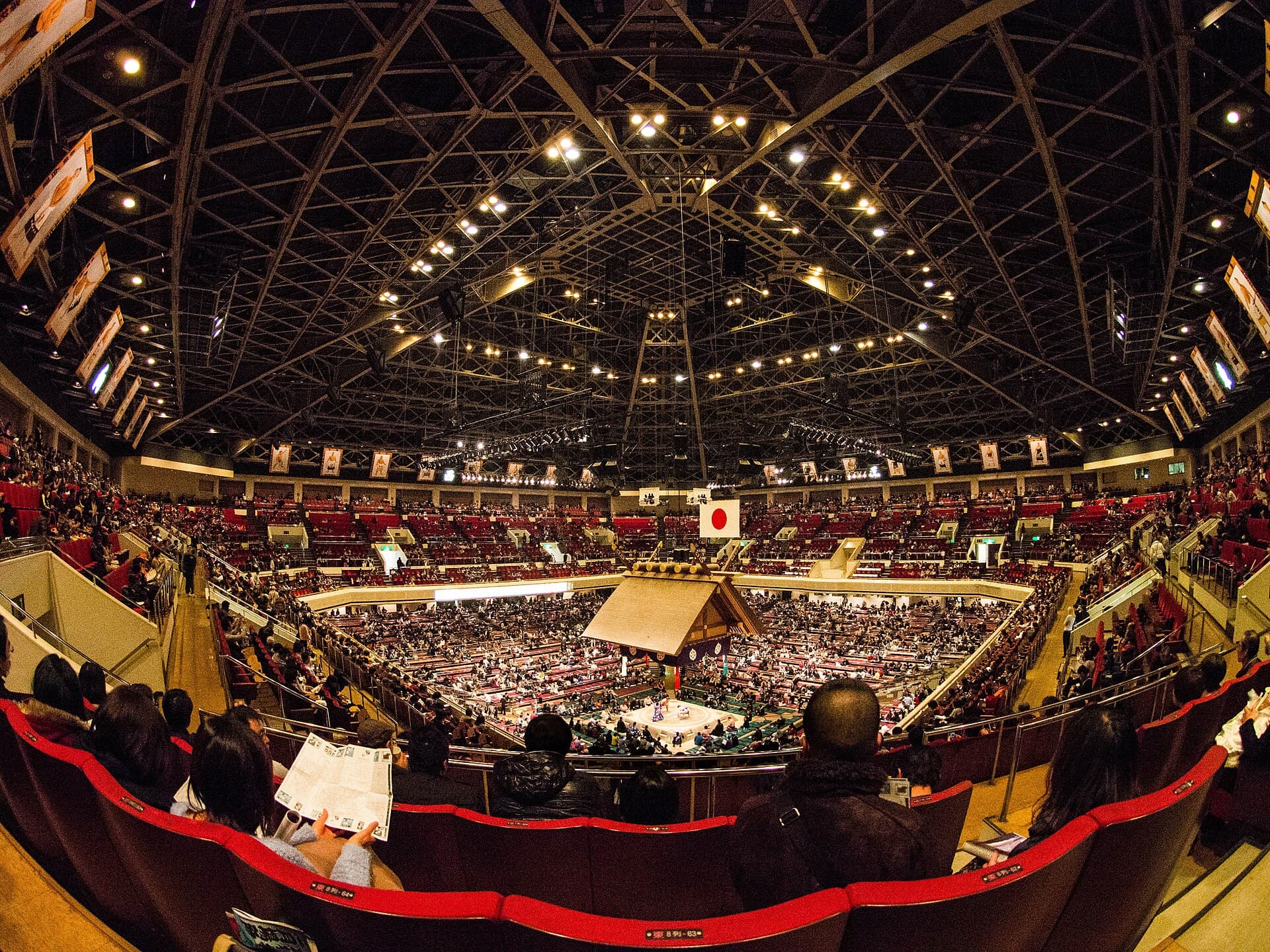
For a traveller, Tokyo offers three clear advantages: the hall is the largest, it is served by a station bearing the neighbourhood's name, and it houses a sumo museum on the ground floor accessible with the day's ticket. The , opened at its current site in 1985, holds about eleven thousand people, which remains small for a national sporting event.
One useful nuance: the hall is also used outside tournaments for other events, and sumo exhibitions, the jungyō, tour the provinces between basho. Those exhibitions are enjoyable and far more accessible, but the bouts do not count towards the rankings, which changes the intensity.
The three seat types, and which to choose#
The hall reads as three concentric rings, from the floor upwards.
The , at the edge of the ring, are cushions on the floor with no backrest, metres from the wrestlers. They are not sold to the general public in the ordinary way and are largely reserved for guests and Association subscribers. You run the risk of catching a wrestler thrown out of the ring, and eating, drinking and photography are forbidden there.
The form the next ring. These are square tatami boxes sold for four people, shoes off, cushions on the floor. It is the most Japanese and the least comfortable experience: the space is calculated for four bodies sitting cross-legged, which assumes a degree of flexibility over five hours. The boxes are sold as a block, so the price should be reasoned per four.
The , the balcony chairs, occupy the upper level. Backrest, armrests, a plunging view over the ring: it is the rational choice for a first tournament, especially in the first or second balcony row.
To these three categories add a fourth route, often overlooked: a batch of goes on sale on the morning itself at the venue box office, in limited numbers, for the highest seats. The queue forms early, and that batch is the only recourse for a sold-out day.
The word 枡 (masu) originally referred to the square wooden box used to measure rice, and later to drink sake. A sumo box carries that name because it has exactly that shape seen from above: a partitioned wooden square. A rice measure became a unit of seating.
How a day unfolds, hour by hour#
Doors open around eight in the morning and bouts begin almost immediately, but most of the day is still empty.
The morning is given over to the lower divisions, in front of sparse stands. It is the most interesting moment for anyone who wants to watch without distraction: bouts follow quickly, young wrestlers are lighter and more technical, and you can move freely around the hall.
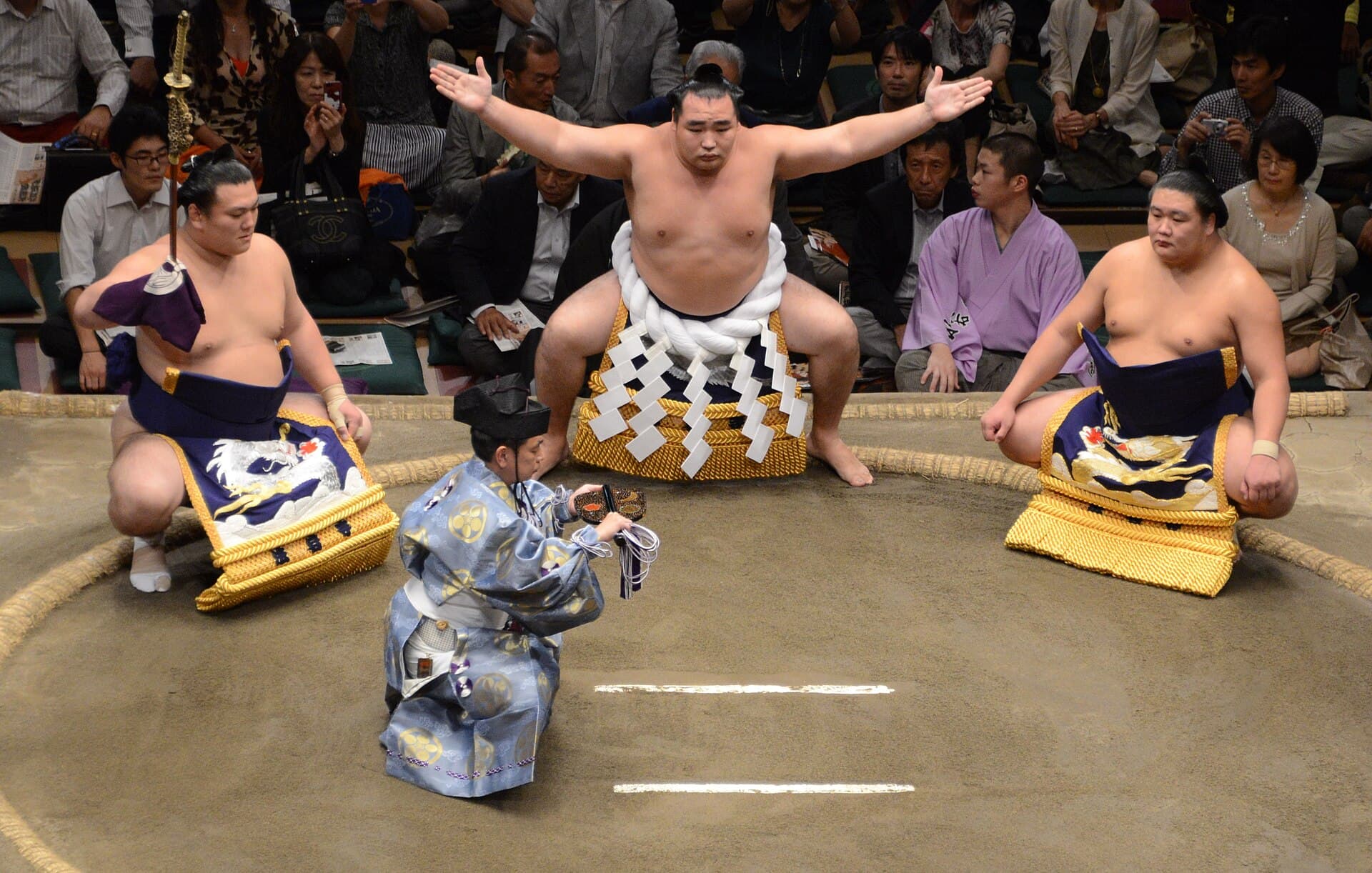
By mid-afternoon, the second division, jūryō, makes its entrance with its presentation ceremony. The hall then fills up within half an hour. Around four, the top-division makuuchi wrestlers climb up in turn in their ceremonial aprons, followed by the yokozuna's solemn entrance if one is active.
The final bouts, the most awaited, take place at the end of the day and the last match falls shortly before six. A brief bow-twirling ceremony, the , closes the day. The hall empties towards the station within minutes, which is worth anticipating.
A tournament day can be followed with only a few words: 枡席 (masu-seki, the tatami box), 当日券 (tōjitsuken, the same-day ticket) and 取組 (torikumi, the bout schedule). JapaneseSRS, our spaced repetition app, installs that vocabulary and the everyday Japanese that goes with it.
Etiquette: what is done and what is not#
Sumo crowds are loud, well fed and good natured, with three exceptions.
You do not stand during a bout. Moving through the aisles happens between matches, which leaves plenty of time given that each bout lasts seconds.
You do not use flash photography, and phone use is tolerated as long as it does not bother the row below. The tamari-seki, for their part, ban cameras outright.
You do not throw your cushion. Tossing a zabuton after a yokozuna's defeat is a spectator tradition the Association has formally banned for safety reasons, and announcements repeat that through the day. It happens anyway, and it is better not to join in.
Two practical customs are worth knowing. The first is food: the Kokugikan allows eating in the hall, serves chanko-nabe in the basement and sells skewers cooked on site, a small institution of the building. The second is re-entry: the ticket lets you leave the hall and come back the same day, which makes the long morning slot far more bearable.
The yakitori sold at the Kokugikan are prepared in a kitchen installed in the basement of the hall. The choice of chicken is not a commercial accident: the bird stands on two legs and never touches the ground with its hands, which makes it an ironic good-luck charm in a sport where putting down anything other than the soles of your feet means defeat.
Planning your day in practice#
Three decisions are enough to get a tournament right.
The date. Weekdays in the middle of the tournament are the easiest to get and the cheapest. The final Sunday, , when the title is often decided, is the hardest and the priciest.
The arrival time. Arriving around two in the afternoon gives a dense four-hour day, with both top divisions and all the ceremonies. Arriving at opening is for those genuinely interested in the lower divisions.
Renting the English audio guide, available on site, which comments on bouts live. It is the only way to understand what just happened in an action that lasted four seconds.
The Ryōgoku neighbourhood deserves the morning before. It holds the Edo-Tokyo Museum, several sumo stables, some of which accept visitors at practice through an agency, and chanko restaurants run by former wrestlers.
Read alsoSumo: the rules, the rites and the banzuke hierarchyBanzuke, kimarite, ranks and rites: what to read before sitting down in the hall.
Sumo is a spectacle that rewards patience: five hours in a hall for a set of bouts that, end to end, would last less than a quarter of an hour. That ratio is exactly what makes the trip worth it, because it cannot be reproduced on television.
Read alsoTokyo: the district guide that makes the city legibleRyōgoku, its stables and its museum make one of Tokyo's most coherent neighbourhoods for half a day.
FAQ#
When are the sumo tournaments in Tokyo? In January, May and September, at the Ryōgoku Kokugikan. Each tournament runs fifteen consecutive days and starts on a Sunday. The other three tournaments of the year take place in Osaka in March, Nagoya in July and Fukuoka in November.
How do you buy sumo tickets? Through the official Japan Sumo Association ticket service, which opens about a month before day one, or through approved resellers. A limited batch of upper-tier tickets is sold on the morning itself at the venue box office.
How much does a seat cost? The gap between categories is large: balcony seats stay in the range of a normal sports ticket, while a tatami box is sold for four people and should be reasoned per group. Prices are revised regularly, so check the official ticket service.
What time should you arrive? Around two in the afternoon for the bulk of the show, meaning both top divisions and the ceremonies. From opening, around eight, if you want to see the lower divisions in a nearly empty hall.
Can you eat and drink during a tournament? Yes, except in the front rows at the edge of the ring. The venue sells food, serves chanko-nabe in the basement, and the ticket allows you to leave and re-enter during the day.
Photo credits: the images in this article come from Wikimedia Commons and are under free licences.
Tokyo: the district guide that makes the city legible
Yamanote and Shitamachi, special wards, terminal stations: how Tokyo is organised, what each district is for, and why the streets have no names.
Cover image: Gregg Tavares · Gregg Tavares, via Wikimedia Commons · CC BY 2.0