K-pop's fifth generation: the rookies rewriting the rules
Hearts2Hearts, KiiiKiii, ALLDAY PROJECT, AHOF: what the 2025-2026 rookie class really says about K-pop's fifth generation and its new methods.
La rédaction Kotoba Interactive
Studio éditorial
On 24 February 2025, SM Entertainment debuted Hearts2Hearts. A month later, on 24 March, Starship Entertainment launched KiiiKiii. In June, The Black Label presented ALLDAY PROJECT. In July, AHOF emerged from a survival show broadcast on SBS. Four major debuts in five months, four different agencies, four formulas that look nothing alike.
That density is not a scheduling accident. K-pop's fifth generation is being built on a precise industrial bet: after the global groups of the third generation and the format explosion of the fourth, agencies are testing several group models at once, on shorter cycles, on the assumption that the market will validate one or two. The 2025-2026 class is the laboratory for that bet.
What defines a generation in K-pop#
K-pop generations are not decreed by any institution. They are retrospective divisions, used by the Korean press and by fandoms, marking breaks in method rather than precise dates. The fifth division is generally placed around 2022-2023, with no firm consensus on the exact year.
Three markers recur in descriptions of this generation. Groups debut with an integrated international presence from day one, skipping the domestic breakthrough phase that used to precede export. Line-ups are multinational by design, with Chinese, Japanese, Taiwanese or Western members recruited for their markets as much as for their skills. And the format itself is variable again after twenty years of stability around the boy group and the girl group.
The Korean word 신인 (sinin, literally "new person") means a newcomer in a profession, and it is the official term for the year-end awards given to groups under one year old. The loanword 루키 (ruki, "rookie") circulates alongside it in the press and in fandoms, with the added nuance of a newcomer already being talked about.
Four debuts, four strategies#
The 2025 class lets you read those strategies almost in pure form, so differently were the four launches built.
| Group | Agency | Debut | Format | The bet |
|---|---|---|---|---|
| Hearts2Hearts | SM Entertainment | 24 February 2025 | 8 members, girl group | Return of the large ensemble |
| KiiiKiii | Starship Entertainment | 24 March 2025 | 5 members, girl group | The tight formula |
| ALLDAY PROJECT | The Black Label | 23 June 2025 | 5 members, mixed gender | Breaking the format |
| AHOF | From Universe League (SBS) | 1 July 2025 | 9 members, boy group | The group built on air |
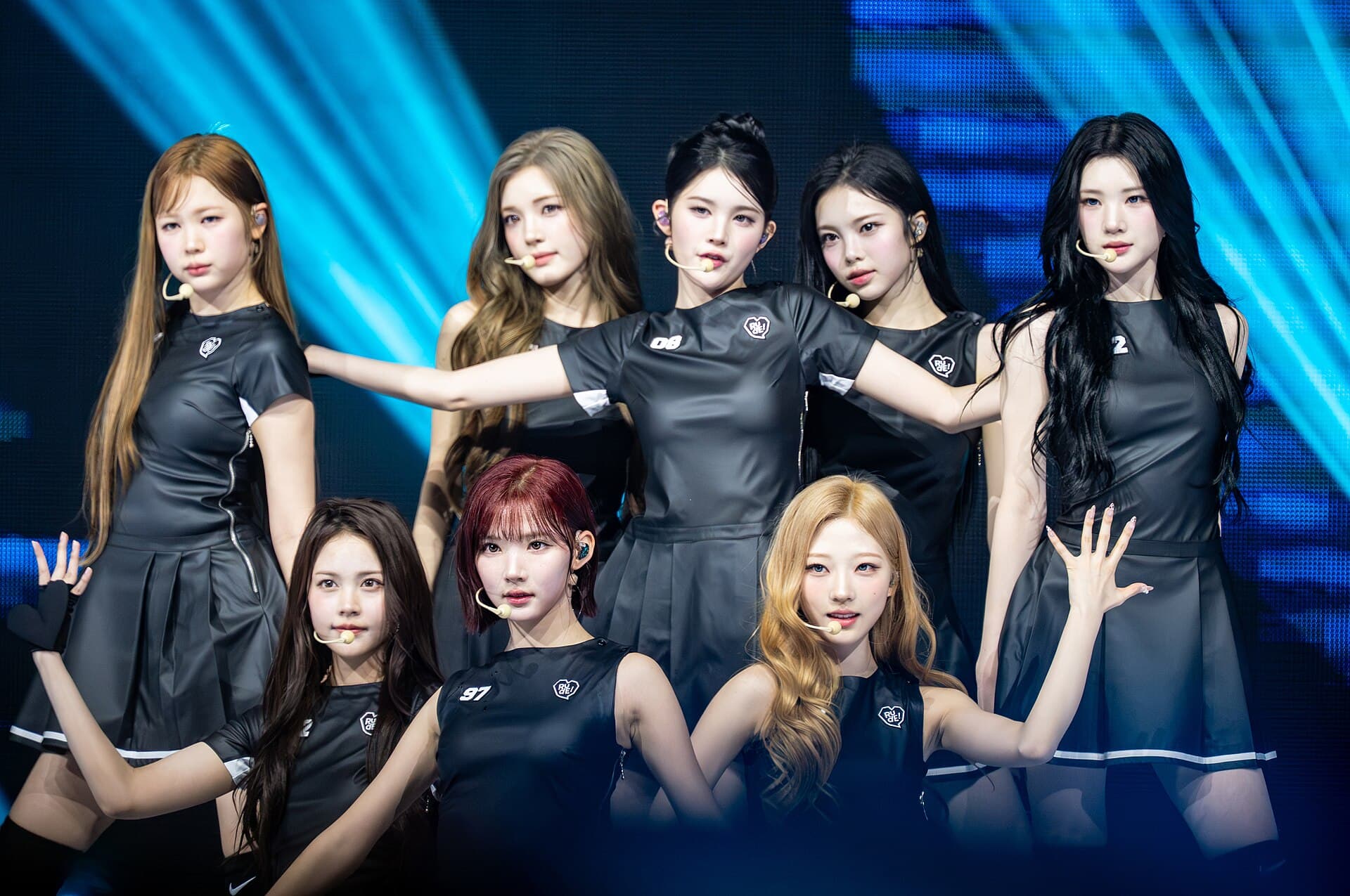
Hearts2Hearts is the most discussed move, because it comes from SM Entertainment, the oldest of the major agencies. It was their first girl group in five years, since aespa in November 2020, and their first large ensemble since Girls' Generation eighteen years earlier. Eight members, at a time when the trend ran towards short line-ups: SM took the opposite bet to its era, with the single album The Chase.
KiiiKiii went the other way. Five members, an EP titled UNCUT GEM, and immediate entry into the rookie brand reputation rankings, where the Korea Corporate Reputation Research Institute placed it first for March 2025, ahead of Hearts2Hearts. The comparison between two groups debuting a month apart in the same segment was treated by the Korean press as a duel, which served both.
ALLDAY PROJECT is the real anomaly of the class. A mixed-gender group, with Tarzzan, Youngseo, Bailey, Woochan and Annie, launched by The Black Label with the tracks Famous and Wicked. The mixed format was long considered commercially risky in K-pop, since fandom structure rests largely on attachment to members of one gender. Seeing it return through a production house known for its sonic choices, rather than through an outsider, marks a change of attitude in the industry.
AHOF, finally, whose name stands for All-Time Hall Of Famer, came out of the survival show Universe League broadcast by SBS. Nine members, a mini album titled Who We Are. This is the classic pipeline since Produce 101, with an advantage agencies value: the group arrives with an audience already built by the broadcast, which shortens the most expensive phase of a launch.
The calendar has tightened#
A second-generation debut had two to three years to establish itself before anyone spoke of failure. The window today is a few months.
That acceleration comes from the structure of discovery. A dance clip works or does not work within days on short-form platforms, and algorithmic pre-selection has replaced the music show appearance as the first filter. Agencies adapted their production accordingly: more teasers, pre-debut content, accounts opened months before the first song.
The question is no longer whether a group will break through in three years, but whether it will have been seen during the six weeks when attention is available.
That compression has a rarely mentioned counterpart: it makes failure faster, therefore cheaper for the agency, but also more brutal for artists trained for five to seven years as trainees.
Following a Korean fandom without translation takes few words, but the right ones: 신인 (sinin, the newcomer), 컴백 (keombaek, the comeback), 활동 (hwaldong, the promotion period). KoreanSRS, our spaced repetition app, installs that vocabulary and the everyday Korean that goes with it.
What the generation owes to a cartoon#
The most revealing event of the period was not a group debut. It was the success of an animated film built around a fictional group, which dominated K-pop-related searches in 2025 and pushed its soundtrack to a level few real groups reach.
The signal sent to the industry is twofold. It confirms that the K-pop format, its visual codes, its choreography and its fandom grammar, works independently of real people being on stage. And it is a reminder that the entry point for Western audiences now runs through fiction and video games as much as through the music itself.
Several agencies have since announced or accelerated virtual group and avatar projects. The internal debate is less about technical feasibility, largely solved, than about what is left to sell when the fandom's emotional bond no longer addresses anyone.
Read alsoThe five generations of K-pop: from Seo Taiji to NewJeansFrom Seo Taiji and Boys to today, the five generations and what really separates them.
What to watch for the rest of 2026#
Three indicators are worth more than view counts when judging the current generation.
Two-year retention first: how many of the groups that debuted in 2025 will still have a contract, a tour and a production budget in 2027. It is the only figure that distinguishes a breakthrough from a successful launch.
The staying power of the mixed format next. If ALLDAY PROJECT lasts, other agencies will follow and the structure of Korean fandoms will change deeply. If it runs out of steam, the format returns to the exceptional status it has held for twenty years.
The place of survival shows finally. They produce groups with a ready-made audience, but they impose fixed-term contracts and governance shared with the broadcaster. Agencies now use them as one channel among several, no longer as the main channel they were between 2016 and 2020.
Read alsoThe Korean Idol System: Trainees, Agencies, and the Star FactorySeven years of training, a contract, a shared bedroom: the trainee system feeding these debuts has not changed in nature.
The fifth generation is still hard to judge, because it has only just begun and because it is the first to have every tool at once: the global market, short-form platforms, variable formats and avatars. What it does with them over the next two years will decide whether we are talking about a generation or merely a busy class.
FAQ#
When does K-pop's fifth generation start? There is no official date. The Korean press and fandoms place the shift around 2022-2023, with the debuts that follow the end of BTS members' military service and the arrival of agencies that did not exist ten years earlier.
Which 2025 rookie groups drew the most attention? Hearts2Hearts (SM Entertainment, February), KiiiKiii (Starship, March), ALLDAY PROJECT (The Black Label, June) and AHOF (July, from the show Universe League) concentrated most of the press coverage and rookie reputation rankings.
Can a mixed-gender group work in K-pop? That is precisely what ALLDAY PROJECT is testing. The format existed in the 1990s and 2000s then disappeared, since the economics of fandom rest on gendered attachment. The commercial result of the next two years will set a precedent for the industry.
Why are so many groups debuting at once? Because launch costs have fallen and the attention window has shortened. Agencies prefer multiplying attempts on short cycles rather than betting several years on a single project, a logic close to that of venture capital.
Will virtual groups replace idols? Nothing suggests so at this stage. They occupy a growing niche and serve as a production laboratory, but the Korean fandom economy rests on fan meetings, signing events and tours, that is on physical presence.
Photo credits: the images in this article come from Wikimedia Commons and are under free licences.
In this article
The cultural terms covered here, each with a short definition.
The five generations of K-pop: from Seo Taiji to NewJeans
A complete guide to the five generations of K-pop. From Seo Taiji and Boys to NewJeans, a look back at thirty years of Korean pop evolution: key artists, innovations and global impact.
Cover image: sublimitas viii · sublimitas viii, via Wikimedia Commons · CC BY-SA 4.0