Isekai: where the genre that rules anime came from, and where it goes
Origins, narrative mechanics, Japanese vocabulary and signs of saturation: the complete guide to the isekai genre, from online novels to today's series.
La rédaction Kotoba Interactive
Studio éditorial
A three-character Japanese word, 異世界 (isekai, "different world"), is now enough to describe a considerable share of each season's Japanese animation output. Readers who see it on a cover know immediately what awaits: a character leaves contemporary Japan for a medieval-style fantasy, usually equipped with an advantage the locals do not have.
The genre passes for a recent phenomenon. It is in fact the convergence of three separate histories: that of the amateur online novel, that of the Japanese role-playing game, and that of a publishing economy that found a way to test its stories before printing them.
Before the word, the structure#
Transfer to another world is an old device, and Japanese animation used it well before isekai served as a commercial label.
Aura Battler Dunbine, a Yoshiyuki Tomino series broadcast in 1983, sends a Japanese motorcyclist into a fantasy world where he pilots an organic robot. In the 1990s, Fushigi Yûgi (1992), Magic Knight Rayearth (1993, after CLAMP) and The Vision of Escaflowne (1996) apply the same mechanic to a largely female audience, with schoolgirl heroines thrown into kingdoms at war. The Twelve Kingdoms, a novel cycle begun by Fuyumi Ono in 1992, gives it its most literary form.
What separates those works from contemporary isekai is not the device but its meaning. Passage into the other world is a trial: the character wants to go home, suffers from displacement, and the story is built on that lack. In 2010s isekai, the other world is an improvement, and the question of returning almost entirely disappears.
The genre distinguishes three modes of access that English tends to blur. 転生 (tensei) means reincarnation: the character dies and is reborn, sometimes as an infant, sometimes as a creature. 召喚 (shōkan) is summoning: a third party, king or mage, brings the hero over deliberately. 転移 (ten'i) is plain transfer: the character shifts across without dying or being called. The first now dominates production by a wide margin.
The real turning point: an amateur novel website#
Modern isekai was born on 小説家になろう (Shōsetsuka ni narō, "let's become a novelist"), a Japanese amateur publishing platform launched in 2004. Anyone posts chapters for free, readers vote, and publishers come looking for manuscripts already validated by an audience.
That circuit produced a whole generation of works following the same path: online novel, then printed light novel, then manga adaptation, then animated series. Overlord (online from 2010), Mushoku Tensei (2012), Re:Zero (2012), KonoSuba (2013) and That Time I Got Reincarnated as a Slime (2013) all went through it.
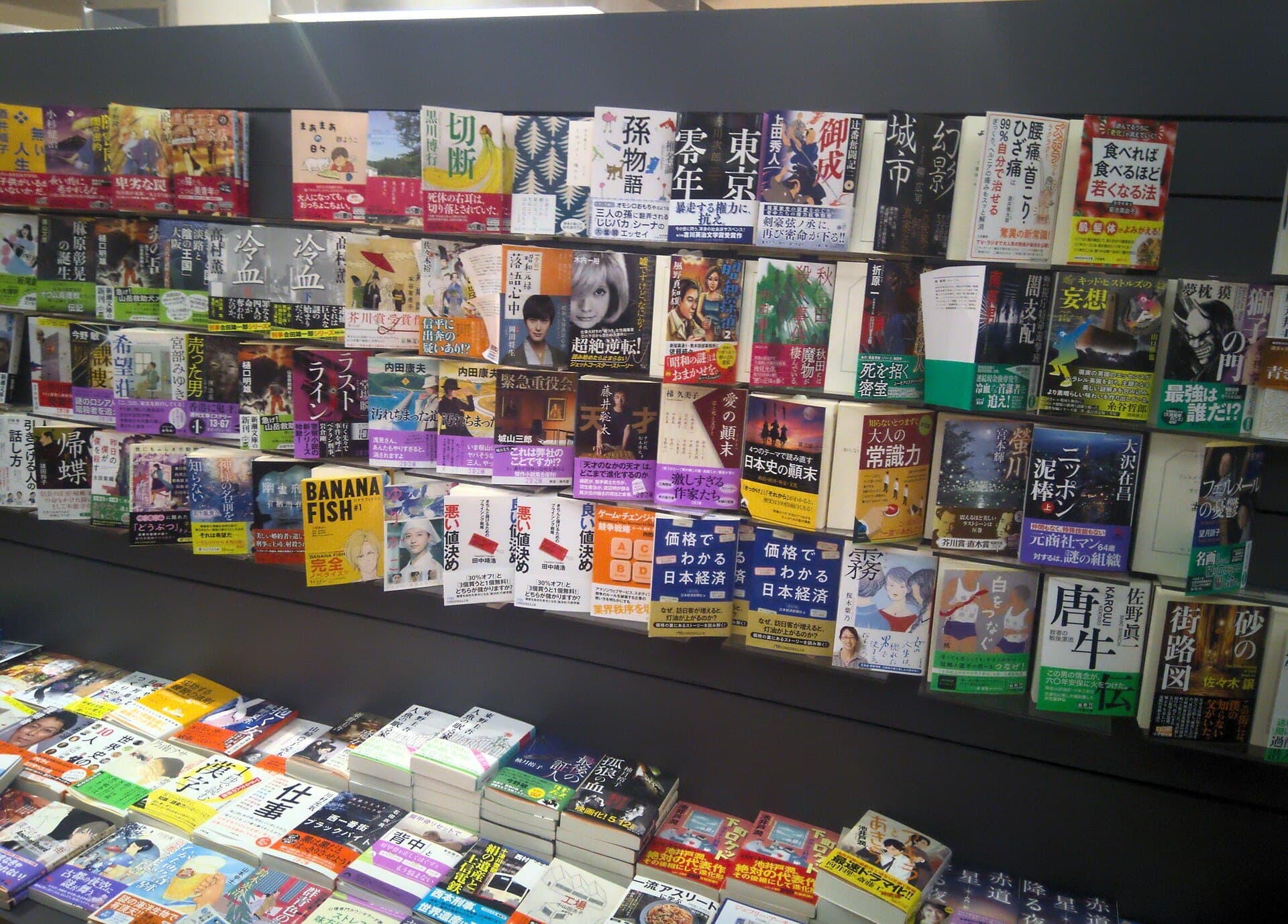
The phrase なろう系 (narō-kei, "of the narō type") designates that school of writing and its conventions in Japanese. It also explains a peculiarity visible from any bookshop shelf: the sprawling titles that summarise the plot in a full sentence. On a platform where thousands of texts compete for a new-releases list, the title acts as the sales pitch, and the habit survived the move to print.
The legacy of the Japanese role-playing game#
Isekai grammar comes straight from video games. Experience points, levels, classes, adventurer guilds, letter ranks, status windows floating before the hero's eyes: none of that belongs to classical Western fantasy, all of it comes from the Japanese role-playing game popularised by Dragon Quest from 1986.
That lineage has a precise narrative consequence. It makes the character's progress measurable, therefore legible chapter by chapter. Where a classical coming-of-age story asks readers to perceive inner change, isekai shows them a number going up.
It also explains the central place of the チート (chīto, "cheat"), the abnormal ability the hero possesses. The word, borrowed from gaming, is used without irony by the genre itself: the character knows he is cheating, other characters tell him so, and reader satisfaction comes from that acknowledged asymmetry.
| Subgenre | Principle | Target audience |
|---|---|---|
| Conquest isekai | The hero exploits his advantage and builds power | Teenage and young adult male readers |
| Slow life | The hero gives up adventure for a quiet life | Broader readership, seeking comfort |
| Reincarnated villainess | A reader is reborn as the antagonist of a romance game | Female readership, from otome games |
| Reverse isekai | A being from the other world arrives in Japan | Comic register |
| Craft and trade | The hero applies modern know-how | Adult readers, documentary vein |
Three words are enough to parse an isekai synopsis in Japanese: 異世界 (isekai, the other world), 転生 (tensei, reincarnation) and 能力 (nōryoku, ability). JapaneseSRS, our spaced repetition app, installs that vocabulary and the everyday Japanese that goes with it.
Why now, and for whom#
The genre is regularly explained through Japanese sociology: economic stagnation, precarious employment, social pressure on young adults. The reading is appealing and deserves careful handling, because it explains poorly the genre's international success with audiences whose situation is nothing alike.
A more modest explanation lies in form. Isekai offers a reading contract of rare clarity: readers know from page one where they are going, which makes entering a series extremely easy. In a season with dozens of new titles, that is a considerable advantage.
The genre also offers a very explicit second chance. The character restarts life with what he already knows, which is about the least culturally specific fantasy there is.
The truck has become a character in its own right. So many heroes die run over by a lorry in the opening pages that Japanese readers nicknamed the vehicle トラック君 (torakku-kun, "Mr Truck"). The accident works as a narrative shortcut: it clears away the previous life in one panel and lets the story begin on page two.
Saturation, parody, and what comes next#
The most reliable sign of a genre's maturity is the appearance of its own parody inside the catalogue. Isekai has been producing it since the mid-2010s, with series that mock status windows, disproportionate abilities and sprawling titles while using all of them.
Two movements have emerged since. The first is a return to fantasy without transfer: several of the decade's best-received series tell a Japanese fantasy story with no character coming from contemporary Japan, which suggests the genre mainly worked as a gateway to fantasy for an audience that did not read it.
The second is the diversification of audiences. The reincarnated villainess subgenre, born from crossing isekai with romance games aimed at women players, opened production to a readership Japanese fantasy reached poorly. It is now one of the liveliest segments.
Read alsoLight novel: the Japanese illustrated novel explainedThe light novel is the genre's industrial vehicle: format, economics and relationship to illustration.
Isekai is not a fad about to pass, it is a production channel. As long as a free platform lets an unknown author have a story validated by ten thousand readers before any publisher takes the slightest risk, the circuit will keep turning. What will change is what gets told through it.
Read alsoMecha: A History of Japan's Giant RobotsDunbine, one of the genre's ancestors, was first a giant robot series: the two traditions crossed long before modern isekai.
FAQ#
What exactly does isekai mean? 異世界 means "different world" in Japanese. The term describes a story in which a character leaves our world for another, usually a medieval fantasy, through reincarnation, summoning or transfer.
What was the first isekai anime? There is no undisputed first, but Aura Battler Dunbine, broadcast in 1983, is regularly cited as the first series to install the full device. The 1990s produced several notable variants, including Magic Knight Rayearth and The Vision of Escaflowne.
Why are isekai titles so long? Because they come from online publishing platforms where thousands of novels compete for attention in a list. The title serves as both summary and sales pitch, and the habit was kept when the works moved to print.
What is the difference between isekai and classical fantasy? The presence of a character from our world. Japanese fantasy without transfer, however medieval, is not isekai, even when it borrows role-playing game codes.
Is the genre declining? Output remains high, but its centre of gravity is shifting: parodies, subgenres aimed at female readers and the return of fantasy without transfer take up a growing share. The editorial channel feeding it, however, has not changed.
Photo credits: the images in this article come from Wikimedia Commons and are under free licences.
In this article
The cultural terms covered here, each with a short definition.
- Anime
- Japanese animation, from feature films to TV series, often adapted from manga.
Light novel: the Japanese illustrated novel explained
The light novel (ライトノベル), a manga-styled illustrated Japanese novel: origins, the Haruhi and Sword Art Online turning points, the narou pipeline and media mix explained.
Cover image: Solomon203 · Solomon203, via Wikimedia Commons · CC BY-SA 4.0