Kimjang: Korea's great collective winter kimchi rite
Every autumn, families and neighbors salt dozens of cabbages together. Meet kimjang, the communal kimchi-making listed by UNESCO in 2013.
La rédaction Kotoba Interactive
Studio éditorial
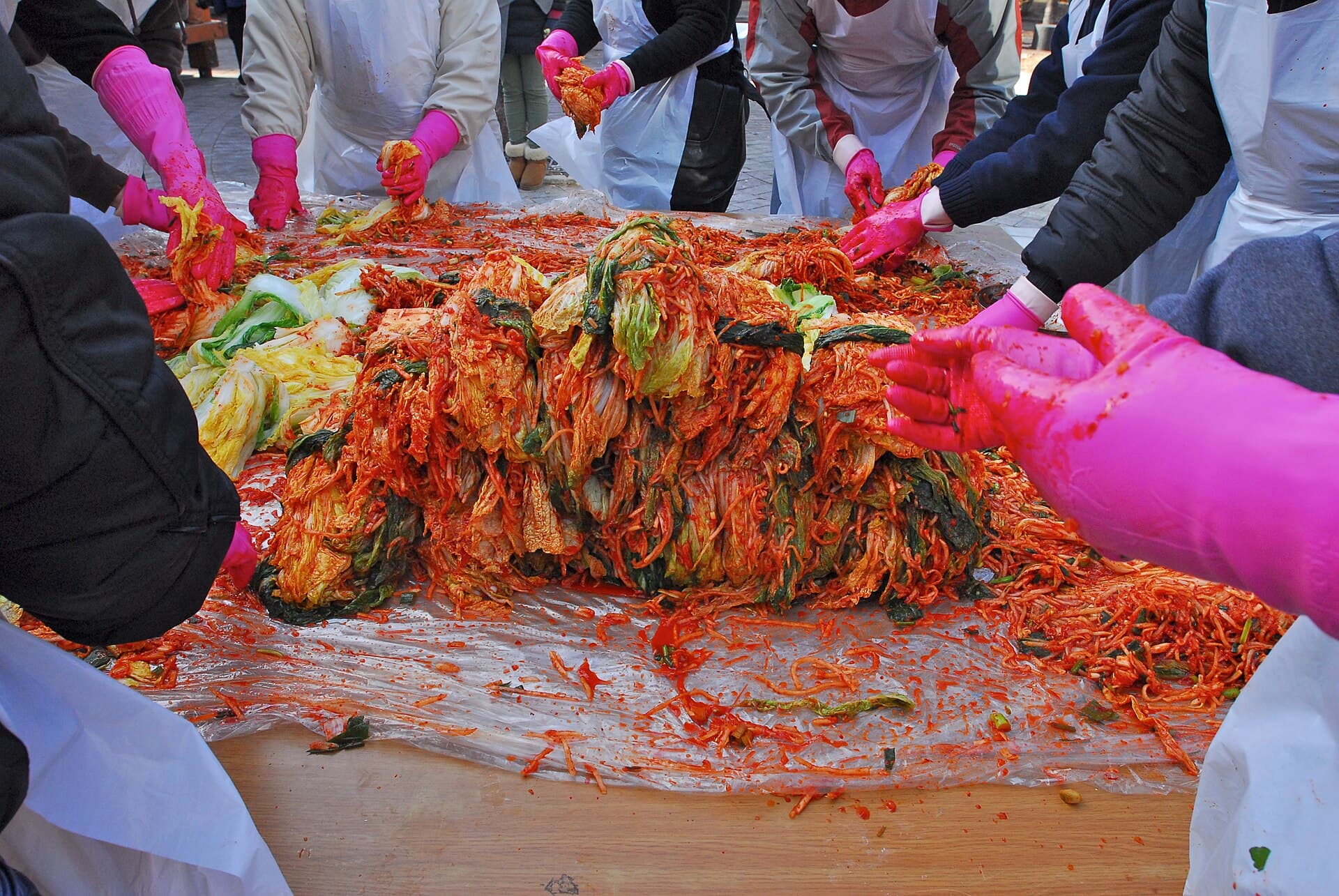
Making kimchi and doing kimjang are two different things. The first fits inside one kitchen on a weeknight, for a jar you will empty in a fortnight. The second mobilizes an extended family, sometimes a whole neighborhood, around mountains of salted cabbage spilling out of basins, arms plunged elbow-deep in chili paste, and conversations that last exactly as long as it takes to coat a hundred cabbages, leaf by leaf. The word does not name the recipe: it names the event.
That event has a calendar, a scale and a purpose with little to do with simply wanting to eat kimchi. Kimjang is the collective building of the winter store, at the precise moment temperatures tip over, through shared labor that binds generations and neighborhoods together. In 2013, UNESCO added it to the Representative List of the Intangible Cultural Heritage of Humanity, not for the taste of kimchi, but for the social bond the act weaves. Here is how a fermented dish became one of Korea's most resilient rituals of mutual aid.
Kimjang is not "making kimchi"#
Kimjang is the large-scale, collective preparation of the kimchi meant to last through winter. The distinction is fundamental and often lost in the West, where the food and the rite are confused. You can make , fresh same-day kimchi, alone, in ten minutes, for the evening meal. Kimjang is counted in dozens of cabbages, prepared over one or two full days, and involves several people.
The term likely comes from , storing by immersion in brine. It says exactly what it is: building up a stock. Before refrigeration, a Korean household with no kimchi store faced months of winter with no fresh vegetables, the frozen ground yielding nothing. Kimjang was therefore a vital necessity as much as a celebration, the guarantee that the table would hold until spring.
breaks into two ideas: kim, the root it shares with , and jang, the notion of storing and preserving. The word names not a dish but a season of work, the one in which a household lays up the store that will feed it until the thaw.
The timing: around ipdong, when the cold falls#
Kimjang is triggered in late autumn, around , the solar term marking the start of winter, near November 7. The calendar is not decorative: it obeys a narrow climatic window. It must be cold enough for the kimchi to ferment slowly and keep, but not yet so cold that the ground freezes and makes harvesting cabbage impossible.
That window rolls up from south to north over the weeks. In the southern regions of or , kimjang starts later, when the cold finally arrives; in Seoul and the north, earlier. Korean weather services once published a genuine "kimjang map," the , announcing region by region the ideal date, much as one announces the arrival of the cherry blossoms in spring. Radio and television relayed the signal: the time had come to bring out the basins.
Kimjang follows the thermometer the way hanami follows the flowers. The whole country watches the same temperature tipping point, and when it arrives, millions of kitchens set to work at once.
The scale: a hundred cabbages in a day#
A family at kimjang does not prepare a few cabbages but dozens, sometimes more than a hundred. The figure baffles until you grasp the function: this kimchi must last the whole winter, for every member of the household, at several servings per meal per person. An extended Korean family aiming for self-sufficiency until spring quickly speaks in hundreds of , the napa cabbage.
The work scales with the quantity. Each cabbage must be split, salted for hours, rinsed, buckets of chili paste prepared, then every leaf of every cabbage coated, one by one. Alone, such a volume would take days; with several pairs of hands, it fits into one day. That is precisely why kimjang is collective: the sheer size of the task demands numbers, and numbers turn drudgery into an event.
Some Korean families traditionally prepared enough kimchi to last up to a hundred and fifty days. A single household's kimjang could thus mobilize two hundred cabbages and several dozen kilos of chili, salt and fermented fish brine, a domestic undertaking on a scale that explains why it is never attempted alone.
Pumasi: mutual aid as the engine#
Kimjang rests on , the Korean system of exchanging labor between neighbors and relatives. The principle is old and simple: today I come help with your kimjang, tomorrow you come do mine. No money changes hands, only time and arms, returned in turn. This barter of labor, inherited from rural society, once structured harvests and major farm work too; kimjang is one of its last living forms in the city.
Around the basins gather above all the women of several generations, grandmother, mother, daughters, daughters-in-law, aunts and neighbors. Transmission passes through the hands as much as through words: you learn the right salting, the correct chili dose, the gesture for stuffing a cabbage by watching the eldest do it, then doing it again beside her. Kimjang is thus an informal school of domestic knowledge, where a family recipe is handed down without ever being written.
The ritual has its gestures of conviviality. On the spot people eat , boiled pork wrapped in a leaf of freshly salted cabbage and kimchi still warm from the day: the immediate reward for the work, the first taste of the store barely born.
Kimjang vocabulary sticks better once you can read it: 김장 (kimjang, the collective preparation), 품앗이 (pumasi, mutual aid), 배추 (baechu, napa cabbage), 옹기 (onggi, the earthenware jar). KoreanSRS, our spaced-repetition app for learning Korean, is coming soon: join the waitlist to decode hangul and these words of tradition from day one.
The sharing: beyond the household#
Kimjang feeds more than those who make it: a share of the kimchi goes to neighbors, distant relatives and those in need. Sharing is built into the act. You keep your store, but you always set aside a few cabbages to hand out, to neighbors who did no kimjang, to family scattered in the city, to the elderly or the poor of the district. This redistribution is part of the very definition of the rite.
It is this sharing that UNESCO highlighted. In the 2013 inscription file, the organization stresses that kimjang "reinforces cooperation and a sense of belonging to a community," and recalls the custom of sharing with the most deprived. To this day, associations and municipalities organize large charity kimjang events, where thousands of volunteers prepare tens of thousands of cabbages redistributed to modest households before winter. The domestic rite has turned into a civic gesture.
Doing kimjang means building your own winter store and, in the same motion, tending to that of others. Sharing is not an added courtesy here: it is part of the recipe.
Onggi and kimchi-naengjanggo: keeping the winter#
Kimjang kimchi was kept in buried earthenware jars, now replaced by specialized refrigerators. The traditional jar, the , with its microporous wall, let the kimchi breathe and regulate its fermentation gases. It was half-buried in the garden or courtyard soil, its neck emerging under a lid, so the earth held a stable, cool temperature all winter, sheltered from both frost and heat.
Urbanization made the buried onggi impractical: you cannot dig a garden in a tower-block flat. The Korean answer was technical. The , literally "kimchi refrigerator," launched commercially in the late 1990s, electronically reproduces the conditions of the buried jar: a stable, low temperature without the swings of an ordinary fridge opened all day long. The appliance has become a common fixture of Korean homes, nearly as widespread as the ordinary refrigerator. Technology took over from the earth, but to carry on exactly the same gesture.
UNESCO and kimjang: a recognized rite#
In 2013, UNESCO added kimjang to the Representative List of the Intangible Cultural Heritage of Humanity. The recognition did not concern kimchi as food, an important distinction, but the social practice of kimjang: the transmitted know-how, the collective organization, the mutual aid and the sharing. South Korea had submitted the nomination; two years later, in 2015, North Korea in turn secured the listing of its own kimjang tradition, making the rite one of the rare heritages claimed on both sides of the border.
That inscription came at a pivotal moment. Urban kimjang was declining: families were shrinking, industrial kimchi filled the shelves, and buying a jar cost less effort than salting a hundred cabbages. Many households had stopped doing it. International recognition acted as a signal, a reminder that a domestic knowledge taken for granted could vanish, and that it was worth preserving.
Urban decline, festive revivals#
Domestic kimjang is retreating in the city, but reviving as festivals and community events. The cause of the decline is well known: cramped flats with no garden to bury the onggi, nuclear families too small to justify a hundred cabbages, the permanent availability of store-bought kimchi. For many young city-dwellers, grandmother's family kimjang has become a memory more than a practice.
The answer was to reinvent it on the scale of the city. Seoul holds a large kimjang festival each autumn, the Seoul Kimchi Festival, where thousands of participants prepare tens of thousands of cabbages together in public squares, part of the output going to charity. Municipalities across the country stage comparable events, blending demonstration, transmission to new generations and solidarity. The rite has left the family courtyard for the public square, but its heart, preparing together and sharing, has stayed intact. What threatened to die in kitchens lives again on the esplanades.
Read alsoBaechu, dongchimi, kkakdugi: the varieties of kimchiTwo hundred varieties of kimchi can be born of this great winter rite. From napa cabbage to radish in brine, discover Korea's edible atlas.
Once the store is built, kimchi reigns over the table as the king of banchan, the little side dishes that accompany every Korean meal.
A dish that builds a community#
Kimjang tells of a Korea where no one survives winter alone. Beneath the mountains of cabbage and the basins of chili, what the rite really builds is not just a food store, but a web of joyful debts and exchanged labor linking a household to its neighbors, one generation to the next, a family to the poorest in its district. You then understand why UNESCO singled out the gesture rather than the taste. On an autumn day, when the cold falls and the whole country plunges its hands into the same red paste, Korea is not merely preparing something to eat: it is preparing itself to face the winter together.
The words of kimjang at a glance#
To follow a kimjang, a few Korean terms come up again and again: here are the essential markers of the rite, from the gesture to the jar.
| Hangul | Romaja | Meaning | Role in kimjang |
|---|---|---|---|
| 김장 | kimjang | Collective winter kimchi preparation | The rite itself, in late autumn |
| 절이기 | jeorigi | Salting | Splitting and salting the cabbages for hours |
| 양념 | yangnyeom | Seasoning paste | The mix of chili, garlic and fish brine |
| 버무리기 | beomurigi | Coating and mixing | Spreading the paste leaf by leaf |
| 저장 | jeojang | Storing | Laying up the batch for winter |
| 품앗이 | pumasi | Mutual aid | The exchange of arms among neighbors and relatives |
| 옹기 | onggi | Earthenware jar | Fermentation vessel, once buried |
FAQ#
What is the difference between kimjang and making kimchi? Making kimchi can be done alone, in small quantity, at any time. is the large-scale, collective preparation, in late autumn, of the kimchi store meant to last the whole winter, involving family and neighbors around dozens of cabbages.
Why does kimjang take place in autumn? It unfolds around , the start of winter near November 7, within a precise climatic window: cold enough for slow fermentation and good keeping, not yet so cold that the ground freezes and prevents the cabbage harvest.
What is pumasi? is the Korean system of mutual aid through exchanged labor: you help with a neighbor's kimjang today, they will help with yours tomorrow. No money changes hands, only time and arms returned in turn.
Why is kimjang listed by UNESCO? UNESCO added it in 2013 to the Intangible Cultural Heritage list not for kimchi itself, but for its social dimension: the know-how transmitted across generations, the collective organization, the mutual aid and the sharing with neighbors and those in need.
How is kimjang kimchi stored today? Once in buried jars, which held a cool, stable temperature. In the city, the , a specialized refrigerator that appeared in the late 1990s, reproduces those conditions and now equips most Korean homes.
Photo credits: the images in this article come from Wikimedia Commons and are under a free license.
In this article
The cultural terms covered here, each with a short definition.
- Kimchi
- Korean fermented vegetables, most often spiced cabbage, a staple of the Korean table.
Talchum: the satirical masked dance of Korea
History and meaning of talchum, Korean masked dance theatre: tal masks, satire of the powerful, village rites, regional variants and UNESCO heritage status.
Cover image: USAG- Humphreys · USAG- Humphreys, via Wikimedia Commons · CC BY 2.0