Dancheong: The Colors of Korean Temples Decoded
Blue, red, yellow, white, black: dancheong paints Korea's temples and palaces. Decoding the five cardinal colors and their symbolism.
La rédaction Kotoba Interactive
Studio éditorial
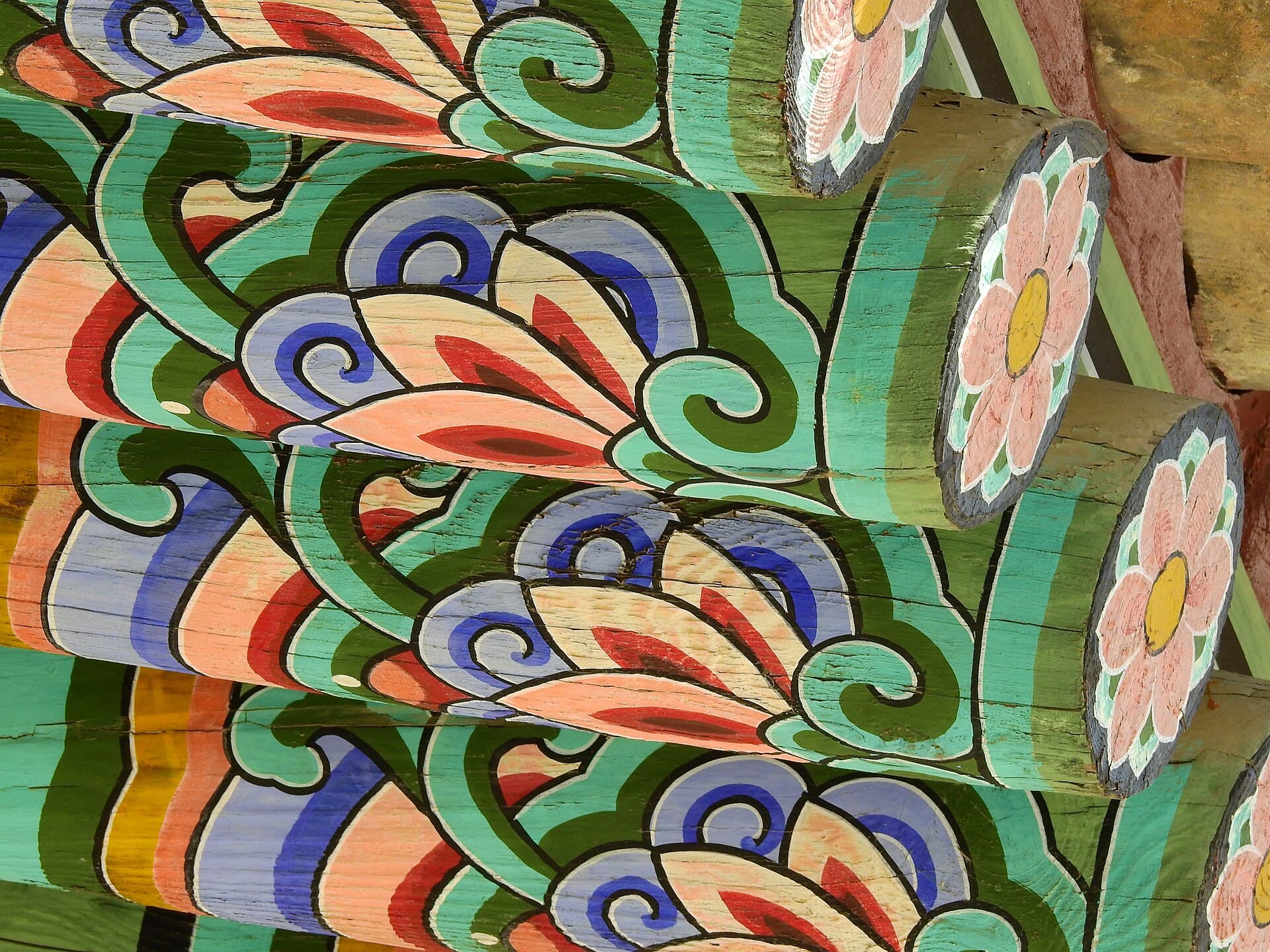
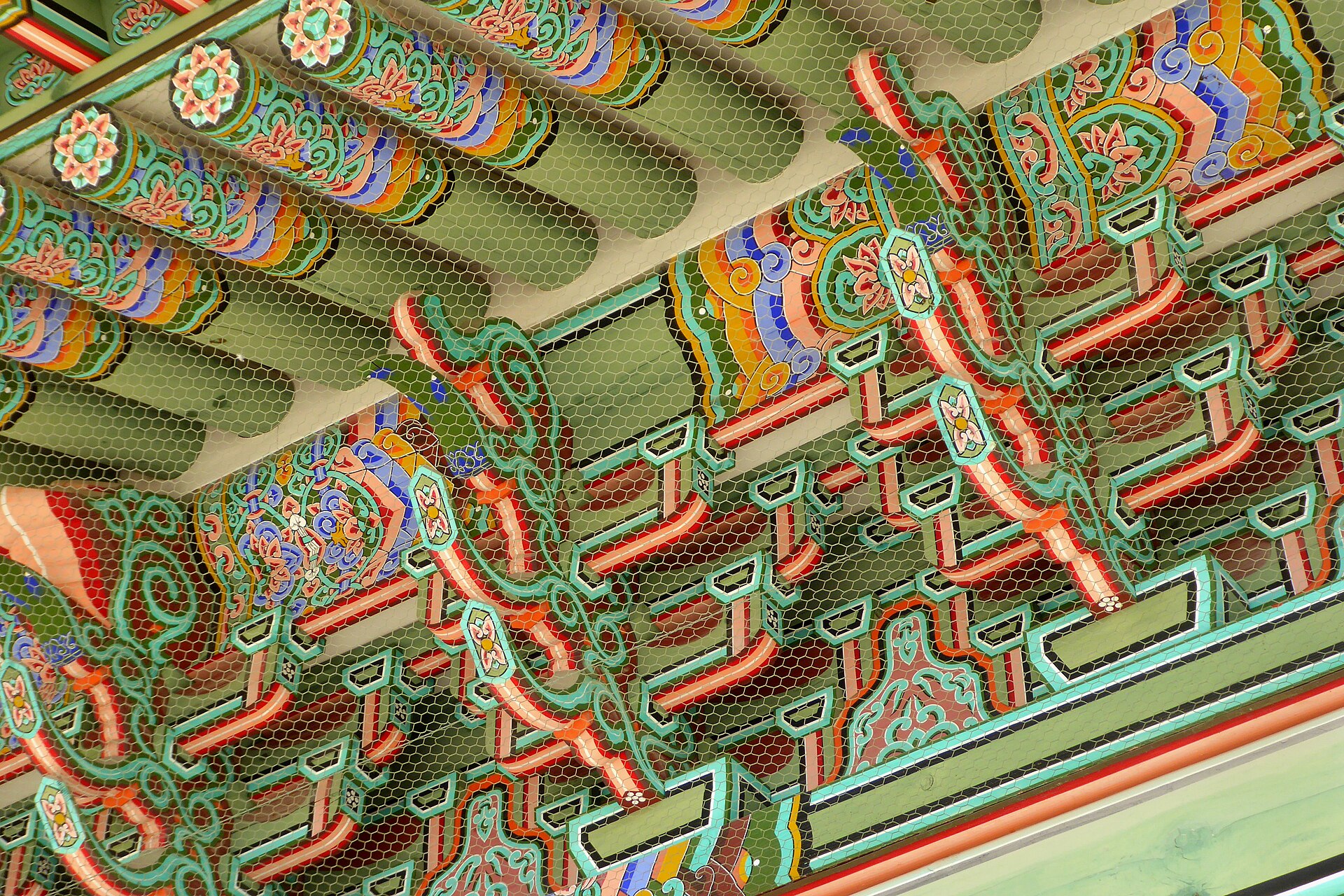
Look up beneath the eaves of a Korean temple. Where shadow should reign, an explosion of color awaits you: cobalt-blue spirals coil around vermilion beams, yellow lotuses burst between green motifs, and across every rafter runs a frieze so dense that not a millimeter of wood escapes the brush. This chromatic blaze has a name: , literally "red and blue." It is no mere decoration. Every hue obeys a precise cosmology, every motif serves a function, and together they transform a timber frame into a map of the universe.
Dancheong is one of the most recognizable visual signatures of Korean architecture, and yet one of the least understood. It is often taken for a cousin of Chinese lacquers or Japanese shrines; in reality it possesses its own grammar, its own color rules, its own body of artisans who hold a knowledge classified as a national treasure. To grasp why the palaces of Seoul and the mountain monasteries of Korea vibrate this way, you have to go back to the five cardinal colors and the thought that governs them.
What Is Dancheong?#
Dancheong refers to the traditional Korean art of decorating wooden buildings (Buddhist temples, royal palaces, monumental gates, pavilions) with brightly colored motifs painted according to codified rules. The term condenses two characters, and , which name by metonymy a far broader palette. Attested on the peninsula as early as the Three Kingdoms period (from the 1st century BCE to the 7th century CE), it already appears in the tomb murals of Goguryeo, where directional colors and guardian creatures foreshadow the logic that would later structure architectural painting.
joins dan (丹, "cinnabar," the mineral red) and cheong (靑, "blue-green"). The two most costly and symbolically charged colors ended up naming the entire art of architectural polychromy, a little as if one were to name a rainbow after two of its bands.
Its spread accompanied the rise of Buddhism, the state religion under Unified Silla (668-935) and then Goryeo (918-1392). Painting a temple was in no way ornamental in the modern decorative sense: color manifested the sacredness of the place, ranked its spaces, and protected the structure. Under the Joseon dynasty (1392-1897), officially Confucian and more austere, dancheong retreated from private architecture but remained the rule for royal and religious buildings, the only ones that intense color was permitted to clothe.
Far from a painter's whim, dancheong answers to a strict set of specifications. The choice of pigments, the order of the colors, the geometry of the motifs, and even the way of layering tones obey conventions passed from workshop to workshop. It is a language, and like any language, it can be read.
The Five Cardinal Colors: Obangsaek#
At the heart of dancheong lies a fundamental chromatic system: the , the "five colors of the directions." Blue, white, red, black, and yellow are chosen not for their beauty but because they embody the cosmic order. Each corresponds to a cardinal point, an element, and a series of attributes (season, guardian animal, virtue) inherited from the Sino-Korean thought of the five phases, the .
| Color | Direction | Element | Season | Guardian |
|---|---|---|---|---|
| Blue-green (청, cheong) | East | Wood | Spring | Blue Dragon (청룡, cheongnyong) |
| Red (적, jeok) | South | Fire | Summer | Vermilion Bird (주작, jujak) |
| Yellow (황, hwang) | Center | Earth | (central axis) | (the sovereign) |
| White (백, baek) | West | Metal | Autumn | White Tiger (백호, baekho) |
| Black (흑, heuk) | North | Water | Winter | Turtle-Snake (현무, hyeonmu) |
governs the east. It is tied to the Wood element, to spring, to birth and growth. Its guardian is the Blue Dragon, , who watches over the eastern flank. On the walls of Goguryeo tombs as on the beams of temples, blue carries the life that is reborn.
belongs to the west, to the Metal element, to autumn, to harvest and purity. Its guardian is the White Tiger, . A color of mourning as much as of moral clarity in Korea, white speaks at once of the end of a cycle and of the clearness of the mind.
holds the south. Fire element, season of summer, it embodies energy, passion, vitality, and the power to ward off evil. Its guardian is the Vermilion Bird, . It is also the protective color: gates were once painted red and certain names were written in red ink to repel malevolent spirits.
occupies the north. Water element, season of winter, it evokes depth, mystery, wisdom, and the origin of things. Its guardian is the black Turtle-Snake, , a composite creature combining longevity and endurance.
reigns at the center. Earth element, it is the color of the sovereign, of the axis around which the four directions arrange themselves. Reserved for the emperor in China, yellow holds a place apart in Korea: that of the point of balance from which everything radiates.
Dancheong does not paint a building: it inscribes a compass into it. Each color points to a direction, summons a guardian, calls up a season, and the whole edifice becomes a scale model of the ordered universe.
From these five pure colors derive the intermediate colors, the , obtained by mixing and associated with the positions between the cardinal points. The real palette of a temple is thus far richer than five hues: soft greens, pinks, browns, and grays unfold across it, but always traceable back to the matrix of the five directions. To understand obangsaek is to hold the key to everything that follows.
What Is Dancheong For? Three Interlocking Functions#
Dancheong fulfills a material function, a symbolic function, and an apotropaic function all at once: protecting the wood, marking rank, warding off evil. To reduce this art to its aesthetic dimension would be to miss its very reason for being.
Protecting and Sealing the Wood#
Before any symbolism, dancheong is a preservation technique. Traditional Korean architecture rests on wood, a material vulnerable to moisture, fungi, wood-boring insects, and the thermal swings of the peninsula's muggy summers and harsh winters. The layers of mineral pigments bound with animal glue form a barrier that slows the penetration of water, limits cracking, and discourages pests.
Traditional pigments were of mineral origin: cinnabar (mercury sulfide) for red, azurite for blue, malachite for green, ochres for yellows and browns, calcined shell white. These minerals, ground and then mixed with a hide-glue binder, offered remarkable resistance to the elements, at the cost of a toxicity and an expense that reserved some of them for the most prestigious buildings. The painted layer was therefore not a luxury laid over the structure: it prolonged its life.
Marking Rank and the Sacred#
Dancheong signals a building's status. Its very presence distinguished official edifices (temples, palaces, sanctuaries, city gates) from ordinary constructions, which had to keep to bare wood or discreet tints. Under Confucian Joseon, restraint was a value, and intense color a regulated privilege: a scholar's or a peasant's house painted like a temple would have been a transgression of the social order.
Within a single complex, the intensity and complexity of the dancheong ranked the spaces. The main pavilion, the Buddha hall, the throne room received the most elaborate motifs and the richest colors; secondary buildings, a more sober treatment. To read the dancheong was to read the relative importance of each place.
Warding Off Evil and Invoking Protection#
The third function is spiritual. Bright colors, and red in particular, were reputed to repel harmful spirits and bad influences. Certain motifs (dragons, phoenixes, lotus flowers, guardian creatures) were not mere ornaments but painted talismans, meant to draw good fortune, longevity, and divine protection onto the occupants and the faithful. In a temple, dancheong took part in sanctifying the space, separating it from the profane world and making it a threshold toward the sacred.
The colors of dancheong already carry words worth learning: 오방색 (obangsaek, the five cardinal colors), 청룡 (cheongnyong, the blue dragon of the east), and 단청 (dancheong, the polychromy of temples). With KoreanSRS and its spaced repetition, this vocabulary settles into memory alongside 한글 (hangeul, the Korean alphabet).
The Grammar of Motifs#
Dancheong does not come down to flat fields of color: it rests on a vocabulary of motifs organized by their placement on the frame. The treatises and workshops distinguish several major families, which combine to cover every architectural element: beam ends, rafter bodies, panels, ceilings.
The refers to the motifs painted at the ends of beams and rafters, where the wood is most exposed and most visible from the ground. These are often stylized floral or geometric compositions (lotus, peonies, palmettes) that form something like colored capitals at the junction of the timbers. The gathers the figurative scenes painted in the open spaces, between the regular motifs: buddhas, bodhisattvas, landscapes, symbolic animals, edifying tales. It is in these panels that the painter most freely expresses his talent.
According to the density and complexity of the decoration, dancheong is traditionally graded from the simplest to the most sumptuous. The gachil dancheong limits itself to one or two solid colors, without motif, applied as a minimal protection. The , at the top of the hierarchy, saturates the surface with motifs, gilding, and layered colors until no bare wood remains: this is the treatment reserved for the main halls of the great temples. Between the two unfolds a whole range of intensities.
One visual characteristic strikes the trained eye: the technique of banded gradation, the or modeling in concentric layers, where a color passes gradually from dark to light in successive steps. This process gives dancheong's floral motifs their characteristic relief and optical vibration. Combined with black outlines and white highlights, it structures the reading of the forms despite the density of the decoration.
The Artisans: The Dancheongjang#
Dancheong is carried by a codified craft, that of the , the master painter of architecture, whose know-how is today protected as intangible cultural heritage. South Korea has inscribed this discipline among its intangible cultural properties and designates official holders charged with transmitting the technique to the following generations. This status places the dancheongjang within the same logic of safeguarding as other traditional arts threatened by industrialization.
Historically, dancheong painters were often monk-artisans, the , trained in the temples where they produced both the architectural paintings and the Buddhist paintings. The boundary between the dancheong painter and the icon painter was porous: one and the same master might decorate a beam in the morning and paint a Buddha in the afternoon. This dual skill explains the figurative richness of certain temple panels.
The work is physically demanding and highly collective. On a large-scale worksite, a hierarchical team divides the tasks: the master traces the motifs using perforated stencils, the , tapping charcoal powder through the holes to transfer the design onto the wood; assistants then apply the colors in an agreed order, from the background toward the details, each specialized in a range of tints. The rigor of the conventions allows several hands to produce a coherent whole. Preparing the pigments, dosing the glue, respecting the order of the layers: each gesture is learned through years of apprenticeship, not from books.
The perforated stencil of dancheong, the boncho, works exactly like a modern stencil: the painter dabs charcoal powder through fine perforations to transfer an identical motif onto dozens of beams. An entire frame can thus receive a perfectly regular decoration, traced by several different hands.
Where to See Dancheong: Emblematic Palaces and Temples#
The finest dancheong is to be contemplated in the royal palaces of Seoul and in the great mountain temples. , the main palace of the Joseon dynasty founded in 1395, offers one of the most accessible examples: its gates, its throne hall , and its pavilions unfold a royal dancheong where blue-green and red dominate, punctuated by imperial dragons and floral motifs. Destroyed during the Japanese invasions of the late 16th century and then restored several times, the palace also shows the successive layers of repainting that make dancheong an art in perpetual renewal.
On the Buddhist side, the temple , near Gyeongju, founded in the 8th century under Silla and inscribed on the UNESCO World Heritage List, illustrates the dialogue between architecture, stone, and color. Its halls, rebuilt after the destructions of the 16th century, bear a dancheong whose lotus motifs and guardian creatures translate the cosmology of Buddhism into color. In mountain temples like those of the Jiri or Seorak ranges, dancheong takes on a particular dimension: set at the heart of the forest, these blazing frames seem to prolong and intensify the colors of the surrounding nature.
The contrast with its neighbors is instructive. Chinese temples also employ a brilliant polychromy, the , from which Korean dancheong partly descends; but the Korean palette favors cooler greens and blues and a specific floral geometry, whereas Chinese decoration pushes red, gold, and figurative representation further. Japanese shrines, by contrast, oscillate between the brilliant vermilion of Shinto torii and the sobriety of the bare wood of Zen temples, color there being on the whole more restrained than in the Korean profusion. For a comparable frame, each culture made a distinct chromatic choice, and dancheong occupies the densest and most systematically colored position of the three.
Want to read these words in the original? The vocabulary of dancheong (단청, 오방색, 청룡) is learned alongside hangul and the 500 words of everyday Korean. KoreanSRS (koreansrs.com) opens soon: the waitlist is open.
Restoring a Fragile Art: Dancheong Against Time#
Dancheong is an art of the ephemeral that demands constant restoration. Exposed to sun, rain, and frost, the layers of pigment flake, fade, and detach; a brilliant dancheong dulls within a few decades, and almost all historic buildings have been repainted several times over the centuries. This impermanence poses a singular heritage problem: should one preserve the faded original remains, precious witnesses, or restore the first brilliance at the risk of erasing the authentic traces?
Modern restoration navigates between these contradictory demands. Practitioners strive to document the old decorations before intervention, to reproduce the motifs identically thanks to traditional stencils, and to return to the original mineral pigments, long replaced by synthetic paints that are less durable and chromatically less true. The debate over the use of natural versus modern pigments, over the fidelity of the tints, and over the acceptable degree of repainting runs through the entire discipline.
Fires have reminded everyone of the vulnerability of this heritage: the destruction in 2008 of the great gate , South Korea's National Treasure Number One, by an act of arson, forced a reconstruction in which the dancheong was redone according to traditional methods, not without controversy over the quality of the pigments and the premature flaking that appeared shortly after. These controversies bear witness to a deep attachment: dancheong is not a negligible decoration to be touched up hastily, but a marker of identity whose slightest imperfection is scrutinized.
Today, dancheong overflows its original supports. Its motifs and its palette inspire contemporary design, fashion, graphic art, and tourist objects; obangsaek permeates Korean visual identity, from the flag to packaging. Beneath the eaves of a temple or on a modern poster, these five colors keep saying the same thing: that the order of the world can be read, and that a little blue and red is enough to turn a plank of wood into a fragment of the cosmos.
Read alsoThe hanok: the genius of the traditional Korean house
The traditional Korean house often prefers bare wood to dancheong: understanding why sheds light on the social role of color in Korea.
The five cardinal colors and the protective power of red sink their roots into a body of beliefs that Korean shamanism long sustained.
The same obangsaek that governs the temples also regulates the colors of traditional dress: a shared chromatic grammar.
FAQ#
What does the word "dancheong" mean? The term dancheong (단청, 丹靑) literally means "red and blue," after dan (cinnabar, red) and cheong (blue-green). By extension, it designates the entire Korean art of painting wooden buildings with colored motifs according to codified rules.
Why are Korean temples so colorful? Color protects the wood from moisture and insects, signals the sacred or official character of the building, and repels evil spirits. The five cardinal colors (obangsaek) also inscribe a genuine map of the ordered universe onto the frame.
What are the five colors of obangsaek? Blue-green (east, Wood), white (west, Metal), red (south, Fire), black (north, Water), and yellow (center, Earth). Each is tied to a direction, an element, a season, and a guardian animal, according to the thought of the five phases.
Does dancheong exist anywhere besides Korea? Architectural polychromy exists in China (the caihua, from which dancheong partly descends) and, more soberly, in Japan. But the cool palette, the floral geometry, and the degree of saturation of Korean dancheong give it a distinct visual identity.
Is dancheong still practiced today? Yes. The craft of the dancheongjang is protected as intangible cultural heritage in South Korea, and master holders transmit the technique. The restoration of palaces and temples constantly draws on their know-how.
Photo credits: images in this article come from Wikimedia Commons and are under free licenses.
Pansori: Korea's opera of a single breath
Discovering pansori, the Korean epic chant: the singer and his drum, han, the great tales, the UNESCO listing and its surprising revival.
Cover image: Huntsmanleader · Huntsmanleader, via Wikimedia Commons · CC BY 4.0