Plastic Surgery in South Korea: Inside Gangnam
Blepharoplasty, V-line, medical tourism: why South Korea is a global hub for cosmetic surgery, between social pressure and feminist pushback.
La rédaction Kotoba
Studio éditorial
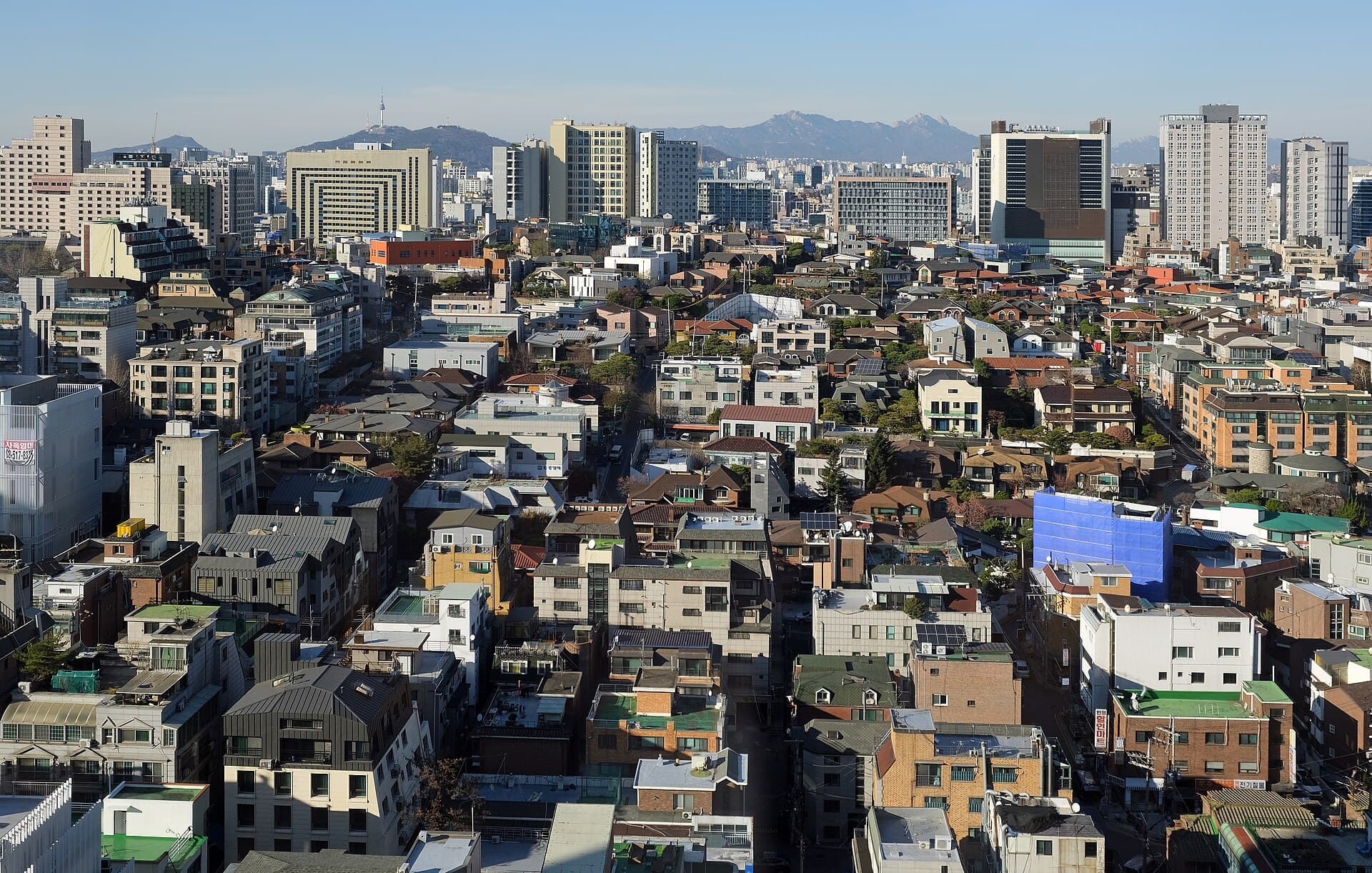
Along a single subway line in Seoul, between Apgujeong and Sinsa stations, the corridors fill with nearly interchangeable posters: a smooth face in "before/after," a reshaped jaw, a slimmer chin, the promise of an eyelid neatly creased with a fold. A few streets uphill, the glass towers of Apgujeong and Cheongdam stack clinic signs floor after floor until the eye is saturated. Few districts in the world concentrate so much supply around a single object: the body.
South Korea regularly ranks among the countries where cosmetic surgery per capita is most widespread, and it has turned the industry into an economic sector in its own right, reaching all the way into medical tourism. Making sense of the phenomenon means holding several threads at once: a precise vocabulary drawn from K-beauty and K-pop, a highly concentrated geography in Gangnam, documented social pressure around employment and marriage, but also a lively feminist pushback and received ideas that need unpicking. The subject deserves accuracy, without caricature or judgment.
Why South Korea is a global hub for plastic surgery#
The answer rests on three combined factors: strong social demand, an ultra-specialized and concentrated medical supply, and an international tourism market. is so normalized there that it is sometimes given as a high-school graduation or university-entrance gift. According to data from the International Society of Aesthetic Plastic Surgery (ISAPS), South Korea consistently ranks among the nations with the highest rate of procedures relative to population.
That ranking calls for caution: methodologies vary from country to country, non-surgical acts (injections, lasers) are counted differently, and precise figures are debated. What is better established is the social normalization of the act and the exceptional density of supply. Around this demand a full industry has been built: surgeons, clinics, medical-tourism agencies, interpreters, recovery hotels.
The word 성형 (seonghyeong) combines 成 (seong, "to form, to accomplish") and 形 (hyeong, "shape"). 성형수술 (seonghyeong susul) literally means "an operation to form the shape," that is, "plastic surgery." The term covers both reconstructive and purely cosmetic surgery, an ambiguity that exists in many languages.
Gangnam and Apgujeong: the "Beauty Belt"#
Gangnam, a southern district of Seoul, concentrates most of the industry, and the neighborhoods of and form what local media nickname the "Beauty Belt." A byword for social status since PSY's 2012 hit Gangnam Style, the area lines up hundreds of clinics within a few subway stops. Several counts cited by the international press mention, for the Gangnam district alone, more than 500 specialized establishments, a large majority of the capital's supply.
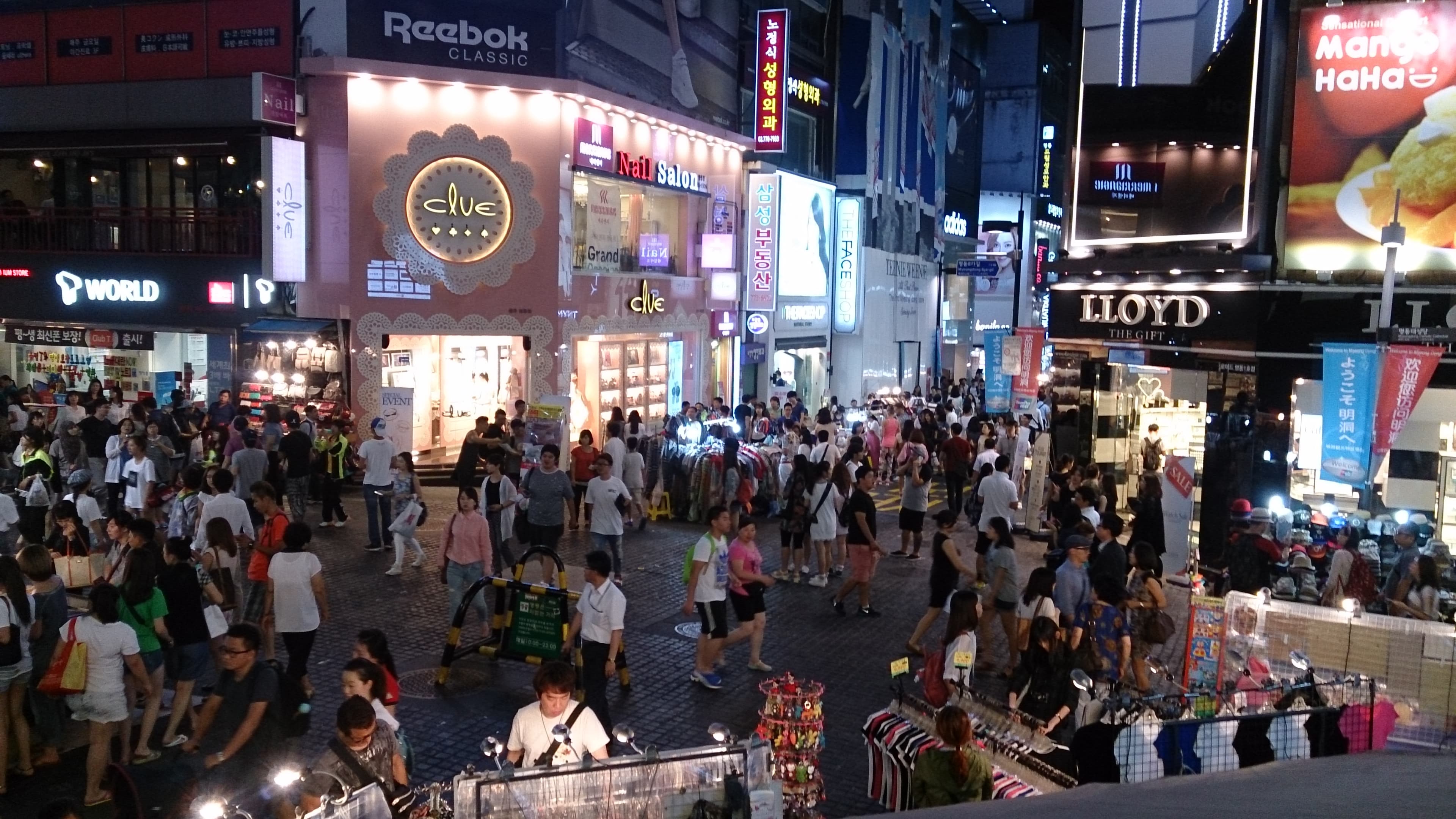
This concentration creates an ecosystem visible the moment you leave the subway: signage, storefronts, multilingual reception desks. The most frequent procedures there are blepharoplasty, the creation or reinforcement of the double eyelid, and facial contouring surgery, which includes reduction of the mandibular angle to draw the famous V-line. The district works as both a showcase and a magnet, for local clients and foreign visitors alike.
The most common procedures#
A handful of procedures recur constantly in advertising and in patients' accounts. The most emblematic is the , or Asian blepharoplasty, which creates a crease on the upper eyelid where it is naturally absent in part of the East Asian population. It is by far the most widespread alteration in the country, often presented as a minor intervention.
Next come , which raises or refines the nose, and , a heavier procedure aimed at obtaining a tapered jaw. The latter can include a jaw osteotomy or a reduction of the mandibular angles, bone surgery with a long and far-from-trivial recovery. It bears repeating that all surgery carries risks, and that advertising tends to downplay how serious it can be.
쌍꺼풀 (ssangkkeopul) joins 쌍 (ssang, "pair, double") and 꺼풀 (kkeopul, "layer, film, membrane"). The word denotes the double fold of the upper eyelid. The surgery that creates it, 쌍꺼풀 수술, has become so ordinary that it often serves as the example for describing an entry into the world of Korean cosmetic surgery.
| Procedure (English) | Hangul + romaja | Description |
|---|---|---|
| Double eyelid (blepharoplasty) | 쌍꺼풀 수술 (ssangkkeopul susul) | Creating a crease on the upper eyelid; the most common act |
| Rhinoplasty | 코 성형 (ko seonghyeong) | Changing the shape or height of the nose |
| Facial contouring surgery | 안면윤곽술 (anmyeon yungwaksul) | Bone reshaping of the jaw and cheekbones for a V-line |
| Jaw osteotomy | 양악수술 (yangak susul) | Two-jaw surgery, heavy, with a long recovery |
| Plastic surgery (general term) | 성형수술 (seonghyeong susul) | The whole set of cosmetic and reconstructive procedures |
The vocabulary of appearance starts with a few words to read in hangeul: 성형 (seonghyeong, plastic surgery), 쌍꺼풀 (ssangkkeopul, the double eyelid), 강남 (Gangnam, the district). KoreanSRS, our spaced-repetition app for learning Korean, is coming soon: join the waiting list to decipher these words from day one.
Medical tourism: an export industry#
Korean cosmetic surgery is also an export product, drawing tens of thousands of foreign patients each year. A notable share of the clientele comes from China, Japan, and Southeast Asia, attracted by the technical reputation of the surgeons, the density of supply, and the prestige of K-beauty. Around them revolves a whole service sector: intermediary agencies, medical interpreters, packages combining procedure, lodging, and recovery.
Korean authorities once encouraged this medical tourism as an economic lever, before having to rein in some abuses: clinics opaque about pricing, intermediaries taking sizable commissions, procedures performed by practitioners other than those advertised. The sector remains dynamic, but it illustrates the tension between a lucrative industry and patient safety, a balance regulation is still seeking.
Lookism, résumé photos, and social pressure#
If surgery is so widespread, it is also because appearance weighs heavily in social and professional life. The word that condenses these tensions is 외모지상주의 (oemojisangjuui), "lookism": the primacy of appearance, to the point of discrimination based on looks. It shows up strikingly in the workplace, where attaching an ID photo to a job application was long a near-mandatory norm.
Reports and recruitment surveys have documented explicit instructions to be "well presented," and it is not unusual for candidates to retouch their portrait, or even to undergo surgery before a job interview. A law that took effect in 2019 sought to limit requests for irrelevant information, including appearance and photos, in certain hiring processes, without erasing a deeply rooted practice. The pressure spills well beyond the office, too: dating apps, campuses, family expectations around marriage.
Read alsoLines, Lookism and Appearance: South Korea's Beauty CanonThe body is treated as capital: an investment with its costs in time, money, and surgery, and its hoped-for returns in employment, marriage, and status.
The vocabulary of "lines" (V-line, S-line, small face) and lookism deserve a decoding of their own: here is how the body became a social language in Korea.
"Escape the Corset" and the feminist pushback#
Against these norms, a counter-movement emerged in 2018: 탈코르셋 (tal-koreusen, "shed the corset"), known internationally as Escape the Corset. Tens of thousands of women posted images of themselves cutting their hair short, breaking their makeup, or giving up heels, casting the whole set of imposed beauty routines, surgery included, as an invisible "corset."
The movement is part of a broader feminist wave in South Korea, driven notably by protests against spy cameras (molka). It sparked heated debate, including within Korean feminism, between those who see it as liberation and those who question the reverse injunction. Generational shifts are real but partial: younger cohorts say they are more critical of lookism and surgery, while remaining exposed to a powerful industry and to social networks that relay it. The phenomenon is fluid, shot through with contradictions, and resists definitive verdicts.
A received idea to unpick#
The most common Western explanation, that surgery aims to "look Western," is contested by several Korean and Korean-American researchers. The targeted ideals, small face, fair skin, soft features, large eyes, draw as much on old East Asian canons and on the aesthetics of K-pop idols as on any imported model. The double eyelid, for instance, occurs naturally in part of the East Asian population and was prized in the region well before beauty standards went global.
Reducing the phenomenon to Westernization misses its internal logic: that of intense social competition, where appearance functions as capital in a country marked by fierce academic and professional rivalry. The role of K-beauty and idols is central here: idols' faces broadcast precise standards, while the cosmetic and surgical industry supplies the tools to approach them. This is a local, modern, commercial dynamic, more than a mere imitation of the foreign.
In 2020, South Korea reformed its regulations to require more transparency about practitioners and to combat the "shadow doctor," the denounced practice in which a surgeon different from the one met in consultation performs the operation while the patient is under anesthesia. The scandal had erupted after several serious incidents reported by the Korean press.
Surgery is only one side of the appearance economy: the Korean skincare routine is its other face, daily, accessible, and exported worldwide.
FAQ#
Why is plastic surgery so widespread in South Korea? It combines strong social demand tied to the weight of appearance in work and marriage, a highly specialized medical supply concentrated in Gangnam, and an international medical-tourism market. 성형수술 (seonghyeong susul) is socially normalized, sometimes given as a graduation gift.
What is the most common procedure? Blepharoplasty, or 쌍꺼풀 수술 (ssangkkeopul susul), which creates a crease on the upper eyelid. It is by far the most widespread alteration, often presented as minor, ahead of rhinoplasty and facial contouring surgery.
Where are the clinics concentrated in Seoul? In the Gangnam district, especially the Apgujeong (압구정) and Cheongdam (청담) neighborhoods, nicknamed the "Beauty Belt." Several counts list more than 500 specialized establishments there, a large majority of the capital's supply.
Does Korean surgery aim to make people look Western? This idea is contested by many researchers. The targeted ideals draw as much on East Asian canons and K-pop idol aesthetics as on an imported model. It is primarily an internal social competition in which appearance is capital.
What is the "Escape the Corset" movement? 탈코르셋 (tal-koreusen), "shed the corset," is a feminist movement that appeared in 2018. Women publicly rejected imposed beauty norms, surgery included, by cutting their hair and giving up makeup. It fueled intense debate within Korean society.
Photo credits: the images in this article come from Wikimedia Commons and are under a free license.
Lines, Lookism and Appearance: South Korea's Beauty Canon
V-line, S-line, small face: decoding the vocabulary of the Korean beauty lines, lookism (외모지상주의) and the counter-movements shaping South Korea today.
Cover image: H. Y. Shin 000 · H. Y. Shin 000, via Wikimedia Commons · CC0