Guanxi: the web of relationships that keeps China running
Renqing, mianzi, banquets, favour debts: what guanxi (关系) really covers, where the line with corruption runs, and what has changed since 2012.
La rédaction Kotoba Interactive
Studio éditorial
A Chinese friend hears that you are flat hunting. You asked for nothing. Two days later his cousin is showing you three apartments, refusing the coffee you offer and blocking every attempt to pay for the taxi. Three months pass, then a message arrives: his daughter is applying to a French university and he would value your view on her file. The link between the two events will never be spelled out. It does not need to be.
is the name of that circuit. Business textbooks translate it as "network", journalists as "connections", and both versions miss the point: this is not an address book, it is a long-term moral accounting system, with rules of entry, delays and possible mistakes.
A perfectly ordinary word before it became a concept#
In everyday Chinese, 关系 means nothing mysterious. The word means "relation", "connection", "link", and turns up in the plainest sentences. The country's most-used reply, , simply means "never mind", literally "there is no connection".
The two characters still illuminate the social usage. 关 means the barrier, the mountain pass, the checkpoint you have to get through. 系 is the tie, the cord, the attachment. To have guanxi is to hold ties that open passages.
The sociological sense of the term is a modern specialisation, popularised by studies of China in the 1980s and 1990s, among them the anthropologist Mayfair Yang's fieldwork published in 1994 as Gifts, Favors, and Banquets. What those works describe existed long before the scholarly label.
Concentric ripples, not a contact list#
The most useful description comes from the sociologist , in From the Soil (乡土中国), published in 1947. He contrasts two ways of organising social ties.
Western society, he writes, works like bundles of firewood: distinct individuals gathered into associations with sharp edges, the company, the club, the church, where you are either in or out. Chinese society works in concentric ripples, like the circles a stone traces when it falls into water: everyone sits at the centre of their own web, and obligations weaken as you move outward. He names this model , the differential mode of association.
The practical consequence is considerable. There is no single rule valid for everyone: what you owe a cousin, a former classmate and a stranger does not sit on the same scale. What looks like unequal treatment in a contract-based logic is, here, the very structure of ethics.
Three words recur constantly and are not interchangeable. 人情 (rénqíng) is the favour received, the affective debt it creates and the feeling that comes with it. 面子 (miànzi) is face, the social credit visible to others. 感情 (gǎnqíng) is genuine attachment between two people. A solid guanxi combines all three; a purely instrumental one has only the first, and everybody knows it.
The debt you never quite settle#
The central rule of guanxi surprises accounting minds: you never repay exactly, and above all not straight away.
Returning the precise equivalent of a service, immediately, closes the account. It is polite, and it is a farewell. The tie lives off its imbalance: as long as one party owes the other something, the relationship has a reason to exist. So you repay later, slightly more, and in a different currency.
Refusing a favour follows the same logic in reverse. Declining the invitation, the service, the gift means refusing to enter the circuit. Hence the scene every visitor eventually witnesses, the fight over the bill in which both diners physically wrestle for the right to pay: the winner does not gain money, he gains a claim.
| Term | Characters | What it refers to |
|---|---|---|
| Guānxi | 关系 | The tie itself, and the network it forms |
| Rénqíng | 人情 | The favour and the moral debt it creates |
| Miànzi | 面子 | Face, visible prestige |
| Lā guānxi | 拉关系 | Actively building a tie, often from scratch |
| Zǒu hòumén | 走后门 | "Going through the back door", jumping the queue |
| Guānxi hù | 关系户 | Someone who gets through connections what they would not get otherwise |
| Quānzi | 圈子 | The circle, the milieu you belong to |
Where guanxi is actually manufactured#
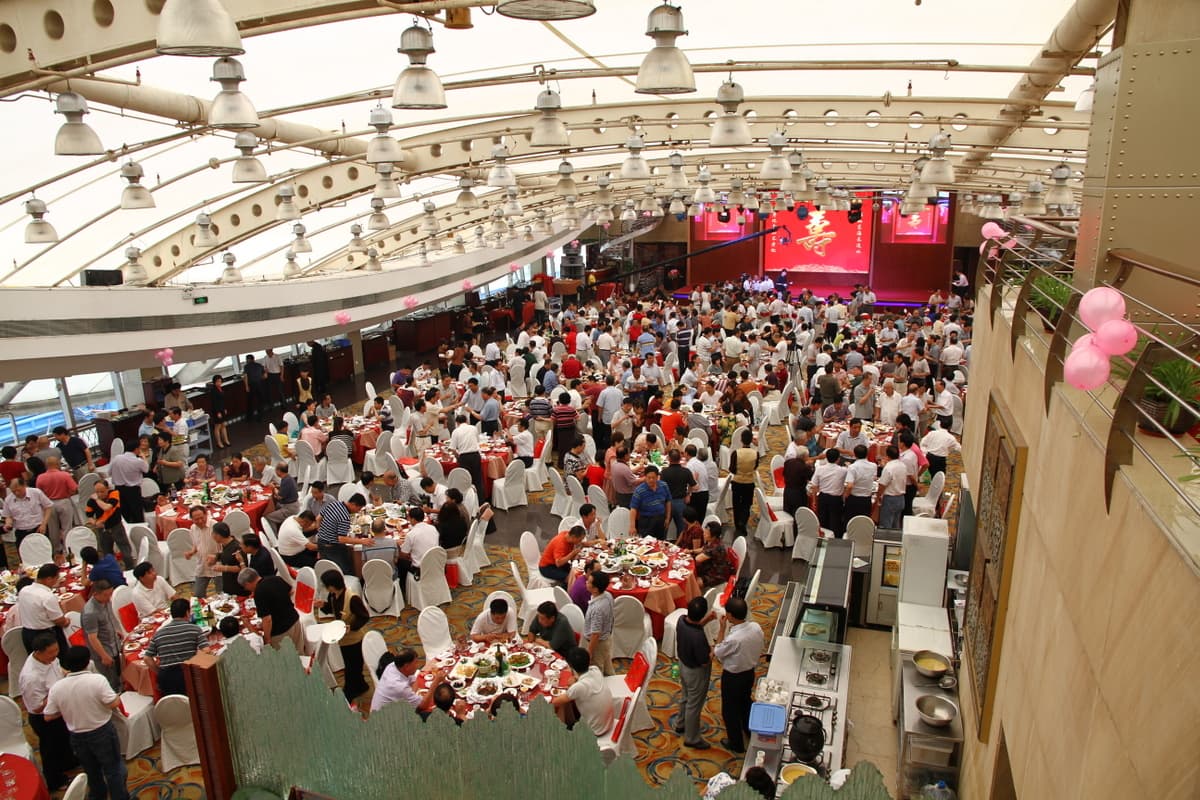
The classic setting is the table. A Chinese banquet is not a business lunch in the Western sense: the file is almost never discussed there, what gets established is who you are.
Everything is coded. The seat of honour faces the door, the host sits with his back to the entrance, the number of dishes ordered must exceed what the guests can eat, and the order of toasts follows the table's hierarchy exactly. works as an accelerator: drinking together to a certain loosening counts as proof of sincerity, which the participants sum up in the idea that you cannot trust someone you have never seen drunk.
Weddings and funerals form the other great register. Guests give a sum in a red envelope, and the amount is recorded in a ledger kept by the family. That notebook is no formality: it will be used, ten years later, to work out what is owed to the giver's son.
A contract organises what two parties owe each other. Guanxi organises what they never need to put in writing.
Three expressions slip into almost every professional conversation in China: 关系 (guānxi, the relationship), 人情 (rénqíng, the favour) and 靠谱 (kàopǔ, "reliable, someone you can count on"). ChineseSRS, our spaced repetition app, installs them along with everyday Chinese, and you stop guessing what is happening around the table.
Where the line with corruption runs#
The question is fair and the answer is not a cultural dodge: the line exists, and Chinese even has a word for the other side. 贿赂 (huìlù) is the bribe, a criminal offence. Guanxi has no stated amount, no defined counterpart, no due date.
Three practical differences settle most cases. A bribe buys a specific act, guanxi creates general availability. A bribe passes between strangers, guanxi assumes a prior relationship. A bribe is settled, guanxi is perpetuated.
None of this protects anyone. Guanxi becomes the vehicle of corruption as soon as it flows one way only, from the petitioner to the decision maker, and Chinese vocabulary acknowledges it: 走后门 (zǒu hòumén), "going through the back door", is not a compliment. The grey zone is real, and it is precisely what the state attacked.
Since 2012, a measurable narrowing#
In December 2012, weeks after Xi Jinping took over the leadership of the Chinese Communist Party, the Politburo adopted the : fewer meetings and speeches, less travel, and above all an end to lavish banquets and gifts funded from public money. The anti-corruption campaign that followed reached millions of officials over a decade.
The effects are legible in the gift economy. Luxury spirits, seafood hampers, high-end mooncake boxes and the vouchers that circulated around the Mid-Autumn Festival saw their market contract sharply, to the point that upmarket restaurants in Beijing had to reinvent themselves for private customers.
The mooncake long served as a parallel currency. Companies handed out not cakes but vouchers, which were resold at a discount, passed from hand to hand and sometimes made their way back to the bakery without a single cake ever being baked. Tighter rules on corporate gifts largely drained that small market.
What remains, and in what form#
Guanxi has not disappeared, it has moved. In the urban private economy, young graduates readily describe a more contractual world than their parents', where skills and degrees weigh more. Where supply is scarce, the opposite still holds: getting an appointment with a leading hospital consultant, placing a child in a sought-after school, moving an administrative file along still often goes through 找人 (zhǎo rén), "finding someone".
The medium has changed too. The address book has become a WeChat feed, red envelopes transfer with one gesture, and belonging to a 圈子 is measured by which group chat you are in. The mechanism has not shifted an inch: you give before you ask, you never fully square the account, and a relationship that has been useless for ten years is not considered dead.
Read alsoMianzi: The Chinese Concept of Face and Its Social WeightFace, that social capital you give, take and lose, is the other half of the system.
What guanxi ultimately reveals is a societal preference: between the rule that treats everyone equally and the tie that binds, Chinese culture long invested in the second, with its benefit, reliability through duration, and its cost, unequal access. Understanding that avoids two symmetrical errors, seeing corruption everywhere, or believing that one dinner is enough to reap the rewards.
Read alsoBaijiu: the national spirit of ChinaThe white spirit that seals business banquets, its codified toasts and its prestige economy.
FAQ#
Is guanxi essential for doing business in China? Less than twenty years ago in big cities and internationalised sectors, where contracts and the law have gained ground. It remains decisive in local administrations, regulated sectors and provinces where the individual counts for more than the procedure.
Can a foreigner really build guanxi? Yes, but slowly and with no shortcuts. The limiting factor is not nationality, it is time: a tie is proved by years of mutual availability, not by a run of dinners.
Is giving a gift risky? It depends on the recipient and the value. With a civil servant or a state-owned enterprise manager, the prudent rule is to avoid anything with notable market value. Between private partners, a modest gift representative of your country is still appreciated.
Are guanxi and nepotism the same thing? No. Nepotism favours kinship, guanxi covers a far wider circle: former classmates, people from the same home town, former colleagues. It can produce favouritism, but it also produces trust in an environment where legal remedies are uncertain.
What does méi guānxi actually mean? 没关系 means "never mind", "it does not matter", with no social connotation. It is one of the first polite formulas learners meet in Chinese, and one of the rare uses where 关系 is not talking about networks.
Photo credits: the images in this article come from Wikimedia Commons and are under free licences.
Mianzi: The Chinese Concept of Face and Its Social Weight
Understand mianzi (面子), Chinese 'face': giving, losing, and saving face, and its ties to guanxi, renqing, and Confucianism in everyday life.
Cover image: Ctny · Ctny, via Wikimedia Commons · CC BY-SA 3.0