Why K-pop works everywhere: the anatomy of an export
What actually explains K-pop's global success: public policy, YouTube, multinational line-ups, songwriting camps, fan platforms and the economics of the comeback.
La rédaction Kotoba Interactive
Studio éditorial
In 1997, South Korea asked the International Monetary Fund for an emergency loan. The country came out of the crisis with a conviction that would shape twenty-five years of public policy: a nation without raw materials has to sell something else, and culture can be an export line like any other. The word "export" is not a metaphor here. It appears in black and white in reports from public agencies that count Korean music the way others count semiconductors.
K-pop did not conquer the world through an accident of virality. It was designed, very early on, to cross borders.
An openly stated cultural policy#
The 1999 law promoting cultural industries and the creation of in 2009 set up something few countries have: a public agency dedicated to content, funding export support programmes, trade fairs, market research and assistance to young companies.
It is worth being precise here, because the legend usually outruns the facts. The Korean state does not produce groups and does not choose songs. It funds the surrounding infrastructure: promotion abroad, market data, distribution support and national branding. The rest is private, very private, and thoroughly capitalist.
literally means "the Korean flow". The word was coined by Chinese journalists in the late 1990s to describe local enthusiasm for Korean drama and music, before Korea itself adopted it as the banner of its cultural policy.
YouTube, or exporting without radio#
The historic bottleneck in music export was radio. A song in Korean had no chance of getting on air in the United States or Europe, and without radio there were no sales.
Online video removed the bottleneck. Korean agencies understood before most that the music video is not a promotional asset but the product itself: choreography readable in a wide shot, saturated colours, a memorable sequence at the midpoint. Gangnam Style became in 2012 the first video to pass a billion YouTube views, without going through traditional Western distribution channels.
That shift has a deep consequence: the exportable product is no longer a song, it is a filmed performance. Language stops being an obstacle, because what circulates is visual.
Groups built for several markets#
The agencies industrialised a practice that is rare elsewhere: assembling groups with members from several countries, in order to speak to several markets in the local language.
TWICE includes Japanese and Taiwanese members, BLACKPINK a Thai member and a member raised in New Zealand, and NCT's unit system pushed the logic to creating sub-groups attached to cities. Add albums recorded in Japanese, long the most profitable market for Korean groups, and tours calibrated for American and European arenas.
| Lever | What it solves | Typical example |
|---|---|---|
| Foreign members | Language and local press | Japanese and Chinese units |
| Songwriting camps | International radio formats | Scandinavian and American writers |
| Choreographed video | The language barrier | Performance filmed in wide shot |
| Short comeback cycle | Constant attention | Two or three releases a year |
| Fan platform | A direct paid relationship | Private messages, exclusive content |
| Physical album as object | Revenue and collecting | Multiple versions, photocards |
The music is written by the whole world#
The least known point may be the most decisive. A significant share of K-pop tracks originates in international songwriting camps, where Swedish, Norwegian, American and British writers and producers work with Korean teams on demos that agencies keep or discard.
The result is music that is technically Western in its making, Korean in its performance and staging. This is not a shameful industry secret, it is an industrial choice: Scandinavian pop production has fed American pop just as much since the 1990s.
Korean agencies often release several physical versions of the same album, with randomly inserted photocards. A fan chasing a specific card sometimes buys several copies of the same record, which has sent Korean physical sales figures soaring in the streaming era, at a time when they were collapsing almost everywhere else.
The fandom as infrastructure#
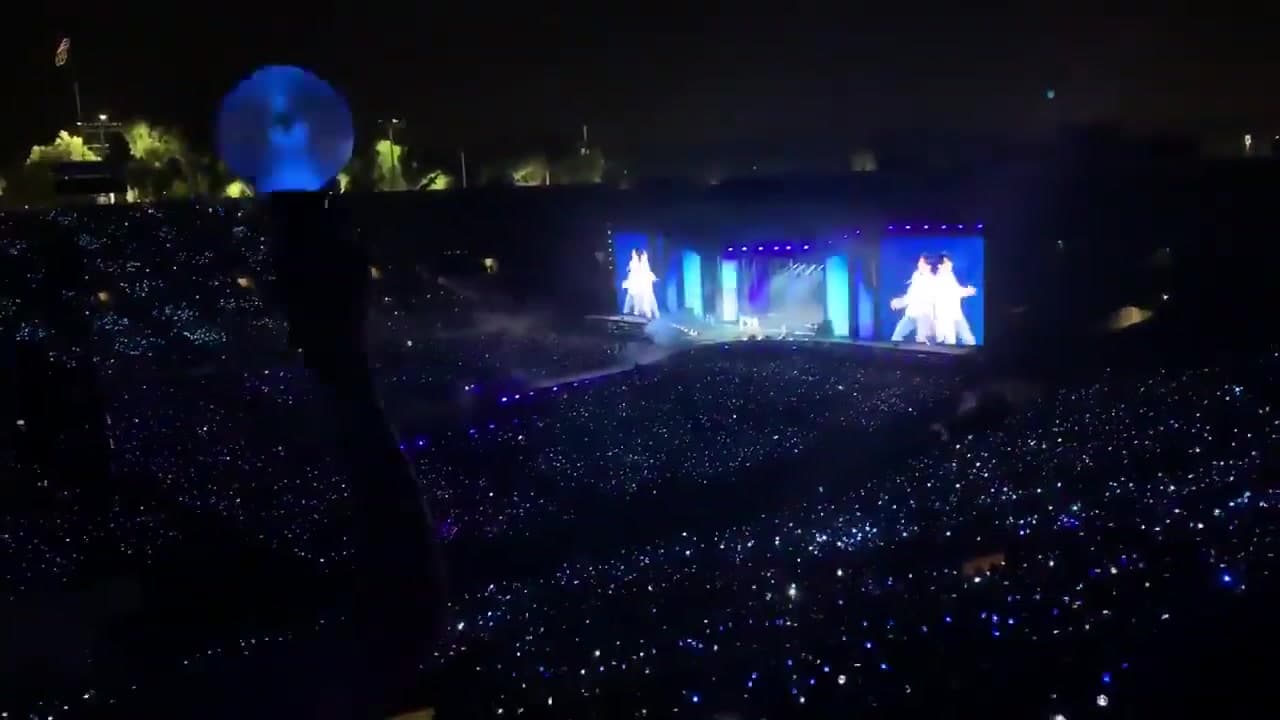
K-pop turned an audience into an organisation. Fandoms have an official name, a colour, a synchronised light stick, chants codified for concerts, and volunteer teams that translate, archive and coordinate voting and streaming campaigns.
Agencies then absorbed that energy: Weverse, run by the HYBE group, and paid messaging services such as Bubble create a direct artist-to-fan relationship, monetised by subscription. The fan is no longer an occasional buyer, they become a subscriber to a relationship.
That machine is what turns local success into measurable global results: chart positions, pre-order records, stadium dates announced sold out within minutes.
K-pop does not sell songs to listeners. It sells belonging to members, and the song is what brings them together.
Three words come up in any K-pop conversation in Korean: 컴백 (keombaek, comeback), 팬덤 (paendeom, fandom) and 응원법 (eungwonbeop, the codified cheering chant). KoreanSRS, our spaced repetition app, installs that vocabulary along with the everyday Korean around it.
The limits the model carries#
The picture would be incomplete without its shadows, widely documented by the Korean press itself.
The trainee system, those years of training before any debut, imposes discipline and media exposure that are very hard on people who are often minors when they sign. Long-term contracts have been the subject of legal proceedings and reforms after several high-profile disputes. Pressure on appearance, dieting and online harassment have been implicated in several tragedies that shook the country.
On top of that comes a structural dependency: South Korea is a small domestic market, and an export-facing industry remains exposed to political decisions in its outlets, as the cooling of cultural relations with China from 2016 made clear.
What the rest of the world copied#
The clearest sign of success is not the number of records sold, it is imitation. Groups formed on the Korean model have appeared in Japan, Thailand, India, the Philippines and even the United States, with the same vocabulary: trainees, comebacks, units, a named fandom.
The model therefore exports on two levels, the songs and the method. That is probably where the next chapter lies: an industry only becomes a norm the day its competitors adopt its procedures.
Read alsoK-pop: the history and backstage of the Korean industryThe history of the industry, from Seo Taiji to the agency system, is covered in our survey of K-pop.
Light sticks, codified chants, fancafes: the inner workings of fandoms deserve their own manual.
FAQ#
Does the Korean government fund the groups? Not directly. It funds the export ecosystem, promotion abroad and support programmes, but the groups are produced by private companies.
Why do songs mix Korean and English? Because choruses are designed to be sung back abroad, and because many tracks are born in English in songwriting camps before being adapted.
Is the global success really recent? No. The Asian breakthrough dates from the 2000s, especially in Japan and China. The Western breakthrough came later and relied on online video.
Why are Korean physical sales so high? Because the album is sold as a collectible object, with several versions and randomised content, which encourages multiple purchases.
Can you enjoy K-pop without speaking Korean? Of course, and most listeners worldwide do. Understanding the lyrics simply changes your relationship with the writing, which is often better than its reputation suggests.
Photo credits: images in this article come from Wikimedia Commons and are under free licence.
In this article
The cultural terms covered here, each with a short definition.
- Hallyu
- The "Korean Wave": the global spread of South Korean pop culture (k-pop, k-dramas, film).
K-pop comebacks: anatomy of a marketing machine
The K-pop comeback decoded: teaser schedules, multi-version albums, first-week sales, music shows, TikTok challenges and the human cost of the cycle.
Cover image: Bonnielou2013 · Wikimedia Commons · CC BY-SA 4.0