K-pop fandom: fanchants, lightsticks and fancafés
How a K-pop fandom works: official names, colours, fanchants, Bluetooth lightsticks, fancafés and paid platforms, plus the lexicon and economy of devotion.
La rédaction Kotoba Interactive
Studio éditorial
Korean concert recordings contain one telling moment: the intro pauses, the artist is not singing yet, and the room fills exactly the silence that was planned for it by chanting the members' names, in order, on the beat. Nobody improvises. That chant was written, released by the agency, learned at home and rehearsed. The K-pop audience is part of the score.
The Korean works like an institution, with an official name, a colour, tools, a vocabulary, rituals and an economy. Understanding the fanchant, the lightstick and the fancafé means understanding why the Korean industry was the first to treat its audience as a permanent organisation rather than a passing crowd.
A fandom has a name, a colour, a card#
Every Korean group has an official fandom name, announced by the agency and often chosen with the audience's input. ARMY for BTS, BLINK for BLACKPINK, ONCE for TWICE, CARAT for SEVENTEEN, STAY for Stray Kids: the name creates a belonging that can be named, carried and claimed.
That identity first showed itself through colour. In the 1990s and 2000s each group received an official shade that audiences waved as inflatable balloons: pearl red for TVXQ, pearl sapphire blue for Super Junior, pastel rose for Girls' Generation. Stands could be read from afar like flags, and seas of colour in stadiums became a matter of prestige between fandoms.
To colour is added formal membership: the official paid fanclub grants ticketing priority, a welcome kit and reserved content. Signing up is not a symbolic gesture but a status, with a membership number and a generation of belonging.
Two Korean words underpin the practice. literally means "method of encouragement": the fanchant, the audience's score. means "encouragement stick": the lightstick. The shared first element, , denotes organised support, the kind given to a sports team.
The fanchant, a score written for the audience#
The fanchant is an official text. Ahead of a comeback, the agency releases a video or document setting out, bar by bar, what the room must shout: the members' names in official order, the group name, lines inserted into the silences, sometimes a whole phrase answering the chorus.
The practice grew out of music shows, where fandoms occupy assigned blocks of seats and where the audience's sonic performance is part of the broadcast. It also connects with , mass singing: a Korean crowd will readily take over an entire chorus, a phenomenon many foreign artists touring Seoul have remarked on with surprise.
A successful fanchant does not cover the song: it occupies exactly the gaps the producer left for it.
The lightstick, from balloon to Bluetooth#
The lightstick replaced coloured balloons in the mid-2010s. Every group now has its object, designed as merchandise identifiable from a distance: BTS's ARMY Bomb, whose successive versions added a wireless connection, set the standard, and every agency followed with its own shape and logo.
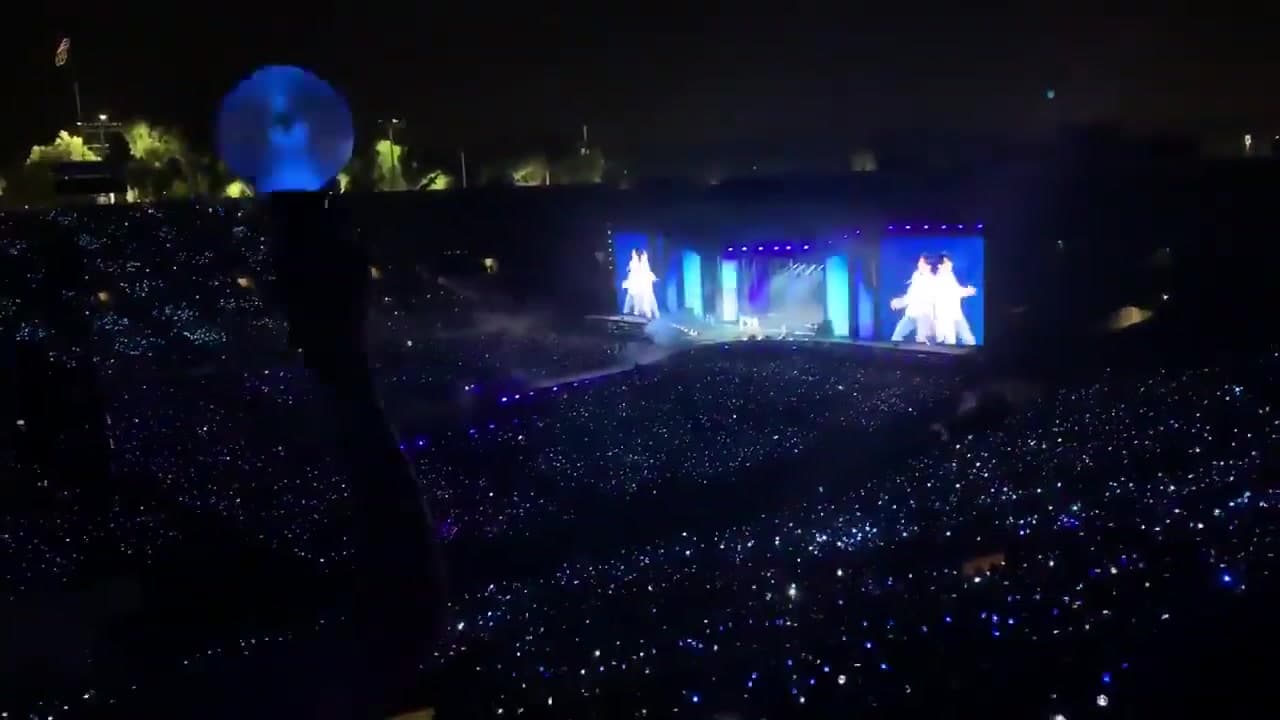
The technical leap came from centralised control. Recent lightsticks connect by Bluetooth to a system run by the production team: the booth can then black out the whole room, change its colour at a precise moment, and draw waves or patterns across the stands. The audience becomes a screen tens of thousands of pixels wide, and staging now treats that surface as a scenographic element.
Around the official object, a parallel economy has formed: accessories, cases, straps, resale, and fan projects handing out coloured sheets to place over the lamp so a message becomes visible from the stage.
Bluetooth coordination of lightsticks has an unexpected consequence: the production team knows in real time how many devices are connected in the venue, section by section. Waving a stick also feeds a dashboard.
Fandom vocabulary is read in hangul first: 팬덤 (paendeom, fandom), 응원 (eungwon, support), 최애 (choeae, favourite), 덕질 (deokjil, active fandom). KoreanSRS, our spaced repetition app for learning Korean, is coming soon: join the waiting list to read a fancafé without machine translation.
The fancafé, a forum turned institution#
Before apps, Korean fandom lived on the , a forum hosted by the Daum portal. Its organisation remains distinctive: access is tiered, and moving up a level requires seniority, a number of posts, sometimes a quiz about the group. A high-level fan reaches closed sections and the notes written by the artists themselves.
That direct writing is the heart of the device. Idols publish personal messages there, often long, addressed to the fandom as to a family circle. The fancafé thus established a lasting norm: the Korean artist speaks to their audience in writing, regularly, in a members-only space.
From 2019 onwards that relationship moved to proprietary platforms. Weverse, launched by HYBE in 2019, combines feeds, a shop, live broadcasts and community subtitles. Bubble, published by Dear U, sells a monthly subscription that simulates a private message conversation with a chosen member. The competitor UNIVERSE, developed by a game publisher, closed in 2023 after its service was sold. The consequence is plain: conversation with the idol has become a subscription.
The fandom lexicon#
| Term | Hangul and romanisation | Meaning |
|---|---|---|
| Entering fandom | 입덕 (ipdeok) | The moment you become a fan |
| Favourite | 최애 (choeae) | The preferred member, the "bias" |
| Active fandom | 덕질 (deokjil) | The whole set of fan practices |
| Group offensive | 총공 (chonggong) | Coordinated streaming or voting campaign |
| Streaming | 스밍 (sseuming) | Repeated listening to support the charts |
| Tribute | 조공 (jogong) | Gifts offered to the artist, now discouraged |
| Site master | 홈마 (homma) | Fan photographer who publishes their shots |
| Fancam | 직캠 (jikkaem) | Video focused on a single member |
| Photocard | 포카 (poka) | Card inserted in albums, a trading object |
| Birthday café | 생카 (saengka) | Café rented and decorated by fans |
| Intrusive fan | 사생 (sasaeng) | Fan who stalks private life, a condemned practice |
The economy of devotion#
K-pop fandom is also an economic circuit with explicit mechanisms. Signing sessions, the , run on lotteries weighted by the number of albums bought from a partner retailer, which pushes multiple purchases. Random photocards inserted in albums sustain a market of trading and resale. Fans fund adverts in the Seoul metro for birthdays, rent out cafés, and produce unofficial goods.
That intensity has produced its own correctives. Lavish gifts, long known as jogong, have been discouraged by most agencies and replaced by charitable donations in the group's name and by rice wreaths, those garlands offered for a concert whose contents go to charities. Criticism of buying albums in bulk for a single card, and of the waste it generates, has led to dematerialised albums and lighter formats.
The resulting mobilising power reaches beyond music. In June 2020, after BTS donated one million dollars to an American campaign against racism, the fandom matched the sum through collective fundraising in a little over a day. That same year Korean fandoms massively flooded political hashtags on social media, proving that an organisation built to push a song up the charts knows how to turn its attention elsewhere.
Read alsoThe Korean Idol System: Trainees, Agencies, and the Star FactoryFandom is the other side of a system: the agencies, training years and contracts that manufacture idols.
These fan practices travelled with the Korean wave, all the way to series and actors.
A community with its limits#
The downside is documented and debated in Korea itself. The closeness sustained by paid messages feeds heavy parasocial expectations, especially among the youngest. Conflicts between rival fandoms sometimes turn into organised harassment. Sasaeng fans, who follow artists to their homes, pose a security problem that agencies handle through regular legal action.
Still, with the modern fandom K-pop invented a kind of audience that existed nowhere else at that scale: named, equipped, trained, able to act in coordination across three continents. When a room fills a two-second silence perfectly, what you hear is not enthusiasm but collective work.
FAQ#
What is a K-pop fanchant? The fanchant, or , is an official text released by the agency stating what the audience must shout during a song: members' names in order, group name, lines placed in the silences. It is learned ahead of concerts and music shows.
What is a lightstick for? The lightstick (응원봉) visually identifies a fandom and serves as a staging tool. Recent models connect by Bluetooth to the production booth, which can change the colour of the whole venue and draw patterns across it during the show.
What is a fancafé? A fancafé (팬카페) is an official fandom forum, historically hosted on the Daum portal, with access levels to earn. Artists publish written messages there for members. Weverse and paid messaging services such as Bubble have taken over since 2019.
What do choeae, ipdeok and chonggong mean? is the favourite member. names the moment of entering a fandom. is a coordinated streaming or voting campaign meant to support a chart placement.
Why do fans buy the same album several times? Because lottery entries for signing sessions are proportional to the number of copies bought, and because each album contains a sought-after random photocard. That practice, criticised for the waste it generates, has encouraged dematerialised formats.
Photo credits: the images in this article come from Wikimedia Commons and are under a free license.
K-drama: the four waves, and where to start
Thirty years in four waves, who broadcasts what, the narrative codes to see once, and the beginner mistakes that spoil your first series.
Cover image: Bonnielou2013 · Bonnielou2013, via Wikimedia Commons · CC BY-SA 4.0