Hoesik: the company dinner that seals bonds in Korea
Understanding hoesik, the Korean team meal: its rituals, the etiquette of drinking, the successive rounds, the hierarchy and its recent evolution.
La rédaction Kotoba Interactive
Studio éditorial
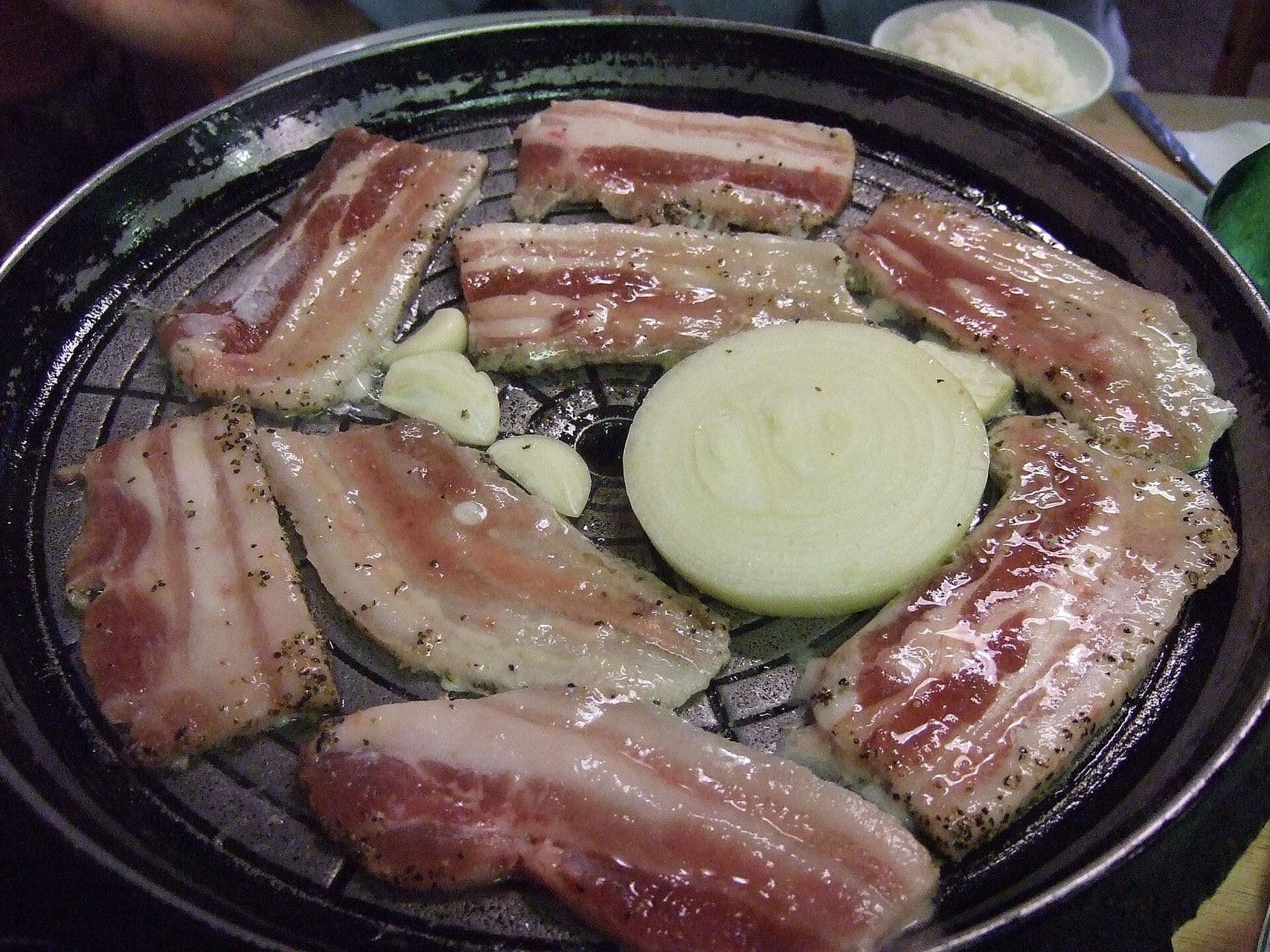
The workday ends, but no one goes home. The whole team rises, follows the department head to a nearby barbecue restaurant, and settles around smoking grills. The green bottles of soju line up, you fill your neighbour's glass with both hands, you toast, you laugh, you speak more freely than at the office. Then comes a second venue, sometimes a third. This is hoesik.
is the collective meal that Korean companies organise outside office hours, to weld teams together. Far more than a dinner among colleagues, it is a social institution, an extension of work governed by precise codes. To understand hoesik is to grasp an essential part of the professional and relational culture of South Korea.
Eating together to make a team#
The word literally means "eating together." In Korean culture, deeply marked by collectivism and group spirit, sharing a meal is no trivial matter: it cements belonging. Hoesik extends this logic to the world of the company.
Its stated goal is dan합 or team spirit: to reinforce cohesion, smooth over tensions, create an intimacy that the office's strict hierarchy forbids. Around the table, the barriers loosen a little, without ever disappearing. Hoesik is an ambiguous space: at once relaxation and obligation, conviviality and social performance.
In Korea, one does not really become a team at the office, but around a barbecue grill and a few glasses of soju. Hoesik is the unofficial cement of the collective.
The rounds: 1cha, 2cha, 3cha#
Hoesik unfolds in successive stages, called , which are numbered. The is the meal proper: most often a Korean barbecue, fried chicken or a stew, washed down with soju and beer.
| Round | Typical place | What happens | Mood |
|---|---|---|---|
| Barbecue or stew restaurant | The shared meal, soju and beer | The whole team, semi-formal | |
| Bar or hof (호프, hopeu, beer tavern) | The drinking continues | Smaller group, more relaxed | |
| Noraebang (노래방, noraebang, private karaoke) | Songs and last glasses | The most committed, late at night |
Then comes the , generally in another place: a bar, a hof (beer tavern), where the drinking continues. The most enduring, or the most constrained, carry on to a , often a , those private karaoke rooms where everyone belts out a tune. The evening can thus stretch late into the night, each round reducing the group to its most committed members.
The term serves here as a counter for the successive "rounds" of a single outing. Ilcha, icha, samcha: first, second, third stop. Knowing at which cha one may decently slip away is a whole social art, heavy with stakes for anyone who wants to spare their reputation without offending their elders.
The etiquette of drinking#
Hoesik obeys a highly codified etiquette of drinking, inherited from the Confucian respect owed to elders and superiors. You never fill your own glass: you serve others', and you wait to be served. When a superior pours you a drink, you hold your glass with both hands, as a sign of deference.
Drinking before an elder also calls for restraint: out of respect, you turn your face slightly away and sometimes cover your glass with your hand to drink. Flatly refusing a drink offered by a superior can be perceived as an affront, even if this norm is softening today. Everything in these gestures re-enacts the hierarchy of ages and functions that structures Korean society.
The gestures of hoesik are learned alongside the words that carry them: 건배 (geonbae, "cheers!"), 두 손 (du son, "with both hands") or 선배 (seonbae, the senior, the mentor). With KoreanSRS and its spaced repetition, these expressions of Korean etiquette settle into memory, ready for your first glass around the grill.
At the heart of hoesik flows soju, the national liquor: to understand its place is to understand a large part of Korean sociability.
Soju, somaek and well-watered conviviality#
Alcohol is the fuel of hoesik, and is its king: this clear, inexpensive and widely available spirit accompanies almost every shared meal. It is often mixed with beer to make , a contraction of soju and maekju (beer), the favourite drink of company evenings.
The rituals of pouring, toasting (geonbae!, "cheers!") and mutual refilling pace the evening and sustain the bond. This conviviality long had a flip side: the pressure to drink could be strong, and hoesik was seen as a near-compulsory rite of professional integration, sometimes at the cost of health and private life.
The hierarchy can be read even in the serving of soju: the youngest or most junior at the table makes sure the elders' glasses are never empty, opens the bottles and pours first. To forget this duty is to risk seeming ill-bred, a misstep that young recruits quickly learn to avoid.
A ritual in full transformation#
Hoesik is no longer what it was. A new generation of workers, more attached to work-life balance, has little tolerance for these late, imposed evenings. The movement, accelerated by the law reducing working hours and by the pandemic lockdowns, has pushed many companies to lighten the tradition.
One now sees shorter hoesik, limited to the 1cha alone, held at lunchtime, or replaced by alcohol-free activities: cultural outings, cafés, games. The pressure to drink is receding, and refusing a glass is becoming more acceptable. Hoesik is reinventing itself, seeking to preserve the spirit of cohesion while respecting limits long ignored.
To discover hoesik is to understand how Korea weaves its professional bonds around the table and the glass, in a unique blend of conviviality and hierarchy. To learn Korean is also to master these words (hoesik, geonbae, somaek) that open the doors of a sociability where knowing how to drink means knowing how to live together.
FAQ#
What is hoesik? Hoesik (회식) is the collective meal organised by Korean companies after work to reinforce team cohesion. Blending relaxation and obligation, it is governed by precise codes, especially around drinking.
What do 1cha, 2cha, 3cha mean? They are the successive "rounds" of a hoesik: the 1cha is the meal, the 2cha a bar to continue drinking, the 3cha often a karaoke (noraebang). Each round reduces the group to the most committed.
What is the drinking etiquette at a hoesik? You never serve yourself, you serve others; you hold your glass with both hands when a superior pours, and you turn your face away to drink before an elder, out of respect for the Confucian hierarchy.
Is hoesik still compulsory? Less and less. The younger generations and reforms of working hours have lightened the tradition: shorter hoesik, alcohol-free or at lunchtime, and a growing right to refuse a drink.
Photo credits: the images used in this article come from Pexels and Unsplash and are royalty-free.
Korean military service: length, exemptions, realities
18 to 21 months depending on the branch, a seven-grade fitness exam, vanishingly rare exemptions: how South Korean conscription works and what it costs.
Cover image: by hellochris · by hellochris, via Wikimedia Commons · CC BY 2.0