Mid-Autumn Festival: the full moon, mooncakes and Chang'e
Origins, legends and customs of the Chinese Mid-Autumn Festival: the goddess Chang'e, mooncakes, the family reunion and the worship of the full moon.
La rédaction Kotoba Interactive
Studio éditorial
On the evening of the fifteenth day of the eighth lunar month, the moon is said to be the roundest and brightest of the year. On balconies and in courtyards, families lay out fruit, light lanterns and cut into equal portions small dense, golden cakes marked with raised patterns. Eyes lift toward the moon, thoughts turn to the absent, and the cakes are shared. This is the Mid-Autumn Festival.
The is, after the New Year, the second most important festival of the Chinese calendar. A festival of harvest and reunion, it celebrates the full moon as a symbol of fullness, unity and family togetherness. To understand this festival is to grasp the deep bond Chinese culture maintains with the lunar cycle and the idea of completeness.
A festival of the moon and the harvest#
The Mid-Autumn Festival falls on the fifteenth day of the eighth month of the Chinese lunisolar calendar, that is, in September or early October. This moment corresponds to the end of the autumn harvests: heaven is thanked for the abundance, in an agrarian tradition millennia old.
But the symbolic heart of the festival is the moon. On that evening, it reaches its maximum roundness, and this luminous fullness becomes a metaphor: that of reunion. In Chinese, the word yuán (圆), "round," also evokes the idea of being "complete," of a family gathered. To contemplate the full moon together is to affirm that the family circle is intact, or to remember, with melancholy, those who are missing.
The round autumn moon says one thing only: may the family be, like it, full and whole. Wherever they are, loved ones gaze at the same moon.
Moved by this poetry of the full moon? Learn to read 月 (yuè, moon), 家 (jiā, family) and 团圆 (tuányuán, reunion) with ChineseSRS and its spaced repetition, to savour the Mid-Autumn Festival in the language itself.
The legend of Chang'e#
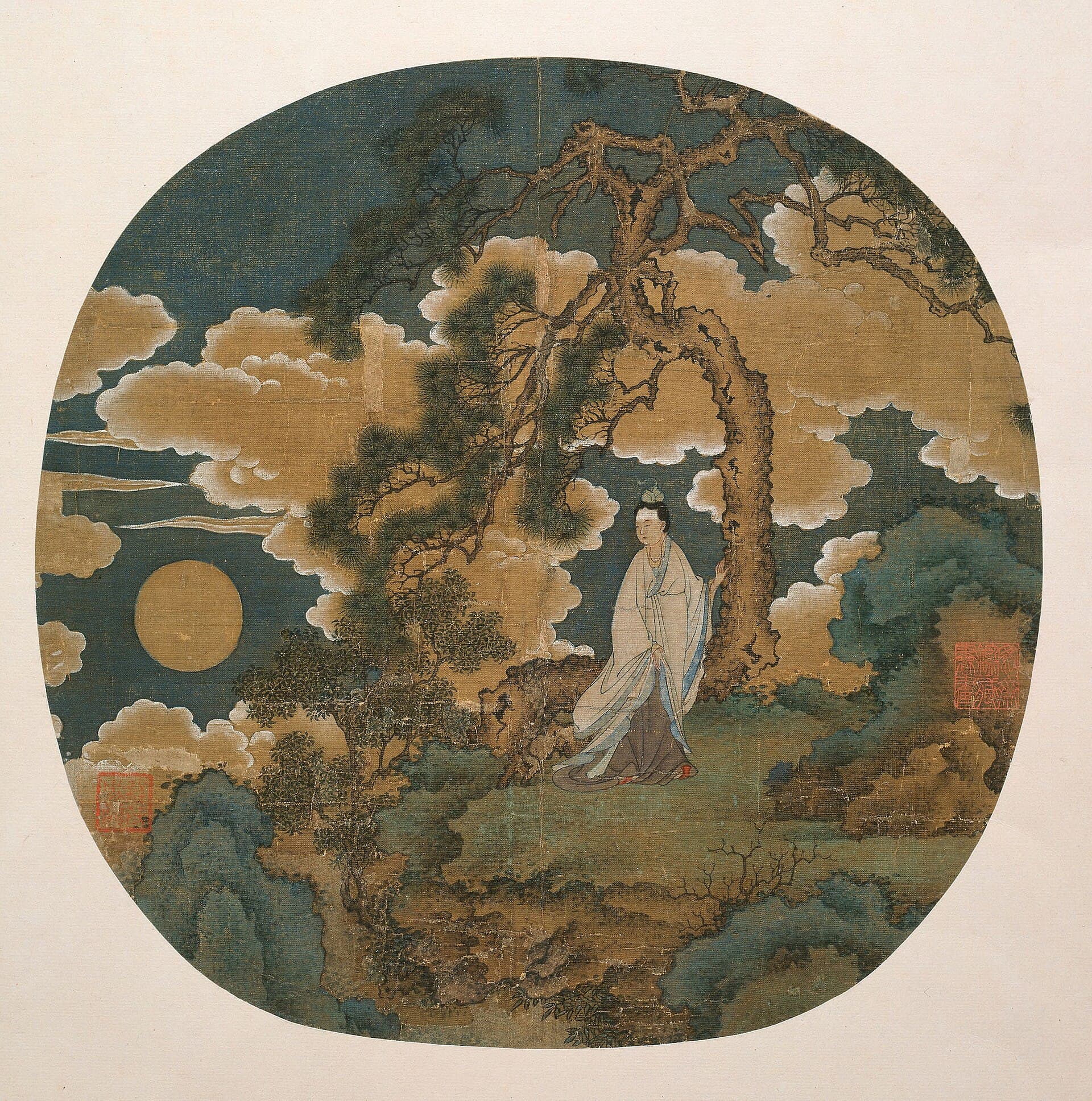
At the heart of the festival sits the most famous of Chinese lunar legends: that of , the goddess of the Moon. The tale, which has many variants, features the heroic archer . According to the most widespread version, when ten suns were scorching the earth, Houyi shot down nine with his arrows, saving humanity. As a reward, he received an elixir of immortality.
Rather than drink it, he entrusted it to his wife Chang'e. But one day, to prevent a thief from seizing it, Chang'e swallowed the elixir: she then rose toward the sky and took refuge on the Moon, forever separated from her husband. Since then, it is said, Houyi offers her each year, at mid-autumn, her favourite fruits and cakes, lifting his eyes toward the orb where she dwells.
The name literally means "mid-autumn." In the old calendar, autumn numbered three months, and this festival falls exactly at the heart of the season, hence its name. It is also sometimes called the "moon festival" (月节) or the "reunion festival" (团圆节).
Mooncakes#
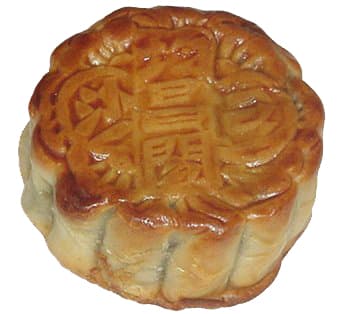
The edible symbol of the festival is the . A small, dense, round pastry, with a thin crust marked with raised patterns (flowers, characters of good wishes), it encloses a rich filling. The most classic combines a sweet lotus seed paste and one or more salted duck egg yolks, whose golden circle evokes the full moon at the heart of the cake.
| Filling | Chinese term | Region or use |
|---|---|---|
| Lotus seed paste and egg yolk | 莲蓉 (liánróng) | Cantonese classic, the most widespread |
| Red bean paste | 豆沙 (dòushā) | Traditional, very popular in the north |
| Five nuts and seeds | 五仁 (wǔrén) | Dried fruits and seeds, an old-time flavour |
| Snow-skin, chilled | 冰皮 (bīngpí) | Cold, modern version, kept refrigerated |
It is cut into portions shared among all family members, a gesture that seals the unity of the group. Very rich, the mooncake is eaten in small quantities, accompanied by tea. Regions and eras have multiplied the variants: red bean paste, dried fruits, ham, and today bold versions (chocolate, ice cream, matcha tea) that also make it a highly codified business gift.
Read alsoChinese New Year: the Spring Festival, the world's largest celebrationLike the New Year, the Mid-Autumn Festival places family reunion at its centre: two great occasions where people return home to share a meal charged with meaning.
Lanterns, pomelos and offerings#
Beyond the cakes, the festival deploys a whole procession of customs. Lanterns, hung or carried by children, light up streets and gardens; some, released into the sky or set upon the water, carry wishes. Seasonal fruits are eaten, in particular the , whose name evokes protection, and small offerings are sometimes set out facing the moon.
In southern China and Hong Kong, fire dragon dances, lantern markets and night outings with family extend the festival. Everywhere, the watchword is the same: to gather, to lift one's eyes, and to savour together the clearest night of the year.
According to a persistent tradition, mooncakes are said to have served as secret messengers at the end of the Mongol Yuan dynasty: notes hidden in the pastries are said to have coordinated an uprising, setting the date of the revolt for the evening of mid-autumn. The anecdote, unverifiable, says much about this cake's place in the Chinese imagination.
A festival that gathers the Chinese world#
The Mid-Autumn Festival is celebrated far beyond mainland China: in Taiwan, Hong Kong, Singapore, Vietnam (under the name Tết Trung Thu, which became chiefly a children's festival) and in all the Chinese diasporas. Everywhere, it remains the moment when people seek to return to their loved ones, or, failing that, to call them while gazing at the same moon.
In a modern and mobile China, where so many families live dispersed between cities and provinces, this festival keeps a powerful emotional charge. It recalls that, across distance, the family bond remains the circle that nothing must break.
To discover the Mid-Autumn Festival is to enter a Chinese poetics of the sky and of return, where a pastry and a celestial body suffice to say the essential. To learn Chinese is also to savour these words (Zhōngqiū, yuèbǐng, tuányuán) that hold, in the light of a full moon, the whole desire to be together.
FAQ#
When is the Mid-Autumn Festival? On the fifteenth day of the eighth month of the Chinese lunisolar calendar, generally in September or early October, the evening when the full moon is said to be the roundest and brightest of the year.
What are mooncakes? Small, round, dense pastries with a crust marked with patterns, filled most often with lotus paste and salted egg yolks. They are shared as a family, their round shape symbolising reunion.
Who is Chang'e? The Chinese goddess of the Moon. According to legend, the wife of the archer Houyi, she swallowed an elixir of immortality and flew to the Moon, where she dwells forever: the central tale of the Mid-Autumn Festival.
What does the full moon symbolise during this festival? Fullness and family reunion. In Chinese, the word "round" (yuán) evokes the idea of being complete; to contemplate the round moon together affirms the unity of the family.
Photo credits: the images used in this article come from Pexels and Unsplash and are royalty-free.
Chang'e and the cowherd: China's four great folk legends
Ten suns, an elixir, a woman on the moon, two lovers split by the Milky Way: the stories all of China knows, and what they say about its society.
Cover image: Lybil BER · Wikimedia Commons · CC BY-SA 3.0