Hallyu: How the Korean Wave Conquered the World
The history of hallyu, the Korean wave: the birth of the term, K-dramas, K-pop, Parasite and Squid Game, soft power and the state strategy behind a global phenomenon.
La rédaction Kotoba Interactive
Studio éditorial
In 2020, a Korean-language film won the Oscar for Best Picture, a first in the history of the Academy. The following year, a Korean series with green tracksuits became the biggest hit in Netflix's history, watched around the world. At the same moment, a group of seven boys addressed the UN General Assembly and placed their songs atop the American charts. In a handful of years, South Korea, once little known, became a cultural superpower. This phenomenon has a name: hallyu.
refers to the worldwide spread of South Korean popular culture: television series (K-dramas), music (K-pop), cinema, video games, fashion, cosmetics and food. Far from being an accident, this conquest is the fruit of a precise history and an avowed strategy. To understand hallyu is to understand how a country turned its culture into one of its most powerful exports.
Origins: a word born outside Korea#
Remarkably, the term hallyu was not coined in Korea but abroad. It was the Chinese press, in the late 1990s, that is said to have invented the expression to describe the sudden enthusiasm of the Chinese public for the Korean series and music then sweeping across the region.
The starting point lies in the decade following the Asian financial crisis of 1997. Hit head-on, South Korea made the strategic choice to bet on cultural industries as an engine of growth and influence. The export of dramas and pop became a policy, not merely a commercial success.
Hallyu did not fall from the sky: it is a wave that Korea learned to manufacture, then to export, turning its cinema, music and series into planetary ambassadors.
Watching a K-drama in the original language is already the start of learning: with KoreanSRS (coming soon) and spaced repetition, effortlessly memorize the words that keep appearing on screen, like 사랑 (sarang, love), 대박 (daebak, "awesome, incredible") or 오빠 (oppa, "older brother," an affectionate term). From fiction to language, it is only one step.
The successive waves#
Specialists often distinguish several stages in the rise of hallyu, each carried by a dominant medium.
| Wave | Era | Dominant medium | Emblematic works |
|---|---|---|---|
| First | 2000s | K-drama (드라마, deurama) | Winter Sonata (2002) |
| Second | 2010s | K-pop (케이팝, keipap) | Gangnam Style (2012), BTS, BLACKPINK |
| Third | 2020s | Cinema and streaming (영화, yeonghwa) | Parasite (2020), Squid Game (2021) |
The first wave: the K-drama#
The first tidal wave was that of the K-dramas. Series such as Winter Sonata (2002) triggered a massive craze in Japan, China and across Southeast Asia, creating a generation of fans and a dedicated tourism. Polished romances, family sagas, addictive pacing: the Korean drama quickly imposed its codes.
The second wave: K-pop#
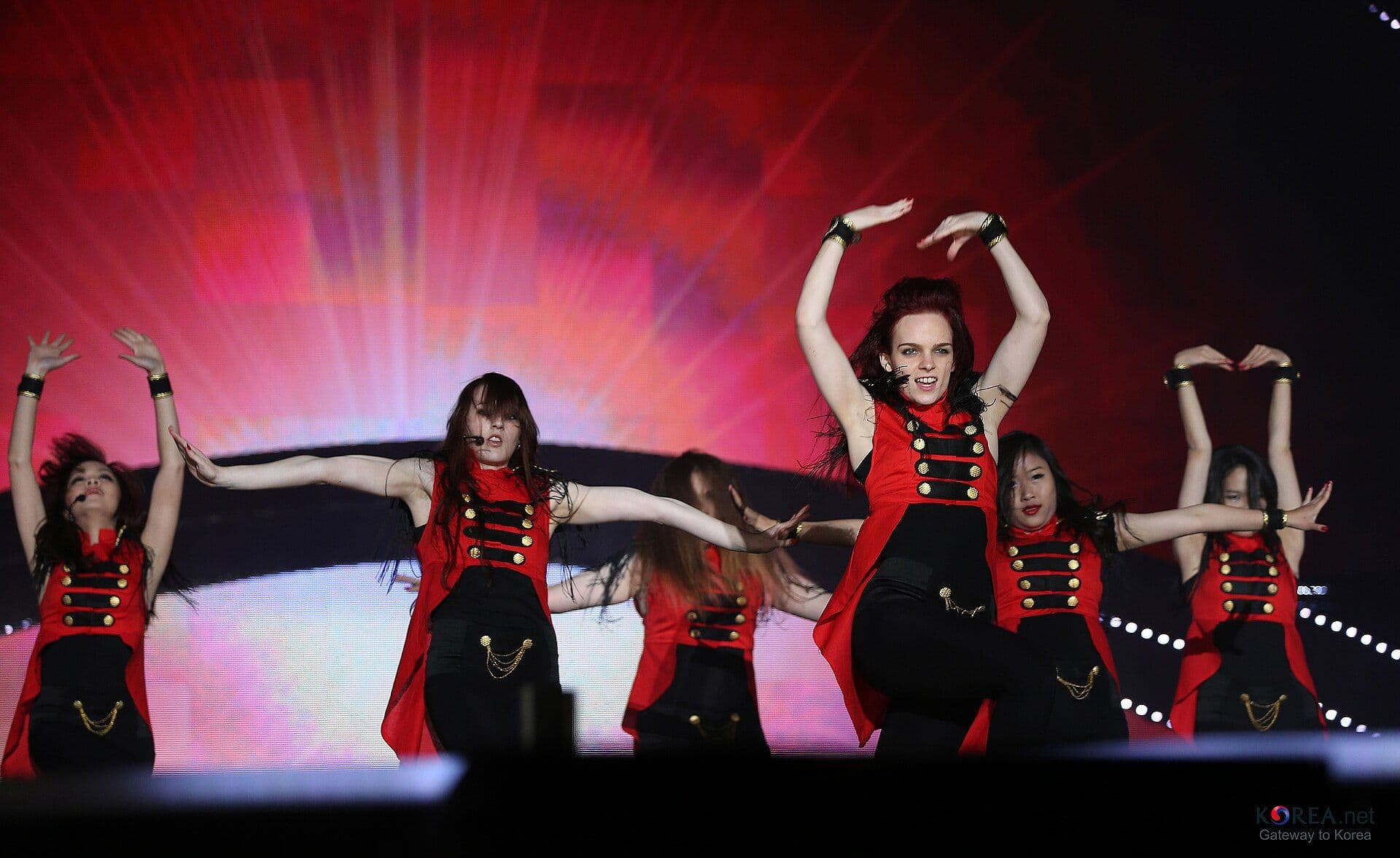
Then came K-pop, carried by groups with carefully crafted visuals, millimeter-precise choreography and a massive online presence. The global turning point dates to the 2010s, with the unexpected planetary success of Gangnam Style (2012), then the rise of groups like BTS and BLACKPINK, the first Korean artists to dominate Western charts.
Gangnam Style by the singer PSY was, in 2012, the first video to surpass a billion views on YouTube, to the point of "breaking" the platform's counter, originally designed for a lower maximum. A symbol of the Korean irruption into global pop.
The third wave: cinema and streaming#
The consecration came at last from the globalized big and small screens. In 2020, Bong Joon-ho's Parasite won the Palme d'Or then the Oscar for Best Picture. In 2021, Squid Game became the most-watched series in Netflix history. Korean fiction was no longer a regional curiosity: it was mainstream.
Soft power, Korean style#
Behind hallyu lies a carefully considered soft power strategy. The South Korean government supported its creative industries early on through funding, dedicated agencies and active cultural diplomacy. To export series and music is also to export an image of the country, its language, its products.
is written with two Sino-Korean characters: han (韓), which designates Korea, and ryu (流), "the flow, the current." Literally, "the Korean current": a liquid metaphor to convey the irresistible spread of a culture beyond borders.
The knock-on effect is spectacular: the popularity of K-dramas and K-pop boosts sales of cosmetics (K-beauty), Korean dishes, language courses. The success of popular culture becomes the megaphone for an entire economy.
Read alsoHanbok: The History and Symbolism of Korea's Traditional DressThe Korean wave does not only spread pop: it has also brought heritage back into the light, like the hanbok, once again an object of pride and fashion.
Hallyu today: a lasting wave?#
Hallyu has become a pillar of South Korean identity and influence. The fandoms, organized and global, are its best ambassadors; Korean is now one of the fastest-growing languages to learn, driven by the desire to understand song lyrics and series dialogue without subtitles.
The phenomenon is not without criticism: intense pressure on idols, aesthetic uniformization, dependence on foreign platforms. But the wave seems far from ebbing: it renews itself, exports to new markets and continues to inspire.
To learn Korean through hallyu is to enter a culture through the grand door: oppa, daebak, aegyo, saranghae, all words gleaned from series and songs. Behind the wave and its glitter, there is a language to understand, and a whole country that asks only to be read in the original version.
FAQ#
What does the word hallyu mean? Hallyu (한류) means "Korean wave" or "Korean current," from han (Korea) and ryu (flow). The term refers to the worldwide spread of South Korean popular culture: series, music, cinema, fashion, food.
Where does the term hallyu come from? It is said to have been coined by the Chinese press in the late 1990s to describe the Chinese public's enthusiasm for Korean series and music. The word then came back to Korea.
What are the major stages of hallyu? Three waves are often distinguished: the K-dramas (2000s), K-pop (2010s, BTS, BLACKPINK), then the triumph of cinema and streaming (Parasite in 2020, Squid Game in 2021).
Is hallyu supported by the state? Yes. After the 1997 crisis, South Korea made cultural industries a strategic axis, supported by funding and cultural diplomacy: hallyu is a genuine instrument of soft power.
Photo credits: the images used in this article come from Pexels and Unsplash and are royalty-free.
In this article
The cultural terms covered here, each with a short definition.
Han: Korean Melancholy, Between Grief and Pride
Han (한, 恨), that Korean sorrow made of swallowed resentment and endurance, is it an age-old essence or a colonial invention? An honest inquiry.
Cover image: Korea.net / Korean Culture and Information Service (Jeon Han) · Korea.net / Korean Culture and Information Service (Jeon Han), via Wikimedia Commons · CC BY-SA 2.0