The qipao: history of the Chinese dress and its mandarin collar
History of the qipao (cheongsam), the iconic Chinese dress: Manchu origins, the 1920s-30s Shanghai revolution, symbolism, decline and revival.
La rédaction Kotoba Interactive
Studio éditorial
A silhouette slit to the thigh, a straight collar that frames the nape, fabric buttons knotted at the side like tiny sculptures: in a single image, the qipao says modern China. You meet it in old Shanghai films, on Art Deco posters, at weddings today. Yet this dress that the whole world takes for the essence of Chinese elegance is barely more than a century old in its current form, and its history is one of an astonishing metamorphosis.
The , also called cheongsam in Cantonese (長衫), is the most iconic women's garment of China. Born from a loose, masculine robe, it became in a few decades the very distillation of modern femininity. To understand the qipao is to follow China itself through its tumultuous passage from empire to modernity.
At the origins: the robe of the Manchu "banners"#
The qipao takes its name from the , the military and administrative units into which the Manchus were organized, the people from the northeast who founded the Qing dynasty (1644-1912). The women of these banners, the qírén (旗人, "banner people"), wore a long, loose one-piece robe, the qípáo, literally "the robe of the banners."
This original robe has almost nothing of the modern qipao. Wide, straight, covering the body from shoulders to ankles, it concealed the figure rather than emphasizing it, in keeping with Confucian modesty. For nearly three centuries, under the Qing, it distinguished Manchu women from Han women, who wore separate jackets and skirts.
The qipao began as a loose and modest ethnic uniform. That it became the sensual symbol of Chinese modernity is owed to a cultural revolution as swift as it was radical.
The Shanghai revolution (1920s-1930s)#
Everything shifted after the fall of the empire in 1912. In the ferment of republican China, and most especially in cosmopolitan Shanghai of the 1920s and 1930s, the qipao entirely reinvented itself. The city's tailors, in contact with Western fashion, transformed the loose Manchu robe into a fitted sheath that hugged the body.
The cut tightened, the waist was marked, the sleeves shortened, and above all the side slit appeared, at first discreet then ever higher, freeing the leg and the stride. The straight collar, the mandarin collar, framed the face. The qipao became the uniform of the modeng (摩登, a transcription of the English "modern"): students, actresses, singers, businesswomen of the new urban China.
literally means "the robe of the banners," from the qí (旗) of the Manchu banners and páo (袍), "the long robe, the tunic." The Cantonese name means "long shirt," a term that originally designated a man's garment instead.
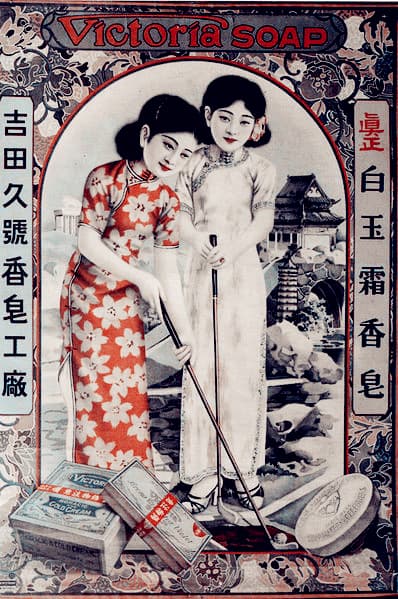
This Shanghai era is the golden age of the qipao. Reproduced on the yuefenpai, those illustrated advertising calendars that adorned the walls, worn by the stars of the nascent cinema, it embodied a new femininity: modern, urban, self-assured, yet draped in a deeply Chinese garment. The qipao thus reconciled tradition and emancipation.
Drawn in by the story of the qipao and 1930s Shanghai? Learn to read 旗袍 (qípáo, the dress), 絲綢 (sīchóu, silk) and hundreds of everyday Chinese words with ChineseSRS and its spaced repetition.
Anatomy of a dress#
Several details make the identity of the qipao, and each carries a craft.
The , called the mandarin collar, rises around the neck and structures the whole silhouette. The asymmetrical closure starts at the collar, slants toward the right armpit, then descends along the side. It is held by , made of braided fabric cord knotted by hand, sometimes in the shape of flowers or butterflies: an art in its own right.
The on one or both sides combines practicality and elegance. The fabrics range from simple cotton to embroidered with auspicious motifs (dragons, phoenixes, peonies, plum blossoms), each charged with meaning in Chinese symbolism.
| Embroidered motif | Chinese name | Symbolism |
|---|---|---|
| Dragon | 龙 (lóng) | Imperial power, strength, favor of heaven |
| Phoenix | 凤 (fèng) | Feminine grace, rebirth, virtue |
| Peony | 牡丹 (mǔdan) | Wealth, honor, blossoming beauty |
| Plum blossom | 梅花 (méihuā) | Resilience, purity, promise of spring |
In Wong Kar-wai's film In the Mood for Love (花樣年華, 2000), the actress Maggie Cheung changes qipao more than twenty times. Each dress, through its color and pattern, accompanies the evolution of the character's feelings: there the qipao becomes a genuine silent language.
Decline and revival#
The qipao nearly disappeared, however. After 1949, in the People's Republic, it was gradually condemned as a "bourgeois" and "feudal" relic. During the Cultural Revolution (1966-1976), wearing such a dress could bring trouble; the blue-grey proletarian uniform replaced the silks of old. The qipao then took refuge in Hong Kong, Taiwan and the diaspora, where it survived as ceremonial and prestige attire.
From the 1980s and the economic opening, the dress returned to favor on the mainland. Today the qipao enjoys a new life: worn at weddings, banquets, the New Year, reworked by contemporary designers, displayed on international runways. It has also become, at times, a cliché (a restaurant uniform or folkloric costume), which takes nothing away from the power of a well-cut dress.
Read alsoChinese calligraphy: the art of the brush and the breathFrom the calligrapher's brush to the knotted buttons of the qipao, China cultivates the same taste for the precise gesture and the meaningful detail.
The qipao today: between heritage and global fashion#
The qipao occupies a singular place in the global imagination: it is one of the rare garments that instantly says "China" while remaining desirable and worn. Western and Chinese stylists draw on it, from fashion shows to red carpets, and the debate on cultural appropriation has even gathered around it, a sign of its status as a global icon.
In China, it is part of the broader movement of reclaiming sartorial heritage, alongside the hanfu, the traditional Han garment that young Chinese are bringing back into style. The qipao keeps its particular aura: neither quite ancient nor truly Western, it is the garment of the China that invented itself as modern.
To discover the qipao is to read on a fabric a century of Chinese history: the fall of an empire, the effervescence of Shanghai, the storms of the 20th century and the return to favor of an elegance. A simple dress, and a whole country reflected in it.
FAQ#
What is the difference between qipao and cheongsam? None in substance: qipao is the Mandarin term, cheongsam the Cantonese term for the same dress. "Cheongsam" is mostly used in Hong Kong and Cantonese-speaking regions.
Is the qipao a very old garment? The original loose Manchu robe goes back to the Qing, but the fitted qipao we know was born in the Shanghai of the 1920s-1930s, under the influence of Western fashion.
Why does the qipao have a side slit? The slit, which appeared with the modern version, allows walking and brings practicality and elegance. Its height has varied with eras and fashions.
What do the embroidered motifs on a qipao symbolize? Motifs like the dragon, phoenix, peony or plum blossom carry auspicious meanings (prosperity, harmony, longevity) drawn from traditional Chinese symbolism.
Photo credits: the images used in this article come from Pexels and Unsplash and are royalty-free.
Hongbao: the art of the red envelope in China
Everything about hongbao, the red envelopes of money given at Chinese New Year and other big occasions. Traditions, amounts, etiquette and the digital turn.
Cover image: Original author unknown · Wikimedia Commons · Public domain