Gunpla: The Culture of Gundam Model Kits in Japan
From Bandai's first 1980 boxes to today's Real Grades, a deep dive into Gunpla, the Japanese hobby where assembling a Gundam becomes a meditative art.
La rédaction Kotoba Interactive
Studio éditorial
In a Tokyo apartment, an office worker opens a box stamped with the logo: runners of injected plastic, an accordion-folded instruction sheet, stickers and water-slide decals. For the next three hours, he cuts, sands, assembles, paints, weathers. By midnight stands a seven-inch , articulated, identical to the one he watched on TV at age seven. This scene, repeated every night by millions of Japanese of all ages, is called . Born in 1980 from an anime that was nearly cancelled and a toy model launched almost as a default, Gunpla has become in forty years a multi-hundred-million-euro industry blending plastic engineering, otaku culture, childhood memory and meditation of the hands.
Gundam: The Anime That Started It All#
A Cursed Series That Became a Cult#
Gunpla goes back to April 7, 1979, when Nagoya TV first broadcast , designed by director for . In the year 0079 of the , Earth and its space colonies wage a total war, and young Amuro Ray, fifteen, finds himself at the controls of an experimental combat robot, the RX-78-2 Gundam.
Unlike previous mecha series, with invincible robots piloted by flawless heroes (Mazinger Z, Grendizer, Getter Robo), Gundam offered a realistic, political vision: the are war machines, and the pilots are afraid, cry, die. This adult approach confused the target children's audience, and the ratings were so poor that the series was cut short at 43 episodes instead of the planned 52, sponsors withdrew, and Tomino was nearly fired.
Rebirth Through Reruns and the Films#
Gundam then found an unexpected audience: teenagers and young adults, drawn in by its psychological and political depth. Reruns on other local channels, then the three compilation films released in 1981 and 1982, relaunched the machine. On February 22, 1981, twenty thousand fans gathered in Shinjuku for the first film, a scene remembered as .
Bandai, which had acquired merchandising rights, decided to exploit the universe. After several unsuccessful attempts at expensive die-cast toys, it tried a low-cost formula: plastic model kits you assembled yourself, priced at 300 yen per box.
1980: The Birth of Gunpla#
The First Box: The RX-78-2 at 1/144 Scale#
In July 1980, Bandai released the first Gunpla: a model of the RX-78-2 Gundam at 1/144 scale (about 12.5 centimeters tall, for an 18-meter robot), sold for 300 yen, slightly more than a bowl of ramen at the time.
Japanese children and teenagers, unable to afford the thousand-yen die-cast toys, rushed on the affordable alternative: more than 400,000 units sold in a few weeks. Bandai released other models (Zaku II, Char's Zaku II, Guncannon, Guntank) then larger scales (1/100, 1/60).
The Gunpla Boom of the 1980s#
Between 1980 and 1984, Japan experienced a true . Toy stores ran out of stock within hours, lines formed every Wednesday, delivery day. Some rare models traded at three or four times their retail price in school black markets, where children resold duplicates.
On January 25, 1982, in a Bambi store in Kanda, Tokyo, a crush of several hundred children eager to acquire the new Gunpla Perfect Gundam injured about thirty of them, several severely. The event forced Bandai to better regulate distribution.
Every Gunpla box is a Japanese lesson: the instruction sheet (取扱説明書, torisetsu, manual), the runners marked 嵌合 (kangō, snap-fit) and the name of the hobby itself, ガンプラ (Gunpla). With JapaneseSRS and its spaced repetition, you will learn to read these kanji and katakana so you can build your Gundam without ever guessing.
The Technical Evolution: From First Kits to Real Grades#
A 2026 Gunpla has nothing to do with a 1980 one: where you once had to glue each piece and hand-paint everything, you can now obtain a colored, articulated model, without paint or glue, using only the technique.
| Line | Year | Scale | Audience |
|---|---|---|---|
| First Grade (FG) | 1980 | 1/144 | Nostalgic collectors |
| High Grade (HG) | 1990 | 1/144 | Beginners (most popular) |
| Master Grade (MG) | 1995 | 1/100 | Seasoned hobbyists |
| Perfect Grade (PG) | 1998 | 1/60 | Experts (the grail) |
| Real Grade (RG) | 2010 | 1/144 | Demanding technicians |
First Grade (FG): The Original Series#
The First Grade, launched in 1980, are the historical Gunpla at 1/144 scale. Simple, barely articulated, colored with decals, they remain the cheapest entry point (around 500 yen), cult items for nostalgic collectors.
High Grade (HG): The Popular Standard#
Launched in 1990 for Gunpla's tenth anniversary, the High Grade (HG) line brought improved articulation, greater fidelity to the anime proportions, and most importantly multi-color molding, which yields pre-colored pieces without the need for paint. HG is today the most popular line, with several hundred references (roughly 1,500 to 2,500 yen per box), through which most beginners discover the hobby.
Master Grade (MG): 1/100 Scale Luxury#
The Master Grade (MG) line, launched in 1995 for the fifteenth anniversary, changed the approach. At 1/100 scale (about 18 centimeters), MGs are complex models with internal structures (skeletons, motors, hydraulic cables) visible under removable armor panels. A box contains 200 to 500 pieces, costs 3,500 to 8,000 yen, and requires six to twelve hours to assemble. MG is the reference line for seasoned hobbyists.
Perfect Grade (PG): The Grail#
Launched in 1998, the Perfect Grade (PG) line is Gunpla's summit. These 1/60 scale models (about 30 centimeters) each contain more than 600 pieces, feature real moving mechanisms and LEDs for the eyes and thrusters, and demand dozens of hours. A PG costs between 15,000 and 30,000 yen; rare, each release is an event.
Real Grade (RG): The Best of Both Worlds#
Launched in 2010 for the thirtieth anniversary, the Real Grade (RG) line is perhaps the most technical of all. At 1/144 size (compact, about 13 centimeters), RGs integrate an articulated internal skeleton (the Advanced MS Joint) and exceptional detail: fitting the complexity of an MG into the volume of an HG.
Since 2010, Bandai has rolled out other specialized lines: Mega Size (1/48, 38 cm), SD Gundam (chibi-deformed), HGUC (High Grade Universal Century for UC series), Entry Grade (2020, assembled in 30 minutes without tools, for young children).
Assembly: A Meditative Ritual#
The Gunpla Builder's Tools#
A has an arsenal of specialized tools. The , precision cutting pliers, detaches pieces from runners; high-end models, made by a Japanese manufacturer in Niigata, can cost up to 12,000 yen. The , a sandpaper or metal file, removes cutting residues (nub marks). , ultra-fine ink pens, trace panel lines. The , an aerosol varnish, protects and matts the finish.
For more advanced builders, the setup grows with airbrushes, paint booths, compressors, Mr. Color acrylic paints from GSI Creos, extra water-slide decals, and even miniature LEDs.
The Steps of Assembly#
Assembly follows a precise sequence: reading the instruction sheet (torisetsu, 取扱説明書), cutting pieces from runners, cleaning the edges, assembling by sub-sections (head, torso, arms, legs, weapons), decals, panel lines, final varnishing.
For a High Grade, count two to four hours for a simple snap-fit, ten to fifteen for a painted and varnished finish. For a Master Grade, six to twelve hours in snap-fit, thirty to fifty for a complete finish. For a Perfect Grade with paint and LEDs, you easily reach 80 to 120 hours. Some builders spend months on a single model.
To build a Gunpla is to enter a slow time: hands work, mind calms. One of the rare modern activities that rewards patient attention and punishes haste.
The Gunpla Builders World Cup and Global Competition#
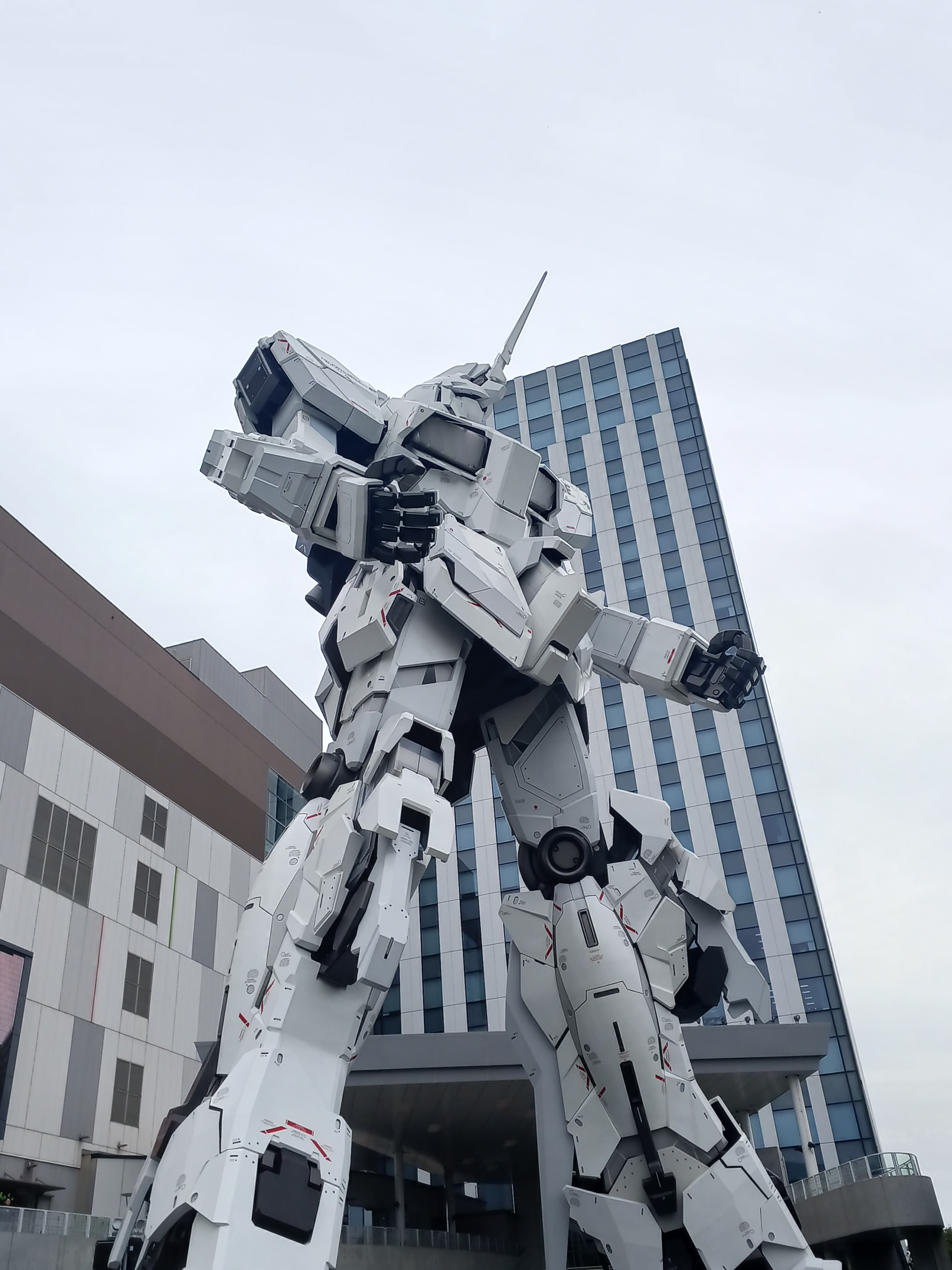
Since 2011, Bandai has held the Gunpla Builders World Cup (GBWC) every year, an international competition gathering participants in more than thirty countries. Categories range from Junior (under 14) to Open (adults), with distinct lines for simple models and complex dioramas. The finals are held at the Gundam Base Tokyo in the Odaiba DiverCity tower, which displays the 19.7-meter life-size RX-78-2 Unicorn Gundam, inaugurated in 2017.
Winners produce battlefield dioramas, modified figures (mixing build), photorealistic paintings, hybrid sculptures combining several kits.
Gundam Base Tokyo: The Mecca of Gunpla#
Opened in 2017 in the DiverCity Tokyo Plaza mall in Odaiba, Gundam Base Tokyo is the largest Gunpla store in the world: more than 5,000 references, some exclusive or limited-edition. An event area hosts exhibitions, masterclasses, monthly contests and meetings with artists. In front of the building, the life-size Unicorn Gundam performs several transformations each day.
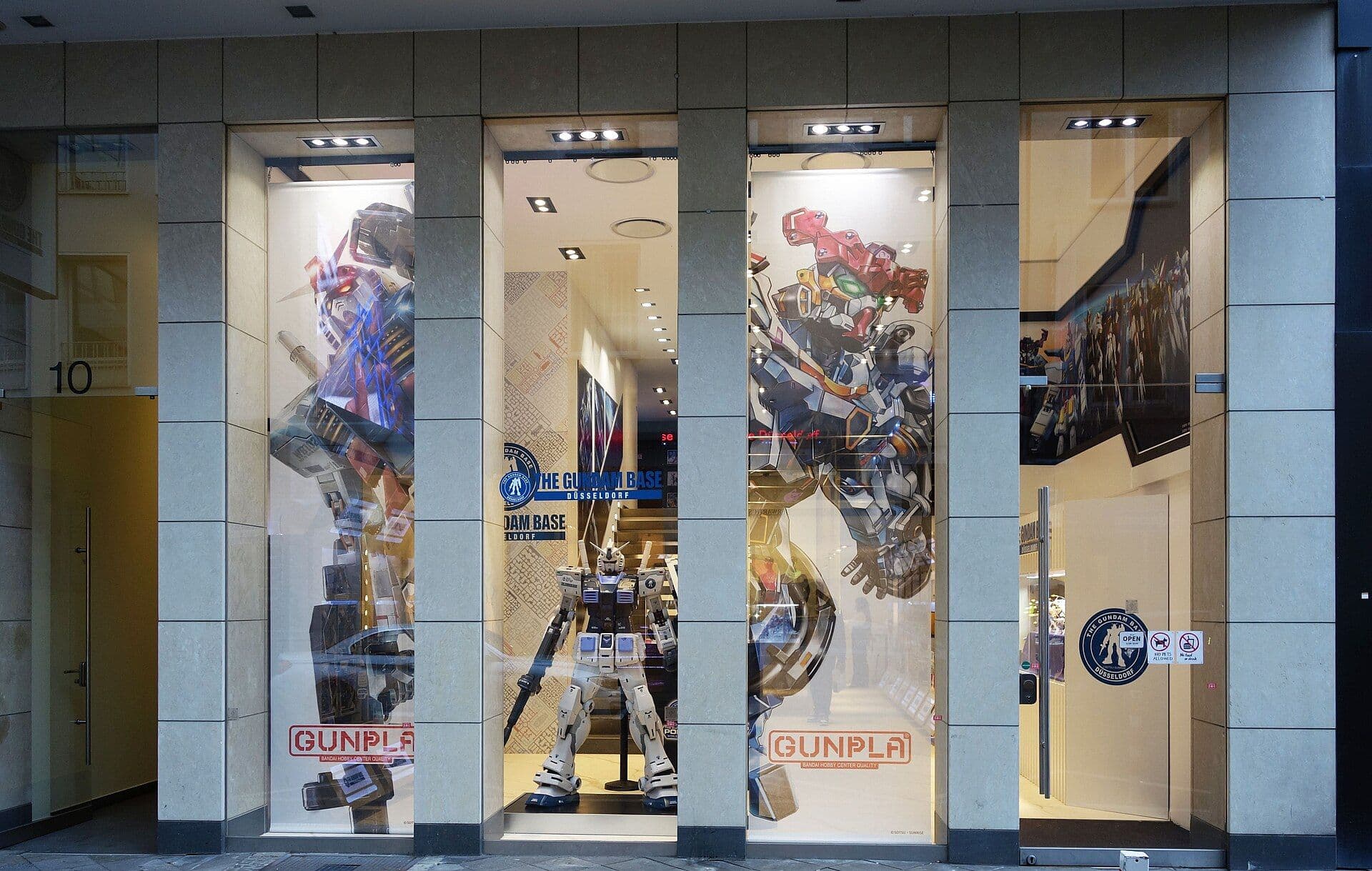
Other Gundam Base locations have opened in Fukuoka, Osaka, Yokohama, Shanghai, Hong Kong, Singapore. In Yokohama, from 2020 to 2024, a Gundam Factory displayed a fully articulated life-size model, capable of walking and kneeling.
Gunpla as Culture: Communities, Magazines, YouTube#
Hobby Japan and Dengeki Hobby#
Two monthly magazines have been the bibles of the Japanese Gunpla builder: , founded in 1969, and , launched in 1998. They publish step-by-steps by professional artists (modeler pros, モデラー), interviews with designers, critical reviews, and the galleries of extraordinary amateur builds. Hobby Japan is still sold in every konbini in Japan.
The YouTube Revolution#
Since the 2010s, Gunpla has gone global thanks to YouTube. Channels like Syd Mead, Mecha World, ThiSis Gundam, Zaku Aurelius have democratized advanced techniques of assembly, painting and weathering. Zaku Aurelius has more than 300,000 subscribers. In Japan, figures like Hide and Tasuke run channels followed by hundreds of thousands of fans.
The Gunpla Phenomenon Outside Japan#
Gunpla arrived in North America in the 1980s via anime conventions, but its real internationalization dates to the 2000s with Gundam Wing (1995) on American TV, then Gundam SEED (2002) and Gundam 00 (2007). In English-speaking markets, the boom came in the 2010s with the rise of e-commerce and specialist shops like HobbyLink Japan, USA Gundam Store, 1999.co.jp. The Discord and Reddit communities (notably r/Gunpla, 700,000 members) form a dense international fabric. Events like Anime Expo in Los Angeles and MCM Comic Con in London offer Gunpla zones, contests and masterclasses led by invited Japanese builders.
Gunpla, Heritage and Philosophy#
Intergenerational Transmission#
Many adult Gunpla builders now build with their own children. Fathers who discovered Gunpla in the 1980s offer their kids Entry Grades, then build High Grades together. Family Gunpla has become its own subcategory of GBWC since 2018.
A Sustainable Economy#
Unlike many toy licenses, Gunpla has not suffered a major crisis since 1980. The Gundam brand generated more than 2 billion euros of revenue in 2023, much of it from the kits. The Gundam Pilot Plant in Shizuoka, Bandai's fully automated factory inaugurated in 2006, alone produces more than 50 million Gunpla a year, exported to more than 40 countries, representing several hundred highly qualified jobs in Japan (part designers, plastic engineers, colorists, decal designers).
A Philosophy of Leisure#
Gunpla embodies a particular Japanese philosophy of leisure: individual but shareable, meticulous but accessible, it rewards patience without discouraging beginners, practiced alone but displayed online. It combines the and the , the technician and the dreamer. It teaches that a thing can be built slowly, with your own hands, and that this slowness is not lost time but gained presence.
Born as a spin-off of a failed anime, Gunpla has become a pillar of adult leisure, an international export, a family and intergenerational practice. Three hours, a small desk, a white box, and for one evening you become the sculptor of your own Gundam. In this sense, it joins the tea ceremony, calligraphy and ikebana: a minor art in form, a major one in attention.
Photo credits: images used in this article come from Pexels and Unsplash and are royalty-free.
In this article
The cultural terms covered here, each with a short definition.
Mecha: A History of Japan's Giant Robots
From Tetsujin and Mazinger to Gundam and Evangelion, the complete history of the mecha genre: super robots, real robots, Gunpla and global influence.
Cover image: Kürschner (talk) 16:40, 11 March 2026 (UTC) · Kürschner (talk) 16:40, 11 March 2026 (UTC), via Wikimedia Commons · CC0