The vermilion of the torii: why Asian temples are these colours
Red that repels evil and protects wood, the gold of the Buddha, the five colours of dancheong: what the colours of Japanese, Chinese and Korean shrines actually say.
La rédaction Kotoba Interactive
Studio éditorial
At the entrance to Fushimi Inari, south of Kyoto, thousands of wooden gateways close one behind the other into a tunnel that climbs the mountain. All are painted the same orange-red, dense, almost unreal, which the morning light sets vibrating among the cedars. The pigment flakes in places, revealing an older layer of the same shade; elsewhere it is fresh, repainted last season. You walk for hours beneath this vault of color, and you quickly understand that this red is no ornament: it is a border, a threshold repeated to infinity between the world of humans and that of the gods.
In East Asia, the color of a temple is never decorative in the sense we usually mean. It says who dwells in the place, what force protects it, what rank it holds in the order of the world. The of Shinto shrines, the and the of Chinese palaces and temples, the five shades of the theory of the make up a chromatic grammar more than two thousand years old. Japan and China share it, but each has bent it to its own idea of the sacred. This article follows two threads: vermilion as a sacred color shared but differently justified, and gold as a marker of the divine and the imperial.
The Vermilion of the Torii: A Red Border#
The , the distinctive gateway set at the entrance to Shinto shrines, marks the passage from the profane to the sacred. To pass through a torii is to enter the space of the kami, the deity. A great many of them, and among the most famous, are painted this intense orange-red called , or sometimes , after the mineral from which the pigment was once drawn.
is written with tori (鳥, "bird") and i (居, "to stand, to dwell"). The most common etymology sees in it a bird perch, echoing the myth of the sun goddess Amaterasu, whom the crowing of roosters drew out of her cave. The gateway would be the perch of the sacred birds announcing the return of the light.
The shrine of , founded in the eighth century, offers the most spectacular example: its thousands of torii, offered over the centuries by worshippers and companies in gratitude for a wish fulfilled, form the famous senbon torii (千本鳥居, "the thousand gateways"). Each gateway bears, engraved in black on the red wood, the name of its donor. Vermilion becomes there an almost liquid substance, so completely does it cover the space.
Why this red, precisely? The answer blends symbol and chemistry.
Warding Off Evil, Preserving the Wood#
In the Japanese tradition, is held to be a protective color, able to repel malignant forces and calamities. Red is the color of the sun, of blood, of life: it drives away darkness and evil spirits. This apotropaic value is found in many cultures, but Shinto gave it a central place, at the very entrance of its holy sites.
To this spiritual justification is added a very concrete reason, one the builders knew from experience. The traditional vermilion pigment was drawn from , an ore of mercuric sulfide. Now mercuric compounds are toxic to the organisms that attack wood: fungi, insects, rot. To paint a gateway or a framework with cinnabar was, without knowing it in modern terms, to treat it against decay. Vermilion thus protected twice over: the worshipper against invisible evil, and the structure against time.
The word cinnabar and the name of the pigment point to mercury, a metal whose vapors are dangerous. The artisans who ground and applied vermilion worked with a toxic substance; today, modern iron-based or synthetic pigments have replaced cinnabar on shrines, but the hue has stayed faithful to that orange-red of mineral origin.
The vermilion of the torii protects twice: the worshipper against invisible evil, and the wood against rot. There, the sacred and chemistry speak with a single voice.
Ise and the Aesthetic of Bare Wood#
Against this red splendor, Shinto cultivates the opposite aesthetic, that of absolute plainness. The , in Mie prefecture, the most venerable of all Japanese shrines since it houses Amaterasu herself, bears no color at all. Its buildings are made of left bare, unpainted, its blond surface slowly graying under the weather. No vermilion, no gold: beauty is born there of raw matter, of the pure line of the thatched roof and the whiteness of new wood.
This bareness stems from a rite unique in the world: the , the identical reconstruction of the shrine every twenty years. Since the seventh century, at an almost unbroken rhythm, Ise is rebuilt anew on an adjacent site, the deity is transferred there, and the old edifice is dismantled. The shrine is therefore never old: it is perpetually new, eternal through renewal rather than through duration. The wood stays pale because it has just been cut.
Two faces of the Shinto sacred thus coexist: the blazing vermilion of Fushimi Inari, which asserts and protects, and the white wood of Ise, which erases all ornament to leave only purity. Color, or its absence, speaks each time a theology.
China: The Red of Happiness, the Gold of the Emperor#
In China, the relationship to color is organized around another axis: not the sacred alone, but power and fortune. there is the color of happiness, of joy, of the favor of heaven. It appears at weddings, at New Year festivals, on the envelopes that pass along lucky money, and of course on the walls and columns of temples and palaces. Where the Japanese red keeps a value of threshold and protection, the Chinese red expresses above all felicity and vital energy.
Above red sits a color higher still: . Yellow was in China the color of the emperor, and of him alone. It evoked the center of the world, the nourishing earth, the legitimate line of the Son of Heaven. This reservation was not merely symbolic: it had the force of law.
The character 黄 (huáng, "yellow") sounds, to the ear, like 皇 (huáng, "august, imperial"), another word of the same pronunciation. This homophony nourished the association of yellow with the imperial person. Yellow was not one hue among others: it was the color of the sovereign, protected like a privilege.
In the of Beijing, the palace of the Ming and Qing emperors, this chromatic hierarchy can be read on the roofs. The yellow glazed tiles, reserved for the emperor, crown the major buildings, while other shades signal subordinate functions. A single glance at the color of a roof told you the rank of who dwelt beneath it.
Read alsoThe Forbidden City: the imperial palace at the heart of BeijingImperial yellow, the red of the ramparts, the nine gates: the Forbidden City of Beijing is an open-air book of symbols. Push its doors open.
The Five Elements and the Five Colors#
Behind this Chinese symbolism stands a cosmological theory of great antiquity: the five phases or . The world is there described as the play of five forces, wood, fire, earth, metal, and water, which generate and dominate one another in turn. To each of these phases correspond a season, a direction, an organ, a sound, and a color. It is the bedrock of a thought that binds together man, nature, and the cosmos.
The five cardinal colors of this system are , , , , and . They are distributed among the five directions: east, south, center, west, and north. Yellow, at the center, belongs to earth and therefore to the emperor, master of the middle world, which redoubles the imperial legitimacy of yellow.
| Color | Element (五行) | Direction | Dominant meaning in China |
|---|---|---|---|
| Blue-green 青 (qīng) | Wood 木 | East | Growth, spring |
| Red 红 (hóng) | Fire 火 | South | Happiness, splendor, energy |
| Yellow 黄 (huáng) | Earth 土 | Center | Emperor, center of the world |
| White 白 (bái) | Metal 金 | West | Mourning, purity, autumn |
| Black 黑 (hēi) | Water 水 | North | Depth, winter, mystery |
This theory spread throughout the Sinicized cultural sphere, shaping architecture, medicine, divination, and the art of gardens. It explains why a color, in China, is never isolated: it belongs to a system in which it answers to a season, a direction, and a principle.
Read alsoFeng shui: the Chinese art of harmonizing space and qiFive elements, orientations, the balance of breath: feng shui extends the same cosmology into the art of arranging space. Discover its logic.
The Gold of the Buddha: The Divine That Radiates#
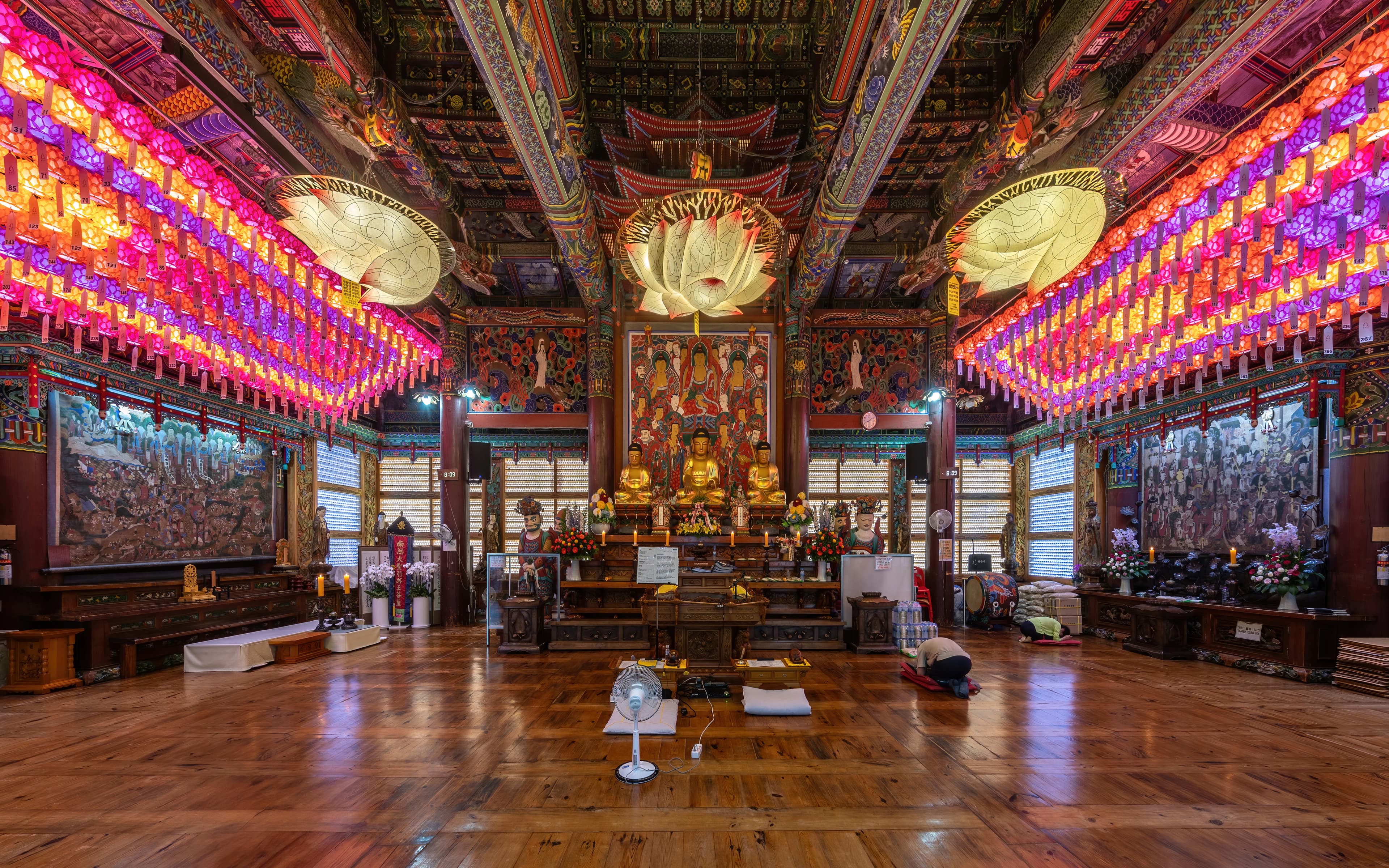
Buddhism introduced into both countries another dazzling use of color, that of gold. In Buddhist temples, the great halls are adorned with gilding, and the statues of the Buddha and the bodhisattvas are lacquered and covered with gold leaf. Gold is not there a sign of wealth in the vulgar sense: it materializes the radiance of enlightenment, the inner light of the accomplished being. The gilded body of the Buddha refers to the texts that describe his skin as of a solar brightness.
In Japan, this golden aesthetic culminates in monuments such as the , the Golden Pavilion of Kyoto, whose upper storeys are entirely covered in gold leaf and reflected in the pond that borders it. In China and throughout the Buddhist world, the main halls of monasteries, the daxiongbaodian (大雄宝殿, "hall of the great hero"), house colossal Buddhas whose gilding catches the least gleam of the oil lamps and candles.
Gold thus makes a junction between the two registers we were following. A marker of the imperial in China, where it joins the yellow of the sovereign, it is everywhere a marker of the divine in Buddhism. Vermilion spoke of the border and of protection; gold speaks of irradiation, of the luminous presence of the sacred at the heart of the edifice.
Vermilion guards the threshold, gold inhabits the sanctuary. One protects, the other radiates: together they speak the sacred of East Asia.
And Korea: Dancheong in Five Colors#
Korea shares this common ground while giving it a very recognizable expression. Korean temples and palaces are covered with a painted polychrome decoration called , which clothes the eaves, the beams, and the ceilings in motifs of extreme refinement. This decoration rests on the , directly inherited from the cosmology of the five elements: blue, red, yellow, white, and black, arranged according to the five directions.
Dancheong protected the wood as Japanese vermilion did, structured the space according to the five phases as in China, and signaled the rank of the building by the richness of its decoration. But its ornamental density, its intertwined floral and geometric motifs, make it a language in its own right that deserves its own telling.
Read alsoDancheong: The Colors of Korean Temples DecodedThe dancheong of Korean temples, the five cardinal colors of obangsaek, the art of painting wood: Korea has made polychromy a signature. Discover its world in a dedicated article.
We will say no more of it here, for Korea deserves better than an aside: it is a whole system that dancheong unfolds, and the article devoted to it explores each of its shades.
One Palette, Three Theologies#
Japan, China, and Korea draw on a neighboring palette, but each tunes it to its own vision. Vermilion protects and delimits in Japan, expresses joy and splendor in China, structures the decoration in Korea. Gold radiates the divine in the Buddhism of all three countries, while marking the emperor in China. Imperial yellow makes sense only in a Chinese context, where the law reserved it for the throne. The white of Ise's bare wood, finally, speaks of an aesthetic of plainness that Chinese and Korean polychromy seem to ignore.
The sacred colors are read in their characters: 朱 (shu, "vermilion"), 鳥居 (torii, the gateway) and 金 (kin, "gold") open the door onto a whole Japanese imagination. Learn to decipher them with JapaneseSRS and its spaced repetition.
To pass beneath the thousand torii of Fushimi Inari, to raise your eyes to the yellow roofs of the Forbidden City, to contemplate the gold of a Buddha in the gloom of a hall: each time, it is the color that speaks first, before any inscription, before any narrative. It says the threshold, the rank, the light. To understand the color symbolism of Asia's temples is to learn to read a painted text that, from vermilion to bare wood, from gold to imperial yellow, tells two thousand years of a thought that never separated the hue from the meaning.
FAQ#
Why are Japanese torii red? Vermilion (朱) is held to be a protective color that repels evil, and red evokes the sun and life. To this spiritual value was added a practical reason: the pigment was drawn from cinnabar, a mercury ore whose compounds preserved the wood from rot and insects. Vermilion therefore protected both the worshipper and the structure.
Why is the Ise shrine not painted? Ise cultivates the aesthetic opposite to vermilion splendor: its cypress wood (檜) stays bare and pale. The shrine is rebuilt identically every twenty years (the rite of shikinen sengū), so its wood has always just been cut. Its beauty is born of raw matter rather than of color.
Why was yellow reserved for the emperor of China? In the theory of the five elements, yellow corresponds to earth and to the direction of the center, hence to the master of the middle world. This symbolism, reinforced by the homophony of huáng ("yellow") and huáng ("imperial"), made yellow the color of the sovereign. Yellow glazed-tile roofs, as at the Forbidden City, were legally reserved for him.
What are the five colors of the five elements? The theory of the five phases (五行, wǔxíng) associates five colors with five forces and five directions: blue-green with wood and the east, red with fire and the south, yellow with earth and the center, white with metal and the west, black with water and the north. This system underlies much of Chinese art and thought.
Why are statues of the Buddha gilded? Gold materializes the radiance of enlightenment and the inner light of the accomplished being. Buddhist texts describe the Buddha's skin as of a solar brightness; to cover his statue in gold leaf is to make that clarity visible. Gold there is not a sign of wealth but of the luminous presence of the sacred.
Photo credits: images in this article come from Wikimedia Commons and are under free licenses.
In this article
The cultural terms covered here, each with a short definition.
- Five Elements
- Chinese theory linking wood, fire, earth, metal and water to explain the world's cycles.
Wushu: the Chinese martial art between combat and poetry
History of wushu and Chinese kung fu: from Shaolin to taiji quan, internal and external styles, traditional weapons and the legacy of martial arts in China.
Cover image: Basile Morin · Basile Morin, via Wikimedia Commons · CC BY-SA 4.0