Akiya: Japan's Nine Million Empty Houses
Akiya (空き家), Japan's vacant homes: nine million in 2023, the tax and inheritance causes, the akiya banks, and what a thousand-euro house really costs.
La rédaction Kotoba Interactive
Studio éditorial
An is an unoccupied dwelling in Japan. The Housing and Land Survey (住宅・土地統計調査), run every five years by Japan's Statistics Bureau, counted 9.0 million of them in October 2023, or 13.8% of the housing stock: a record since the survey began in 1948.
The figure travels well abroad, usually attached to a promise of a house for the price of a bicycle. The statistical detail is more interesting than the promise, and it explains most of what there is to know about Japanese demographics, inheritance law and property taxation.
What the survey actually counts#
The nine million are not nine million abandoned houses. The survey sorts vacant dwellings into four categories, and only one of them matches the ghost-village image.
| Category (2023 survey) | What it is | Approximate count |
|---|---|---|
| 賃貸用の住宅 | Waiting for a tenant | 4.4 million |
| 売却用の住宅 | Listed for sale | 0.3 million |
| 二次的住宅 | Second homes, holiday houses | 0.4 million |
| その他の住宅 | The rest: inherited, abandoned, neither rented nor sold | 3.85 million |
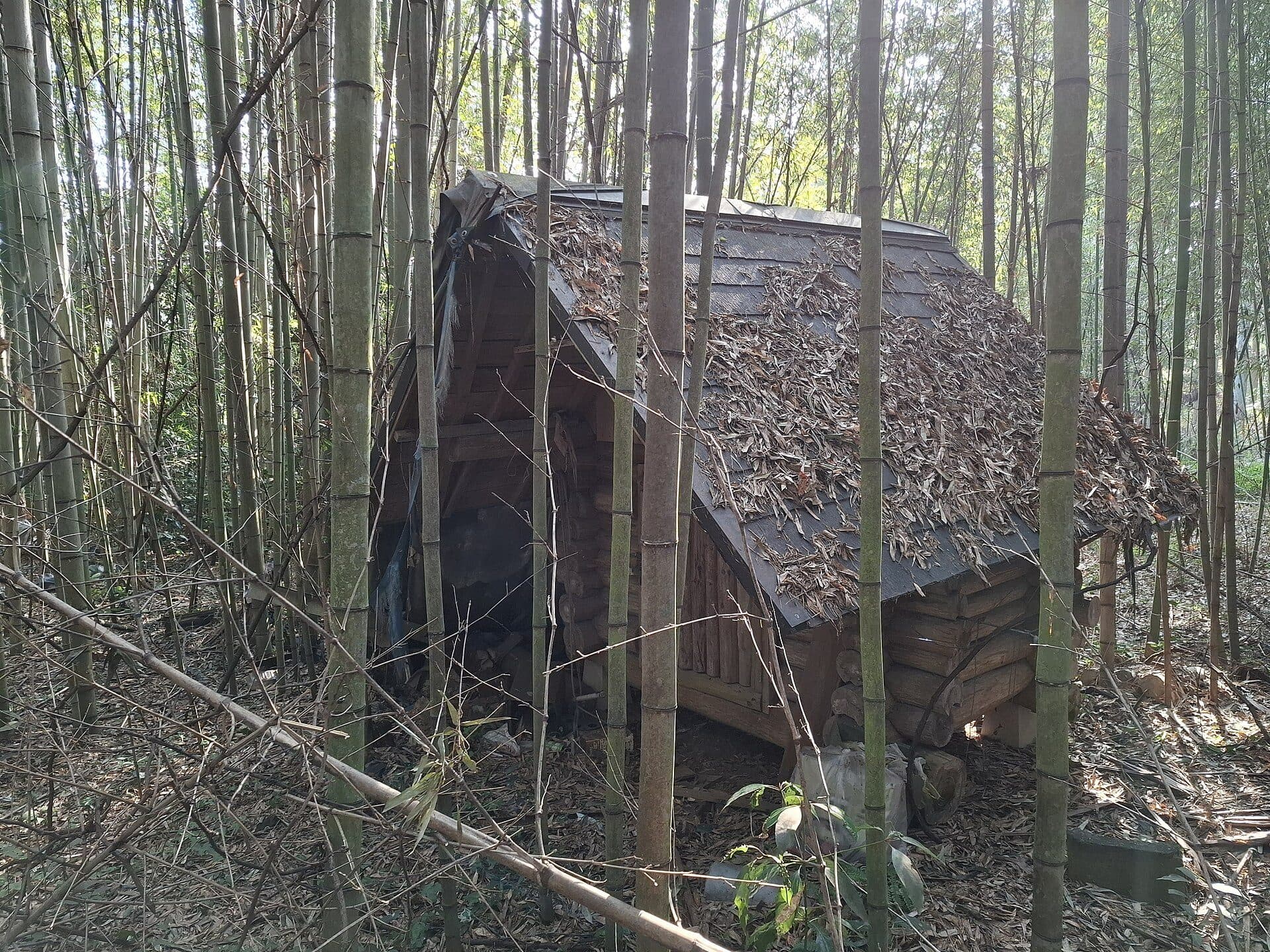
The last line is the problem. Those 3.85 million dwellings (up from 3.49 million in 2018) are on no market at all: nobody rents them, nobody sells them, nobody lives in them. They age, they decay, and some of them eventually fall onto the neighbouring plot.
The geography follows depopulation. Wakayama and Tokushima prefectures exceed 21% vacancy; Saitama and Kanagawa, in Tokyo's orbit, stay below 10%.
combines 空き (aki, "empty", "free") and 家 (ya, "house"). The word long predates the phenomenon: it simply meant an unoccupied dwelling, the way one would say "a free unit". It was the scale of the count, from the 2000s onward, that turned it into a term of public policy.
Why a house stays empty#
Three mechanisms stack up, and none of them is accidental.
The first is demographic. Japan's population has been shrinking since 2008, and the countryside empties faster than the national average. The number of households kept rising into the mid-2020s, because households are getting smaller: more people living alone, fewer families of four. The country went on building while its population fell.
The second is industrial. Japan builds roughly 800,000 new dwellings a year, and a wooden single-family house is treated as a durable consumer good: its market value collapses within twenty to thirty years, with the residual value concentrated in the land. A buyer will almost always prefer to demolish and rebuild rather than acquire the existing structure. The secondhand market accounts for a far smaller share of transactions than in France or the United States.
The third is inheritance. A house inherited by three siblings settled in the city becomes jointly owned property that nobody uses, that nobody wants to pay to demolish, and that filial duty forbids selling off cheaply. Until 2024, nothing required an heir to record the inheritance in the land registry: the Ministry of Justice estimated that a significant share of Japanese land had an owner of record who was untraceable or long dead, which makes any transaction impossible.
The tax trap: demolishing costs more than walking away#
The rule most often cited by specialists fits in one line of the fixed asset tax (固定資産税). Land carrying a dwelling qualifies for the residential land exception (住宅用地の特例): the taxable base is divided by six up to 200 m², by three beyond that.
An owner who demolishes a derelict house therefore sees the property tax rise by a factor of up to six, on top of paying for the demolition itself, often more than a million yen for a single-family house. The arithmetic is quick: the house stays standing.
Japanese tax law spent decades rewarding precisely the behaviour it needed to discourage: keeping upright a house nobody wants any more.
The 2015 law, and what it changed#
Parliament passed the Act on Special Measures Concerning Vacant Houses (空家等対策の推進に関する特別措置法) in 2014; it took full effect in May 2015. It gives municipalities three powers they previously lacked: consulting tax files to identify an owner, designating a property as 特定空家 (tokutei akiya, "specified vacant house") when it threatens safety, hygiene or the landscape, and ordering demolition at the owner's expense through administrative execution (行政代執行).
Designation as 特定空家 carries a direct deterrent: it strips the property of the residential land tax break. The fiscal lever that pushed owners to do nothing is turned around.
The 2023 revision, in force since December of that year, adds an intermediate step, the 管理不全空家 (kanri fuzen akiya, "poorly managed vacant house"): a property not yet dangerous but heading that way also loses its tax break after formal notice. The aim is to intervene before collapse rather than after.
Since 1 April 2024, another reform reaches the root of the problem: registering inherited real estate has become compulsory within three years, under penalty of an administrative fine of up to 100,000 yen. It is the first time Japanese law has obliged an heir to declare ownership.
The vocabulary of Japanese real estate comes down to a handful of recurring words: 空き家 (akiya, empty house), 相続 (sōzoku, inheritance), 固定資産税 (kotei shisanzei, property tax). JapaneseSRS drills them alongside the 500 words of daily life.
The akiya banks#
An 空き家バンク (akiya bank) is a public listing kept by a municipality, matching owners of vacant homes with people willing to move in. The scheme started locally in the 2000s, before the Ministry of Land, Infrastructure and Transport (国土交通省) launched a national portal in 2017 aggregating municipal listings, operated by private property platforms.
The spectacular offers are real but rare. Okutama, at the western edge of Tokyo Metropolis, hands over houses almost free to families with children who commit to staying. Other municipalities sell hundred-square-metre wooden houses for 500,000 yen. The conditions are almost always the same: residency requirements, a renovation commitment, sometimes an obligation to enrol children in the local school.
What a thousand-euro house really costs#
Three items escape the advertised price.
Renovation first. A house built before 1981 does not meet the seismic standard revised that year (新耐震基準), and bringing it up to code runs into the millions of yen. Insulation, wiring and plumbing in rural Japanese houses often date from the same era.
The right to rebuild next. A plot that does not front a road at least four metres wide along at least two metres is classified 再建築不可 (saikenchiku fuka, "rebuilding not permitted"): the existing house may be repaired, but nothing can replace it. Such plots are over-represented among cheap akiya.
Then the extras: acquisition tax, agency fees, annual property tax, and for a non-resident buyer, the absence of any residence right attached to the purchase. Japan places no nationality restriction on buying property, but buying a house grants no right to live in the country.
Kyoto voted in 2022 for a municipal tax on non-occupied dwellings (非居住住宅利活用促進税), the first of its kind in Japan, calibrated to hit second homes and properties left empty in a city where residents struggle to find housing. Its entry into force, repeatedly postponed, is scheduled from 2026.
What the number says about what comes next#
Projections diverge. Nomura Research Institute published a 2016 estimate of a 30% vacancy rate by 2033, revised downward since, as demolitions increased and new construction slowed. The consensus is a rate that keeps climbing, more slowly than the gloomiest forecasts.
What the 2023 survey mainly shows is a shift: the problem is no longer rural. Akiya are now spreading through the suburbs of the large metropolitan areas, in the subdivisions built for 1970s salarymen whose children never came back.
FAQ#
Can a foreigner buy an akiya? Yes. Japan imposes no nationality or residency restriction on acquiring property, land included. The purchase confers no right of residence.
Why do Japanese houses lose their value? A wooden single-family house is depreciated over 22 years for tax purposes and its market value becomes marginal after two or three decades. Value sits in the land, and the typical buyer demolishes to rebuild.
How much does demolishing a house cost? Industry figures range from one to three million yen for a standard wooden house, more on constrained sites or where asbestos is present.
Are all empty houses for sale? No. Of the nine million counted, roughly 3.85 million are neither for sale nor for rent: those, often inherited, are the genuinely frozen stock.
Read alsoJapanese Housing: Decoding Mansion, Apāto and the 1K CodeThe words of Japanese housing, from the 1K studio to the concrete "mansion", explained one by one.
Sources and further reading#
- Statistics Bureau of Japan, Housing and Land Survey 2023 (results published April 2024)
- Ministry of Land, Infrastructure, Transport and Tourism (国土交通省), policy file on vacant house measures
- Ministry of Justice, reform making inheritance registration compulsory, April 2024
- City of Kyoto, deliberation on the non-occupied dwelling tax, 2022
Reikin and Shikikin: What a Japanese Lease Really Costs
Reikin (礼金) and shikikin (敷金): Japan's key money and rental deposit. The full move-in bill, renewal fees, restoration rules and the guarantor company.
Cover image: Kuroshio no Neko · Kuroshio no Neko, via Wikimedia Commons · CC BY 4.0