Undōkai: The Sports Day of Japanese Schools
Undōkai (運動会), the Japanese school sports day: its 1874 naval origins, its team events, the human pyramid controversy, and why it changed season.
La rédaction Kotoba Interactive
Studio éditorial
The is the day of athletic competition every Japanese school organises, from kindergarten to junior high, with families in attendance. It takes place in the school grounds, runs a full day, and pits not individuals against one another but teams: traditionally reds against whites, 紅白 (kōhaku).
The word matters for what it does not say. This is not a meet between schools but an internal festival, where individual performance counts for less than a side's standing and the group's synchronisation.
An invention of 1874#
The first documented event of this kind in Japan was held in 1874 at the naval school in Tsukiji, Tokyo, under the name 競闘遊戯会, organised at the initiative of British instructors on the model of English school athletic sports. Sapporo Agricultural College held one of its own in the late 1870s.
The spread was political. In the 1880s the first Minister of Education, 森有礼 (Mori Arinori), made collective gymnastics an instrument of civic and physical formation for the nation, and the undōkai spread through elementary schools across the country. Its form, team events performed in cadence before an audience, still carries that origin.
運動会 combines 運動 (undō, "movement", "physical exercise") and 会 (kai, "gathering"). In high school the event is instead called 体育祭 (taiikusai, "physical education festival"), and the character 祭 (matsuri, festival) says enough about what the day has become.
The day's programme#
The events vary little from school to school, and most exist nowhere else.
| Event | Japanese name | What it involves |
|---|---|---|
| Sprint | 徒競走 | The individual dash, often the only individual event |
| Relay | リレー | The climax of the day, by class or by team |
| Tug of war | 綱引き | A whole class against another |
| Ball into basket | 玉入れ | Throwing as many balls as possible into a high basket, against the clock |
| Cavalry battle | 騎馬戦 | Three carriers, one rider, the goal being to snatch the opposing headband |
| Pole toppling | 棒倒し | Two teams, two poles, a general scrum |
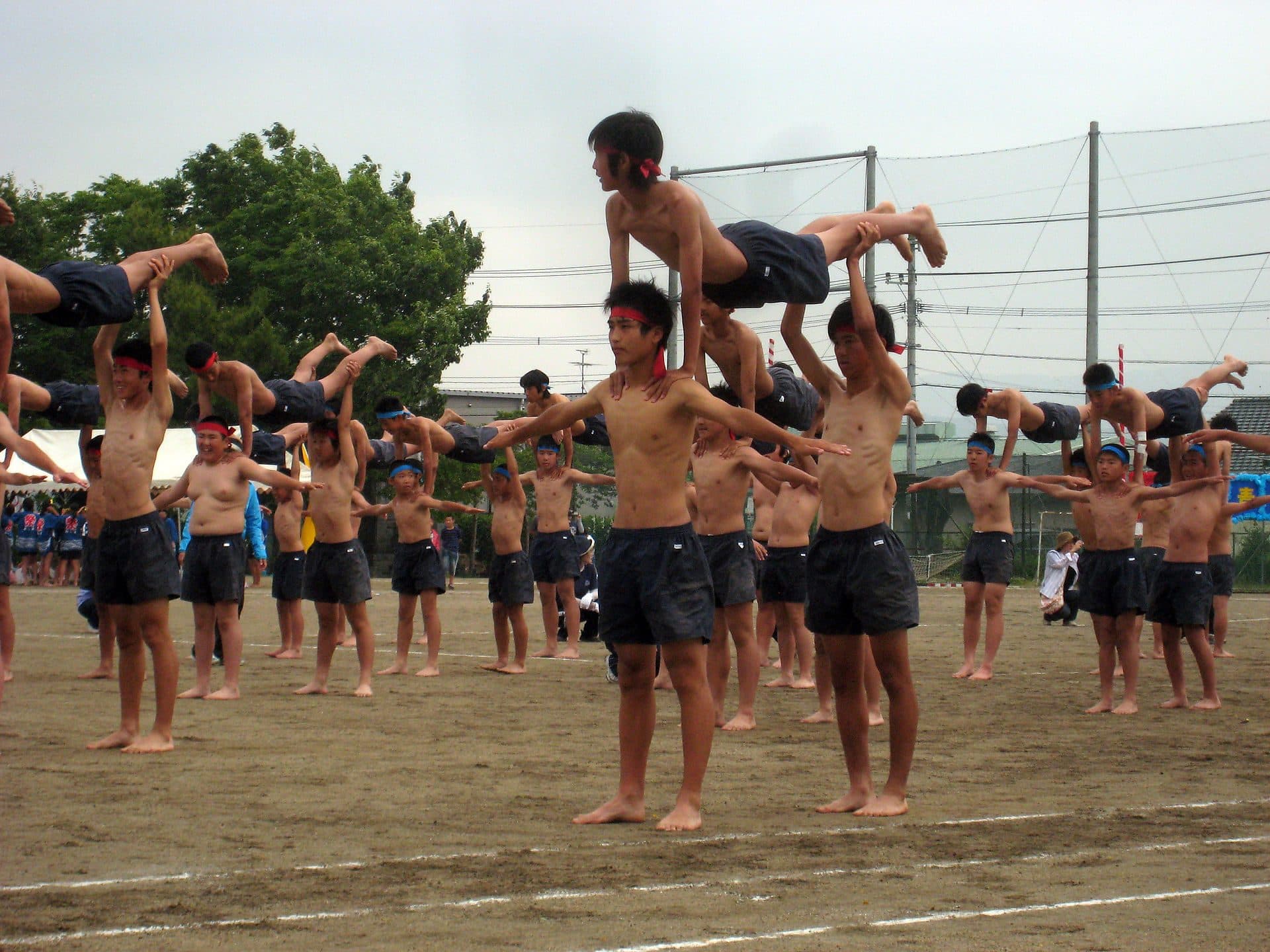
| Group gymnastics | 組体操 | Formations and human pyramids performed in unison |
| Dance | ダンス | Choreography rehearsed for weeks, often with props |
Add to that the 応援団 (ōendan), the cheering squad with its drums and codified chants, and lunch: families spread tarpaulins on the ground and unpack the bentō made that morning, a moment many former pupils name as their main memory of the day.
Why it matters so much#
Three reasons explain the place this day holds in Japanese school life.
It is prepared over weeks, during class hours and sometimes before school: dance and gymnastics rehearsals take up a real share of the September or May calendar.
It is public. Parents, grandparents and neighbours fill the grounds, which explains the dawn scramble for spots, 場所取り (bashodori), and the forest of tripods at the back of the field.
And it is where a skill explicitly named in the Japanese curriculum gets learned: acting together, in rhythm, with no individual exception. That is what the day celebrates, and also what draws criticism.
The undōkai does not reward the fastest. It rewards the team from which nobody broke ranks.
School vocabulary turns up in every school scene in manga and drama: 運動会 (undōkai), 応援 (ōen, encouragement), 練習 (renshū, practice). JapaneseSRS teaches these words with their kanji and the situations they belong to.
The human pyramid and its controversy#
組体操 (kumitaisō), group gymnastics, culminates in two formations: the tower (タワー) and the pyramid (ピラミッド), built several tiers high by dozens of pupils. An escalation took place through the 2000s and 2010s, with some schools reaching nine or ten tiers, a height at which a fall is measured in metres.
Public debate crystallised in September 2015, when a ten-tier pyramid collapsed at a junior high school in Osaka prefecture, filmed and widely shared, sending several pupils to hospital. Data from the Japan Sport Council, the body that compensates school accidents, showed several thousand injuries a year in this discipline alone.
The Ministry of Education issued a notice in March 2016 asking schools to attempt these formations only where safety is assured, without formally banning them. Many local school boards went further, capping the number of tiers or dropping pyramids altogether. The formation still exists, in a distinctly lower form.
The undōkai has changed season#
The Japanese school calendar traditionally placed the undōkai in autumn, around 10 October, the opening date of the 1964 Tokyo Olympics and a public holiday devoted to sport until it moved to the second Monday of October in 2000, then was renamed スポーツの日 ("Sports Day") in 2020.
Japan's increasingly hot summers have shifted the festival. Many elementary schools now hold it in May or June, or keep it in September but cut it to a half day, without the family lunch. Heatstroke protocols, shade tents, hydration breaks and cancellation above a given heat index have been part of the programme since the late 2010s.
The undōkai is not only for children. Japanese companies revived the 社内運動会 in the 2010s, the in-house sports day inherited from the post-war years, as a team-building exercise: same events, same red and white headbands, with specialist firms to run it.
FAQ#
When is the undōkai held? Historically in September or October. Heat has pushed many schools towards May and June, often over a half day.
Do parents really attend? Yes, it is a family event. Spots are claimed early in the morning, and the shared lunch in the school grounds is a highlight wherever it has been kept.
Are human pyramids banned? No, but they have been regulated since the 2016 ministerial notice, and several local school boards have limited their height or removed them.
Is there a high school equivalent? Yes, the 体育祭 (taiikusai), organised by the students themselves, with more choreography, painted banners and staging by the cheering squads.
Read alsoJuken, bukatsu, randoseru: the Japanese school system explainedThe Japanese school path as a whole, from the compulsory club to the regulation satchel.
Sources and further reading#
- Ministry of Education, Culture, Sports, Science and Technology (文部科学省), March 2016 notice on the safety of group gymnastics
- Japan Sport Council (日本スポーツ振興センター), school accident statistics
- History of the 1874 競闘遊戯会 at the Tsukiji naval school
- Public Holidays Act, creation of 体育の日 in 1966 and renaming to スポーツの日 in 2020
Juku: The Cram Schools That Rule Japan's Nights
Inside Japan's juku (塾), the private after-school cram schools. Definition, types, history from the terakoya, major chains, costs and the debate over academic pressure.
Cover image: Josh Berglund · Josh Berglund, via Wikimedia Commons · CC BY 2.0