Sorting Rubbish in Japan: Up to 45 Categories
Japanese waste sorting: rules set town by town, the village of Kamikatsu and its 45 categories, paid collection for bulky waste, and why the country still incinerates most of it.
La rédaction Kotoba Interactive
Studio éditorial
In Japan, waste sorting rules are not national: they are set by each of the country's roughly 1,700 municipalities. The same piece of packaging goes into the burnable bag in Osaka and into recyclable plastics in Yokohama, and no standard settles the matter.
The number of categories therefore varies tenfold. Most cities impose between five and ten. The village of , in Tokushima prefecture, has 45, which is why it is cited everywhere the subject comes up.
What a household actually sorts#
Beneath the municipal variety, a common skeleton shows up almost everywhere.
| Category | Japanese name | What goes in |
|---|---|---|
| Burnable | 燃えるごみ / 可燃ごみ | Food scraps, soiled paper, small plastics depending on the town |
| Non-burnable | 燃えないごみ / 不燃ごみ | Metal, ceramics, non-deposit glass, small appliances |
| Resources | 資源ごみ | PET bottles, cans, glass bottles, cardboard, newspapers |
| Plastic packaging | プラ | Trays, films, bags carrying the プラ mark |
| Hazardous | 有害ごみ | Batteries, bulbs, lighters, aerosols |
| Bulky | 粗大ごみ | Furniture, bicycles, mattresses, anything over about 30 cm |
Expected gestures come with the grid: rinse a PET bottle and remove cap and label, which go into two different streams; flatten cardboard; empty an aerosol before discarding it. Many municipalities require a , bought at the konbini, whose price funds collection and discourages volume.
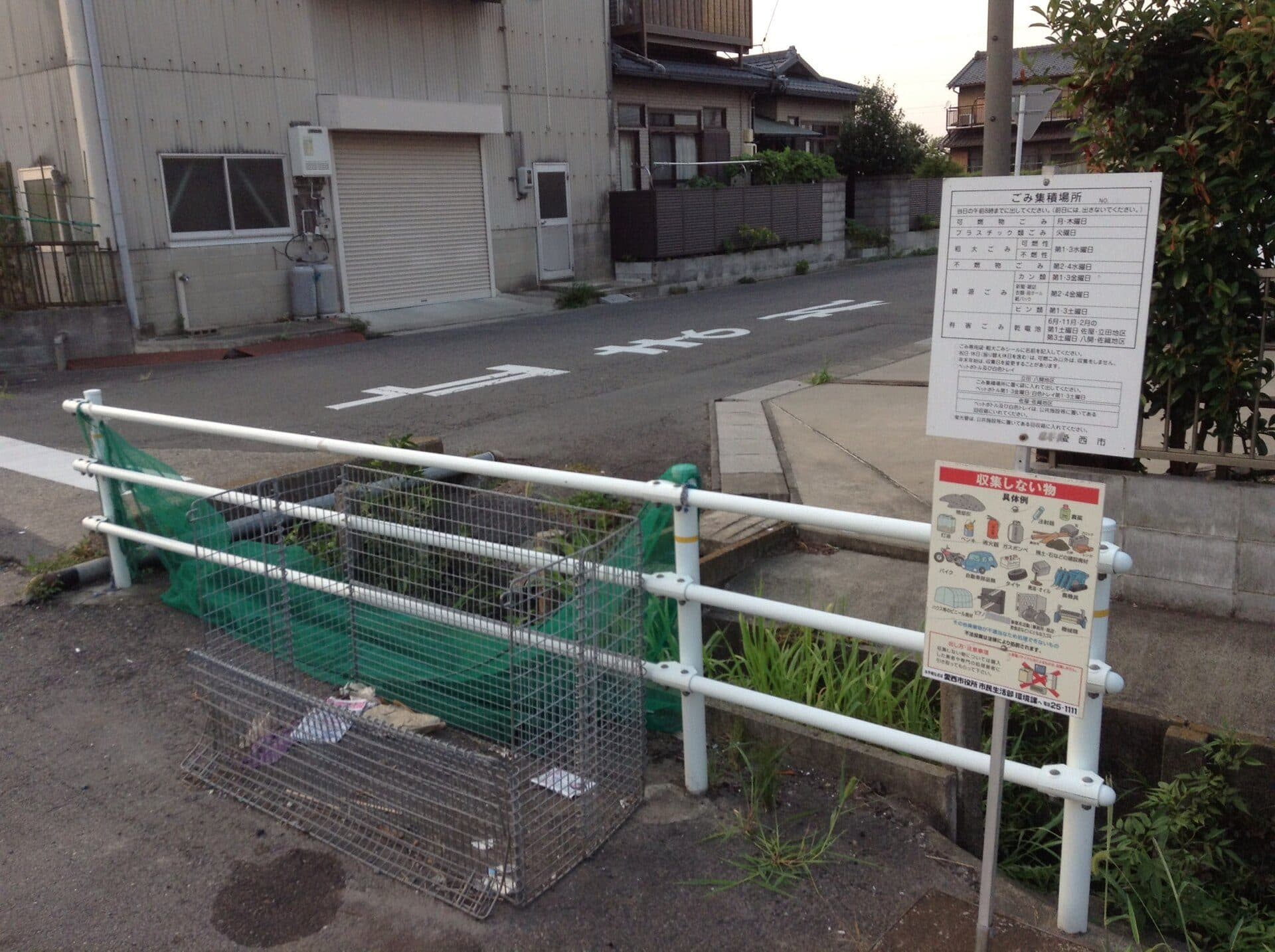
The bag goes out on the morning of collection, at a shared drop-off point (ごみ集積所), often under a net meant to keep crows away. A badly sorted bag is not taken: it stays put with a rejection sticker, visible to the whole neighbourhood, and that is the real enforcement mechanism.
ごみ (gomi) is the generic word for rubbish. It appears in 粗大ごみ (sodai gomi, "bulky waste"), in ごみ屋敷 (gomi yashiki, the "rubbish house" of a compulsive hoarder) and in the expression ごみ出し (gomi dashi), "taking the bins out", a chore whose division fuels its own domestic folklore.
Throwing out furniture costs money#
粗大ごみ (sodai gomi) follows a separate procedure. You call or fill in an online form with the municipal service, get a collection date, buy a processing stamp (粗大ごみ処理券) at the konbini at the rate matching the item, stick it on with your reference number, and put the item out on the appointed day.
Rates run from a few hundred to a few thousand yen depending on size. Four appliances escape even this route: televisions, fridges, washing machines and air conditioners fall under the Home Appliance Recycling Act (家電リサイクル法) in force since 2001, which makes the owner pay for recycling, usually through the retailer.
That cost explains a good share of illegal dumping in the mountains, and the success of vans that cruise the neighbourhoods offering free removal, a service sometimes legal, sometimes not.
Kamikatsu, the village with 45 bins#
Kamikatsu has about 1,400 residents and no rubbish truck. Having closed its open-air incinerator on health grounds, the village adopted a "zero waste" declaration in 2003, the first in Japan, aiming to eliminate landfill and incineration by 2020.
Residents wash, dry and carry their own waste to the sorting centre, where 45 bins separate newsprint from advertising paper, aluminium from steel, metal caps from plastic ones. Each bin states what the material becomes and what it costs or earns the village.
The result, around 80% diverted, far exceeds the national average without reaching the announced zero. The village acknowledged the partial failure and renewed the target, opening in 2020 a centre built from salvaged materials, with a hotel and a reuse shop, now a study-tourism destination.
Japanese sorting impresses because it is visible. What happens next is much less so.
Rubbish vocabulary is the first thing a foreign resident has to master: 燃えるごみ (moeru gomi, burnable), 資源 (shigen, resource), 回収 (kaishū, collection). JapaneseSRS teaches these everyday words with their kanji and readings.
What sorting does not fix#
Japan incinerates most of its household waste, around three quarters of the total, the highest proportion in the OECD. It runs more than a thousand incineration plants for the purpose, more than any other country, often sited in the middle of cities and fitted with heat recovery, sometimes heating a municipal swimming pool.
The architecture has a simple geographical reason: the country lacks space to bury waste. It also has a statistical consequence: Japan's municipal recycling rate sits around 20%, below several European countries whose residents sort far less meticulously.
The contrast is sharp on one specific stream. PET bottles, collected separately, show a recovery rate above 85% according to the industry council, among the best in the world. Mixed packaging plastic, on the other hand, mostly goes to "thermal recovery", meaning the incinerator with energy capture, a category Japan counts and the European Union does not treat as recycling.
The medals for the Tokyo 2020 Games were cast from electronics handed in by the public: some 78,000 tonnes of collected equipment, including more than six million phones, to produce the roughly 5,000 medals of the competition, under the 2013 act on small appliance recycling.
The unwritten rules#
Three habits surprise newcomers.
Public bins are rare. They largely vanished from public space after the 1995 sarin gas attack and never came back: you carry your rubbish home, or leave it at the konbini where you bought the item.
Bags are often transparent or translucent, by municipal requirement, precisely so the contents can be checked.
Finally, the calendar rules everything. Each neighbourhood receives an annual schedule listing the day for each stream, and waste put out a day early or in the wrong stream comes back to its owner. In small towns, where bags sometimes carry the household name, social pressure does the rest.
FAQ#
How many sorting categories are there in Japan? It depends on the municipality. Five to ten in most cities, 45 in Kamikatsu, around fifteen in some rural towns pursuing similar schemes.
How do you get rid of furniture? Book a collection with the municipality, buy the processing stamp at the konbini at the item's rate, and put it out on the agreed day. The service is paid for.
Does Japan recycle a lot? It sorts a lot and incinerates a lot. The municipal recycling rate is around 20%, with incineration plus energy recovery absorbing most of the rest.
What happens if you sort badly? The bag is not collected and stays at the drop-off point with a sticker flagging the error. If it happens repeatedly, the town hall or the neighbourhood association steps in.
Read alsoKonbini: why Japan's convenience stores are legendaryThe konbini, unofficial counter of Japanese daily life, where the bags and the waste processing stamps are bought too.
Sources and further reading#
- Ministry of the Environment of Japan (環境省), annual municipal waste statistics
- Village of Kamikatsu, 2003 zero waste declaration and follow-up reports
- Council for PET Bottle Recycling, annual reports
- Home Appliance Recycling Act (家電リサイクル法), 2001, and Small Home Appliance Recycling Act, 2013
Reikin and Shikikin: What a Japanese Lease Really Costs
Reikin (礼金) and shikikin (敷金): Japan's key money and rental deposit. The full move-in bill, renewal fees, restoration rules and the guarantor company.
Cover image: 円周率3パーセント · 円周率3パーセント, via Wikimedia Commons · CC BY-SA 3.0