Konbini: why Japan's convenience stores are legendary
56,000 konbini nationwide, open around the clock, official disaster shelters: inside the Japanese convenience store that became a national institution.
La rédaction Kotoba Interactive
Studio éditorial
A triangle of rice sealed in a plastic wrapper engineered to the millimetre: you pull a tab, a film splits in two, and the sheet of nori (海苔, dried seaweed) drapes over the rice before it has had time to go soft. Millions of Japanese perform this gesture every day in front of the chilled shelves of a . Behind the most ordinary object in the country lies an obsessive piece of engineering, and behind the store itself, a social institution with no equal in the world.
The is not a simple corner shop in Japan: it is an infrastructure of daily life, an unofficial public service and a source of national pride. There are roughly 56,000 of them across the archipelago, open twenty-four hours a day, where you can eat better than in many canteens, pay your bills, withdraw cash, ship a parcel and, in a disaster, find shelter. To understand the konbini is to understand how Japan turned an American franchise imported in 1974 into a model so refined that it ended up buying out its own parent company.
The origins: an American licence perfected in Japan#
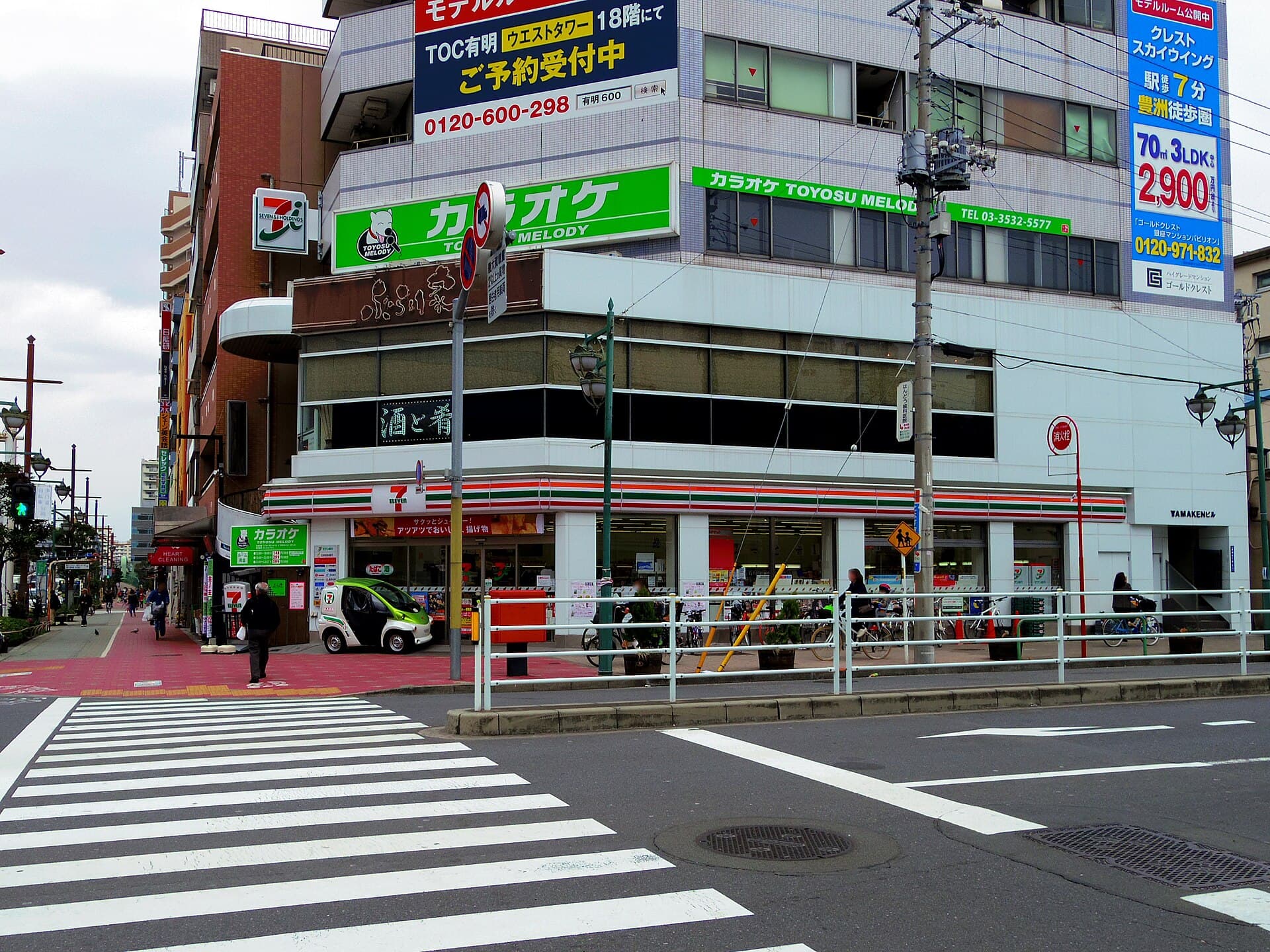
The first konbini in Japanese history opened in 1974 in Toyosu (豊洲), a district of Tokyo, under the banner. The idea was not Japanese: it was imported under licence from America's Southland Corporation, owner of the 7-Eleven brand born in Texas. What Japan did next amounts to creative appropriation: it took a foreign concept and pushed it to a level of refinement its inventor had never reached.
The reversal is complete, and it is symbolic. In 2005, Ito-Yokado, the Japanese group that operated the licence, bought out the American parent and became the owner of the global brand, now overseen by the Seven & i Holdings conglomerate. The student had surpassed the master to the point of absorbing him.
Japan did not invent the convenience store: it reinvented it, until the Japanese version became the benchmark the rest of the world tries to copy.
This story says everything about a recurring Japanese method, already at work in cars and electronics: import an idea, take it apart, optimise it relentlessly, then hand it back transformed. The konbini is one of the most everyday and least spectacular embodiments of that method, and perhaps for that reason one of the most revealing.
The big three: Seven-Eleven, FamilyMart, Lawson#
Three chains dominate the landscape and share the bulk of the country's 56,000 stores. Japanese customers tell them apart at a glance from their colours and logos, and many have an openly declared favourite, often tied to one specific in-house product.
is the historic leader and the densest network, prized for the quality of its private-brand products and its counter coffee. stands out for its piece-by-piece fried chicken, the , an institution in itself. , recognisable by its milk-bottle logo, bets on its pastries and runs a health-focused banner, Natural Lawson, and a discount banner, Lawson Store 100.
| Chain (native) | Founded in Japan | Signature item / private brand | Notable trait |
|---|---|---|---|
| Seven-Eleven (セブンイレブン) | 1974, Toyosu | Onigiri and counter coffee | Market leader; its US parent was bought out in 2005 |
| FamilyMart (ファミマ) | 1980s | Famichiki (ファミチキ), piece-by-piece fried chicken | Fried chicken as its emblematic draw |
| Lawson (ローソン) | 1970s | Pastries and "konbini sweets" desserts | Runs Natural Lawson (health) and Lawson Store 100 (discount) |
This three-way rivalry, fierce and permanent, largely explains the sector's excellence: each chain watches the others' new releases, copies the good ideas and keeps reigniting the innovation race, on recipes as much as on services.
Why the food is so good#
The first reason for the konbini legend is on the plate: you eat remarkably well for a corner store. The absolute pillar is the , the filled triangular rice ball, whose split-film wrapper keeps the nori crisp until the first bite. Alongside it sit the , the full meal tray reheated at the till, and, come winter, , a hotpot of fish cakes and eggs simmering in broth right on the counter.
The menu goes further. Lawson's karaage-kun, bite-sized fried chicken, the , an egg-salad sandwich whose thick filling and ultra-fluffy bread conquered social media, and above all the boom in , those private-brand pastries, cakes, cream puffs and parfaits, whose quality rivals that of neighbourhood patisseries, have turned the konbini into a genuine food destination.
is the Japanese abbreviation of the English convenience store. Japanese readily clips foreign loanwords: of convenience, only konbini survives, much like depato for department store or pasokon for personal computer.
This quality owes nothing to chance: it rests on a formidable logistics chain. , a fine-grained tracking of sales product by product, allows orders to be adjusted in real time, while fresh shelves are restocked up to three times a day by tightly scheduled deliveries. Add to that omnipresent private brands (PB) and a constant stream of seasonal limited editions, sakura in spring, chestnut in autumn, that keep you wanting to come back and see what has changed.
The konbini is an open-air lesson in everyday Japanese: コンビニ (konbini, the convenience store), おにぎり (onigiri, the rice ball), 弁当 (bentō, the meal tray) and お会計 (o-kaikei, "the bill, please"). Learn to read these words and hundreds more with JapaneseSRS and its spaced repetition. The app is coming soon: join the waitlist to be notified at launch.
Far more than a shop: the konbini as public service#
Beyond the fridge, the konbini has become a universal counter that spills far past retail. You settle your , electricity, gas, water, simply by handing the slip to the cashier. You withdraw cash from an ATM available day and night, often the only one reachable at three in the morning.
The list of services is dizzying. At a konbini you buy concert, match or travel tickets from multi-service kiosks, you drop off and pick up parcels through , the express courier service, you photocopy and print documents, and you use clean, free, accessible toilets, a precious commodity in the city. Each chain has turned its store into an administrative Swiss Army knife open around the clock.
The konbini holds an official status few businesses can claim: that of a shelter in the event of disaster. Under the scheme to help stranded people return home (災害時帰宅支援, saigaiji kitaku shien), the major chains have committed by agreement with the authorities to provide passersby, during a major earthquake, with drinking water, toilets and information. The corner store is also a link in the national crisis-management plan.
This role as an official refuge changes everything: it makes the konbini a piece of civil infrastructure, on a par with a fire hydrant or a shelter. In a country exposed to earthquakes and typhoons, knowing that a point of light, water and information stays open at any hour is far from trivial. The convenience store has become a marker of safety as much as a shop.
A backdrop of Japanese culture#
A social institution, the konbini has logically become a setting and a subject of Japanese culture. Its white light, spotless shelves and staff reciting welcome phrases form a familiar backdrop in film and animation, that neutral, reassuring place where characters buy a coffee, cross paths with a stranger or kill time at night.
Literary consecration came in 2016 with , a novel by crowned with the prestigious Akutagawa Prize. Its heroine, a konbini worker for eighteen years, finds her place in the world only within the store's perfect order and codified rituals, outside which society deems her a misfit.
In Sayaka Murata's hands, the konbini is not a backdrop: it is an organism whose heroine becomes a cog, the only place on earth where the disorder of existence finally files itself onto shelves.
The novel, translated into dozens of languages, has made the konbini an exportable symbol, a magnifying glass held up to conformism, loneliness and the search for belonging in contemporary Japan. The store becomes a metaphor: a place where everything is in its place, including, perhaps, those who fit nowhere else.
Behind the scenes: the model's tensions#
This admirable model is also under strain, and its cracks say a great deal about Japan today. The first is demographic: in an ageing country short of labour, konbini increasingly run on foreign workers, highly visible behind the tills of big cities, while the population of franchise owners is itself ageing and struggling to find successors.
The question of round-the-clock opening has become a flashpoint. Around 2019, the revolt of a Seven-Eleven owner who refused to keep his store open all night, for want of staff and profitability, made headlines and forced the chains to soften a hitherto untouchable dogma. Permanent opening, the konbini's founding promise, proved unsustainable for part of the network.
To this is added the problem of food waste: constant freshness and ever-stocked shelves come at a cost, that of unsold goods thrown out at short expiry, long borne by the franchisees, a subject that has become politically sensitive. The konbini pays for its promise of abundance and total availability in waste.
These tensions are no footnote: they reveal a mature model that must reinvent itself, caught between the shortage of hands, the social cost of permanent opening and ecological demands. The perfect store is discovering the price of its own perfection.
FAQ#
What exactly does "konbini" mean? It is the Japanese abbreviation of the English convenience store. Japanese commonly clips loanwords: of convenience, only konbini (コンビニ) remains, denoting the round-the-clock stores of which Seven-Eleven, FamilyMart and Lawson are the three big chains.
How many konbini are there in Japan? Roughly 56,000 across the whole archipelago, dominated by the big three: Seven-Eleven, FamilyMart and Lawson. This density, one of the highest in the world, is why you can almost always find an open konbini nearby, day or night.
What can you do in a konbini beyond shopping? Far more than buy food: pay your electricity, gas or water bills, withdraw cash from an ATM, buy concert or travel tickets, drop off and collect parcels via takkyubin, photocopy, print and use clean, free toilets, at any hour.
Why is a konbini a shelter in the event of disaster? Because the major chains have committed, by agreement with the authorities, to the scheme for helping stranded people return home (災害時帰宅支援). In a major earthquake they provide passersby with drinking water, toilets and information, making the konbini an official link in crisis management.
Why are konbini open day and night? Continuous opening has been the model's founding promise since the 1970s. It is increasingly debated, however: the labour shortage and the franchisee revolt around 2019 pushed the chains to allow certain stores to close at night.
Read alsoVending Machines in Japan: Why Are They Everywhere?
Another face of this Japan of permanent availability, the vending machines blanket the archipelago with the same promise: everything, everywhere, at any hour.
Behind round-the-clock opening lies a Japanese relationship to work whose darkest side is karoshi, death by overwork.
From the first Toyosu store in 1974 to the official refuge of earthquake nights, the konbini tells a Japan in miniature: a country that takes an idea from elsewhere, polishes it to obsession and makes it part of its social contract. In the perfectly wrapped rice triangle you unwrap with a single gesture lie the engineering, the logistics, the urban loneliness and the kept promise that, at three in the morning, somewhere, a light stays on for you.
Photo credits: the images in this article come from Wikimedia Commons and are under a free licence.
Kabukichō Host Clubs: The Job, the Rankings, the Tab
Japanese host clubs: how a Kabukichō club works, the shimei system, the champagne call, the sales rankings, and the 2025 law that banned running a tab.
Cover image: LERK · LERK, via Wikimedia Commons · CC BY-SA 3.0