China's One-Child Policy: 1980-2015, and After
China's one-child policy: what it actually prohibited, its rural exceptions, the birth sex imbalance, the children without household registration, and the demography it left behind.
La rédaction Kotoba Interactive
Studio éditorial
The limited a large share of Chinese couples to a single child from 1980 to 2015. It was announced in an open letter from the Communist Party's Central Committee to its members in September 1980, and repealed by a decision of the same Central Committee in October 2015, taking effect on 1 January 2016.
Two received ideas deserve to be set aside at once. It never applied to the entire population, and it is not what made Chinese fertility fall.
The fall had already happened#
Demographic data are unambiguous here. China's fertility rate went from around 5.8 children per woman in 1970 to under 2.8 in 1979, before the one-child policy came into force.
That decline was the effect of the 1970s campaign summed up in three characters, 晚稀少 (wǎn xī shǎo): marry later, space births further apart, have fewer children. It relied on contraception, propaganda and neighbourhood committees, not on prohibition.
The 1980 policy was therefore introduced once most of the decline had already been achieved. It extended a trend rather than creating one, which remains the main argument of demographers who question its usefulness.
What it actually allowed#
The name misleads. The regime was never uniform across the country.
| Situation | What was permitted |
|---|---|
| Urban couples, public sector employees | One child, the strictest regime |
| Rural couples whose first child was a girl | A second child, often after a few years' wait |
| Ethnic minorities | Two children, sometimes three depending on the region |
| Couples where both partners were only children | Two children, from the 2000s in several provinces |
The rural rule, formalised from 1984, is decisive: it acknowledges that a son is seen as a farming family's old-age insurance, and gives ground on that point to avoid revolt. Researchers estimate that around a third of the population was genuinely subject to a one-child rule with no exception.
计划生育 literally means "giving birth according to a plan": 计划 (jìhuà, plan) and 生育 (shēngyù, procreation). The vocabulary is that of the planned economy, applied to births. The certificate issued to compliant couples was called 独生子女证, "only-child certificate".
How it was enforced#
The apparatus combined incentive and penalty. The only-child certificate opened rights to allowances, housing priority, school points. Exceeding the quota triggered the 社会抚养费, the "social maintenance fee", a fine calculated in multiples of household annual income, which could amount to several years of pay.
Local campaigns produced documented practices of imposed sterilisations and abortions, particularly during the 1983 mobilisation and through the 1990s, when local cadres' careers depended on their birth quotas. Beijing periodically condemned these abuses without changing the incentive mechanism that produced them.
A national policy, local quotas, and careers indexed to them: that chain, more than the text itself, explains what happened in the countryside.
Chinese demographic vocabulary recurs throughout the country's press: 人口 (rénkǒu, population), 出生率 (chūshēnglǜ, birth rate), 独生子女 (dúshēng zǐnǚ, only child). ChineseSRS teaches these words with their characters and their pinyin.
What it left behind#
Four consequences are firmly established.
The birth imbalance. The sex ratio at birth, normally 105 boys per 100 girls, peaked around 121 to 100 in the mid-2000s, the combined effect of son preference, newly accessible ultrasound and a capped number of children. Prenatal sex selection has been banned in China since 1994, without the ban proving sufficient. The result is a surplus of men of marrying age estimated in the tens of millions.
Children without registration. A birth outside quota could go undeclared to avoid the fine, leaving the child without a hukou, and so without state schooling, an identity card or access to healthcare. The 2010 census counted thirteen million unregistered people, a large share of them in this situation. A State Council decision at the end of 2015 organised their regularisation.
The 4-2-1 structure. One child, two parents, four grandparents: the burden of old age rests on a single pair of shoulders in urban families, in a country where the public pension remains modest and where a 2013 law requires children to visit their elderly parents.
Ageing. China's age pyramid ran thirty years ahead of its income level, which Chinese demographers sum up in a phrase that has become common: the country grew old before it grew rich.
The reversal, and its failure#
Beijing loosened the grip in stages. A second child for couples where one partner was an only child in 2013, a second child for everyone in 2016, a third child in May 2021, with the excess-birth fines abolished shortly after.
Births rose briefly in 2016, to about 17.9 million, then collapsed: under 10 million a year from 2022. Total population fell for the first time since 1961 in 2022, and kept falling in the following years. India became the world's most populous country in 2023.
China's fertility rate now sits around 1.0 child per woman, among the lowest on the planet, despite birth bonuses, extended parental leave and official campaigns. Housing costs, education costs and women's position in the labour market weigh more heavily than administrative permission to have a third child.
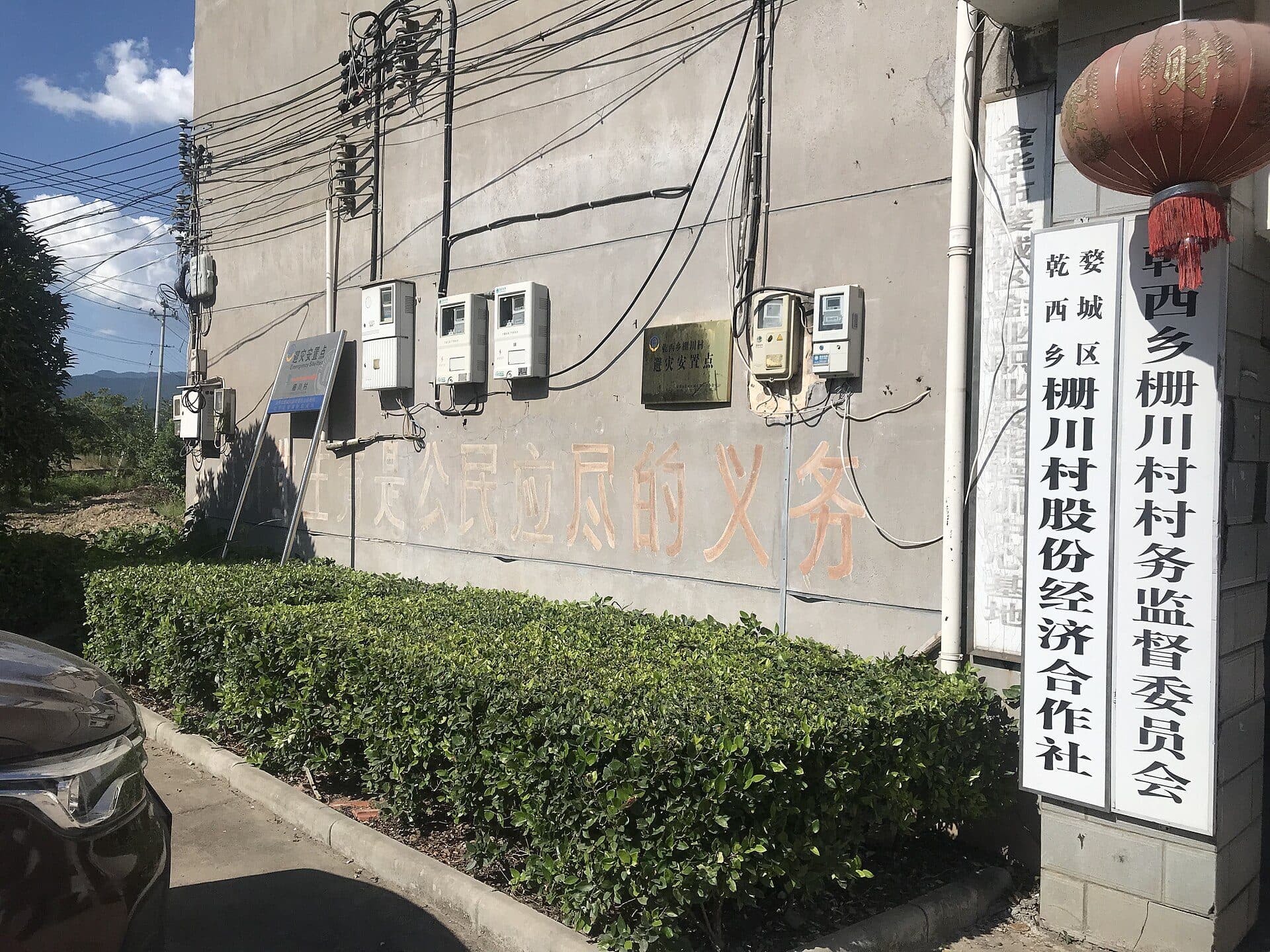
The slogans painted on village walls, long the main medium of birth-control propaganda, have been repainted twice: first erased when the policy changed, then replaced with the opposite message encouraging births. Some villages display both, the old one showing through the new.
FAQ#
Did the one-child policy apply to all Chinese people? No. Rural couples whose first child was a girl could have a second, and ethnic minorities had a looser regime. The share of the population under the strict rule is estimated at around a third.
When did it end? The decision dates from October 2015, and permission for a second child for everyone took effect on 1 January 2016. A third child was allowed in May 2021.
Did it cause the fall in Chinese fertility? The main fall happened in the 1970s, before it. Its own effect, real but more limited, is still debated among demographers.
Why are births not recovering? Housing and schooling costs, working hours and the uneven division of domestic labour weigh more than the legal permission to have several children.
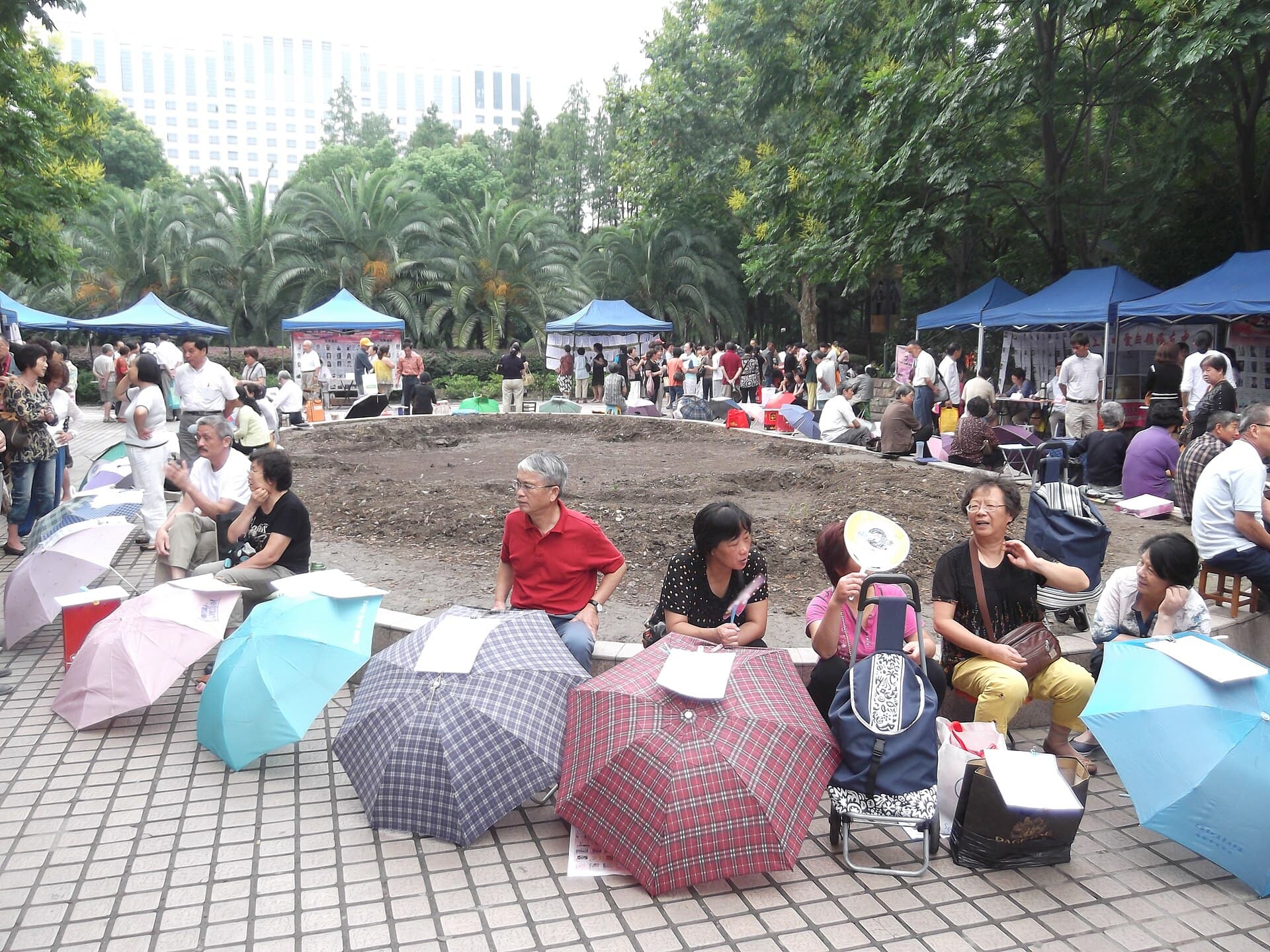
Read alsoShanghai's Parent Marriage Market (相亲角)Shanghai's marriage market, where parents look for a spouse for their only child, a direct consequence of this demography.
Sources and further reading#
- Central Committee of the Communist Party of China, open letter of September 1980 and decision of October 2015
- National Bureau of Statistics of China, censuses of 1990, 2000, 2010 and 2020, annual population data
- State Council, 2015 decision on registering people without hukou
- Population and Family Planning Law (人口与计划生育法), revisions of 2015 and 2021
Shanghai's Parent Marriage Market (相亲角)
Every weekend, Chinese parents 'sell' their single children at Shanghai's People's Park. Inside the 相亲角, its résumé sheets and its unwritten rules.
Cover image: MNXANL · MNXANL, via Wikimedia Commons · CC BY-SA 4.0