Sanrio and Hello Kitty: The Global Empire of Japanese Kawaii
From silk to Hello Kitty through Kuromi, Cinnamoroll and My Melody, the history of Sanrio, the Japanese company that invented the economy of kawaii.
La rédaction Kotoba Interactive
Studio éditorial
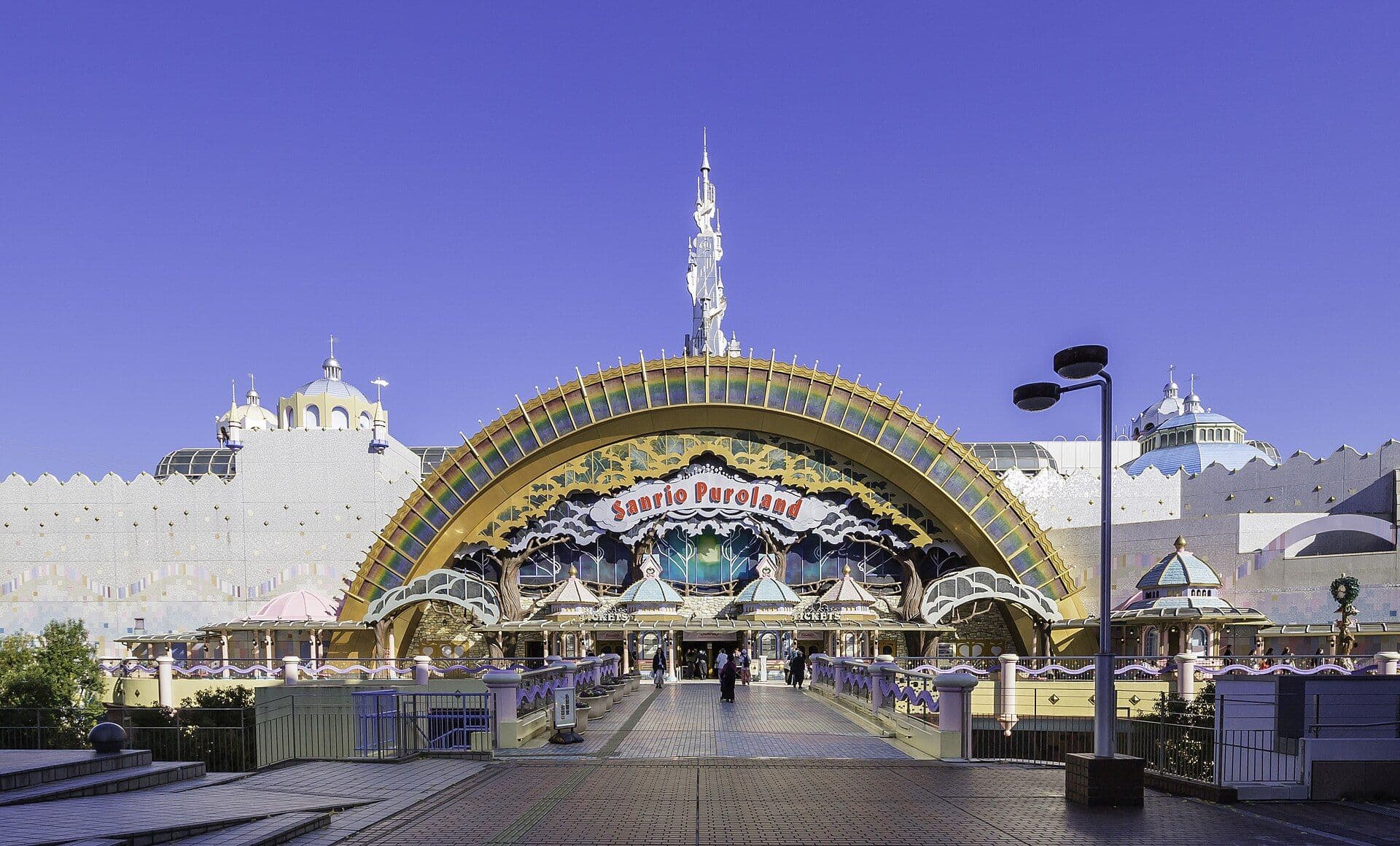
In Tokyo, on the Tama hills, since 1990 the theme park has stood. A million and a half visitors come each year to meet a little white cat with a red bow, who in fifty years has become the most profitable commercial icon in Japanese history after Pokémon. was born in 1974 from the pencil of designer Yuko Shimizu. She has no mouth, does not speak, weighs three apples, is five apples tall, lives in London and has a twin sister, Mimmy. Around her, has built, starting from a silk shop in a provincial train station, an empire of more than 400 characters, a theme park, thousands of stores in 130 countries and a philosophy: that of , which has become one of the main vehicles of Japanese soft power. Its founder, , spent his life trying to convince the world that cuteness could be a form of love.
Origins: Shintaro Tsuji and the Silk Shop#
A Youth Marked by War#
was born on December 7, 1927 in Kōfu, Yamanashi prefecture. His mother died while he was still a child, his stepmother treated him harshly, and he was fifteen when World War II broke out. From this childhood without maternal affection he drew his conviction: lack of tenderness equals social tragedy. Surrounding people with small visual comforts would be his life's mission.
After the war, Tsuji studied at the University of Tokyo, then worked in the Yamanashi prefectural administration. In 1960, he resigned to found the Yamanashi Silk Company, specialized in selling silk zori sandals and small gifts, at Kōfu station then in Tokyo. His intuition: the best-selling gifts are not the most functional, but those that decorate, amuse and comfort.
The Discovery of the "Small Affective Gift"#
In the mid-1960s, Tsuji steered the company toward : stationery, handkerchiefs, coin purses, lunch boxes with floral patterns. In 1962, he created the slogan Social Communication, the idea that a small cute object is a vehicle of friendship. The company took the name Sanrio in 1973, from San Rio, the "three rivers" in Spanish and Japanese.
From 1971, Sanrio printed original characters designed by young Japanese artists on its products. The first success was a little dog named Coro Chan, followed by a bear, a rabbit, a bird. These characters had a simple personality, minimalist features and a heartwarming story, so that children and teenage girls could project themselves onto them: the Sanrio formula was born.
1974: The Birth of Hello Kitty#
Yuko Shimizu and the First Drawing#
In 1974, Sanrio asked , a 28-year-old designer, to create a character for its coin-purse line. Yuko proposed a little white cat, in profile, with a red bow above the left ear, inspired by a drawing of Alice in Wonderland she had loved as a child. The character has no mouth, deliberately: Tsuji wanted Hello Kitty to "speak through the heart" rather than through words, and every child to project their own emotion onto her, joyful or sad. First called Kitty White, the name Kitty comes from Lewis Carroll's novel Through the Looking-Glass, where Alice addresses her cat as "Kitty."
The first product, a vinyl coin purse sold at 240 yen, came out in March 1975; within a month the entire production was sold out. Girls aged 7 to 15 rushed on the object, extended to handkerchiefs, pencil cases, school bags, planners and pens. By 1977, Hello Kitty alone generated half the revenue of Sanrio.
International Expansion from the 1980s#
In 1976, Sanrio opened its first US store in San Jose, California, then distributed its products at Sears, Kmart and specialty chains. In the 1990s, the adult category exploded: young women adopted Hello Kitty as an ironic accessory of femininity. Mariah Carey, Lady Gaga, Katy Perry, Paris Hilton and Fergie wore Hello Kitty bags and jewelry.
In 2004, Sanrio signed its first Hello Kitty credit-card deals (Mastercard and JCB). In 2008, she became Japan's tourism ambassador for China and Hong Kong; in 2014, official ambassador of Japan to the United States at Expo 2014. In 2018, for her 40th anniversary, a worldwide survey ranked her the third most recognized brand in the world after Coca-Cola and Disney.
Today, Hello Kitty is distributed in more than 130 countries, on more than 50,000 product references, generating estimated annual revenue of $8 billion. Over 50 years, the franchise has generated more than $80 billion in cumulative revenue, the second most profitable franchise in history, behind Pokémon.
Sanrio character names are real Japanese lessons: かわいい (kawaii, "cute"), ハローキティ (Hārō Kiti, Hello Kitty) and 闇かわいい (yami kawaii, "dark kawaii"). Learn to read these words in kana and kanji with JapaneseSRS and its spaced repetition, and decode the Japan hidden behind the red bow.
The Other Characters in the Sanrio Catalog#
Sanrio has created more than 400 characters, several of considerable success. Since 1986, it has held the , a yearly global online contest where fans vote for their favorite character.
| Character | Japanese name (rōmaji) | Year | Animal and world |
|---|---|---|---|
| Hello Kitty | ハローキティ (Hārō Kiti) | 1974 | White cat with a red bow |
| My Melody | マイメロディ (Mai Merodi) | 1975 | Pink rabbit in a hood |
| Pompompurin | ポムポムプリン (Pomupomupurin) | 1996 | Golden retriever in a beret |
| Cinnamoroll | シナモロール (Shinamorōru) | 2001 | Flying long-eared puppy |
| Kuromi | クロミ (Kuromi) | 2005 | Punk black rabbit (yami kawaii) |
| Gudetama | ぐでたま (Gudetama) | 2013 | Lazy egg yolk |
My Melody: The Little Hooded Rabbit#
appeared in 1975, a year after Hello Kitty: a little pink rabbit in a red hood, friend of flowers and forest animals. Her world, Mary Land, is inspired by Little Red Riding Hood. She had a revival with the anime Onegai My Melody (おねがいマイメロディ) aired in 2005, where she faces her antagonist Kuromi, a punk black rabbit.
Kuromi: The Gothic Rebel#
, created in 2005 for the Onegai My Melody anime, is one of the most popular Sanrio characters among teenagers and young adults. Her rebel aesthetic (black hood, skull on the forehead, mischievous gaze) embodies . She has won the Sanrio Character Ranking several years in a row since 2022, surpassing Hello Kitty among under-25s.
Cinnamoroll: The Long-Eared Puppy#
, created in 2001 by designer Miyuki Okumura, is a white puppy whose long ears let him fly. Born from a blue sky, he lives in a Parisian café, Café Cinnamon, in Tokyo. He has regularly won the Sanrio Character Ranking since the 2010s and is the brand's most popular male character.
Pompompurin: The Golden Retriever in a Brown Beret#
, created in 1996 by Taeko Iwasaki, is a golden retriever wearing a brown beret, passionate about pudding. He was Sanrio's most popular character during the 2010s, before being dethroned by Cinnamoroll and then Kuromi.
Other Cult Characters#
- : a green frog with big eyes, friend of ponds.
- : a mischievous little black penguin, for boys.
- : a little black cat with pointed ears.
- : a penguin in a bow tie.
- : a lazy and depressed egg yolk, embodiment of modern fatigue, viral among millennials.
- : a red panda office worker who exorcises her frustration in nighttime death metal karaoke sessions, adapted into a Netflix series in 2018.
Sanrio Puroland: The Kawaii Theme Park#
A Park Unlike Any Other#
In December 1990, Sanrio opened in Tama New Town, in Tokyo's western suburbs, the theme park. Unlike Disneyland, Puroland is a fully indoor park, on five floors of a 44,000 square-meter complex. It offers gentle attractions (a boat ride in My Melody's world, a Cinnamoroll teacup ride), musical shows (Hello Kitty Kabuki, Miracle Gift Parade), themed restaurants (Kitty Chan's Kitchen, Cinnamon Café) and vast merchandise stores. In 2024, Puroland welcomed 2.6 million visitors, a record.
In 1991, Sanrio opened a second theme park, Harmonyland, in Ōita prefecture on the island of Kyūshū. Smaller, outdoors, it focuses on outdoor parades and children's rides.
The Photo Spot Phenomenon#
Puroland's main attraction is not its rides but its photo spots: composed sets where visitors, often in cosplay of their favorite character, take selfies. The park has become a global Instagram destination, drawing Korean, Chinese, Thai and American tourists.
Kawaii as Philosophy and Soft Power#
Defining Kawaii#
is more than an adjective meaning "cute": an aesthetic code and, for many Japanese women, a way to inhabit the world. The term, originally in classical Japanese, designates what is small, soft, vulnerable, and awakens the desire to protect. It is opposed to and to .
Anthropologists Sharon Kinsella (University of Manchester) and Inuhiko Yomota (Meiji Gakuin University) place the emergence of kawaii as a massive cultural phenomenon in the late 1970s, when Hello Kitty conquered the market. The handwriting of 1980s high school girls, pastel aesthetics, oversized plushies, animal costumes: an ecosystem of which Sanrio is the most systematic commercial promoter.
Global Soft Power#
In 2009, the named three : Misako Aoki (lolita fashion), Yu Kimura (harajuku fashion) and Shizuka Fujioka (school uniform fashion). Sociologist Christine Yano (University of Hawai'i) calls kawaii "Japan's greatest unofficial cultural export after manga and anime." It has inspired the cute art of American pop art (Jeff Koons, Takashi Murakami), the harajuku aesthetic on Paris runways and the kidult trend of adults collecting childhood objects.
Kawaii Against Melancholy#
Yuko Yamaguchi, chief designer of Hello Kitty at Sanrio for 40 years, sees kawaii as a response to the anxiety of modernity: "Hello Kitty has no mouth so that everyone can look at her and see their own smile or their own sadness."
Kawaii is not a childish aesthetic. It is an adult philosophy that recognizes that tenderness is a fundamental human need, as much as food or sleep.
Sanrio Today: A Family Business Gone Global#
The Tsuji Succession#
Shintaro Tsuji led Sanrio for nearly 60 years, until his retirement at age 92 in July 2020. He passed the presidency to his grandson, , then 31 years old, one of the youngest CEOs of a publicly traded Japanese company. Honorary chairman thereafter, Shintaro passed away in July 2023 at age 95.
Modernization and Digital Strategy#
Under Tomokuni Tsuji, Sanrio signed partnerships with Nintendo (Hello Kitty in Animal Crossing), Roblox, TikTok and BTS (Sanrio x BT21 collaboration in 2023). Digital revenue now accounts for more than 20 percent of turnover, and Sanrio opened a virtual Hello Kitty museum in Fortnite in 2024.
Hello Kitty's 50th Anniversary#
November 1, 2024 marked Hello Kitty's 50th anniversary, celebrated with a year of events: exhibitions at the Museum of Modern Art in New York and the Barbican Centre in London, collaborations with Gucci, Balenciaga and Coach, J-pop concerts, an anniversary book in twelve languages, a commemorative gold coin issued by the Japan Mint. The event generated a sales peak of more than $2 billion.
The 2024 Financial Results#
Sanrio announced for fiscal year 2024 a record revenue of 144 billion yen (about $960 million) and a net profit tripled compared to 2023. The Sanrio share, listed on the Tokyo Stock Exchange, saw its price multiplied by five between 2020 and 2024. Tomokuni Tsuji's strategy (character diversification, digital, kawaii tourism) is bearing fruit.
Hello Kitty has no mouth because her creator, Shintaro Tsuji, a war orphan, wanted to offer the world a voiceless friend who would speak through each person's emotion. Fifty years later, Sanrio has made kawaii into an industry, but also a universal language: that of a tiny tenderness, without words or judgment.
Photo credits: images used in this article come from Pexels and Unsplash and are royalty-free.
In this article
The cultural terms covered here, each with a short definition.
- Hello Kitty
- Sanrio's kawaii character, a small white cat that became a global icon of cuteness.
- Japanese soft power
- Japan's cultural influence through its manga, games and characters rather than force.
- Kawaii
- Japanese aesthetic of "cuteness," pervasive in pop culture and design.
- Sanrio
- Japanese company behind kawaii characters, including Hello Kitty.
Gachapon: Japan's Capsule Toy Culture
The history and culture of gachapon, Japan's capsule-toy machines. Onomatopoeic origins, Bandai, Kaiyōdō, Fuchiko, and an industry worth hundreds of billions of yen.
Cover image: Kakidai · Kakidai, via Wikimedia Commons · CC BY-SA 4.0